Every customs declaration is a small, precise, legally attested record of trade. It states what the goods are, where they were made, what they are worth, who is moving them, under which procedure, at what rate of duty and with which preference claimed. Multiplied across thousands of entries a year, those records form one of the richest structured datasets any trading business owns.
For most businesses, that dataset has served exactly one purpose: getting goods released. Once a declaration is accepted, it is filed, archived and forgotten — until an audit letter arrives and someone has to reconstruct three years of decisions from a folder of movement reference numbers.
That is starting to change, quickly and across the industry. Customs platforms are beginning to put conversational analytics layers over declaration data, down to individual declaration lines, so that a user can ask plain-language questions about duty spend, tariff exposure, clearance performance and compliance trends, and receive answers, charts and flagged inconsistencies in return. The framing is as notable as the products: the AI is positioned as supporting customs professionals rather than replacing them.
Each of those products is a product story. What sits behind them is an industry shift — from customs platforms that submit data to customs platforms that understand it.
The Most Underused Dataset in Trade
A customs declaration is not a form. It is a structured record in which every field is defined, coded and validated against a legal data model, and in which the declarant carries responsibility for the accuracy of what is stated.

Across a year of entries, those lines describe a business’s sourcing, cost base, compliance posture and supply chain performance more precisely than almost any other internal system.
The raw material has also become easier to obtain. Since 13 November 2025, HMRC’s free Get Customs Data service has allowed importers, exporters and their agents with a GB EORI to download reports built from their own Customs Declaration Service data.
HMRC’s Get Customs Data Service at a Glance
In other words, the regulator’s copy of your trade record is now available to you, free, in a machine-readable format. Very few businesses do anything with it.
That gap matters more than it used to. The World Trade Organization’s World Trade Report 2025 notes that customs authorities are stepping up enforcement through more frequent audits and post-clearance reviews, producing higher retroactive duty collections and greater compliance risk for traders. The authority is increasingly reading your declarations analytically. The question is whether you are.
What the Industry Is Now Building
Across the trade and logistics sector, the capabilities being built on top of customs data are converging on a recognisable set.
The evidence that this is broad rather than isolated comes from neutral sources.
What the Evidence Says
Customs Administrations Got There First
Traders are arriving at customs intelligence later than the authorities they declare to. The World Customs Organization has been building analytical capacity among its member administrations for years, and in the EU the direction is now written into law.
Same Data, Two Readers
The consequence is an information asymmetry. The same declaration data is increasingly being read analytically on one side of the border and archivally on the other. A trader who cannot see the patterns in their own entries is, in practical terms, learning about them from the authority — usually in the form of a query, an assessment or an audit.
Customs intelligence on the trader side is not about outsmarting the authority. It is about seeing your own record the way the authority already does.
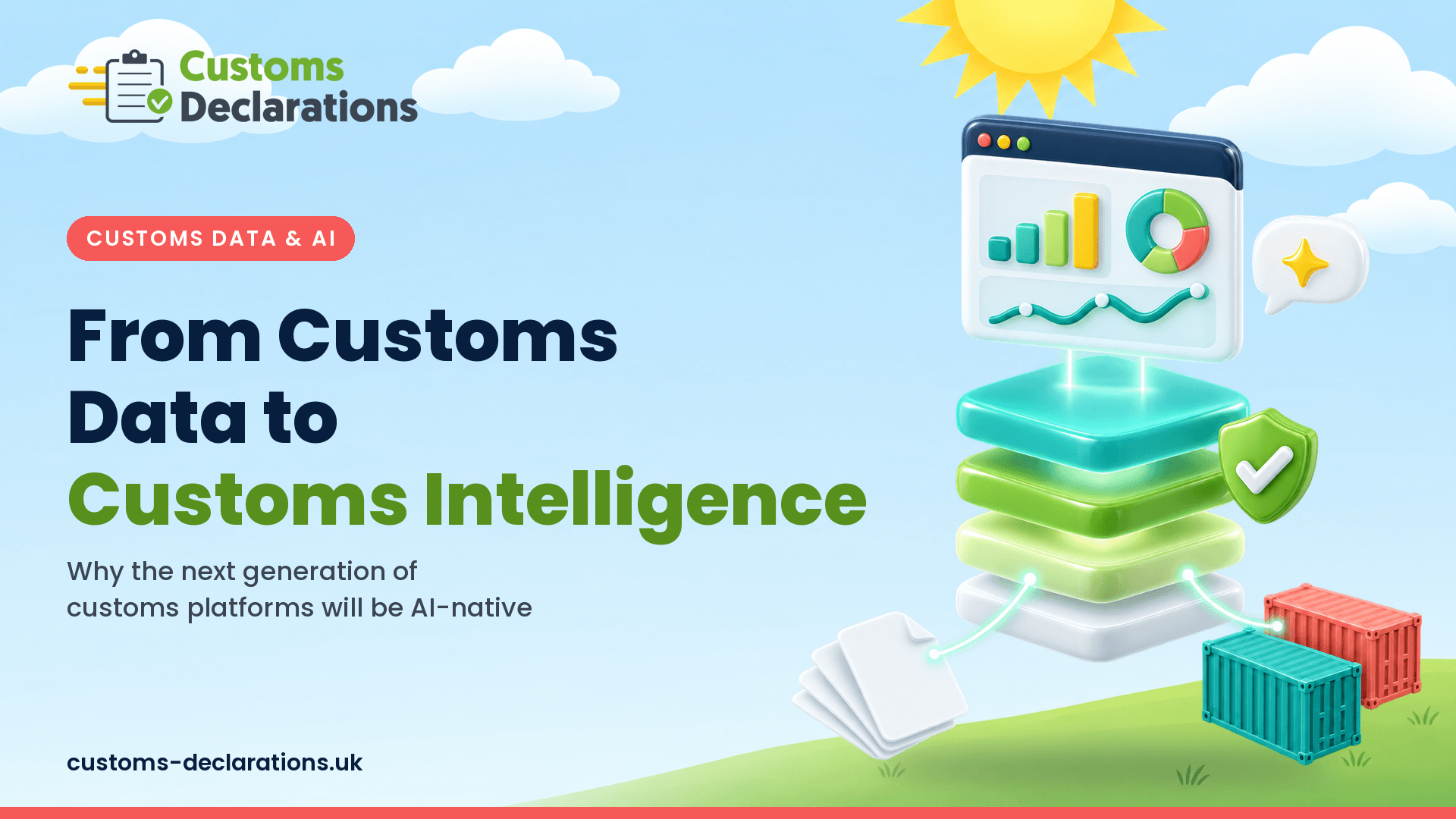
The Four Layers: From Data to Intelligence
Intelligence does not begin with a chat interface. It is the top layer of a stack, and each layer below it determines what the top layer can honestly say.

Capture turns the documents a business already receives into data. Structure maps that data to defined fields at line level, in a form that aligns with the customs data model rather than with whatever a spreadsheet happened to hold. Validate checks it against the tariff, the rules and itself before it is submitted. And intelligence operates on the accumulated, validated, accepted record — which is the only record worth reasoning over.
AI-Native Versus AI-Added
The distinction the next generation of platforms will be judged on is not whether they “have AI”. Almost everything will. It is where the AI sits in the architecture, and what it is allowed to reason over.
A chat or analytics layer bolted onto exported data
Built into capture, validation and analysis from the first document
Whatever the legacy system happened to store
Structured, line-level, aligned to the customs data model at source
After submission, in reports
Before submission, at the point they can still be fixed
Answers without a clear trail back to source
Every answer traceable to a declaration line and a source document
Reviews outputs after the fact
Confirms at defined decision points, with conflicts flagged not guessed
Static
Authority responses and corrections feed back into validation
Added when a customer or regulator asks
Logging, confidence and explainability designed in
The most important line in that table is the second.
An AI-native customs platform is, before anything else, a data-native one.
Why the Data Layer Decides Everything
The WTO–ICC finding that firms cite access to high-quality data as a barrier to AI adoption is not a technical footnote. In customs it is the whole problem.
Customs data is only comparable if it is consistent. Four disciplines decide whether it is.
The Four Disciplines of Comparable Customs Data
This is why standardisation and intelligence are the same agenda rather than two different ones. The WCO Data Model exists as a common language for information exchange between the parties in cross-border trade, enabling single-window systems and fuelling data analytics. The EU’s reformed customs framework is built around submitting information once to a single environment rather than twenty-seven times to different ones. Both are, at root, bets that structured, standard-aligned data at source is what makes everything downstream — risk management, facilitation, analytics — possible.
For a trader or broker, the practical lesson is that the intelligence you will be able to extract in 2028 is being determined by the discipline of the declarations you file today. The questions worth asking of a customs dataset — which preferences did we fail to claim, where did classification drift, which values moved without explanation — can only be answered if the underlying lines were captured consistently in the first place.
Human in the Loop Is Not a Slogan
Every serious product in this space makes the same point: AI supports customs professionals, it does not replace them. That is not modesty. It is the law.
The person who makes a customs declaration remains responsible for the accuracy and completeness of the information in it. That responsibility does not transfer to a model, a vendor or a platform. An AI that silently fills a field it was not sure about has not saved the declarant time; it has moved a liability into a place where nobody can see it.
What “Support, Not Replace” Looks Like in Practice
The platforms that get this right will not be the ones that automate the most. They will be the ones whose automation a customs professional can defend.
What Customs Intelligence Looks Like in Practice
The value of intelligence is best understood through the questions it lets a business ask of its own record.
Countries, commodities and suppliers driving cost
Sourcing, pricing and tariff-engineering decisions
Eligible lines declared at full rate
Recoverable duty where retrospective claims are permitted
Classification drift by SKU or supplier
One of the most common triggers for post-clearance assessment
Valuation anomalies over time
Undervaluation and overvaluation risk, before the authority finds it
Recurring holds by lane, port, broker or document type
Lead time, demurrage and working capital
Exposure by commodity and origin
Planning ahead of policy rather than reacting to it
Divergence between agent filings and internal records
Oversight of representatives, and the liability that remains with you
None of those questions is new. Customs managers have always wanted the answers. What is new is that the answers can now come in seconds rather than weeks, provided the data underneath them is sound.
Where Customs Declarations UK Fits
Customs Declarations UK has been built from the data layer up, on the view that intelligence is only as good as the declarations beneath it.
That consistency is reinforced where most inconsistency creeps in.
Intelligent document processing is available on every declaration type. It extracts data from the documents operators already receive — invoices, packing lists, transport documents — and, where documents disagree, it flags the fields requiring operator confirmation rather than making assumptions. The operator reviews and confirms before anything is submitted.
It is a small, deliberate example of the principle this article describes: capture and structure handled by the system, judgement left with the professional who carries responsibility for it.
The Point
For decades, customs platforms competed on how reliably they could get a declaration from a document to an acceptance message. That remains the foundation, and it is not going away. But the value is moving up the stack — from submitting data to understanding it, from filing to knowing.
The businesses that benefit will not be the ones that bolt a chat window onto a spreadsheet export. They will be the ones whose declarations were captured cleanly, structured consistently and validated properly from the start, so that when they finally ask their own record a question, the answer is one they can stand behind.
Customs data was always intelligence. It was simply never asked.
To see how structured, validated declarations are built across CDS, safety and security, ICS2, ELO, NCTS and GVMS, visit the Customs Declarations UK solutions overview.