
About this tool
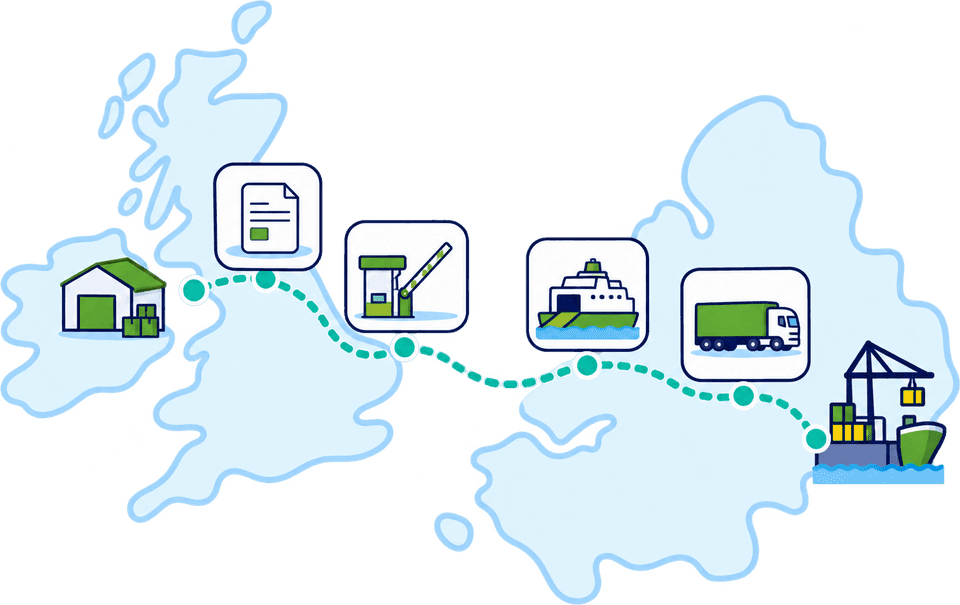
Moving goods across a border involves several separate filings, and each has its own owner and deadline. This planner shows them in order, so you know what has to happen before the lorry leaves.
Tell it where the goods start, where they end up, how they travel and what they are. It returns the export and import declarations, the safety and security declaration, the goods movement reference and any French or health-control steps. Each step says whose rule it is: UK, EU or the French border.
It reads an authored rule set built from HMRC, GOV.UK, European Commission and French customs guidance, and each rule shows its source and review date. It does not plan Northern Ireland movements. Those follow the Windsor Framework and are flagged for you to check.
How this was worked out
What the tool does with your answers, in order.
Choose where the goods start and where they are going, including Great Britain or Northern Ireland if either end is in the UK.
Say how they travel, and the crossing if you know it, then what they are: search the UK tariff for the product or pick the kind of goods.
Say what your part in the movement is, and optionally anything special, such as transit or a temporary move.
The planner classes the movement by territory and checks each customs domain separately, so a gap in one never hides another.
Steps are sorted into exit side, crossing and entry side, then ordered by deadline.
Each step card shows the rule’s owner, who normally files it, the reference it produces and the reference it needs.
Worked example: France to Great Britain by lorry, Calais to Dover, general goods
- EU export declarationRequired (EU rule, exporter)
- ELORequired (French border rule, one party chosen by the supply chain)
- Goods movement reference (GMR)Required (UK rule, haulier)
- Entry summary declaration, S&S GBRequired (UK rule, haulier)
- Import declaration, CDSRequired (UK rule, importer or agent)
- ICS2does not appear, because it is an EU entry system and the goods are entering Great Britain
Illustrative example. In the tool, each step shows its rule, source and review date.
Your questions, answered.
Short answers about the Customs Journey Planner.
What customs steps do I need to move goods from the EU to Great Britain?
For general goods by lorry you normally need an export declaration in the EU, an import declaration and an entry summary declaration for Great Britain, and a goods movement reference if the port uses GVMS. If you cross from France, an ELO is also required. Health controls may add more. The planner works out your case.
Is ICS2 needed for goods coming into Great Britain?
No. ICS2 is the European Union’s entry safety and security system. The Great Britain equivalent is the Safety and Security (S&S GB) entry summary declaration lodged with HMRC. The planner shows ICS2 only for goods entering the EU, and shows the S&S GB declaration for goods entering Great Britain.
What is an ELO and is it the same as a GMR?
No. The ELO (Enveloppe Logistique Obligatoire) is a French border requirement on the France–UK route. A GMR is a UK goods movement reference created in GVMS. They are separate, and the GMR is not entered in the ELO. French customs has required the ELO since 20 April 2026, one per transport unit, loaded or empty.
Who files each declaration?
It depends on the step. The trader or its agent normally files import and export declarations. For accompanied roll-on roll-off freight the haulier is normally responsible for the entry summary declaration and creates the GMR. Roles vary by contract and carrier, so the planner labels these as the usual arrangement, not a rule.
Does the planner cover Northern Ireland?
No. Movements involving Northern Ireland follow the Windsor Framework and are not planned here. The planner says so plainly instead of giving a guessed plan, links to the official GOV.UK guidance and lets you switch to a Great Britain movement or talk to our team.
What if I do not know the route yet?
You still get a plan. Steps that depend on the crossing, such as the GMR and ELO, are marked Likely instead of Required. Pick the port or terminal pair later and the cards update. Entering a commodity code also adds product-specific measures from the UK tariff.
Where does the planner’s data come from?
From an authored rule set that CDUK reviews against HMRC and GOV.UK guidance, European Commission ICS2 pages and French customs ELO guidance. Every rule carries its source link, jurisdiction and review date. GVMS port data comes from the GOV.UK list, and commodity measures come from the UK Trade Tariff.
What does the planner not cover?
It does not cover lanes that never touch the UK, mixed loads where only some goods move under transit, or personal belongings. It does not give legal advice or confirm that you meet any requirement. Health controls carry a dated notice: the Border Target Operating Model applies today, and the UK and EU are negotiating an SPS agreement that the UK government intends to take effect in mid-2027.
Data sources
- GOV.UK: list of ports using the Goods Vehicle Movement Service United Kingdom · daily check; reviewed on change
- UK Trade Tariff (when a commodity code is given) United Kingdom · daily; cached 24 hours
- European Commission: ICS2 rules and deadlines European Union · monitored
- French customs: Enveloppe Logistique Obligatoire (ELO) French border · daily check
- CDUK authored route rules (each sourced, dated and versioned) United Kingdom · on regulatory change
United Kingdom and European Union · data checked 3 Oct 2026. UK government data is reused under the Open Government Licence v3.0.
Guidance only — not adviceWhat this tool is, and is not
This tool gives general guidance and indicative figures based on the information you enter and on official data available at the date shown. It is not legal, tax, customs or financial advice, it is not a ruling or a decision by any customs authority, and it does not recommend any course of action, guarantee, amount, route, supplier or service.
Customs authorities decide the classification, value, origin, charges and guarantee amounts that apply. You remain solely responsible for your declarations, guarantees, shipments and transactions, and for checking every figure against HMRC’s published guidance and the official sources before you rely on it or act on it.
Rates, rules and data can change without notice, and the results may be incomplete or inaccurate. To the fullest extent permitted by law, Customs Declarations UK accepts no liability for any loss, cost, penalty, delay or damage arising from the use of, or reliance on, this tool or its results.