
On 16 September 2026, the European Parliament did two things in a single afternoon. It gave final approval to the reform of the Union Customs Code — the last parliamentary step in a legislative process that began in May 2023. And it adopted its first-reading position on the Single Market and Customs Programme for 2028 to 2034, the instrument that will pay for what the reform builds.
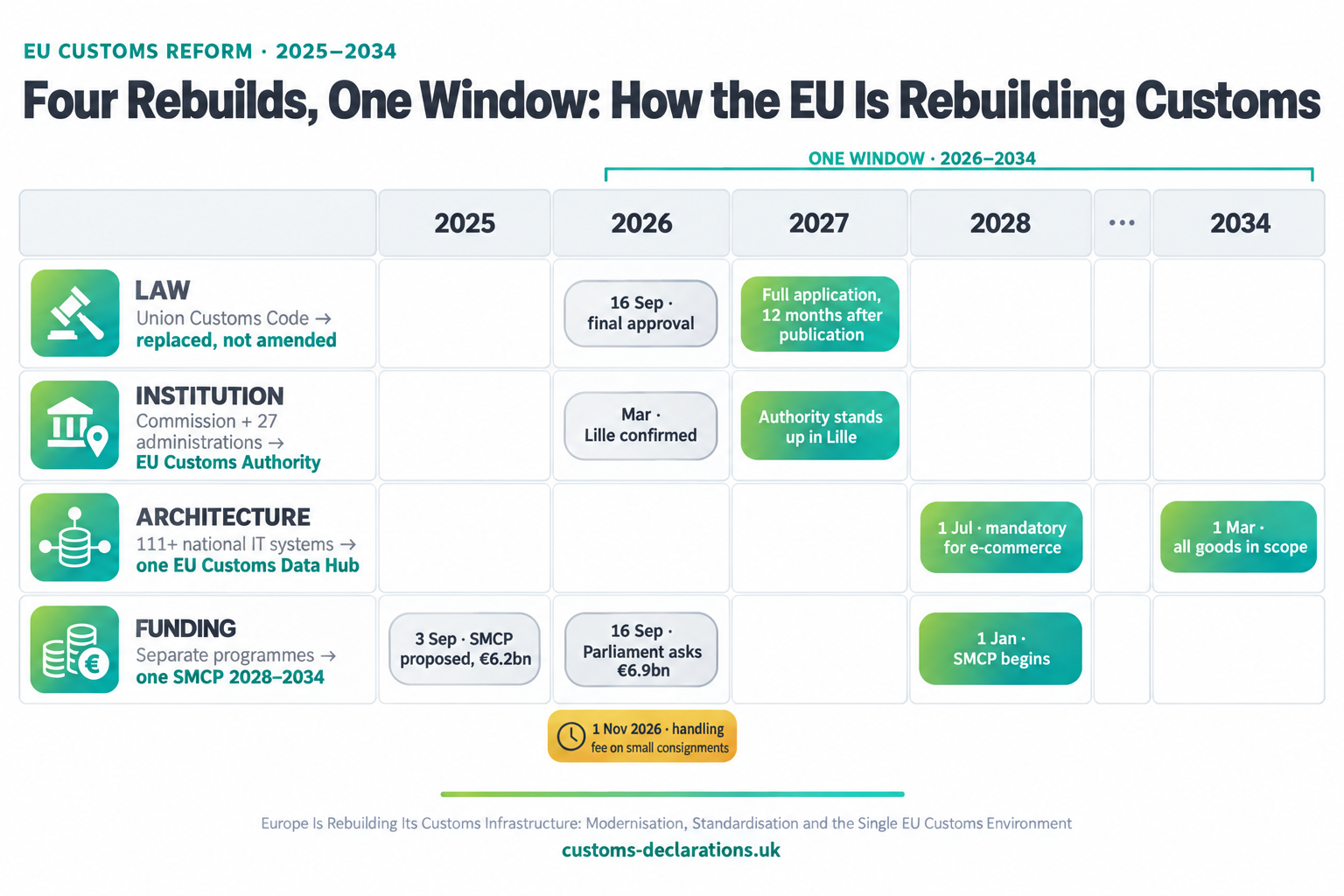
Those two votes are usually reported separately, as law on one side and budget on the other. Read together, they say something sharper. Europe is not amending its customs rules. It is replacing the law, creating a new authority, rebuilding the IT architecture and redrawing the funding framework at the same time, on a timetable that runs to 2034.
This is customs modernisation in its literal sense. Not better versions of twenty-seven national systems, but one standard applied across the Union — with the law, the institution, the architecture and the money all moving to the same timetable.
Most regulatory change moves one layer at a time. This moves four.
The legal layer changes because the Union Customs Code is being replaced rather than amended. The institutional layer changes because a new decentralised agency, the EU Customs Authority, takes on operational tasks that until now sat with the Commission and twenty-seven national administrations. The technical layer changes because a single EU Customs Data Hub replaces a landscape that the Parliament itself describes as at least 111 separate customs IT systems. And the funding layer changes because the programmes that have paid for customs digitalisation since 2021 are being folded into one instrument from 1 January 2028.
When all four move together, the sequencing matters more than any individual provision. Everything downstream — national implementation, trader interfaces, software roadmaps — is timed off that window.
The customs reform is now done as legislation. The programme that funds it is not — and that is the file still in play.
The Commission proposed the Single Market and Customs Programme on 3 September 2025 as part of the package for the next multiannual financial framework, the €1.8 trillion long-term budget presented on 16 July 2025.
The proposal repeals five regulations and merges four programme strands into a single instrument, with a proposed budget of €6.2 billion.
(EU) 2021/690
(EU) 2021/444
(EU) 2021/1077
(EU) 2021/847
(EU) 2021/785
The repeals take effect from 1 January 2028. Parliament’s position asks for the envelope to rise by ten per cent, from €6.2 billion to €6.9 billion, on the stated ground that member state customs authorities face a significant workload increase driven by the growth of e-commerce. The Council, in its December 2025 partial mandate, accepted the consolidation but wants greater member state involvement through a comitology committee of national experts.
The strategic point is not the number. It is that customs digitalisation, tax cooperation, market surveillance and anti-fraud will be funded from one pot, governed by one set of objectives, for seven years. That is a deliberate consolidation of the money behind a deliberate consolidation of the architecture.
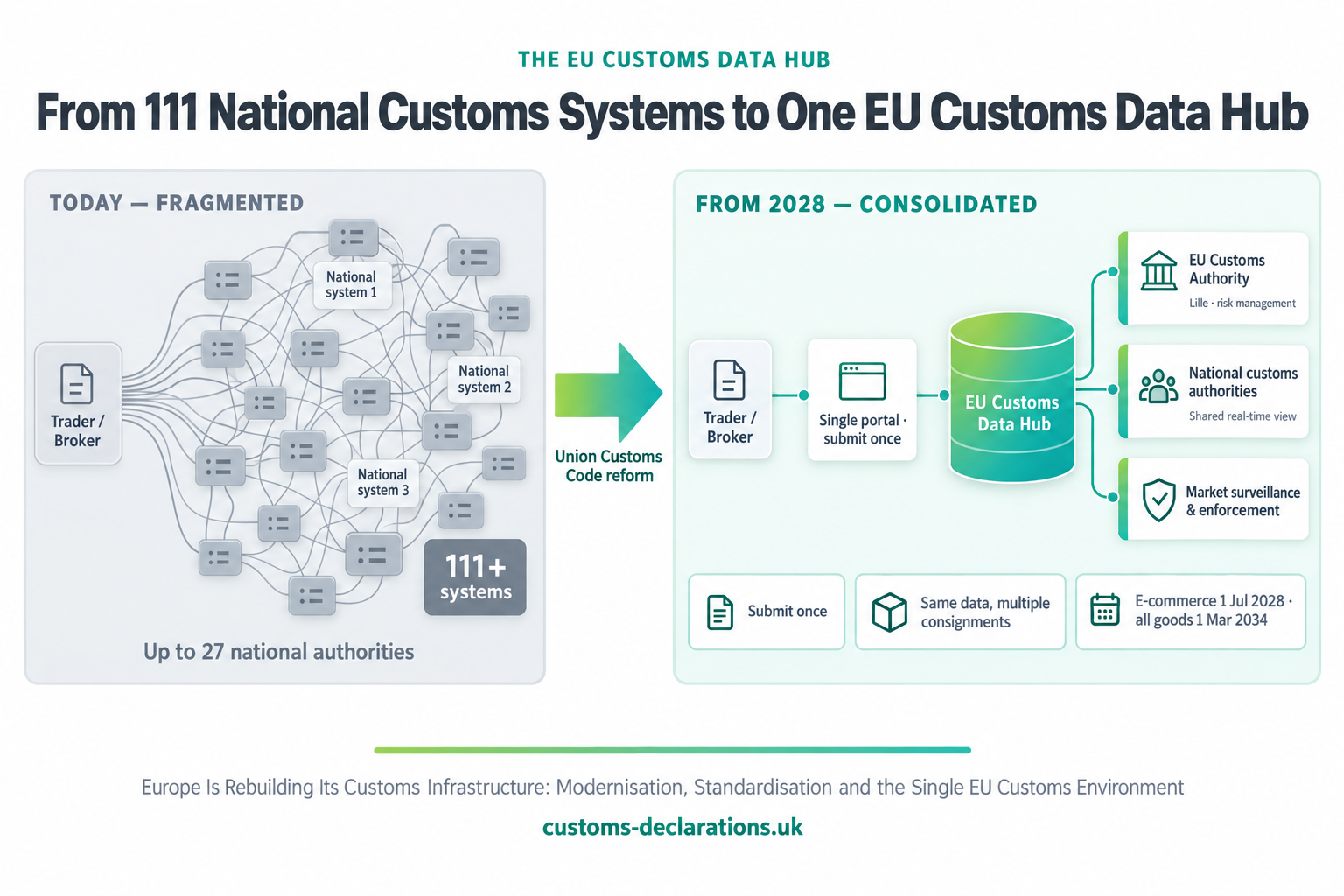
Under the agreed reform, businesses importing to and exporting from the EU submit customs information once to a single portal rather than to up to twenty-seven national authorities, and the same information can cover multiple consignments. National administrations gain a shared, real-time view of trade flows.
The EU Customs Authority will be located in Lille and established on the day the overarching regulation enters into force. Its job is to oversee the Data Hub and support EU-level risk management — analysing the continuously updated import and export data to identify the cargo that should be prioritised for inspection, setting priority control areas and risk criteria, and coordinating crisis management.
Alongside the architecture come three changes that reshape commercial behaviour.
Read as red tape, the reform is a decade of mandatory rework. Read accurately, it is a standardisation programme — the same customs act, described the same way and processed the same way, wherever in the Union it happens. Three consequences follow from that design.
The interface standardises; the underlying work does not disappear. A single portal does not remove the need to classify goods, value them, prove origin, manage authorisations, reconcile documents or answer queries. It removes the need to do all of that twenty-seven different ways. The effort shifts away from national connectivity and towards data quality, validation and consistent process — which is where the real modernisation gain sits.
Data obligations deepen as procedures lighten. Trust and check status buys the removal of active customs intervention at the price of continuous, structured visibility of goods movements. Simplification is earned with data rather than with history. Operators who cannot produce clean, complete and timely records will not qualify, whatever their compliance record looks like on paper.
The transition is long and deliberately overlapping. The Data Hub becomes mandatory for e-commerce on 1 July 2028 and covers all movements of goods by 1 March 2034. For most of the next eight years, national systems and the Hub run side by side, and operators need to be able to work to both standards at once.
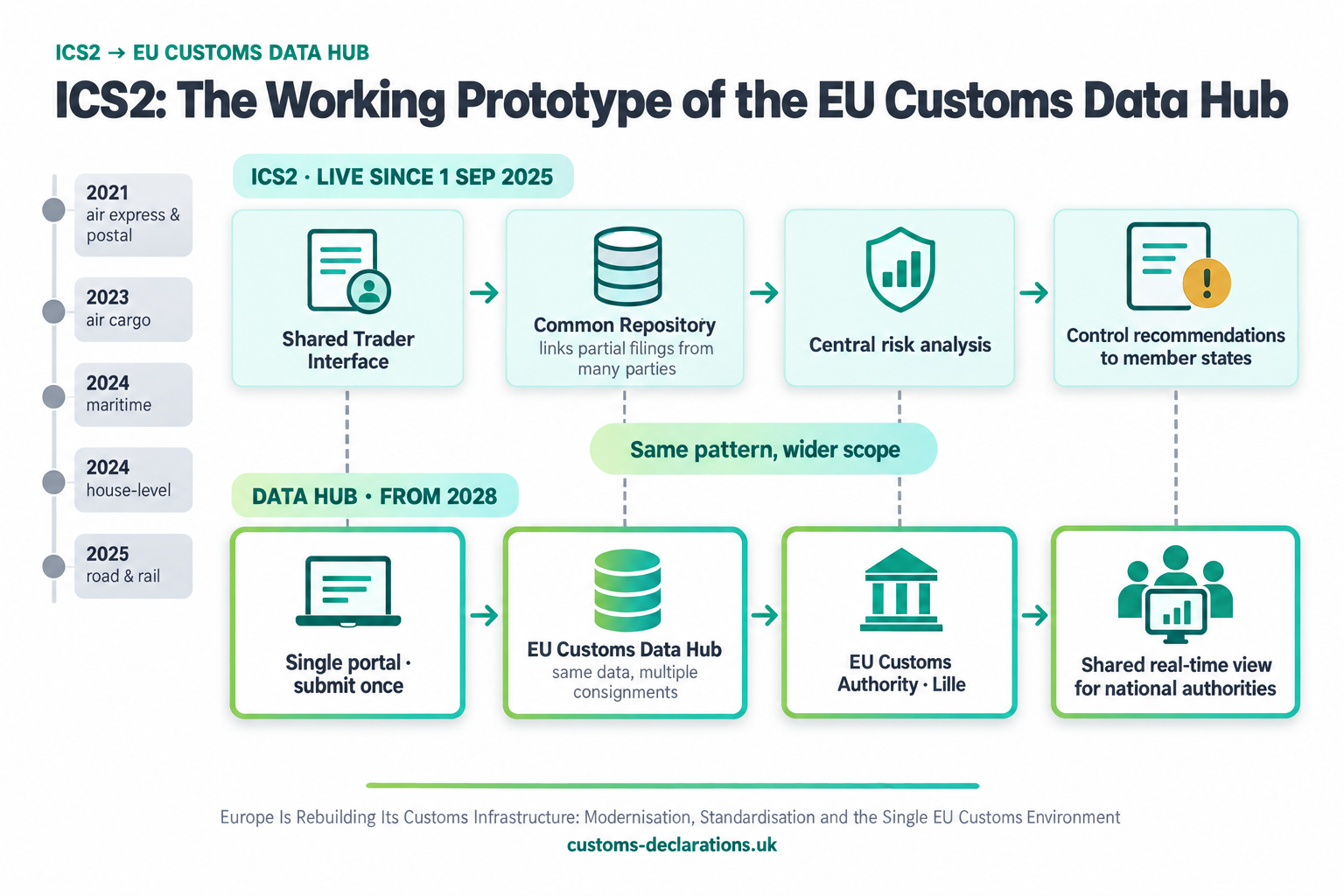
The most useful thing an operator can know about the Data Hub is that a working version of its architecture already exists, and has been live across every transport mode since 1 September 2025.
The Import Control System 2 is the EU’s pre-arrival safety and security system for goods entering the customs territory. It is not a national system with an EU wrapper. It is a centrally operated EU environment: a Shared Trader Interface through which economic operators submit, and a Common Repository that links partial submissions from multiple parties in the same supply chain, holds the results of risk analysis and distributes control recommendations back out to national authorities.
That is, in miniature, exactly the pattern the Data Hub generalises — submit once to a central EU environment, allow multiple parties to contribute to the same record, let risk analysis run centrally, and push results to the member states that need to act on them.
ICS2 reached that state in stages. Release 1 covered air express and postal from March 2021. Release 2 extended to general air cargo from March 2023. Release 3 brought in maritime and inland waterways from June 2024, house-level filers from December 2024, and road and rail through a deployment window that closed on 1 September 2025, at which point ICS1 was withdrawn and ICS2 became the only system for safety and security data across all modes.
Filing ICS2 properly — multiple filing, partial submissions, central risk responses, MRN lifecycle management — is not a niche border requirement. It is the same standardised way of working that the Data Hub will apply to the full declaration, arriving four to eight years earlier and in a narrower scope. Operators and systems already fluent in it have, in effect, been running the pilot.
Customs Declarations UK has been building against this architecture rather than around it.
Across declaration types — CDS import and export, ENS, ICS2 and NCTS transit — intelligent document processing turns the commercial documents an operator already receives into a structured draft, with the operator confirming before submission. In a world where simplification is bought with data quality, that is the part of the stack that compounds.
Europe has decided that its customs union will be run on one shared standard rather than on twenty-seven parallel ones, has passed the law to do it, has picked a city to run it from, and is now negotiating the seven-year budget that pays for it. The Parliament’s two votes on 16 September 2026 closed the first question and opened the last one.
What that leaves operators is unusual clarity. The direction is fixed, the dates are published, and a working example of the standard — ICS2 — has been live across every transport mode for over a year. The businesses that treat the next twenty-four months as a standardisation exercise, getting their data, authorisations and processes into a form that travels across borders unchanged, will arrive at 2028 with the work already behind them.
For EU filings today and the architecture that follows, see the Customs Declarations UK solutions overview.