On 1 June 2026, the United Kingdom joined the European Union, Norway and Switzerland in launching the digital ATA Carnet — the eATA — marking the most significant structural change to the temporary import and export document in its history. For businesses that regularly move commercial samples, professional equipment, and exhibition goods across international borders without paying duties or taxes, the transition from a stamped paper booklet to a QR-code-driven mobile application is not simply an administrative update. It represents a fundamental shift in how temporary admission customs procedures are prepared, presented, and recorded at the border.
HMRC confirmed the launch in the June 2026 edition of its Agent Update, noting that the process will move from paper to a secure digital format, with digital carnets accessible on mobile devices and allowing businesses and customs intermediaries to download carnets, prepare declarations, and receive confirmations electronically. The announcement is part of a broader international programme aiming to complete the global transition from paper to fully digital ATA Carnets by the end of 2027.
What an ATA Carnet Is and Why It Matters
The ATA Carnet — from the combined French and English phrase “Admission Temporaire / Temporary Admission” — is an internationally recognised customs document that allows goods to be temporarily imported into participating countries without payment of import duties or taxes, provided the goods are re-exported within the carnet’s validity period and returned in the same condition. Widely used by exhibitors, salespeople, broadcasters, engineers and event professionals, it simplifies customs procedures by replacing individual country declarations with a single document, valid across more than 80 countries worldwide.
In the UK, carnets are issued by local chambers of commerce affiliated with the UK National ATA Carnet Organisation (UKNATACO). The carnet functions as a passport for goods, enabling businesses to cross multiple borders on a single document during the carnet’s validity rather than completing each country’s individual temporary admission procedures, such as lodging a temporary import bond.
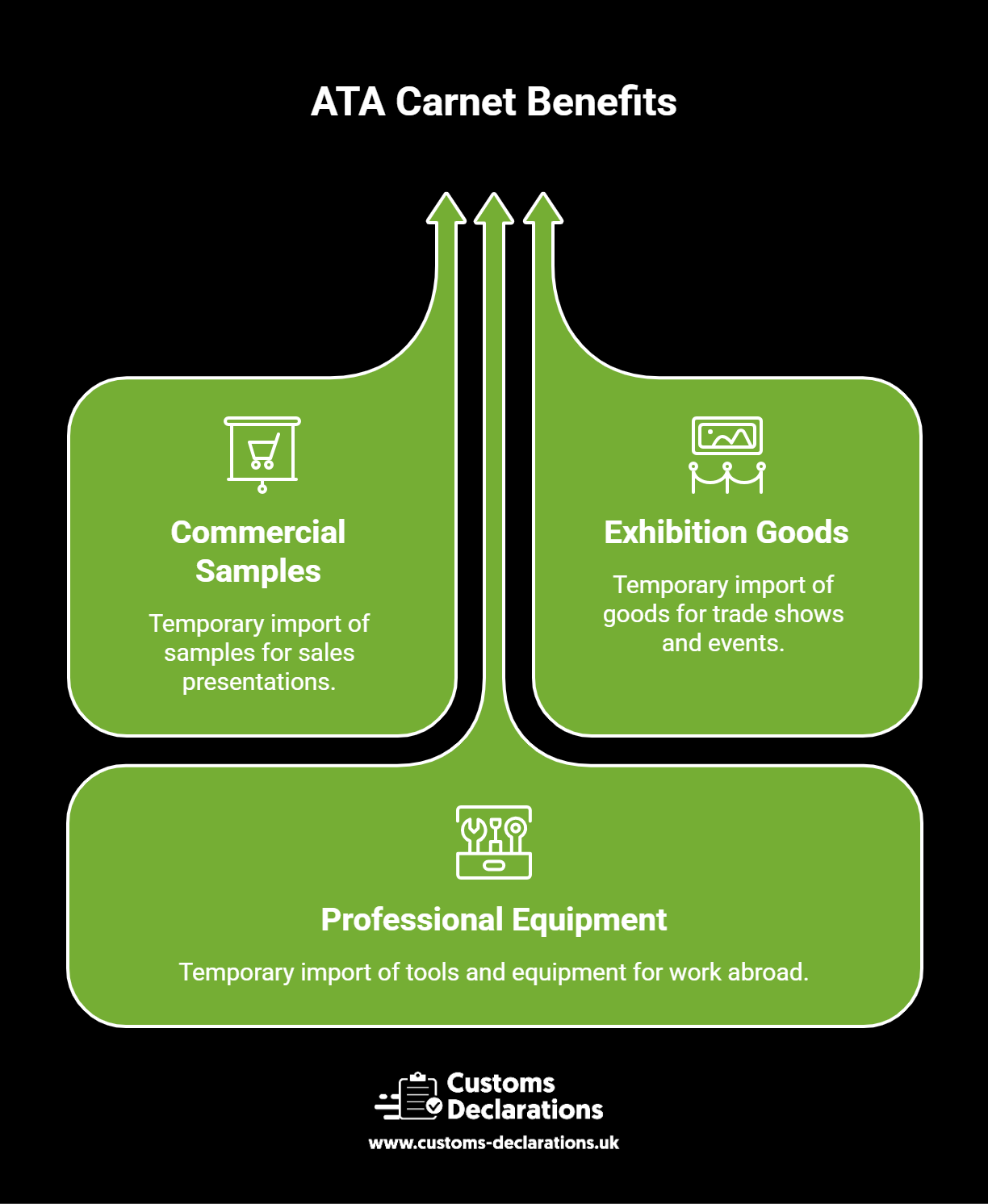
Three principal categories of goods are eligible. Commercial samples cover items such as jewellery, fashion, and technology goods presented to potential buyers without being sold. Exhibition and trade fair goods cover items displayed at shows, conferences, galleries, and similar events. Professional equipment covers tools, instruments, testing equipment, broadcast tools, race vehicles, theatrical effects, and orchestral equipment used for paid commercial activities abroad. The common thread across all three categories is that the goods are not intended to enter commerce in the destination country — they will be returned to their origin, which is the basis on which the duty and tax relief operates.
The historical limitation of the paper system was its dependence on physical handling at every stage. Every movement required a customs officer to stamp the booklet and remove a paper voucher as goods entered or left each country. Losing the booklet, missing an endorsement, or presenting a damaged document could trigger investigations and, in some cases, unexpected customs duty claims against the carnet guarantee.
What Has Changed: The eATA System Explained
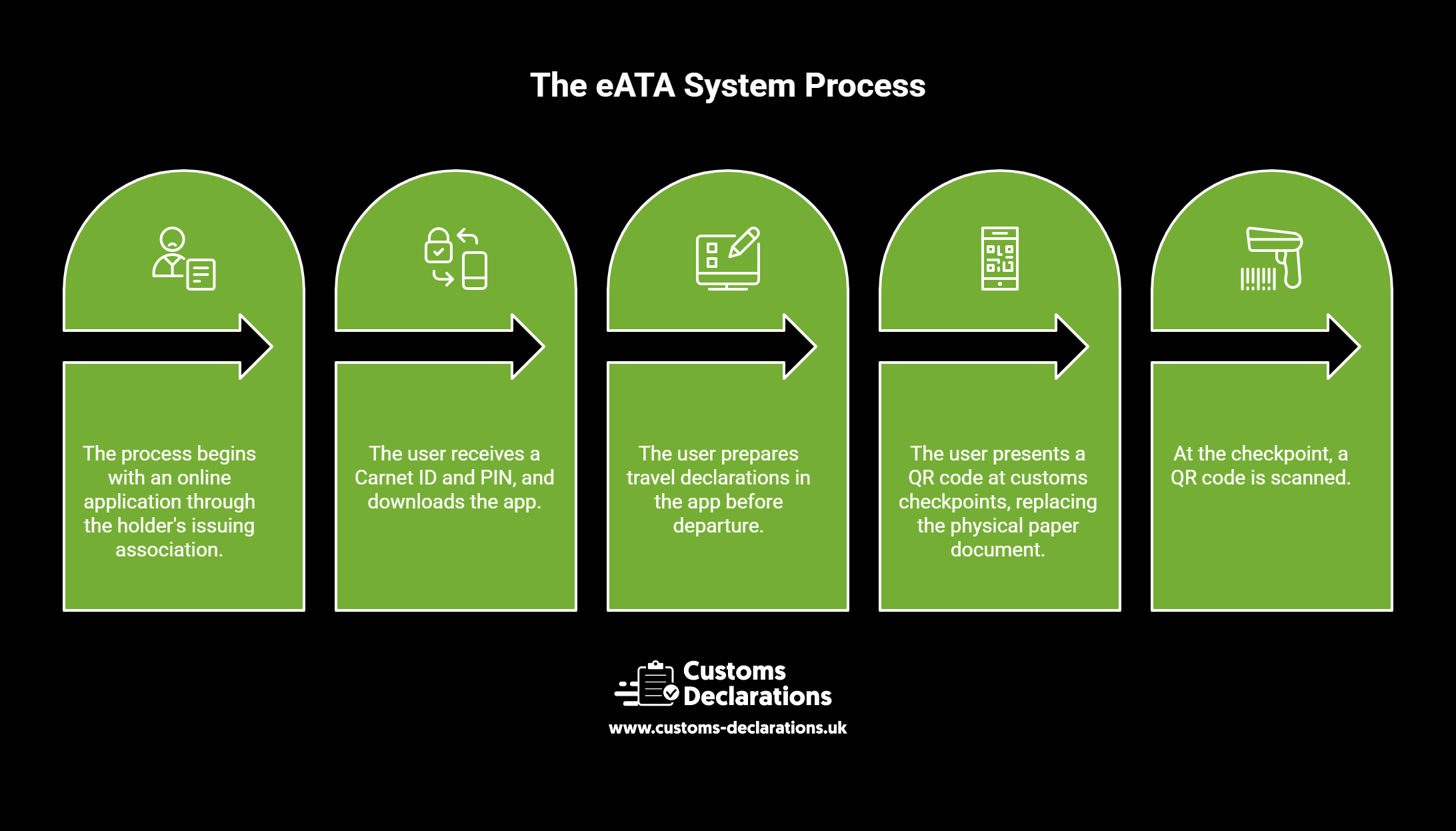
The ATA Carnet App functions as a secure mobile digital wallet for holders and their representatives. Users prepare travel declarations in the app and present a QR code at customs checkpoints — replacing the physical paper document entirely. The process begins with an online application through the holder’s issuing association. The user receives a Carnet ID and PIN, downloads the app, and prepares travel declarations before departure. At the checkpoint, a QR code is scanned.
The GOV.UK technical handbook for the digital ATA Carnet sets out the architecture clearly. Each digital carnet is issued by an authorised chamber and contains three main digital elements that mirror the paper version: a front cover showing the carnet number, holder and representative details, validity period, and issuing chamber; a general list describing all goods covered by the carnet including item numbers, weights, and values; and a set of Travels — each Travel recording one movement of goods, whether export, import, re-export, re-import, or transit.
The Travel is the key operational concept in the new system. Before each movement, the holder selects the relevant goods from their general list and creates a new Travel. The app generates a unique QR code for that Travel, which is presented to customs officers for scanning. Travels can be created for each movement required during the carnet’s validity. Each Travel is time-stamped and cannot be edited once validated. Holders receive immediate confirmation in the app once the transaction is validated.
For businesses managing multiple movements across a complex itinerary — for example, a company taking exhibition equipment to four EU countries in succession — this represents a material operational improvement over the paper process. Each leg of the journey is a separate Travel within the same carnet, prepared in advance, and confirmed digitally at each border. There is no risk of a lost booklet derailing the entire itinerary.
A desktop management facility is also available for freight forwarders and high-volume users. If the eCarnet is handled by a freight forwarder or customs service provider, the carnet holder can either send them individual QR codes or share their login details — an eCarnet ID and PIN — for full access via the provider’s app. This is an important provision for intermediaries who manage carnets on behalf of clients and need to prepare or present Travels without the holder being physically present at the border.
Security, Record-Keeping, and the Guarantee Position
All digital carnet data is encrypted and securely stored on International Chamber of Commerce (ICC) servers. Issuing chambers and national guaranteeing organisations can access real-time movement history for monitoring and audit. Holders are encouraged to regularly synchronise their app to ensure all customs endorsements are recorded correctly.
This real-time visibility is a significant improvement over the paper system from a compliance and risk management perspective. Under the paper process, a guaranteeing body could only verify that endorsements had been made by inspecting the returned booklet at the end of the carnet’s validity. Under the digital system, the ICC servers record each validated Travel as it occurs, giving the issuing chamber and UKNATACO continuous sight of the carnet’s movement history.
The guarantee position itself has not changed. The issuing chamber still requires a security deposit or guarantee against the potential duty liability on the goods listed on the carnet — typically a percentage of their declared value — to protect against the risk of goods not being re-exported. What has changed is that the audit trail supporting any claim or dispute is now digital, timestamped, and accessible in real time rather than dependent on stamped paper.
The Transition Period: What Applies Now
The 1 June 2026 launch is a soft start. Both paper and digital carnets are running in parallel, and the date at which digital countries will stop accepting paper carnets entirely has not yet been confirmed. Paper carnets issued before 1 June 2026 remain valid for use in digital countries until expiry. Digital countries will accept paper carnets if the trader is unable to obtain a digital carnet. This ensures no delays at the border due to technical issues or countries not yet having transitioned to digital carnets. For itineraries covering both digital and non-digital countries, issuing chambers will provide both paper and digital carnets.
This is an important operational point for businesses planning movements that include countries outside the current eATA network. From 1 June 2026, 30 countries — including all 27 EU Member States, Norway, Switzerland, and the United Kingdom — began accepting digital carnets. The remaining countries are expected to complete their transition by 31 December 2027. Where a journey takes goods into countries that have not yet joined the eATA system, the issuing chamber will advise whether a paper carnet, a digital carnet, or both are required for that specific itinerary.
One practical note for UK businesses: Border Force scanners for processing digital carnets at UK borders are expected to be in place from August 2026. During the period between 1 June and August, there may be some variability in digital processing capacity at specific UK border points, and businesses should plan accordingly for inbound movements.
Impact on Freight Forwarders and Customs Intermediaries
The change has direct implications for intermediaries who handle carnets as part of their service offering. The paper-based process required physical handling of the booklet — it had to be in the right place at the right time for each border crossing. The digital system removes that dependency, but it introduces a new requirement for intermediaries to operate within the eATA app environment.
Where a customs intermediary is preparing or presenting a Travel on behalf of a carnet holder, a Letter of Authorisation is required for the forwarder to act on the holder’s behalf. This mirrors the existing representative arrangements for paper carnets but must be reflected in how access to the digital carnet is configured within the app or desktop portal. Issuing chambers will advise on the specific authorisation requirements for each arrangement.
The HMRC Agent Update also noted that digital carnets will allow businesses and customs intermediaries to download carnets, prepare declarations, and receive confirmations electronically. For intermediaries who manage high volumes of carnet movements for clients in the events, broadcasting, motorsport, and trade fair sectors, the desktop facility and the ability to receive individual QR codes from carnet holders will be the standard operating model.
The June 2026 Agent Update also announced a separate but related development: a new customs intermediaries standard, published as a Publicly Available Specification on the British Standards Institution (BSI) website on 2 June 2026, sets out a shared baseline of good practice covering due diligence, systems and processes, customer service, transparency, complaints handling, and continued professional development. A certification scheme is in development, due to be introduced in twelve to eighteen months. The combination of the digital carnet launch and a new professional standard for intermediaries signals a period of sustained modernisation in UK customs practice.
Who Should Be Acting Now
For businesses that use ATA Carnets regularly, the immediate steps are clear. Download the ATA Carnet app from the Apple App Store or Google Play Store and familiarise your team with the Travel creation and QR code presentation process before the next movement occurs rather than at the border. Review any upcoming itineraries that involve the UK, EU, Norway, or Switzerland and confirm with your issuing chamber whether a digital carnet, a paper carnet, or both will be issued for each specific route.
Where a freight forwarder or customs agent manages your carnets, confirm with them that they have access to the desktop portal and have the necessary authorisation documentation in place. Ensure the team member who will physically travel with goods — whether a salesperson, technician, or exhibition manager — understands how to present the QR code at each customs checkpoint and knows what to do if they lose mobile connectivity.
For businesses that have not used ATA Carnets before but move goods temporarily for exhibitions, demonstrations, testing, or professional activities, this is an appropriate moment to assess whether the carnet route is more efficient than alternative temporary admission procedures. The digital format lowers one of the traditional friction points — the risk of document loss or mishandling — and the global transition means the system will become increasingly straightforward to use as more countries join the eATA network over the next eighteen months.
How Customs Declarations UK Supports the Broader Temporary Admission Picture
The digital ATA Carnet handles the movement document — the international passport for goods — but it sits within a wider customs framework that includes the underlying CDS declarations that may be required at the UK border for goods that do not qualify for ATA Carnet treatment, or for movements that involve more complex special procedure arrangements such as Inward Processing or Temporary Admission under CDS. Where goods are being returned to the UK after a carnet movement, the re-import declaration on HMRC’s Customs Declaration Service must correctly reflect the special procedure and the goods’ condition.
The Customs Declarations UK import and export declarations platform provides the guided, validated route for managing those CDS submissions — ensuring that the data submitted to HMRC aligns with the carnet movement records and that the special procedure codes, authorisation references, and customs values are correctly recorded for the statutory retention period. For businesses managing both ATA Carnet movements and standard CDS declarations within the same supply chain, maintaining consistency across both sets of records is a compliance requirement that becomes significantly easier when declarations are filed through a structured, validation-first platform.