Pre-loader

Agentic AI, Physical AI, and Domain-Specific Models: What Gartner’s 2026 Supply Chain Technology Trends Mean for Customs and Trade Compliance

Gartner recently published its annual ranking of the top technology trends shaping the global supply chain. The list names eight technologies across three organising themes — autonomy and agency, specialisation and intelligence, and trust and governance — and its positioning of agentic AI and physical AI at the forefront of the analysis reflects a broader shift that is already visible in how leading trade and logistics operations are being redesigned. For customs professionals, freight forwarders, and supply chain leaders, the Gartner framework is not an abstract technology forecast. It is a useful lens through which to understand decisions that are already being made — or that need to be made — about how declaration data, document processing, and compliance workflows are structured for the next several years.

The Three Themes and Why They Matter for Trade

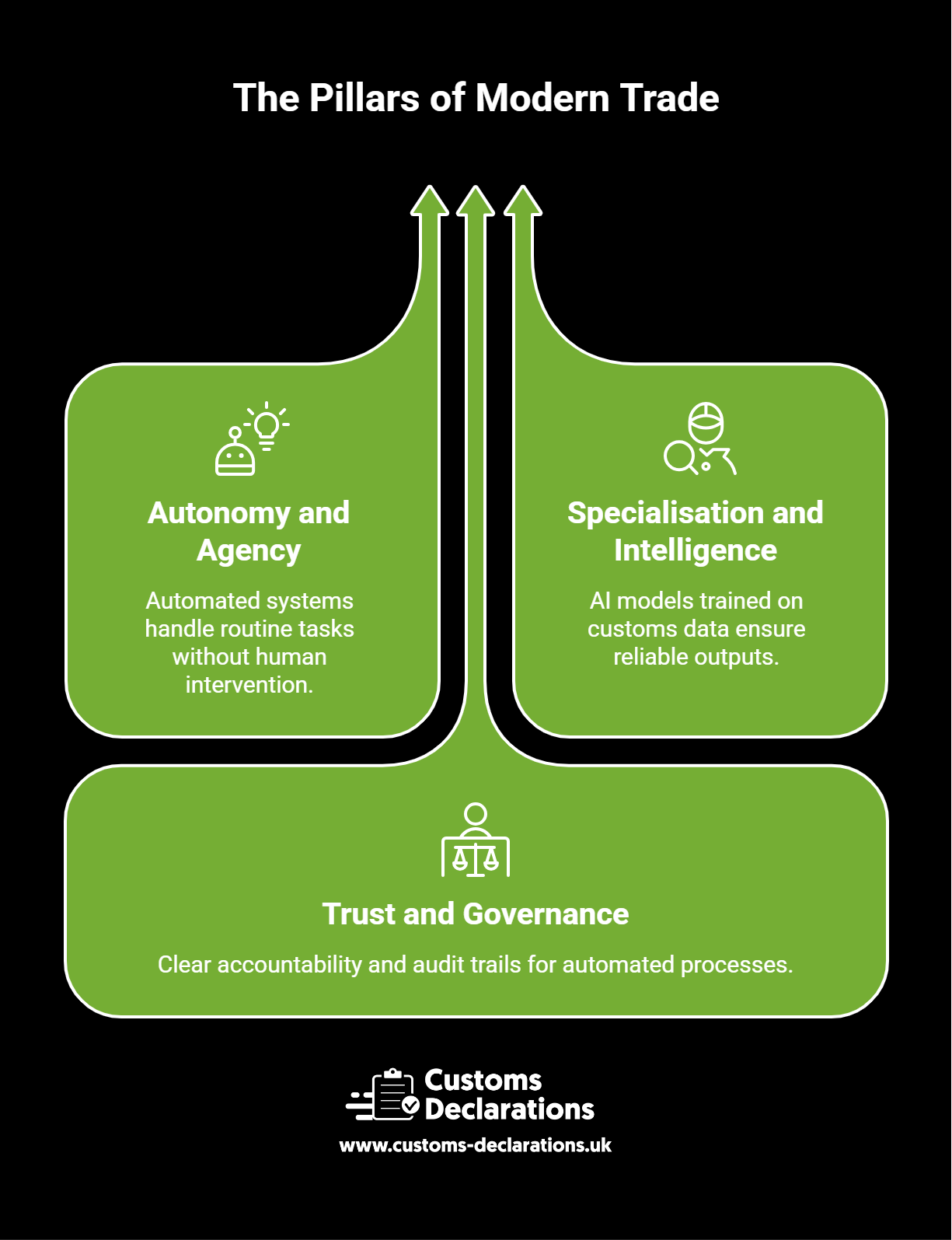
Gartner’s framing of its eight trends under three overarching themes is itself instructive. The firm describes the overarching direction as a shift toward intelligent, self-directed and accountable systems that operate seamlessly across digital and physical environments. As organisations move toward hyperconnected, AI-driven environments, leaders must focus not only on deploying advanced technologies, but also on ensuring they work together to deliver measurable value and long-term resilience.

The three themes map with unusual precision onto the specific pressures facing customs and trade operations in 2026. Autonomy and agency speaks to the question of how routine, high-volume work — declaration preparation, document checking, data entry — can be removed from the human queue and handled by systems capable of planning and executing without step-by-step instruction. Specialisation and intelligence speaks to the quality problem: general AI tools applied to customs produce plausible-sounding but unreliable outputs, whereas models trained on the actual language, code sets, and logic of customs — procedure codes, commodity classifications, valuation rules, ENS data fields — produce outputs that can be trusted. Trust and governance speaks to the accountability question that regulators and HMRC ask of any automated customs process: who is responsible, how is the decision documented, and what is the audit trail.

Each of these maps directly onto lived operational challenges in the customs sector today. The Gartner trends are not predicting a distant future; they are describing a transition that has already begun in the most advanced customs technology environments.

Agentic AI: From Insights to Execution

A class of AI systems is emerging that introduces a virtual workforce of agents that move beyond insights to execution, capable of planning, acting and adapting to achieve goals in complex environments. As adoption expands, organisations must establish guardrails to ensure explainability, accountability and responsible use.

In the context of customs and trade, the distinction between AI that provides insights and AI that executes is critical. Most customs AI deployments to date have sat firmly in the insights category — tools that highlight potential classification errors, flag value anomalies, or surface documentation gaps for a human to review and act upon. The agentic AI shift means systems that do not wait for a human to decide. An agentic customs workflow might receive a commercial invoice, identify the goods, determine the correct commodity code, select the appropriate procedure, populate the declaration fields, run validation against CDS schema requirements, and submit — with a human approval step only at the point where the system flags low confidence or detects an edge case.

Gartner says companies will need clear guardrails to ensure these systems remain transparent and accountable. In customs, this is not a generic governance observation: it is a legal requirement. The declarant remains liable for the accuracy of the declaration submitted to HMRC, regardless of how that declaration was populated. Any agentic system operating in the customs space must therefore maintain a clear and auditable record of what data it used, what decisions it made, what sources it drew upon, and where human review was applied. The HMRC requirement to retain declaration records for six years is not softened by the involvement of an AI agent; if anything, the governance obligation intensifies.

Collaborative Multiagent Systems: Coordinating Across the Trade Chain

Extending from agentic AI, collaborative multiagent systems enable multiple agents to work together across workflows and environments, each specialising in a specific task or domain. By coordinating these agents, organisations can automate complex, multistep processes and improve scalability and adaptability, while requiring strong governance to manage emerging risks.

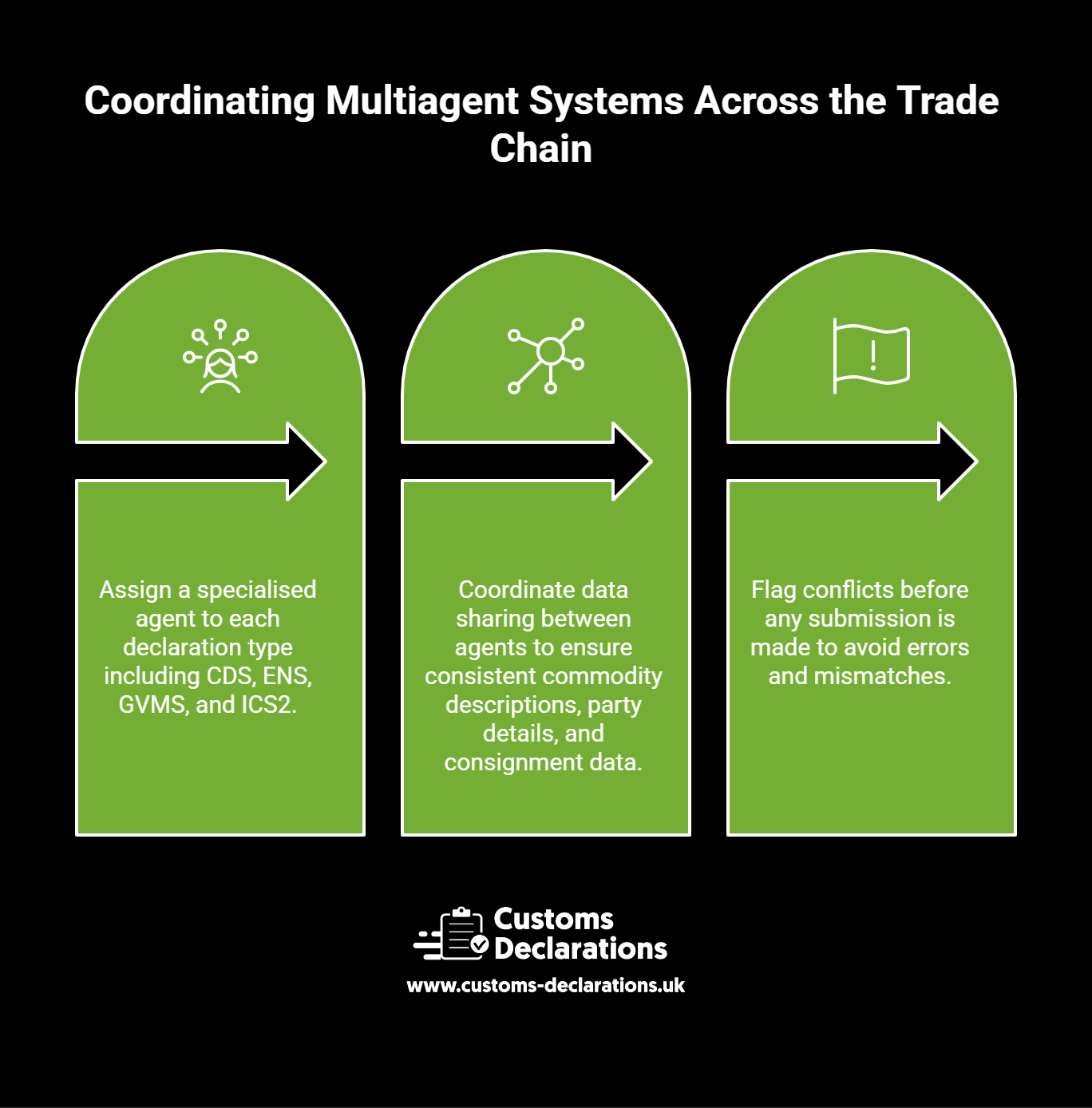
For a freight forwarder managing a complex consignment — one that involves CDS import declarations, an ENS safety and security filing, GVMS movement references, and potentially an ICS2 Entry Summary Declaration for onward EU transit — the multiagent framing is directly applicable. The data requirements of each filing draw from the same underlying commercial documents but have different field structures, different validation rules, different submission windows, and different HMRC or EU customs authority interfaces. A multiagent architecture can assign a specialised agent to each declaration type, coordinate data sharing between them so that commodity descriptions, party details, and consignment data are consistent, and flag conflicts before any submission is made. The alternative — sequential human review across each filing type — is where errors and mismatches arise in practice.

Physical AI: Connecting the Warehouse to the Declaration

Physical AI brings AI into physical operations by combining AI models with IoT sensors, robotics and automation systems to enable real-time sensing, analysis and execution across supply chain environments. It enhances operational efficiency, safety and adaptability across manufacturing, warehousing and transportation.

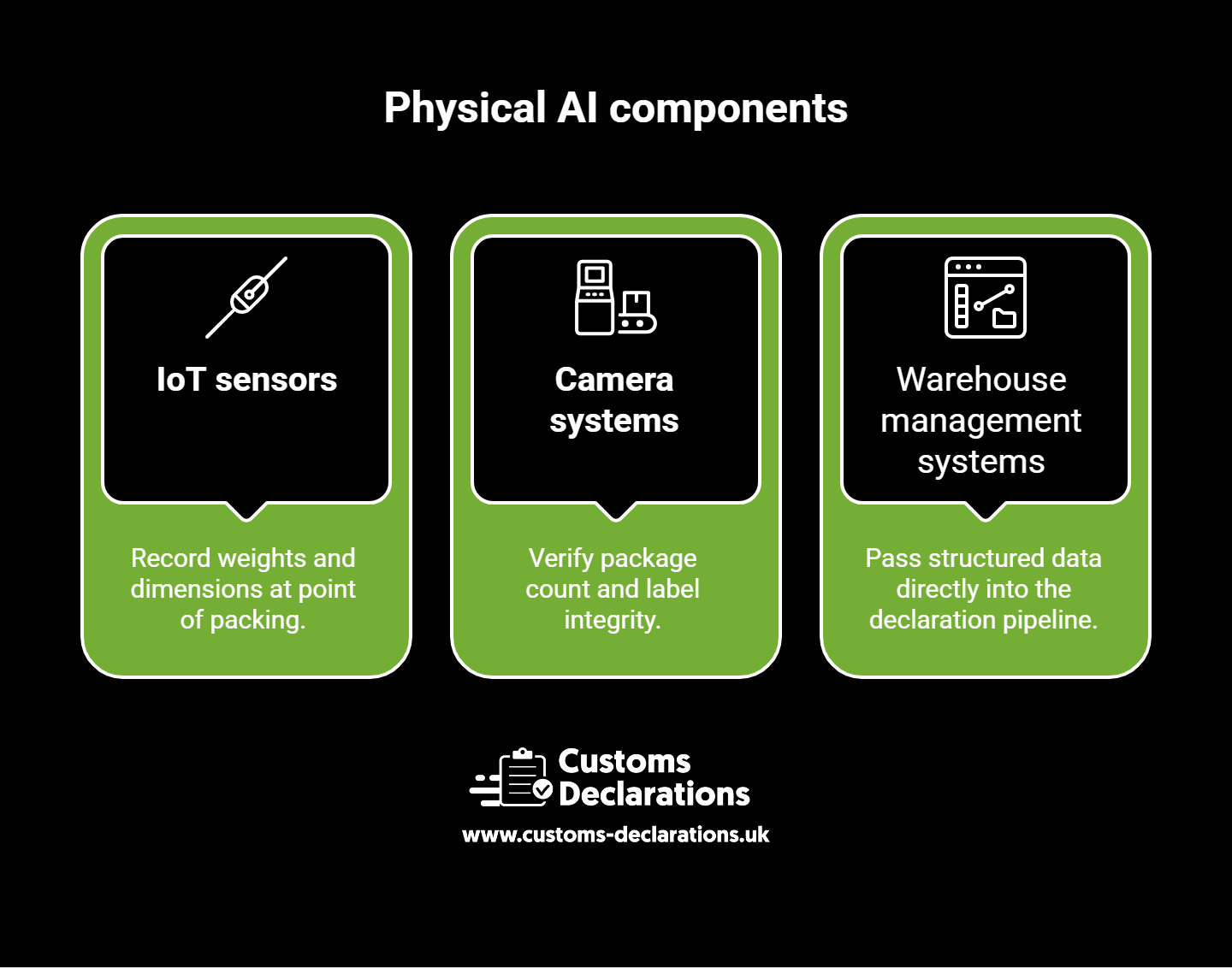
For customs, physical AI’s most immediate relevance is in the connection between what is physically happening to goods at a warehouse, port, or distribution centre and what appears on the customs declaration. Discrepancies between declared weights, package counts, and descriptions and the physical goods at the border are one of the most common triggers for HMRC queries and port holds. A physical AI environment — where IoT sensors record weights and dimensions at point of packing, camera systems verify package count and label integrity, and automated warehouse management systems pass structured data directly into the declaration pipeline — closes the gap between physical reality and declared data in a way that manual processes cannot achieve at scale.

Intelligent Simulation: The Planning Tool for Trade Compliance Teams

Intelligent simulation integrates AI, machine learning and advanced analytics into simulation models to improve predictive capabilities and decision making. It enables more dynamic planning across logistics, transportation and warehouse operations, supporting a shift toward proactive and adaptive supply chain management.

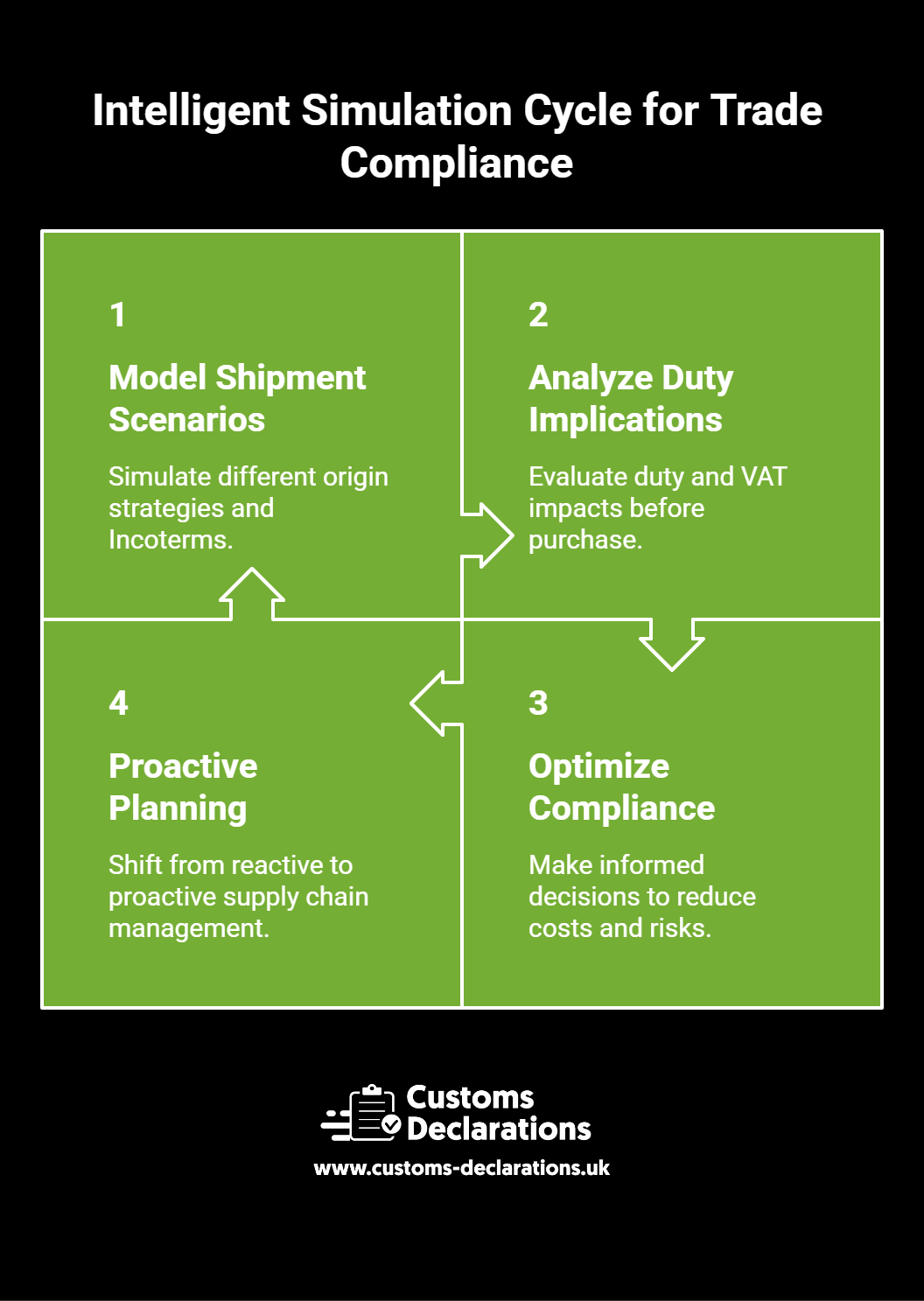
For compliance teams, intelligent simulation has a specific and underused application: modelling the landed cost, duty exposure, and documentation requirements for a shipment before it moves. Current practice in many customs operations is reactive — the goods arrive, the documents come in, and the declaration is assembled from what is available. Intelligent simulation inverts this: it allows a trader or customs agent to model alternative origin strategies, different Incoterm selections, or different commodity classifications against a proposed shipment and see the duty and VAT implications before the purchase order is raised. As EU customs reform moves toward full standard tariff rates on all imports in 2028 and as new measures like the €3 low-value duty reshape e-commerce economics, the commercial case for proactive simulation grows materially.

Domain-Specific Language Models: The Customs Compliance Opportunity

Of all eight Gartner trends, the entry on domain-specific language models is the one with the most direct and immediate relevance to customs declaration and compliance work. Designed for targeted business needs, these models are trained or fine-tuned for specialised supply chain use cases, delivering greater accuracy, reliability and compliance than general-purpose AI models. They enable improved performance in areas such as knowledge management, compliance, workflow automation and decision support.

The customs domain is a textbook case for why general-purpose language models are insufficient. The language of customs — procedure codes, additional codes, document codes, CDS data element references, TARIC code structures, ENS field specifications — is not natural language. It is a highly structured, jurisdiction-specific technical vocabulary that general AI models encounter rarely and inconsistently in their training data. A model that has been fine-tuned on the actual CDS schema, the UK Trade Tariff API responses, HMRC guidance notes, and validated declaration data from real CDS submissions will make fundamentally different and more reliable suggestions than a general model asked to guess a commodity code from a product description.

The compliance application is equally compelling. HMRC’s published guidance, the UCC-derived rules on customs valuation, the specific conditions attaching to procedure codes for special procedures such as inward processing or customs warehousing — these are documents that a domain-specific model trained on authoritative regulatory sources can navigate with a precision that general tools cannot match. The same applies to the ENS safety and security field requirements, the ICS2 Entry Summary Declaration data set, and the NCTS Phase 6 data element specifications for transit declarations.

Product Provenance and Decision Governance: The Accountability Layer

The two trends in Gartner’s trust and governance theme complete the picture and deserve particular attention from customs operators who are beginning to deploy AI-assisted workflows. Growing demand for transparency and regulatory compliance is driving the need to trace and verify the origin and journey of products across the supply chain. Technologies such as AI, blockchain and knowledge graphs are advancing the ability to scale provenance across complex supply networks.

In customs, product provenance has a direct and compulsory expression: rules of origin. Whether goods qualify for preferential tariff treatment under the UK–EU Trade and Cooperation Agreement, the UK–Japan CEPA, or any other agreement depends on demonstrable, evidenced origin — not a label or a seller’s assertion, but a verifiable claim supported by supplier declarations, certificates of origin, or substantial transformation analysis. As AI tools become part of the origin assessment and preference claim process, the governance expectation is that the AI’s reasoning is explainable, the source documents are traceable, and the claim can be defended in a post-clearance audit.

As AI adoption scales, organisations are implementing frameworks and guardrails to govern AI-enabled decision making, ensuring transparency, accountability and compliance. This approach is essential to building trust and enabling high-quality, auditable decisions across complex supply chain processes. For HMRC-regulated declarants, this is not optional. The governance framework that Gartner describes as a technology trend is a legal obligation in the customs context — and it must be designed in from the start, not bolted on after deployment.

Where Customs Declarations UK Is Already Building

The Gartner framework describes where the market is heading. Customs Declarations UK has already begun building in several of the directions that the framework maps out, and it is worth being specific about what that means in practice.

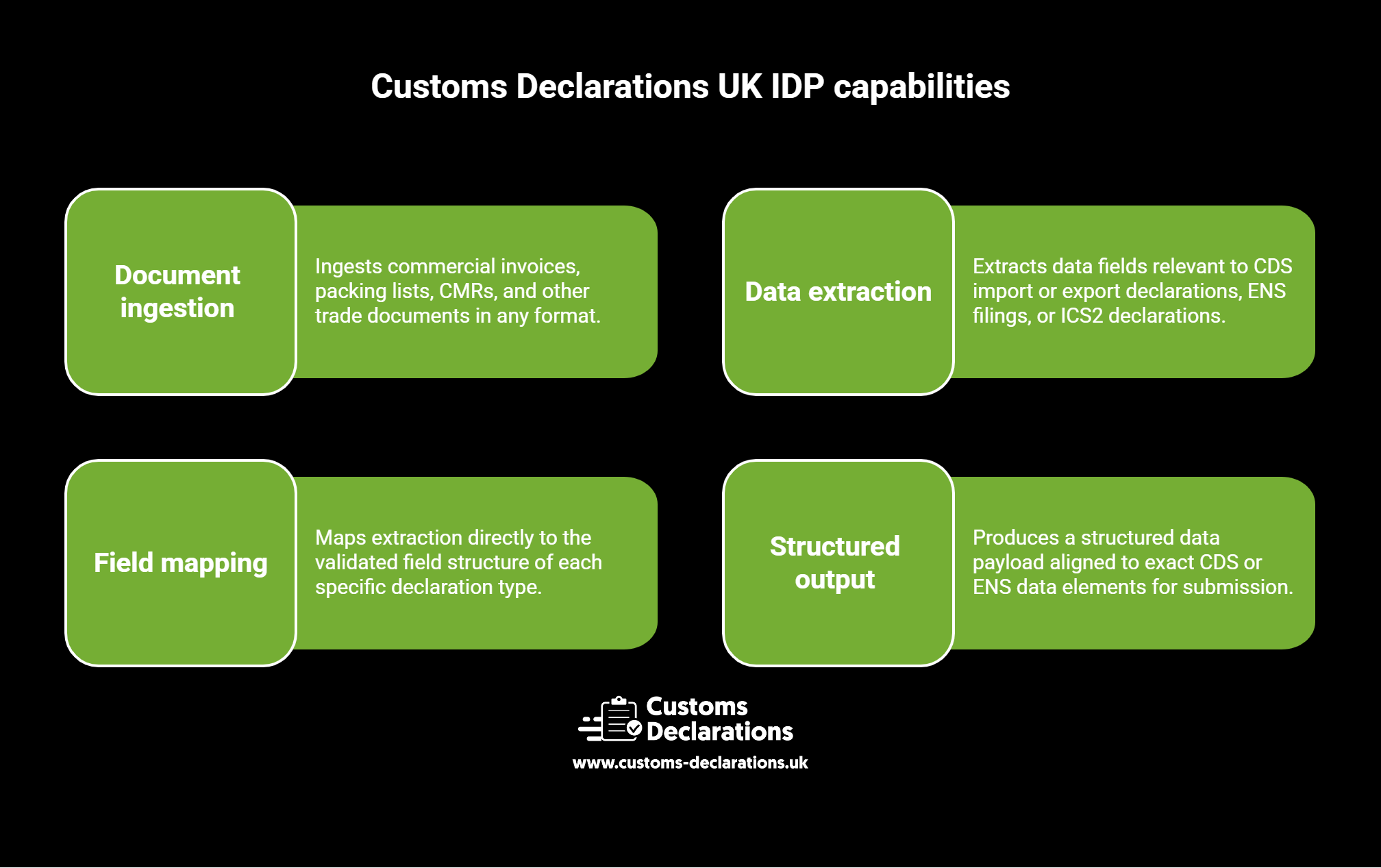
The Intelligent Document Processing (IDP) capability currently in testing on the CDUK platform sits at the intersection of the document AI and domain-specific model trends. The platform’s IDP pipeline is designed to ingest commercial invoices, packing lists, CMRs, and other trade documents in any format — scanned PDFs, structured Excel files, electronic copies — and extract the data fields relevant to a CDS import or export declaration, an ENS safety and security filing, or an ICS2 Entry Summary Declaration. The extraction is mapped directly to the validated field structure of each declaration type, not to a generic data schema. This is the specialisation that Gartner’s domain-specific language model trend describes: the model’s output is not a summary of the document in natural language but a structured data payload aligned to the exact CDS or ENS data elements required for a valid submission.

The population of declaration fields from extracted document data is not the end of the process — it is the beginning of it. The validation layer that runs on every declaration prepared on the CDUK platform checks the populated data against the same rules that HMRC’s CDS backend applies on receipt: mandatory field completeness, code list validity, procedure code combinations, commodity code format, EORI structure, and value consistency. Errors and inconsistencies are surfaced before submission, not after rejection. This is the first-attempt submission quality standard — the 99% first-attempt rate referenced across CDUK’s service — that AI-assisted document processing is designed to protect rather than undermine.

As the platform’s AI capabilities move from testing toward production, the integration between document ingestion, field population, guided validation, and direct CDS submission will give users — whether they are customs agents filing tens of declarations a day or importers managing their own in-house compliance function — a workflow that embodies what Gartner’s trends describe: specialised intelligence applied to a specific domain, executed by a system that knows the rules it is operating within, and governed by a platform that preserves every submission record, every validation result, and every acceptance confirmation for the statutory retention period.

The supply chain technology trends that Gartner has named for 2026 are not a single leap. They are a direction of travel, and the distance each organisation has covered along that path varies enormously. The Gartner observation that organisations must focus not only on deploying advanced technologies but on ensuring they work together to deliver measurable value applies with particular force to customs operations, where the regulatory consequences of getting the data wrong are not a product quality issue but a legal liability. The most valuable AI deployment in a customs context is not the most sophisticated one — it is the one most tightly integrated with validated, auditable, regulator-aligned workflows. That is the architecture Customs Declarations UK is building.

We value your feedback, and if you have any comments, suggestions or anything else that you would like to highlight to us, we will be delighted to hear from you and incorporate your feedback into our content.

Note: While we have made every attempt to ensure that the information contained in this Site has been obtained from reliable sources, Customs Declarations UK is not responsible for any errors or omissions, or for the results obtained from the use of this information. All information in this Site is provided “as is”, with no guarantee of completeness, accuracy, timeliness or of the results obtained from the use of this information, and without warranty of any kind, express or implied, including, but not limited to warranties of performance, merchantability and fitness for a particular purpose. Nothing herein shall to any extent substitute for the independent investigations and the sound technical and business judgment of the reader. In no event will Customs Declarations UK, or its partners, employees or agents, be liable to you or anyone else for any decision made or action taken in reliance on the information in this Site or for any consequential, special or similar damages, even if advised of the possibility of such damages. Certain links in this Site connect to other Web Sites maintained by third parties over whom Customs Declarations UK has no control. Customs Declarations UK makes no representations as to the accuracy or any other aspect of information contained in other Web Sites.