
About this tool
CO₂e means carbon dioxide equivalent, a single figure that combines the warming effect of different greenhouse gases. This tool estimates the CO₂e of moving a shipment. Enter the weight, the distance or two places, and the mode, and you get a figure with its method shown.
Shippers reporting transport emissions, sales teams answering customer questions and planners weighing modes use it. It reads the UK government's greenhouse gas conversion factors for 2026. The method multiplies tonnes by kilometres by a factor for each leg, which follows the activity-based approach used by the GLEC Framework and ISO 14083.
It does not claim to meet either standard, and it is not an audited carbon report. Warehousing, handling and empty running are not included unless the factor includes them. Every result states its method, factor source, factor year and confidence.
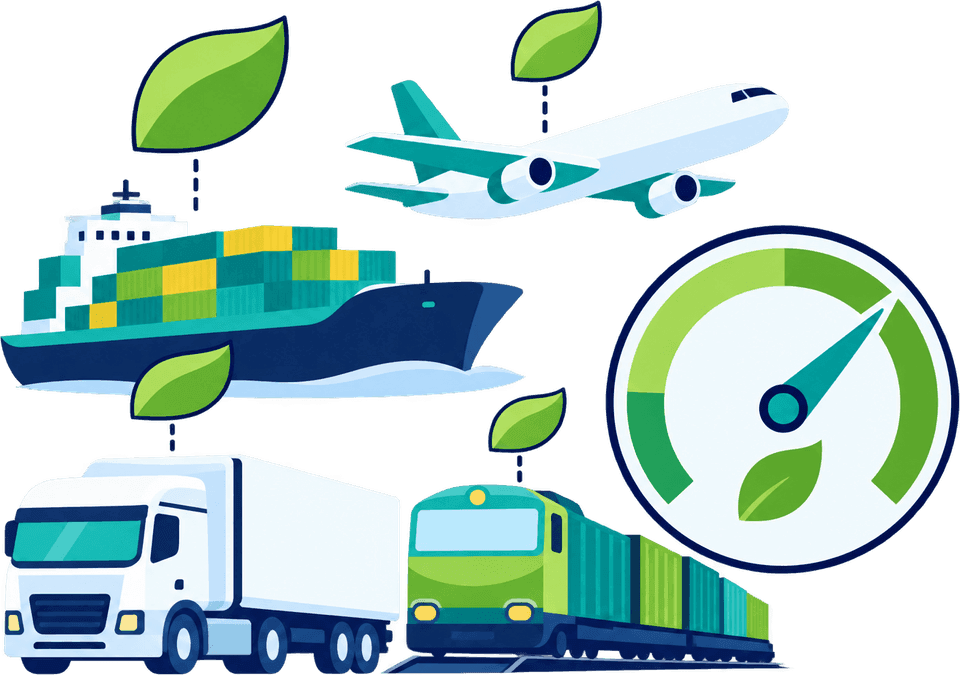
How this was worked out
What the tool does with your answers, in order.
Enter the shipment weight in tonnes or kilograms; if you came from the Container / CBM Calculator, its weight is offered in one tap.
Enter the origin and destination, or type the distance yourself.
Choose road, rail, sea or air, or add legs for a multimodal journey.
The tool multiplies tonnes by kilometres by the emission factor for each leg, then adds the legs together.
Fuel production (well-to-tank) is included by default and can be switched off.
The result shows a confidence level, a mode comparison for the lane, and the factor source and year.
Worked example: 10 tonnes, 1,000 km by road
- Shipment10 tonnes; distance 1,000 km
- Emission factor used in this example0.1 kg CO₂e per tonne-km
- Calculation10 t × 1,000 km × 0.1 kg per tonne-km
- Result1,000 kg CO₂e, or 100 kg per tonne
- ConfidenceMedium when the distance is estimated; High when you enter the distance and the vehicle type
Illustrative figures that show the working, not statements about real rates or factors.
Your questions, answered.
Short answers about the Freight CO₂ Calculator.
How are freight emissions calculated?
Emissions equal the shipment weight in tonnes, multiplied by the distance in kilometres, multiplied by an emission factor for the mode and vehicle class. A multi-leg journey is calculated leg by leg and the legs are summed. The result is in kilograms of CO₂e. The tool shows the working so you can check it.
Which emission factors does the tool use?
The UK government's greenhouse gas reporting conversion factors for 2026, from the freighting goods tables and the matching well-to-tank tables. Factors are loaded from the published files, not typed into code, and the factor year is shown with every result. For air, the set that includes non-CO₂ effects is used and labelled.
What is well-to-tank?
Well-to-tank covers the emissions from producing and delivering the fuel, before it is burned in the vehicle, vessel or aircraft. It is on by default and can be switched off. Turning it off lowers the total and changes the label on the result, so you can see which basis a figure uses.
Does this calculation follow GLEC or ISO 14083?
It follows the activity-based approach those frameworks use: distance, mass and a factor per leg. The tool has not been reviewed or audited against either standard and makes no claim to meet them. If you need a figure for formal reporting, use a verified method and check which standard your customer or regulator requires.
How accurate is the distance?
If you enter the distance, or a port-to-port distance applies, confidence is higher. If you give only places, the tool estimates the distance from coordinates with a mode-specific uplift, labels it an estimated distance and shows medium confidence. Where a place cannot be located, it asks you for a distance.
Which mode has the lowest emissions per tonne-km?
With real conversion factors, sea freight is normally the lowest and air freight the highest per tonne-km, with rail and road between them. Total emissions also depend on the distance, since routes differ by mode. The comparison shows only modes that are physically plausible for your lane.
Where does the data come from?
From the UK government's 2026 greenhouse gas conversion factors, published in June 2026 with a flat file reissued in July, and from UN/LOCODE for place coordinates. The factors are refreshed each year in June. The method, factor source and factor year are shown with every figure.
What does this tool not cover?
It does not produce an audited carbon footprint or a certified report. Warehousing, handling and empty running are not included unless the factor includes them. It does not allocate emissions across several customers sharing a vehicle beyond the load you enter, and it does not cover emissions from packaging.
Data sources
- UK government greenhouse gas reporting conversion factors 2026 United Kingdom · Yearly, each June
- UN/LOCODE (UNECE), place coordinates International · Each release
United Kingdom · data checked 3 Oct 2026. UK government data is reused under the Open Government Licence v3.0.
Guidance only — not adviceWhat this tool is, and is not
This tool gives general guidance and indicative figures based on the information you enter and on official data available at the date shown. It is not legal, tax, customs or financial advice, it is not a ruling or a decision by any customs authority, and it does not recommend any course of action, guarantee, amount, route, supplier or service.
Customs authorities decide the classification, value, origin, charges and guarantee amounts that apply. You remain solely responsible for your declarations, guarantees, shipments and transactions, and for checking every figure against HMRC’s published guidance and the official sources before you rely on it or act on it.
Rates, rules and data can change without notice, and the results may be incomplete or inaccurate. To the fullest extent permitted by law, Customs Declarations UK accepts no liability for any loss, cost, penalty, delay or damage arising from the use of, or reliance on, this tool or its results.