Pre-loader

Importing Cut Flowers from the Netherlands to the United Kingdom: A Complete Compliance and Logistics Guide

The Netherlands is the world’s foremost hub for cut flower trade, accounting for the majority of global flower exports through its iconic auction houses at Aalsmeer, Naaldwijk, and Rijnsburg. For UK importers, Dutch flower suppliers remain indispensable partners — but since Brexit, every consignment of cut flowers arriving in Great Britain from the Netherlands must navigate a structured and time-sensitive customs, phytosanitary, and logistics framework. This guide sets out that framework in full, from supplier agreements and phytosanitary certification to filing customs declarations through HMRC’s Customs Declaration Service.

Understanding the Post-Brexit Import Framework

Prior to Brexit, cut flowers moved freely between the Netherlands and the United Kingdom under EU single market rules. That frictionless arrangement no longer applies. Since 1 January 2021, goods imported from the European Union into Great Britain are treated as third-country imports, requiring formal customs declarations and compliance with UK border controls.

For cut flowers specifically, this means importers must hold a valid GB EORI number, submit import declarations to HMRC via the Customs Declaration Service (CDS), and comply with UK phytosanitary import requirements administered by the Animal and Plant Health Agency (APHA). The UK-EU Trade and Cooperation Agreement (TCA) provides for zero tariffs on goods of EU preferential origin, which is relevant to cut flowers grown and exported from the Netherlands, but it does not eliminate documentation obligations. Origin evidence must be held and produced to claim duty-free treatment.

Phytosanitary Requirements and Plant Health Controls

Cut flowers are living plant material and are therefore subject to rigorous plant health controls at the UK border. This is among the most operationally critical aspects of importing flowers from the Netherlands, and failures here can lead to consignment rejection or destruction.

Phytosanitary Certificates

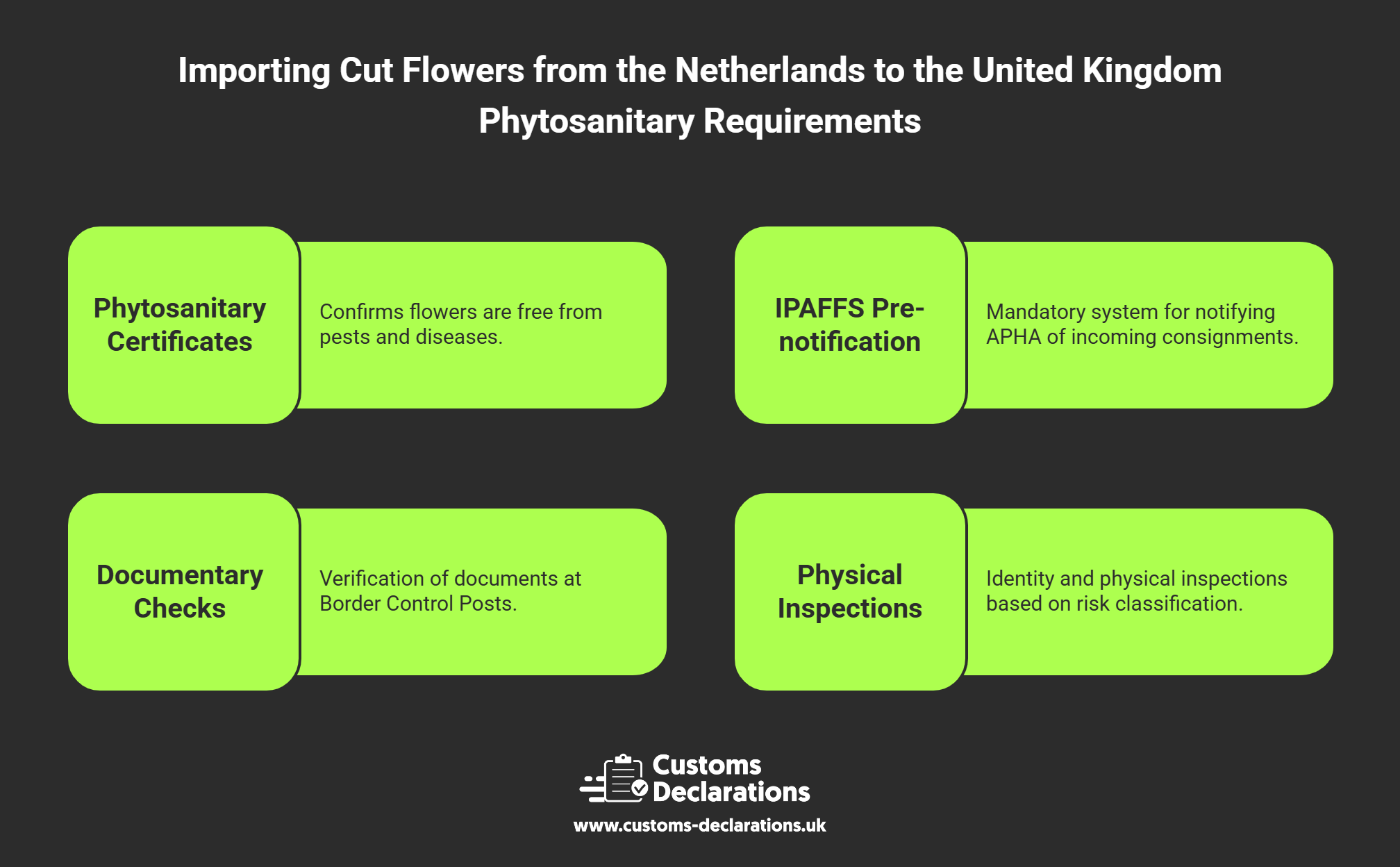
Most cut flowers imported into Great Britain from the European Union require a Phytosanitary Certificate (PC) issued by the Netherlands Food and Consumer Product Safety Authority (NVWA). This certificate confirms that the flowers have been inspected, are free from regulated pests and diseases, and meet UK import requirements. Without a valid Phytosanitary Certificate, APHA border inspectors will not permit release of the consignment.

Importers must pre-notify APHA of incoming consignments through the Import of Products, Animals, Food and Feed System (IPAFFS) before the goods arrive at the UK border. IPAFFS is HMRC’s and APHA’s designated pre-notification platform and is mandatory for plant products subject to phytosanitary controls. Failure to pre-notify or providing incorrect information in IPAFFS can trigger immediate holds at the border. For further guidance, visit the official GOV.UK guidance on importing plants and plant products.

Documentary Checks and Physical Inspections

Regulated plant consignments are subject to documentary checks and, depending on risk classification, identity checks and physical inspections at Border Control Posts (BCPs). Not all UK ports are designated BCPs for plants. Importers should confirm that their intended port of entry is appropriately designated for plant health inspections before booking freight. The Port of Dover and Heathrow Airport are among the principal BCPs used for Dutch flower consignments, with specialist cold-storage facilities available for perishable goods.

Customs Classification and Tariff Coding

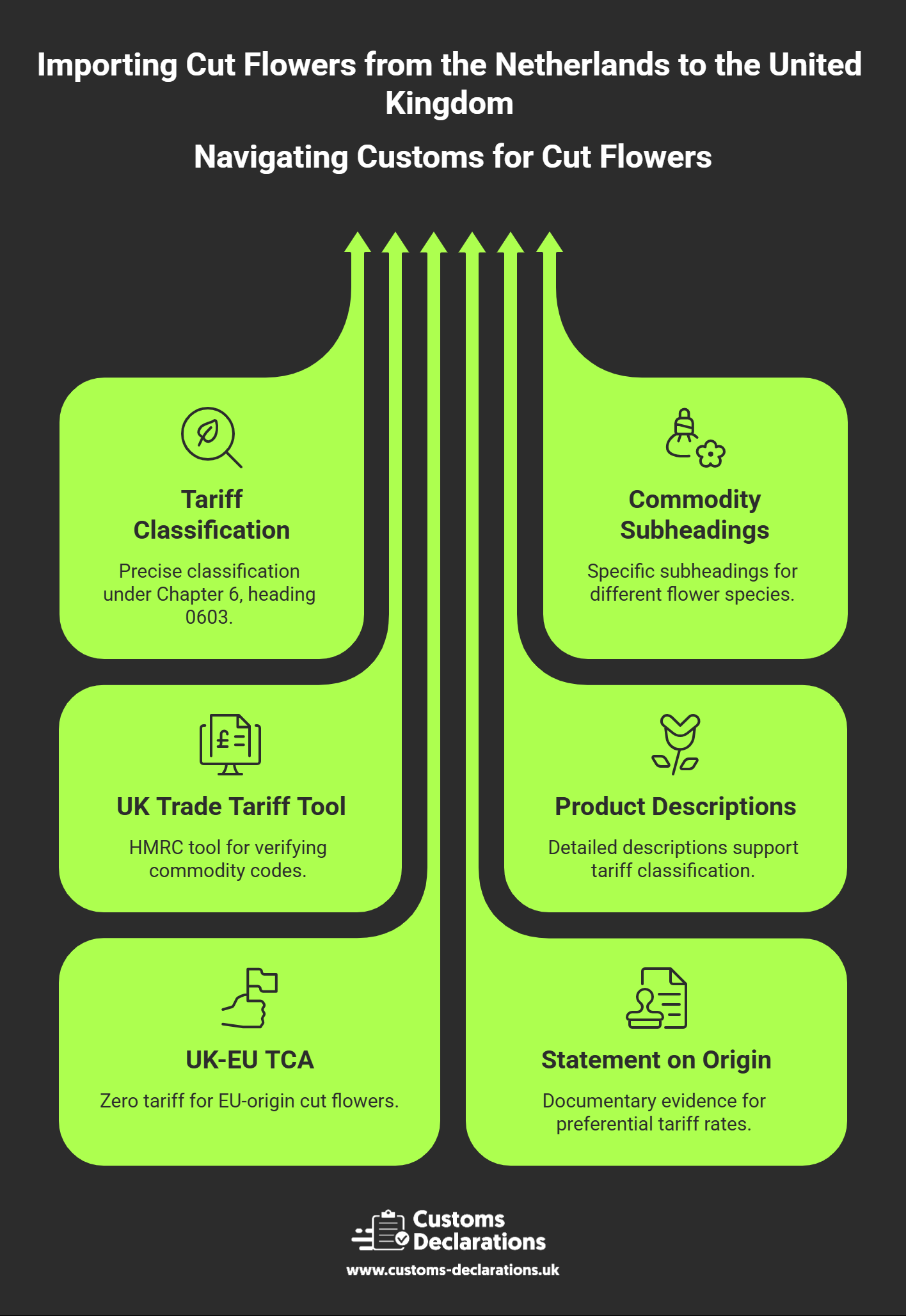
Accurate tariff classification underpins every compliant customs declaration. Cut flowers are classified under Chapter 6 of the UK Integrated Tariff, specifically heading 0603, which covers cut flowers and flower buds of a kind suitable for bouquets or ornamental purposes, fresh, dried, dyed, bleached, impregnated, or otherwise prepared.

The specific commodity subheading depends on the species of flower and whether they are fresh or processed. Roses, carnations, orchids, chrysanthemums, and lilies each attract their own subheadings under 0603. Importers should verify the precise ten-digit commodity code using HMRC’s UK Trade Tariff tool and should retain product descriptions and specifications to support that classification if challenged. Misclassification, even on a product as apparently straightforward as cut flowers, can result in post-clearance assessments, duty discrepancies, and HMRC enquiries.

Under the UK-EU TCA, cut flowers of EU origin attract a zero tariff rate. However, claiming this preference requires documentary evidence, typically a Statement on Origin provided by the Dutch exporter. Without such evidence, the Most-Favoured-Nation (MFN) duty rate will apply. Importers should confirm the preferential rate applicable to each subheading before filing declarations.

Customs Valuation

The customs value for cut flowers must be calculated using the transaction value method — that is, the price actually paid or payable for the goods when sold for export to the UK. This value must include all costs incurred up to the UK frontier, including international freight and insurance, but should exclude post-import costs such as domestic UK delivery charges and VAT.

Given that cut flowers are typically purchased through auction or on short-term commercial contracts, invoice values can fluctuate daily. Importers should ensure that commercial invoices consistently reflect the correct transactional value and are structured in a way that supports HMRC’s valuation requirements. Understatement of customs value — whether through invoice manipulation or omission of dutiable charges — carries significant penalty risk.

Import VAT and Postponed VAT Accounting

Import VAT at the standard rate of 20% applies to the customs value of cut flowers. VAT-registered importers can take advantage of Postponed VAT Accounting (PVA), which allows import VAT to be accounted for on the VAT return rather than paid at the frontier. This is a significant cash flow advantage for businesses handling daily or weekly flower consignments, where the cumulative VAT liability across a year can be substantial. A Duty Deferment Account is also available for businesses wishing to consolidate duty and VAT payments on a monthly basis rather than per shipment.

Logistics, Cold Chain, and Documentation

Cut flowers are highly perishable. The logistics window between harvest in the Netherlands and sale in the UK is exceptionally narrow — typically 24 to 72 hours for fresh-cut stock. This places considerable pressure on the customs and phytosanitary clearance process, making first-time-right declarations and pre-notifications absolutely essential.

Transport and Incoterms

Road transport via refrigerated vehicles (known as reefer trucks) through the Channel Tunnel or via ferry crossings from Hook of Holland or Rotterdam to UK ports is the dominant mode for Dutch flower imports. The choice of Incoterms governs the allocation of risk and cost between the Dutch supplier and the UK importer. DAP (Delivered at Place) and DDP (Delivered Duty Paid) terms are common in the flower trade, though DDP can create complications for VAT reclaim and should be assessed carefully before acceptance.

Essential Commercial Documents

A complete documentary pack for each consignment should include the commercial invoice, packing list, Phytosanitary Certificate, proof of preferential origin (Statement on Origin), Certificate of Origin where applicable, transport documents, and the IPAFFS pre-notification reference. All documents must align with one another in terms of quantities, species descriptions, values, and party identities. Inconsistencies between shipping documents and customs declarations are a leading cause of border holds and HMRC enquiries.

Filing Customs Declarations Using Customs Declarations UK

The administrative heart of every UK flower import is the import declaration submitted to HMRC through the Customs Declaration Service. For businesses importing regularly from the Netherlands — whether as direct importers, freight forwarders, or customs brokers — having a reliable and validated declaration platform is not optional but essential.

The Customs Declarations UK (CDUK) platform provides a structured, wizard-based pathway for filing import declarations directly with HMRC’s CDS. Designed for importers of all experience levels, CDUK guides users through each data element in plain English, removing the complexity of CDS’s technical data requirements while ensuring that every mandatory field is correctly populated.

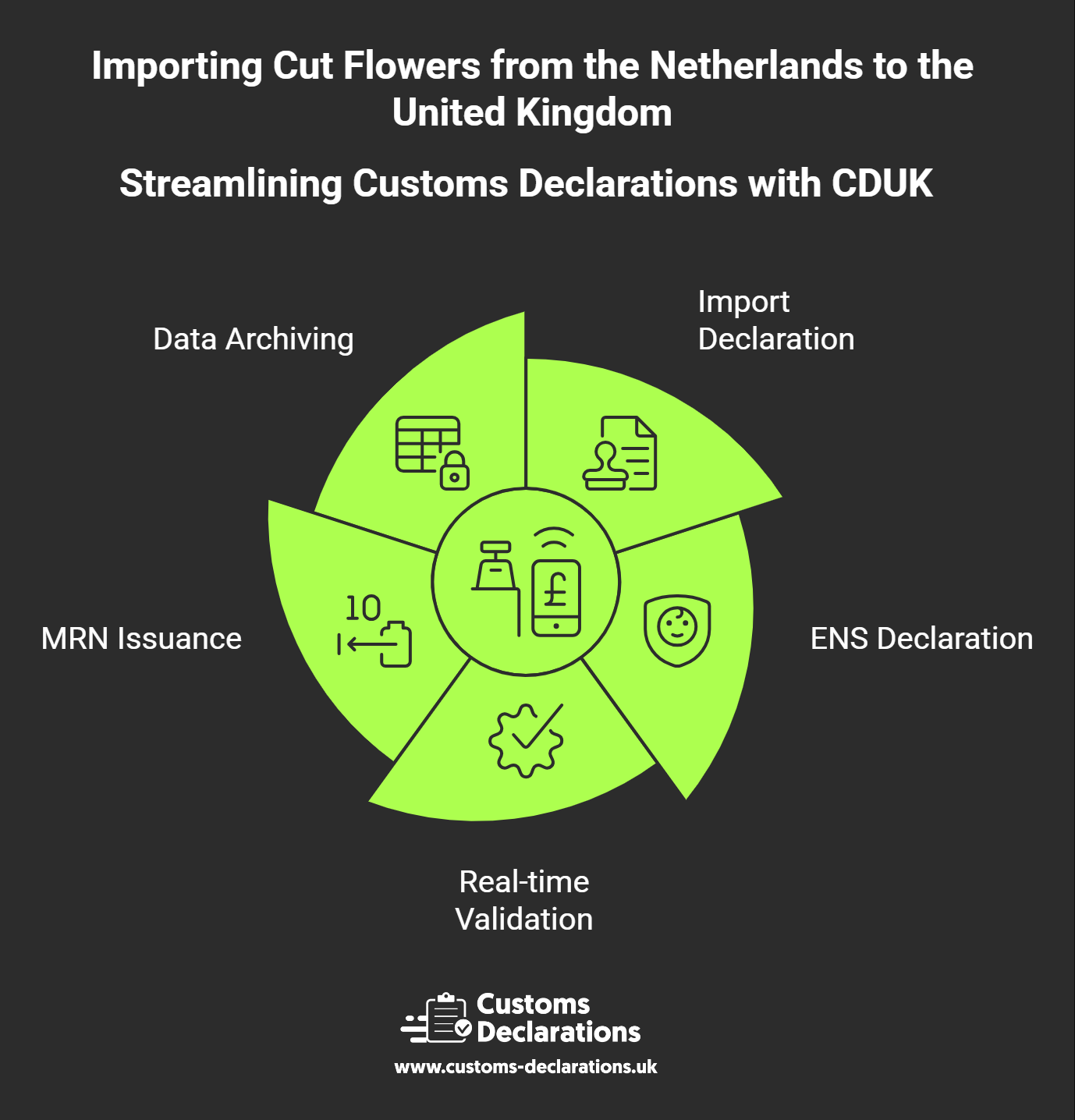
Using CDUK, importers of cut flowers can enter all relevant consignment details — importer and exporter identities, commodity descriptions, tariff codes, customs value components, Incoterms, origin, and preferential duty claims — within a logical and sequential workflow. The platform’s real-time validation engine checks for missing or inconsistent data before submission, significantly reducing the risk of HMRC rejection. For perishable goods where border delays carry direct commercial cost, submitting a correct and validated declaration at the first attempt is critical.

Upon HMRC acceptance of the declaration, CDUK issues the Movement Reference Number (MRN) instantly, which is required by port Community System Providers and Border Control Post staff to release the goods. The platform also archives all declaration data securely for the statutory six-year retention period, ensuring that records are readily available for HMRC audits or market surveillance enquiries.

For businesses also required to submit ENS declarations — the safety and security Entry Summary Declarations required for goods entering Great Britain — CDUK’s integrated ENS module allows these filings to be handled within the same platform. ENS data can be aligned directly with the import declaration, preventing the data mismatches that frequently cause avoidable holds at the border.

The Customs Declarations UK platform integrates with the UK’s leading port Community System Providers, including MCP, CNS, and CCS-UK, providing seamless connectivity with the ports and Border Control Posts through which Dutch flower consignments arrive. This integration ensures that declaration data flows electronically to the right systems at the right time, supporting the rapid clearance that perishable cargo demands.

Extended Producer Responsibility and Post-Import Obligations

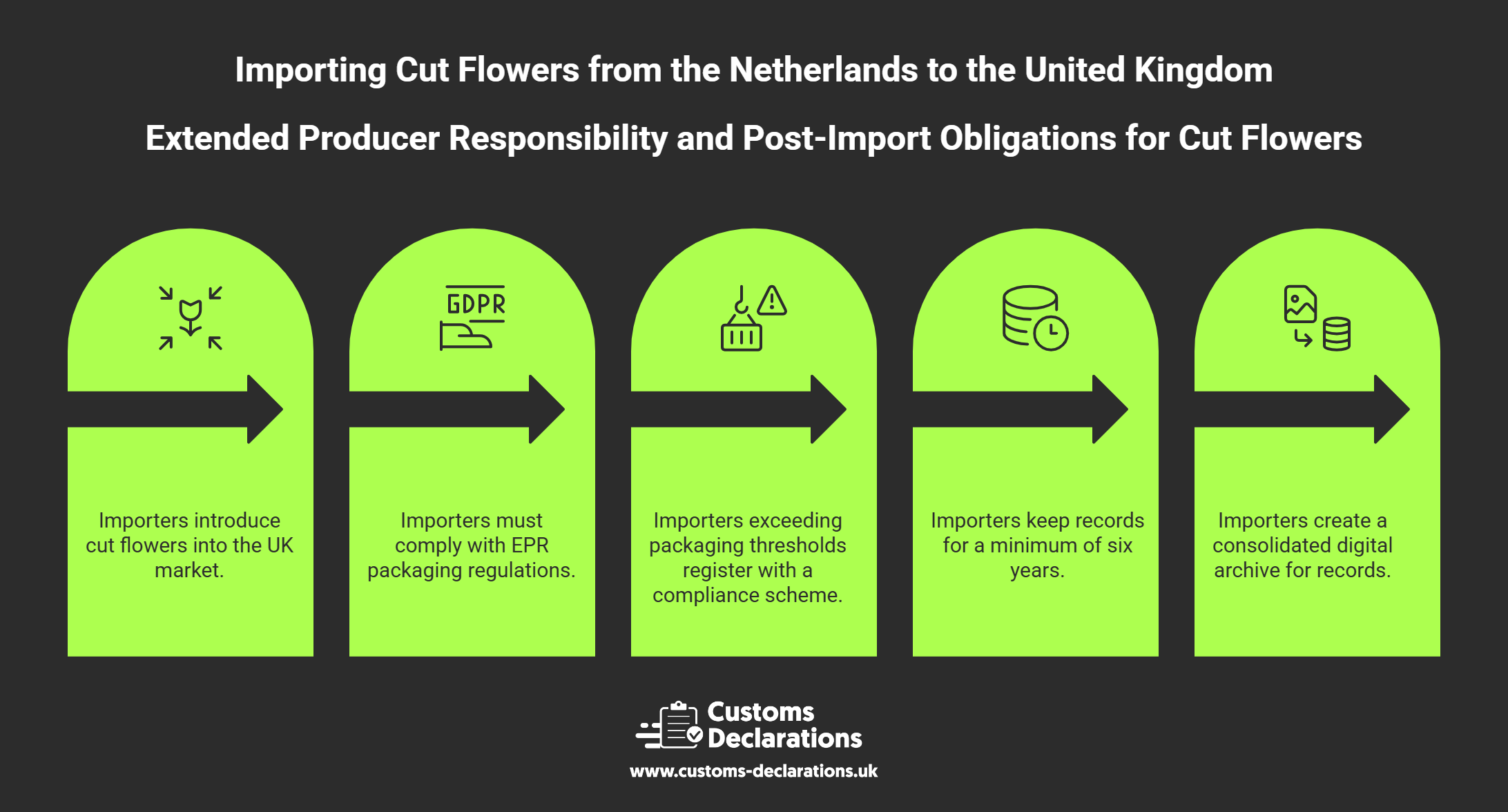
Importers of cut flowers should also be aware of packaging obligations under the UK’s Extended Producer Responsibility (EPR) for Packaging regime. Flower consignments from the Netherlands typically arrive in plastic wrapping, cardboard boxes, and other packaging materials. Where importers place these products on the UK market and supply packaging to end users, registration obligations under the EPR framework may apply. Businesses exceeding the threshold tonnages for packaging supplied should register with an approved compliance scheme.

Records of all imports — invoices, transport documents, Phytosanitary Certificates, IPAFFS notifications, customs declarations, and origin evidence — must be maintained for a minimum of six years in accordance with HMRC requirements. Given APHA’s separate record-keeping expectations for plant health controls, maintaining a consolidated digital archive aligned with each customs declaration is strongly advisable.

Conclusion: Building a Reliable Supply Chain for Dutch Flower Imports

Importing cut flowers from the Netherlands to the United Kingdom is a commercially rewarding but technically demanding operation. The combination of plant health controls, perishability, and post-Brexit customs obligations creates a compliance environment in which preparation and precision are directly linked to commercial outcomes. Delays at the border are not merely inconvenient — for perishable flower consignments, they can destroy the entire value of a shipment.

By ensuring phytosanitary documentation is in order, Phytosanitary Certificates are verified before departure, IPAFFS pre-notifications are filed in advance, and customs declarations are submitted accurately through the Customs Declarations UK platform with real-time validation, UK importers can build a reliable, compliant, and commercially competitive cut flower supply chain from the Netherlands. With the right processes embedded from the outset, every consignment can clear efficiently — protecting both the flowers and the business that depends on them.

We value your feedback, and if you have any comments, suggestions or anything else that you would like to highlight to us, we will be delighted to hear from you and incorporate your feedback into our content.

Note: While we have made every attempt to ensure that the information contained in this Site has been obtained from reliable sources, Customs Declarations UK is not responsible for any errors or omissions, or for the results obtained from the use of this information. All information in this Site is provided “as is”, with no guarantee of completeness, accuracy, timeliness or of the results obtained from the use of this information, and without warranty of any kind, express or implied, including, but not limited to warranties of performance, merchantability and fitness for a particular purpose. Nothing herein shall to any extent substitute for the independent investigations and the sound technical and business judgment of the reader. In no event will Customs Declarations UK, or its partners, employees or agents, be liable to you or anyone else for any decision made or action taken in reliance on the information in this Site or for any consequential, special or similar damages, even if advised of the possibility of such damages. Certain links in this Site connect to other Web Sites maintained by third parties over whom Customs Declarations UK has no control. Customs Declarations UK makes no representations as to the accuracy or any other aspect of information contained in other Web Sites.