The landscape of UK-EU trade is entering a period of unprecedented scrutiny. While the logistics industry has spent much of the last two years adjusting to the general requirements of the Import Control System 2 (ICS2), a specific and more dangerous challenge is emerging: the “High-Value Goods Trap.”
For customs agents, freight forwarders, and logistics providers, high-value consignments—ranging from luxury electronics and pharmaceuticals to specialized industrial machinery—have always required careful handling. However, under ICS2 Release 3, these goods are now subject to a new level of digital scrutiny. The margin for error in an Entry Summary Declaration (ENS) has effectively vanished. In this environment, a minor data discrepancy is no longer a clerical annoyance; it is a trigger for a “Do Not Load” (DNL) notification that can derail a high-stakes supply chain in minutes.
The Evolution of Risk: Why High-Value Goods?
ICS2 is not merely an administrative update; it is a sophisticated, AI-driven security engine designed to protect the EU’s single market. The European Commission has identified high-value goods as a primary area of risk—not just for revenue loss (duty and VAT evasion), but for security concerns including the movement of dual-use goods and intellectual property theft.
Under the legacy ICS1 system, customs authorities often operated on a “clearance at the frontier” model. ICS2 flips this entirely. Risk analysis now happens pre-loading. For high-value goods leaving the UK, the scrutiny is doubled. Authorities are no longer looking just for what is in the box; they are looking at the integrity of the data surrounding the transaction.
The Anatomy of the “High-Value Trap”
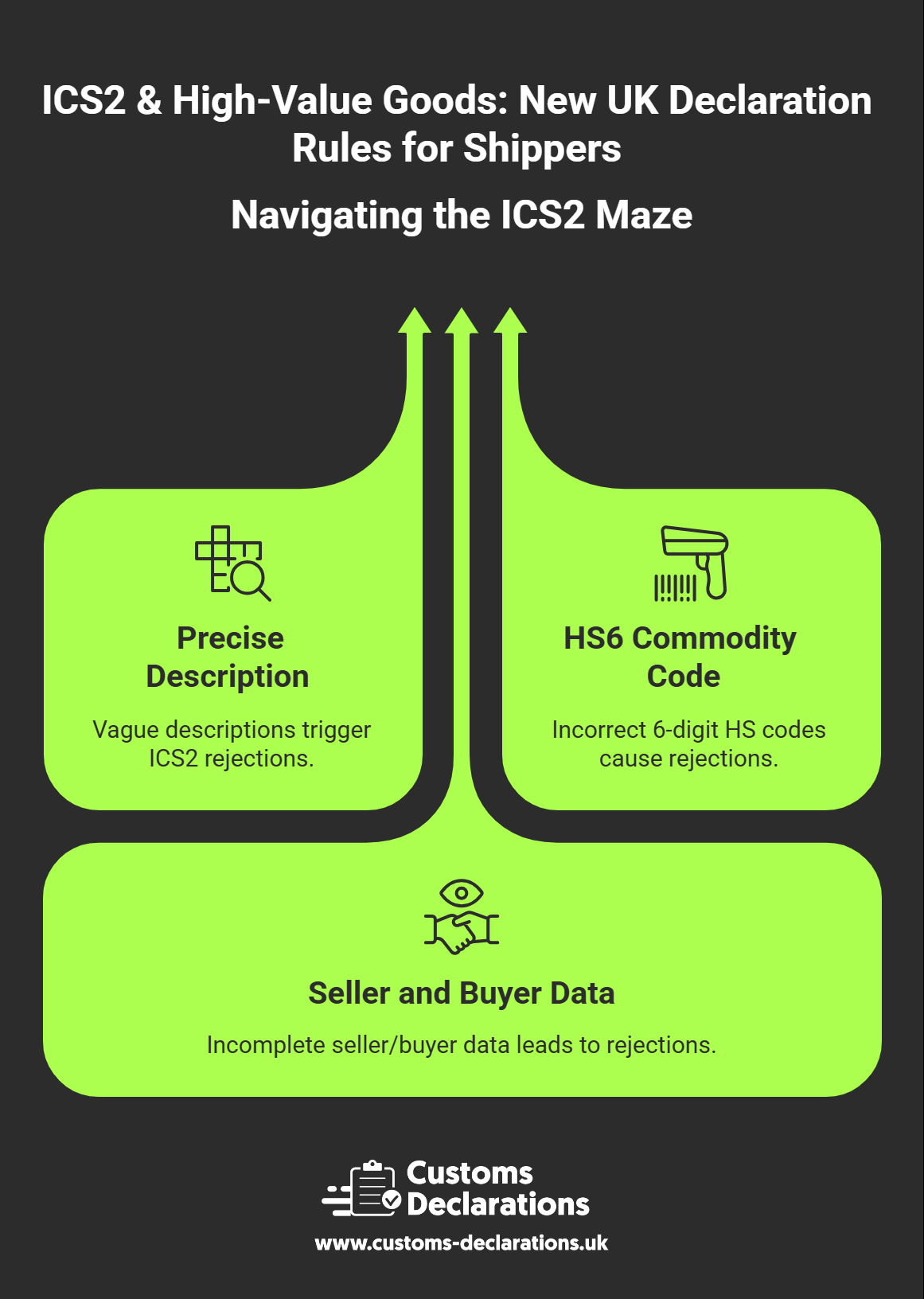
The “trap” exists in the gap between traditional shipping documentation and the granular data requirements of the modern ENS. For UK shippers, three specific areas are causing the most friction:
1. The Precise Description Mandate
Vague descriptions like “Electronics,” “Machinery Parts,” or “Laboratory Equipment” are the most common triggers for ICS2 rejections. For high-value goods, the system now demands a “plain language” description so clear that a non-expert can identify the goods.
- The Trap: A shipper uses the commercial invoice description which is highly technical or internal.
- The ICS2 Requirement: The description must match the 6-digit HS code logic exactly. If shipping high-end smartphones, “Telecommunication devices” may be rejected; “Mobile telephones for cellular networks” is the required standard.
2. The HS6 Commodity Code Pressure
While many shippers have historically relied on 4-digit codes for preliminary paperwork, ICS2 Release 3 mandates a minimum 6-digit HS code for every item in a consignment. For high-value items, where duty rates can vary significantly between sub-headings, an incorrect 6-digit code is flagged as a potential attempt at duty circumvention.
3. Seller and Buyer Data Transparency
ICS2 requires the EORI numbers and full address details of the actual buyer and seller, not just the transport parties. In complex high-value trades involving third-party financiers or drop-shipping, identifying the correct “underlying” parties is often where the data chain breaks.
Operational Deadlines: The Road and Rail Reality
For road and rail transport—the lifeblood of UK-EU trade—the timing is critical. As we move through 2026, the decommissioning of ICS1 for land transport in countries like Poland, Romania, and Slovakia means that the “safety net” is gone.
- Road Transport: The ENS must be accepted at least one hour before arrival at the EU border.
- Rail Transport: The deadline is two hours.
For a high-value truckload of pharmaceuticals crossing from Dover to Calais, that one-hour window is non-negotiable. If the ENS is rejected due to a “High-Value Trap” error, the vehicle cannot board the shuttle or ferry. The financial cost of a high-value truck sitting idle for 24 hours while data is rectified can run into thousands of pounds in liquidated damages and repositioning fees.
The AI Factor: Automated Risk Assessment
The most significant change in 2026 is that a human customs officer is no longer the first person to see your declaration. An AI-driven risk-management engine scans the ENS against thousands of data points.
If the declared value of a high-end component doesn’t align with the trade lane norms for that specific HS code, the system triggers an “exception.” In the execution-focused AI environment of 2026, these systems are increasingly programmed to “trigger actions rather than alerts.” This means the system will automatically hold the declaration rather than simply flagging it for a later human review. For high-value shippers, this “automated friction” is the greatest threat to their “just-in-time” delivery promises.
Strategic Mitigation for Freight Forwarders
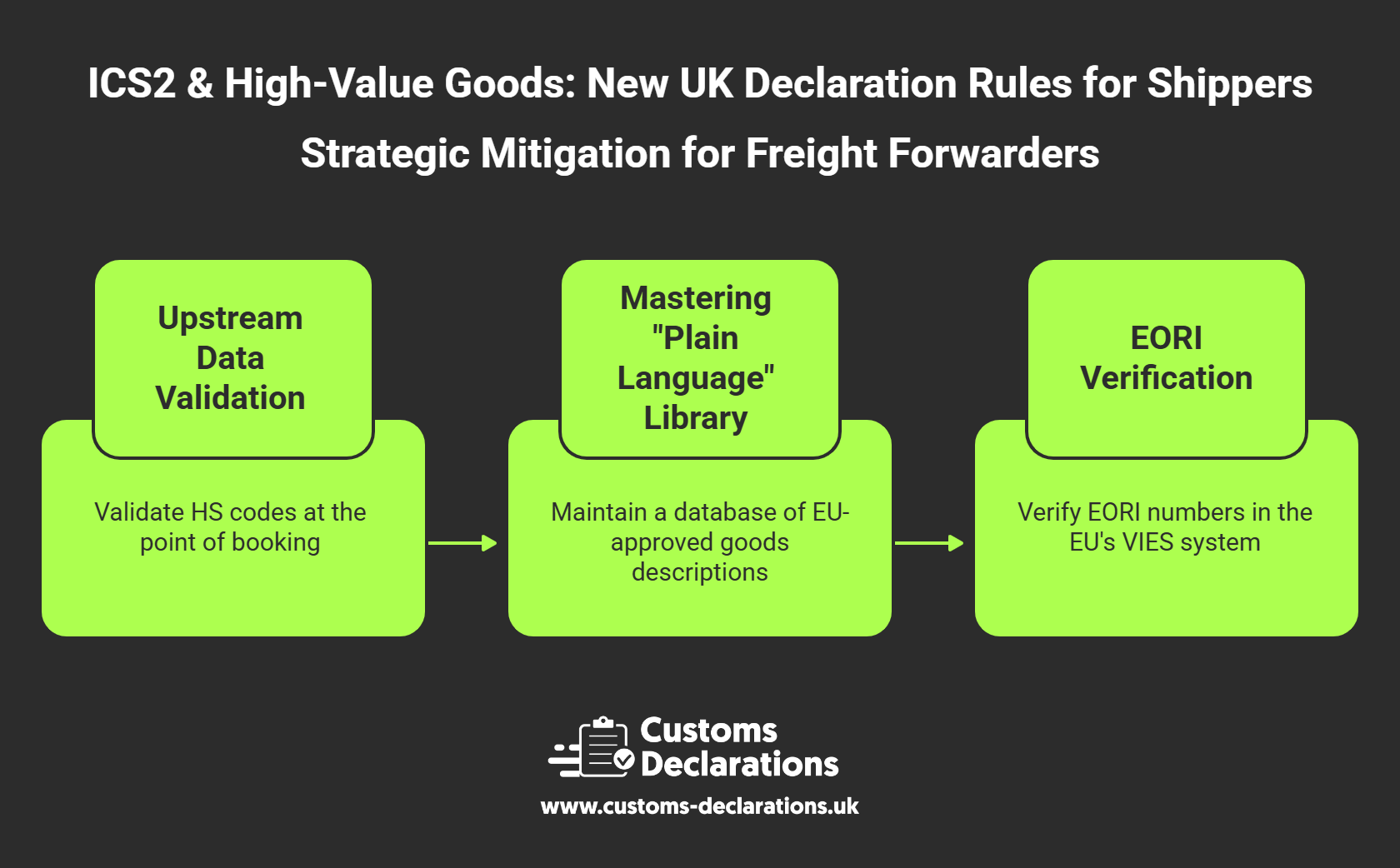
To avoid the High-Value Trap, freight forwarders must transition from being “data carriers” to “data auditors.”
- Upstream Data Validation: Do not wait for the goods to reach the warehouse to audit the HS codes. Validation must happen at the point of booking.
- Mastering the “Plain Language” Library: Maintain a database of EU-approved goods descriptions mapped to 6-digit HS codes specifically for high-value clients.
- EORI Verification: Use real-time validation tools to ensure that both the buyer and seller EORI numbers are active and correctly formatted in the EU’s VIES system.
Customs Declaration UK: Navigating High-Value Complexity
As the regulatory environment tightens, the technology you use to file your declarations becomes your most important asset. At Customs Declaration UK, we have engineered our platform to specifically neutralize the “High-Value Goods Trap.”
We understand that for customs agents and logistics providers, a high-value shipment represents a high-value relationship. Our platform provides a seamless, easy, and intuitive gateway to both customs UK and EU ICS2 compliance:
- Smart Validation for HS6: Our system doesn’t just accept a commodity code; it validates it against the latest 2026 tariff requirements, ensuring your high-value items are classified correctly the first time.
- Multi-Modal Coverage: Whether your high-value goods are moving by road, air, sea, or rail, our platform provides a single, unified interface for all ENS and customs filings.
- Real-Time Exception Handling: Our AI-driven logic identifies potential “trap” triggers—such as vague descriptions or valuation anomalies—before you submit, reducing the risk of a “Do Not Load” notification to near zero.
- Automated Document Linking: Our platform allows for the easy attachment and cross-referencing of supporting documents (licenses, certificates of origin), which are often mandatory for high-value or restricted goods.
By using Customs Declaration UK, you aren’t just filing a form; you are deploying a sophisticated compliance shield that ensures your most valuable cargo keeps moving, regardless of the transport mode.
Conclusion
The rollout of ICS2 Release 3 has fundamentally changed the rules of engagement for UK exporters. High-value goods, once the crown jewels of a logistics portfolio, now represent the highest area of compliance risk.
The “High-Value Goods Trap” is avoidable, but only through a combination of meticulous data preparation and the use of advanced declaration technology. By focusing on 6-digit HS code accuracy, precise goods descriptions, and leveraging a multi-modal partner like Customs Declaration UK, one can ensure that high-value trade remains a high-growth opportunity, rather than a regulatory nightmare.
In the digital-first borders of 2026, compliance is no longer a back-office function—it is the engine of the supply chain.