The digital transformation of European borders is reaching its most critical phase. While the logistics industry has spent the last few years adapting to new requirements for postal, express, and air cargo, the scope is now widening. ICS2 Release 3 is the final and most complex piece of the puzzle, extending safety and security requirements to all goods entering or transiting the EU by road and rail.
For customs agents, freight forwarders, and logistics providers, this isn’t just another layer of bureaucracy; it is a fundamental shift in how the customs UK and EU interface operates. By 2026, the legacy ICS1 system will be a relic of the past, replaced by a data-driven, real-time risk assessment engine that demands unprecedented levels of data accuracy.
Understanding the ICS2 Evolution
The Import Control System 2 (ICS2) is a large-scale IT system designed to collect data on all goods entering the EU prior to their arrival. Its primary goal is to protect the EU’s single market and its citizens through a more effective, risk-based approach to customs controls.
Historically, road and rail transport enjoyed a relatively “low-touch” environment compared to air and sea. However, with the rising volume of cross-border trade and the increasing complexity of global supply chains, the European Commission determined that a uniform safety and security layer across all transport modes was essential.
Release 3 brings the “land bridge” into the fold. This means that every truck and train crossing an EU external border must have a valid Entry Summary Declaration (ENS) filed and accepted before arrival.
The Operational Impact on Road and Rail
The transition to ICS2 Release 3 represents a significant departure from traditional land-based logistics workflows. Unlike air or sea cargo, where lead times are often longer, road transport operates on tight margins and “just-in-time” schedules.
1. The Pre-Arrival Filing Requirement
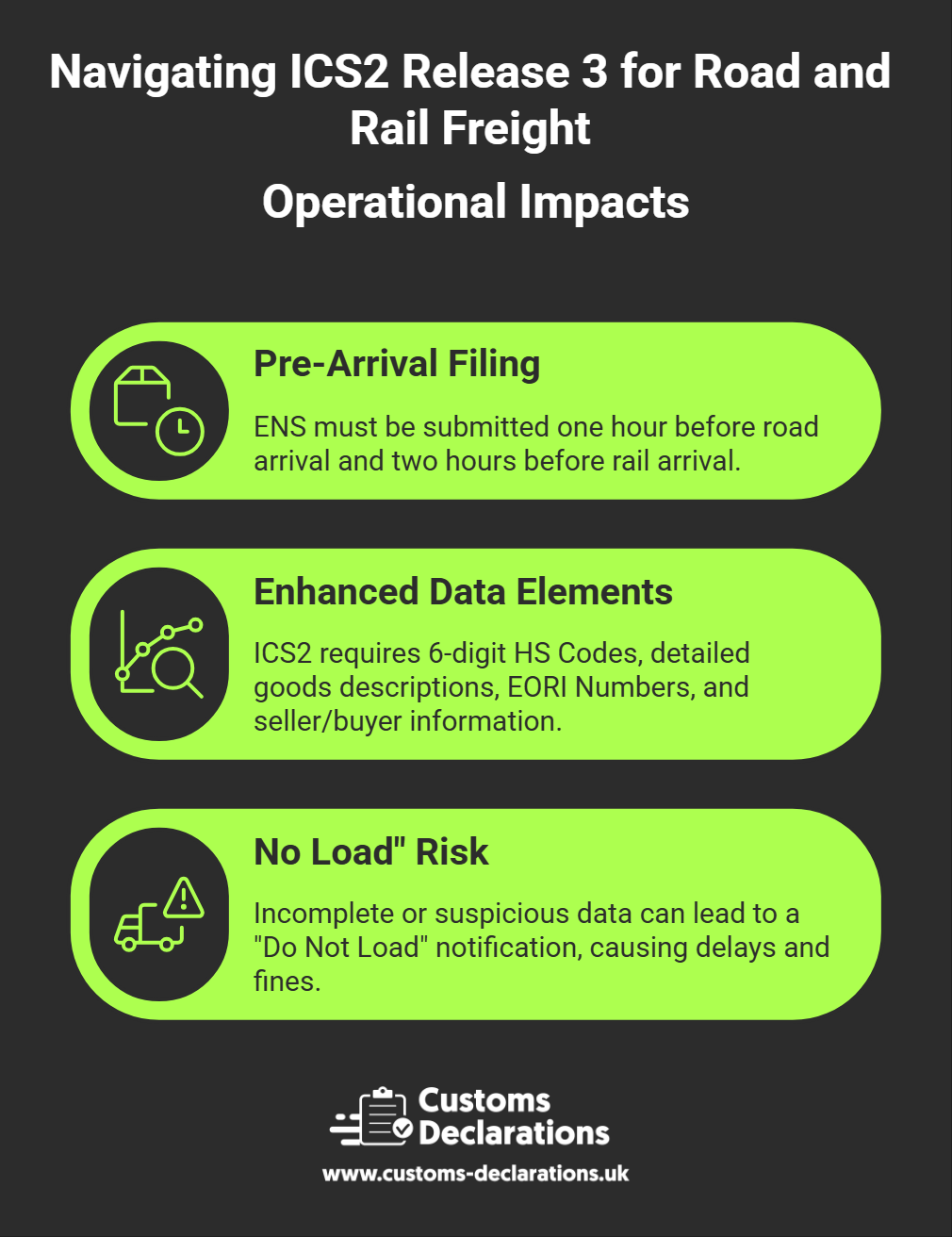
For road transport, the ENS must be submitted and accepted at least one hour before the vehicle arrives at the customs office of first entry. For rail, the deadline is two hours before arrival. In a high-frequency environment like the UK-EU land border, these windows leave no room for error.
2. Enhanced Data Elements
ICS2 is data-hungry. Gone are the days of vague descriptions like “Auto parts” or “General cargo.” The system now mandates:
- 6-digit HS Codes: Precise classification is required for every item in the consignment.
- Detailed Goods Descriptions: Plain language that clearly identifies the nature of the goods.
- EORI Numbers: Valid Economic Operators Registration and Identification numbers for all parties involved (carrier, declarant, consignor, consignee).
- Seller and Buyer Information: Detailed data on the actual parties involved in the transaction, not just the transport entities.
3. The “No Load” and “No Arrival” Risk
Under ICS2, if the data is incomplete or suspicious, customs authorities can issue a “Do Not Load” (DNL) notification. For road transport, this effectively translates to a “Do Not Proceed” order. If a truck arrives at the border without a successfully processed ENS, it will be held, resulting in significant delays, potential fines, and a cascading failure of the delivery schedule.
The Transition Timeline: 2025-2026
The rollout of Release 3 is not happening overnight. It is a phased deployment to allow Member States and Economic Operators (EOs) to connect to the new system.
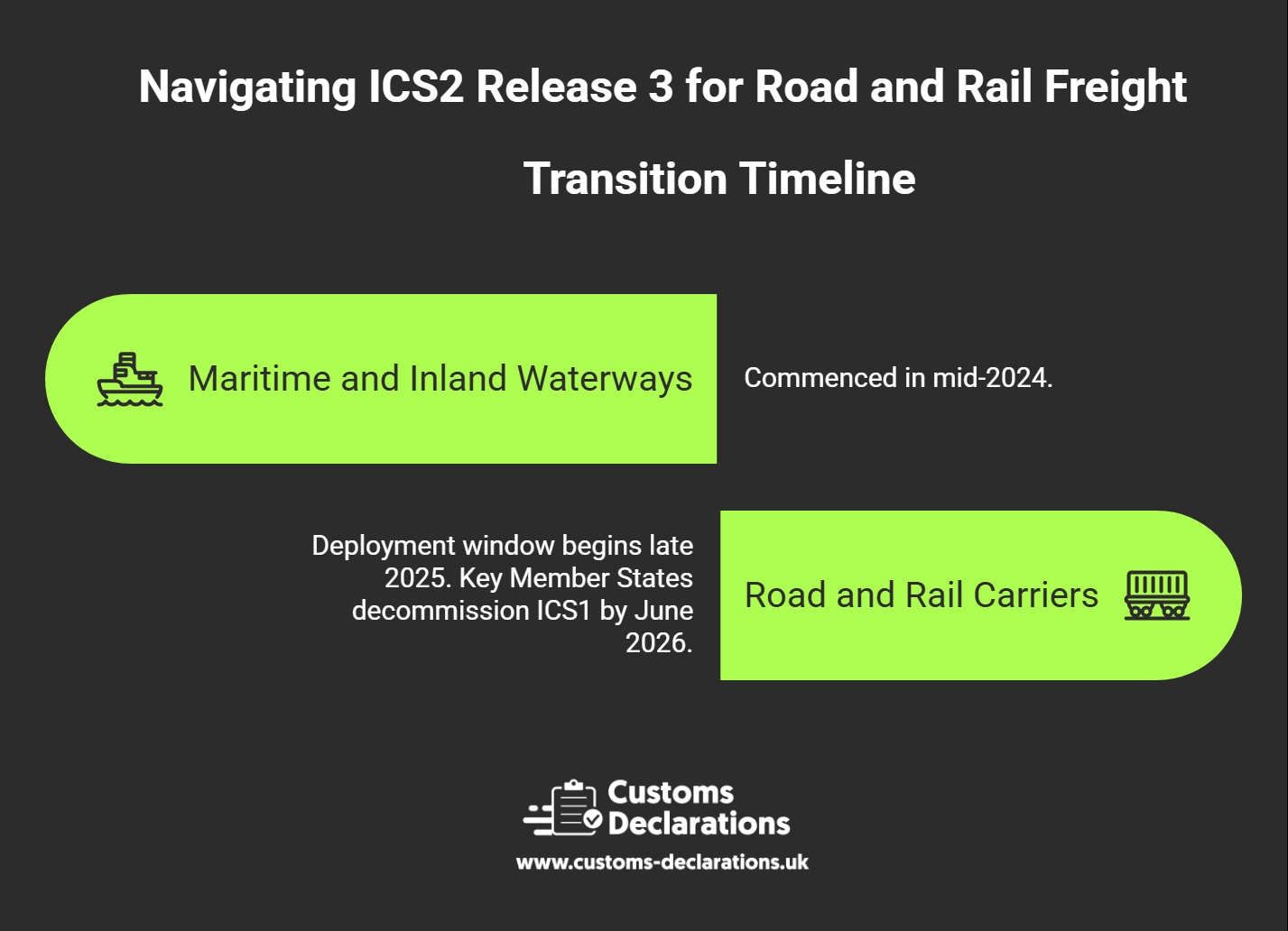
- Maritime and Inland Waterways: Commenced in mid-2024.
- Road and Rail Carriers: The deployment window for land-based transport begins in late 2025, with several key Member States (including Poland, Romania, and Slovakia) decommissioning ICS1 for road transport by June 2026.
For those involved in customs UK operations, this timeline is particularly relevant. As the UK acts as a primary gateway for goods moving to and from the EU, the synchronization of UK and EU systems is paramount to avoid friction at the Channel crossings.
Challenges for Freight Forwarders and Agents
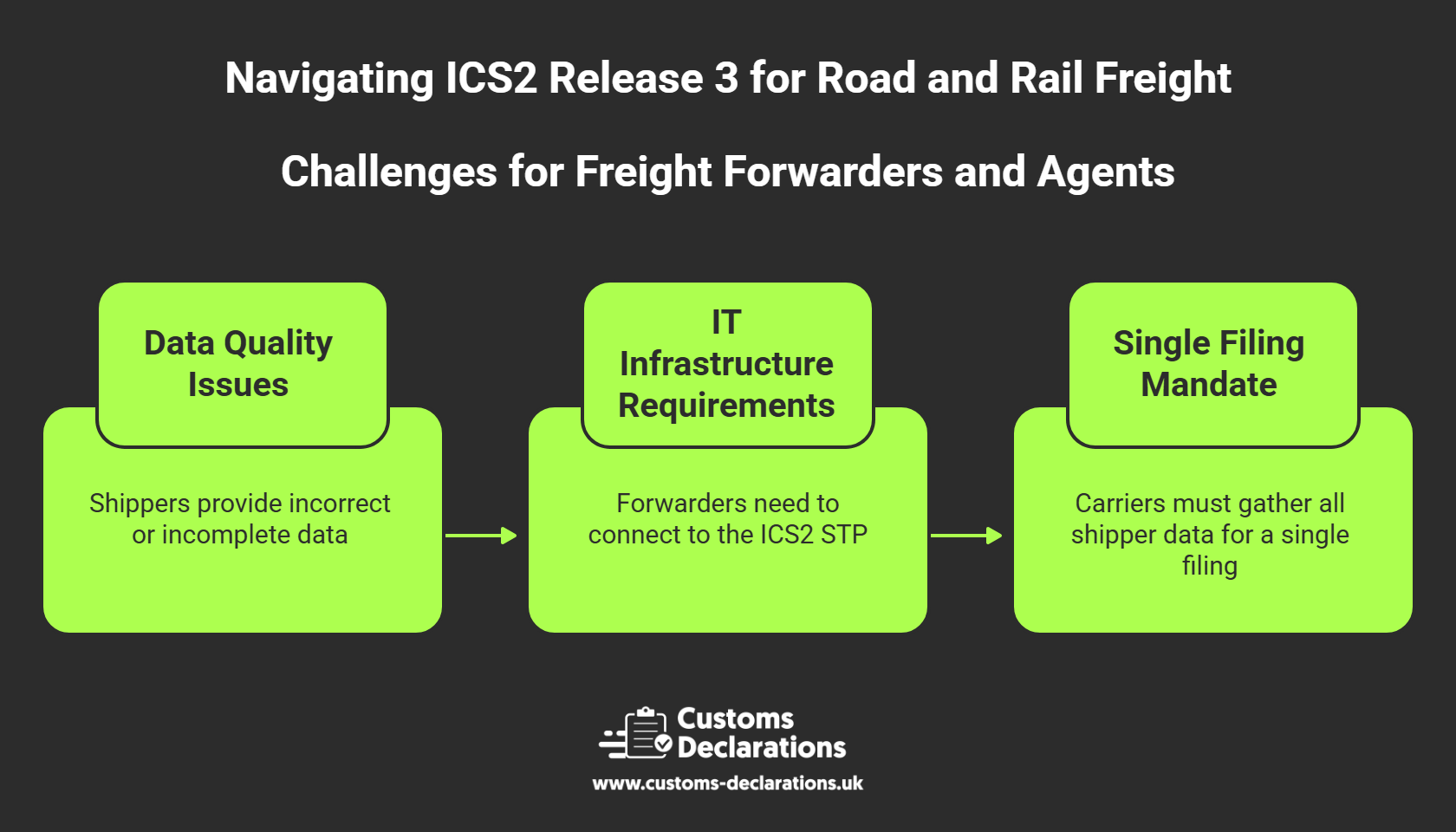
The transition brings three primary challenges:
- Data Quality: Freight forwarders often rely on data provided by shippers. If the shipper provides an incorrect HS code or an incomplete description, the forwarder (as the declarant) bears the brunt of the compliance failure.
- IT Infrastructure: Connecting to the ICS2 Shared Trader Portal (STP) requires significant technical investment or a partnership with a robust software provider.
- Single vs. Multiple Filing: While the system eventually intends to allow multiple parties to contribute to a single ENS (Multiple Filing), the current mandate for road transport still largely leans toward a single, comprehensive filing. This requires the carrier to have all information from all shippers on a multi-drop trailer—a massive coordination task.
The Strategic Importance of Accurate Filings of the Customs Declarations
As the UK refines its own border strategies, the interplay between UK exports and EU ICS2 requirements becomes a focal point. Every export from the UK into the EU now triggers an ICS2 requirement. Professionals responsible for customs declarations must ensure that the data leaving the UK systems mirrors the data entering the EU ICS2 environment.
Discrepancies between the UK Export Declaration and the EU ENS can trigger red flags in the automated risk-analysis systems, leading to physical inspections and audits.
Customs Declaration UK: Your Partner in Multi-Modal Compliance
In this climate of rapid regulatory change, the value of a specialized partner cannot be overstated. At Customs Declaration UK, we have built our platform specifically to bridge the gap between traditional logistics and the new digital mandates of ICS2 Release 3.
We understand that for road and rail freight, speed is just as important as accuracy. Our services are designed to be:
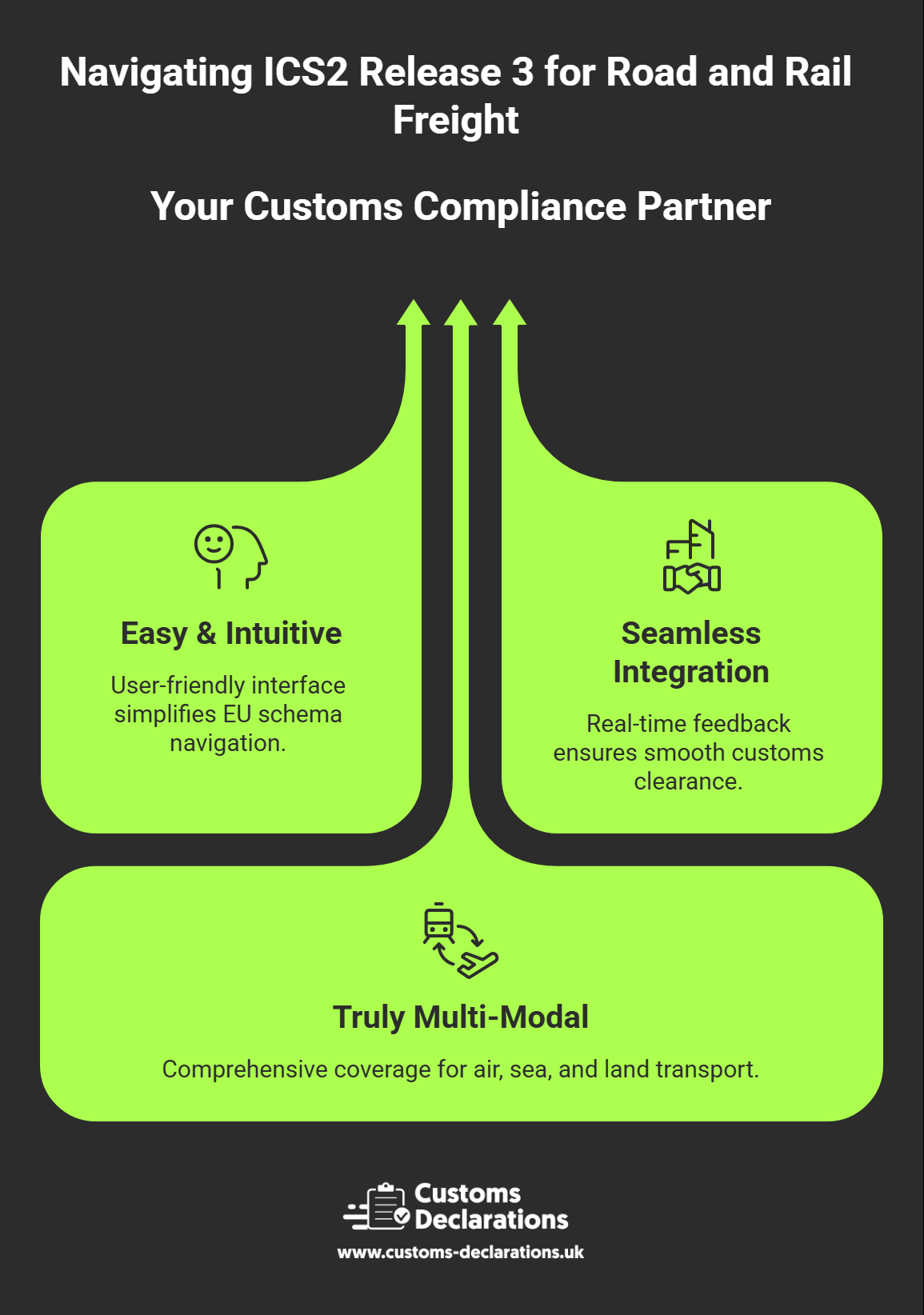
- Easy & Intuitive: We strip away the complexity of EU schemas, providing a user-friendly interface that guides you through the mandatory fields for road and rail ENS filings.
- Seamless Integration: Our platform connects directly with the relevant customs authorities, providing real-time feedback on your declaration status. You’ll know the moment your ENS is accepted, allowing your drivers to proceed with confidence.
- Truly Multi-Modal: While Release 3 focuses on land, our expertise covers air and sea as well. This “single pane of glass” approach means you can manage your all kinds of ICS2 declarations from one place, regardless of how the goods are moving.
Whether you are a small haulage firm or a large-scale freight forwarder, our tools ensure that you meet the one-hour road filing deadline every time, protecting your margins and your reputation.
Conclusion
The extension of ICS2 Release 3 to road and rail freight is the final step in creating a “smart” European border. While the requirements for 6-digit HS codes and pre-arrival filings are rigorous, they also offer an opportunity for logistics providers to professionalize their data management and offer more reliable services to their clients.
By preparing now—auditing your data quality, understanding the June 2026 decommission dates, and partnering with a technology leader like Customs Declaration UK—you can turn a regulatory hurdle into a competitive advantage. The future of customs UK and EU trade is digital, and the time to adapt is now.