The central finding from Q1 2026 supply chain analysis is not subtle. Artificial intelligence is moving out of the planning room and into the operational core of trade and logistics, changing how supply chains respond in real time rather than in retrospect. Transportation costs are firming across major corridors, energy markets remain volatile, and labour availability stays structurally tight. Together, these conditions are making intelligent, real-time decisioning not a competitive advantage but an operational necessity. Leading organisations are focusing less on expanding their reporting capabilities and more on reducing execution latency — and critically, on automating exception handling so that systems trigger corrective actions rather than simply generating alerts that require human follow-up.
For customs and trade compliance professionals, this shift carries specific and urgent implications. The customs declaration process has long sat at the slow end of the trade workflow — a function characterised by high data volumes, complex regulatory rules, and manual intervention points that create friction at precisely the moment goods need to move. As AI transitions from generating insights to driving outcomes, customs teams face both the opportunity and the pressure to modernise how declarations are prepared, validated, and submitted. This article examines what the Q1 2026 trends mean for trade compliance in practice, outlines the key use-cases where execution-focused AI delivers measurable value, and explains how the Customs Declarations UK platform positions businesses to operate at this new standard.
From Insight to Intervention: Why the Shift Matters
The reporting-to-execution transition is best understood through a simple analogy. A risk dashboard that flags a valuation anomaly is useful. A system that automatically holds that declaration, enriches it with comparable trade data, and routes it to a reviewer with a pre-drafted query is transformative. The difference is not intelligence — both systems may draw on the same underlying model — but agency. Execution-focused AI does not wait for a human to act on an alert. It acts, within defined parameters, and brings the human in only where genuine judgement is required.
In supply chain terms, this matters because the costs of delay compound quickly. A shipment held at a major UK port for four hours during peak flow does not simply cost four hours. It costs repositioning fees, potential demurrage, customer penalties, and — in temperature-sensitive or time-critical categories — spoilage or contract exposure. Q1 2026 data consistently shows that organisations with the lowest execution latency are those that have embedded AI into workflow triggers, not just reporting layers.
For customs compliance, the corollary is direct. Declaration errors that could be caught and corrected pre-submission, ENS data mismatches that could be flagged before a vessel departs, and classification inconsistencies that could be resolved before a shipment reaches the frontier — all of these represent execution gaps where AI intervention dramatically reduces cost and risk.
The Q1 2026 Macro Context and What It Means for Trade Filings
Three macro conditions are defining the operating environment for customs and logistics professionals in 2026. Transportation costs have firmed across ocean and road corridors, driven by capacity constraints, fuel cost pass-throughs, and sustained demand in key trade lanes. Energy market volatility continues to create unpredictability in landed cost modelling, affecting valuations and duty calculations in ways that require more frequent recalibration. And labour markets remain tight across the logistics sector, meaning that the assumption of unlimited human bandwidth to manage compliance tasks is no longer credible.
Each of these factors has a direct customs dimension. Firming freight costs increase the transaction values against which duty and import VAT are assessed, requiring more rigorous and dynamic valuation methodology. Energy volatility affects the landed cost models that underpin commercial invoices, creating greater pressure on the accuracy of declared customs values. And labour constraints mean that customs teams — already stretched by the volume of post-Brexit declaration requirements, ICS2 obligations, and the expanding scope of safety and security filings — cannot simply add headcount to manage growing complexity. Execution-focused AI addresses all three by doing more of the mechanical work precisely, continuously, and without fatigue.
The Six Use-Cases Where Execution AI Delivers in Customs
Understanding where AI delivers operational value in customs requires moving beyond the abstract and into specific workflow moments. The following six use-cases represent the highest-impact areas identified from Q1 2026 trade and compliance analysis.
Real-Time Exception Handling in Declaration Preparation
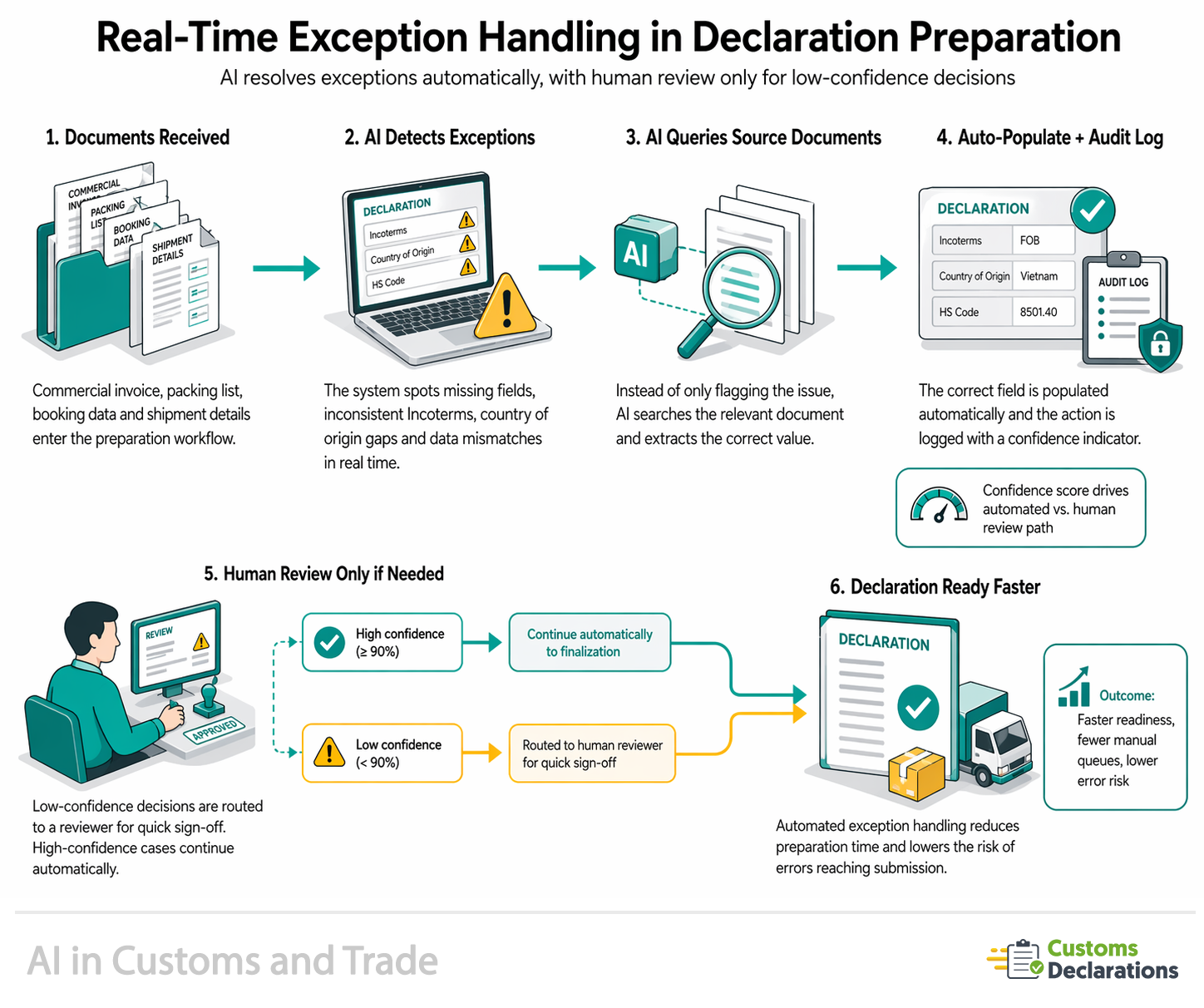
The most significant shift in 2026 is from AI that detects problems to AI that resolves them. In declaration preparation, this means systems that do not merely flag a missing country of origin field or an inconsistent Incoterm — but that query the relevant document, extract the correct value, populate the field, and log the action with a confidence indicator for reviewer sign-off. Exception handling moves from a manual queue to an automated pipeline with a human review layer only at low-confidence decisions. The result is a dramatic reduction in the time between shipment booking and declaration readiness, and a corresponding reduction in the risk of errors reaching submission.
Intelligent HS Classification Assistance at Point of Entry
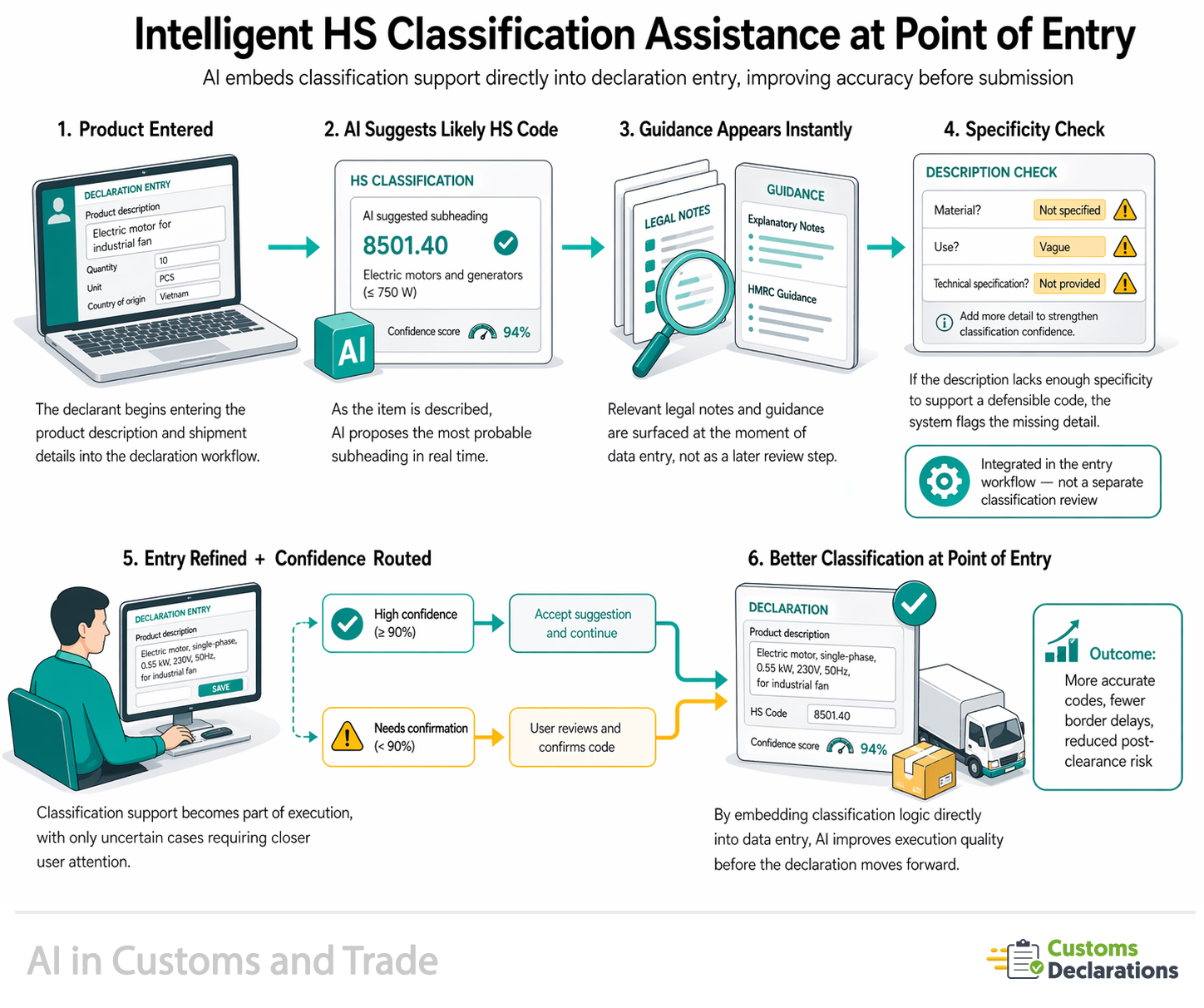
Commodity code misclassification remains one of the most frequent triggers for post-clearance assessments, penalties, and border delays. Execution-focused AI addresses this not by generating a classification suggestion for a human to evaluate at leisure, but by embedding classification logic directly into the declaration entry workflow. As a declarant describes a product, the system proposes the most probable subheading, surfaces relevant legal notes and HMRC guidance, and flags where the description lacks the specificity needed to support a defensible code. Critically, it does this at the moment of data entry — not as a separate review step — turning classification assistance into an integrated part of execution rather than an afterthought.
Automated Safety and Security Pre-Screening
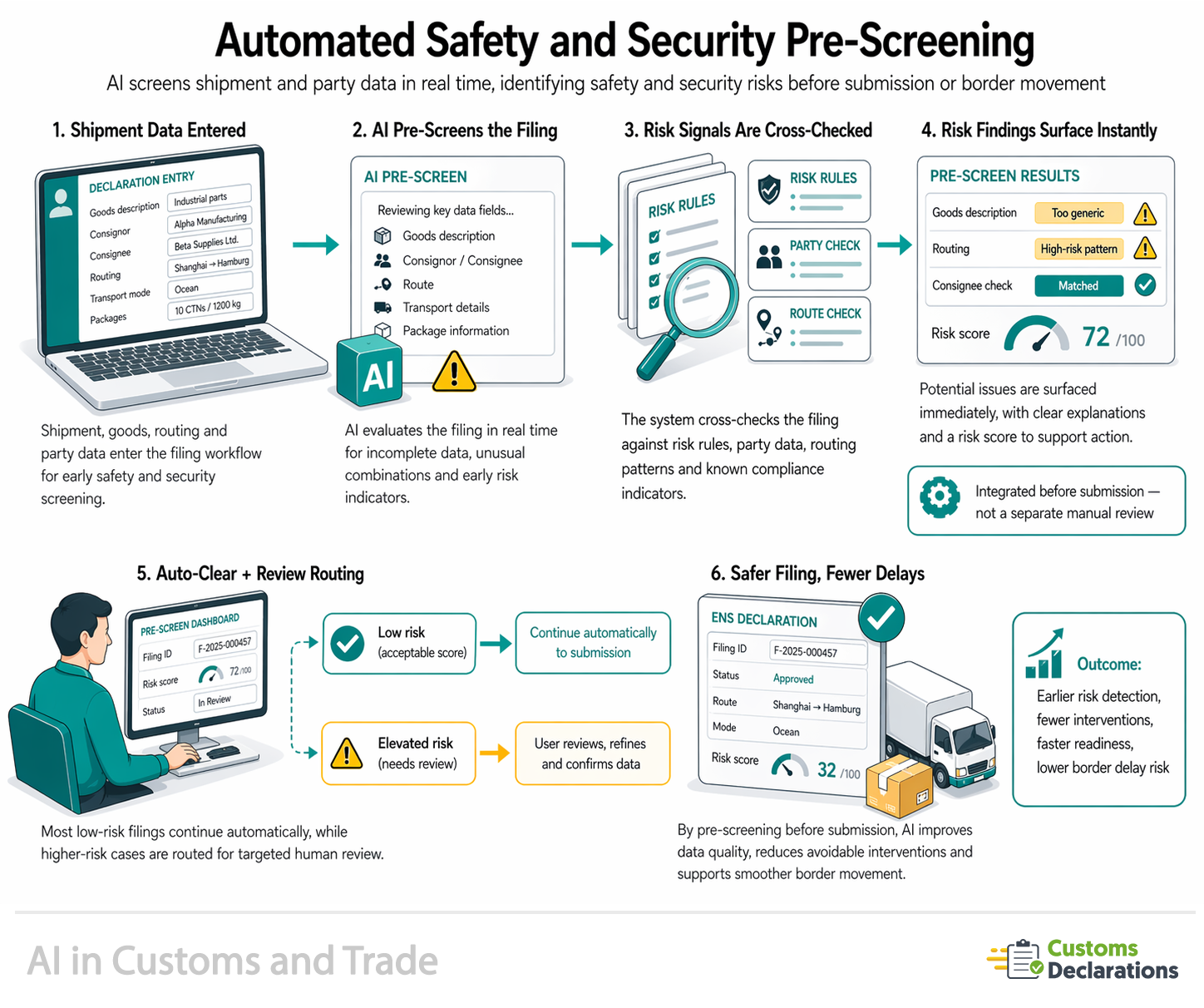
Entry Summary Declarations carry safety and security obligations that are time-sensitive by design. Under ICS2 and the UK’s equivalent safety and security regime, advance cargo information must be submitted before loading or arrival, meaning errors cannot be corrected at the frontier without creating delays or enforcement exposure. Execution AI addresses this by running pre-screening logic against ENS data as it is assembled — checking carrier details, routing patterns, commodity descriptions, and consignee identifiers against risk indicators and regulatory requirements before the filing is submitted. Systems that identify a routing inconsistency or a restricted goods flag at this stage trigger resolution workflows automatically, rather than passing a defective filing to the border.
Valuation Anomaly Detection and Dynamic Correction
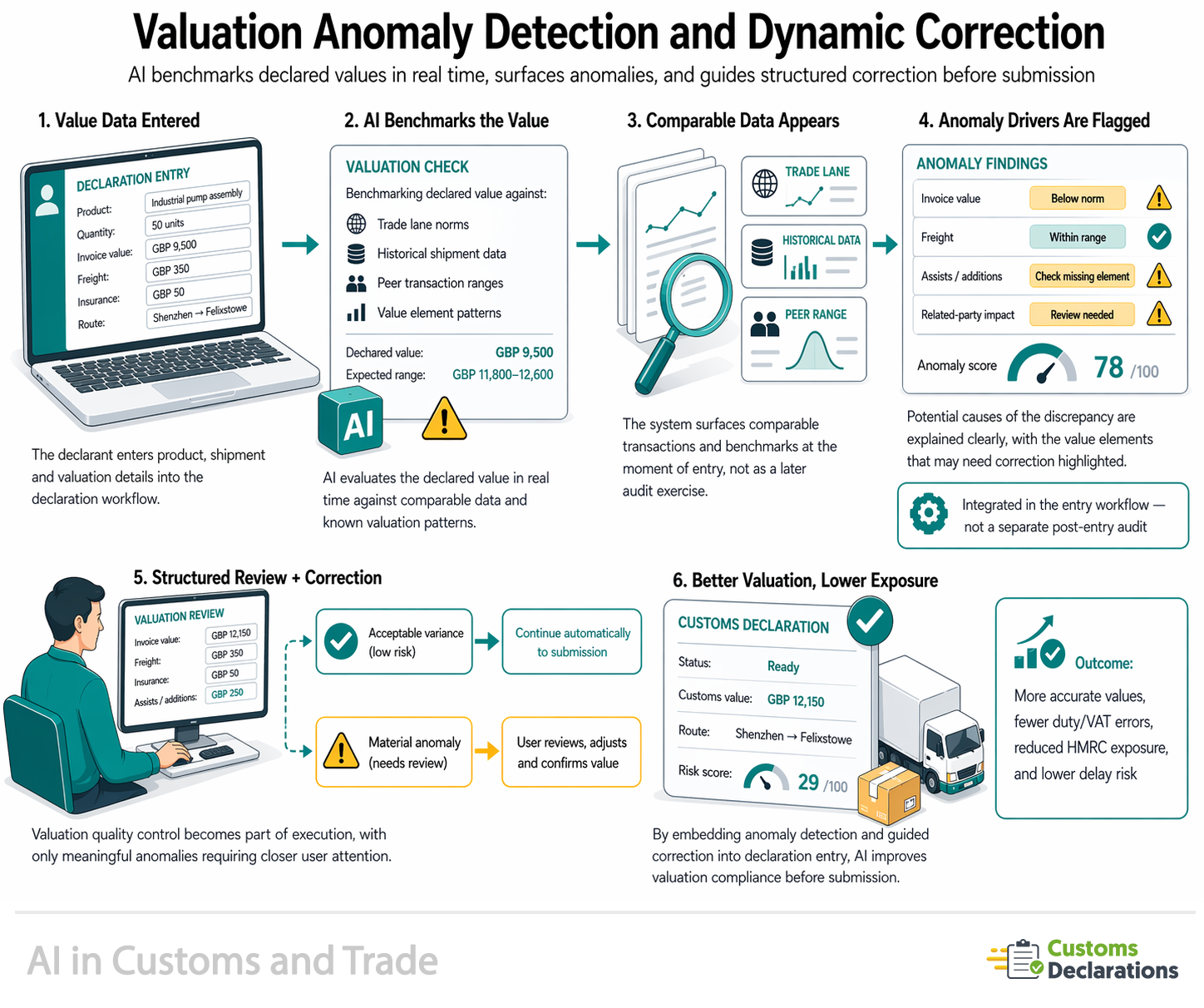
Customs valuation is one of the most technically demanding aspects of declaration preparation, and one of the most consequential. Under-declared values create revenue risk and HMRC exposure; over-declared values result in unnecessary duty and VAT liability. Execution AI brings statistical valuation benchmarking directly into the declaration workflow, comparing declared values against trade lane norms, historical shipment data, and peer transaction ranges. Where an anomaly is detected, the system does not simply generate an alert — it presents the declarant with the comparable data, flags which elements of the declared value may be contributing to the discrepancy, and prompts a structured review. This transforms valuation compliance from a periodic audit function into a continuous, embedded quality control.
Intelligent Document Extraction and Auto-Population
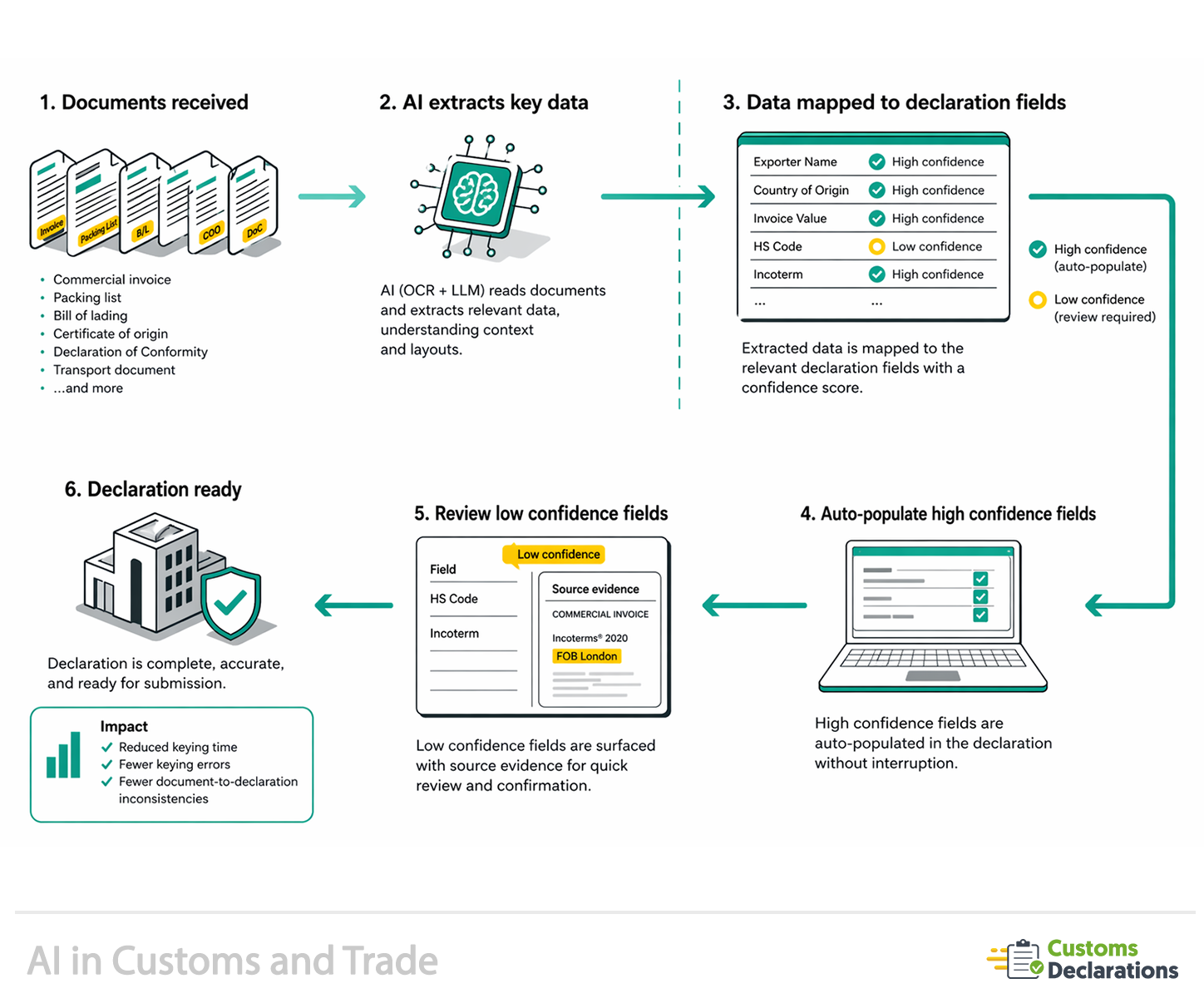
The volume of supporting documentation attached to a typical customs entry — commercial invoice, packing list, bill of lading, certificate of origin, Declaration of Conformity, transport document — creates significant manual data entry burden. Intelligent Document Processing (IDP), powered by OCR and large language model extraction, addresses this by reading source documents and mapping their contents directly to declaration fields. In execution-focused implementations, this does not produce a suggested pre-fill for a human to approve line by line. Instead, high-confidence fields are auto-populated without interruption, low-confidence fields are surfaced for review with the source evidence displayed alongside, and the declarant’s time is reserved for the decisions that genuinely require judgement. The reduction in keying time, keying errors, and document-to-declaration inconsistencies is immediate and measurable.
Predictive Clearance Routing and Port Readiness
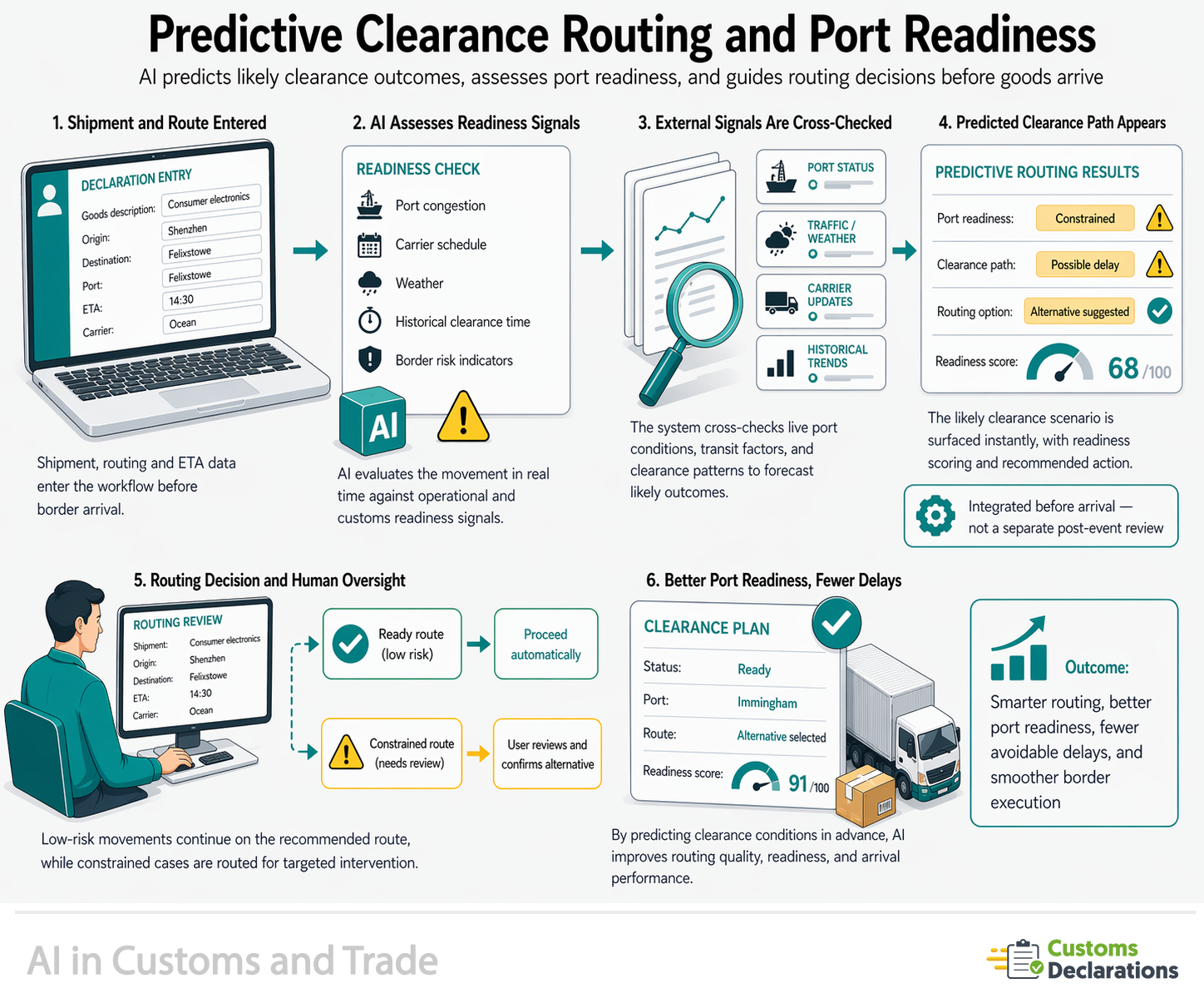
The final use-case concerns the moment of submission and what happens immediately after. Execution AI can assess the characteristics of a declaration — commodity type, origin, declared value, trader profile, route — and predict the most likely clearance pathway, including the probability of documentary requests, physical examination, or intervention. This prediction is not passive; it drives action. Where examination risk is elevated, the system prompts the declarant to pre-attach supporting documents, ensures ENS data is fully aligned with the customs declaration, and flags the shipment to the relevant team for proactive monitoring. Border delays that previously surprised businesses become manageable, predicted events with response workflows already triggered.
The Governance Imperative: Execution AI Requires Controlled Autonomy
As AI moves into execution, the governance question becomes more urgent. Systems that trigger actions — rather than generating alerts — must operate within well-defined boundaries, with clear human accountability at every consequential decision point. In customs, this means that automated actions such as field population, document extraction, and exception routing must be logged with full provenance, reviewed periodically for accuracy, and subject to override at any stage. The risk of unauditable automation in a regulatory environment as strict as customs is not abstract; HMRC and equivalent authorities require that declarants can demonstrate the basis for every declared value, classification, and procedural choice. Execution AI that operates without traceable reasoning is not just a compliance risk — it is a liability.
Leading organisations are addressing this by designing AI workflows with explicit human-in-the-loop requirements at defined confidence thresholds, maintaining full audit trails of automated actions alongside declarant approvals, and treating model accuracy as an ongoing operational metric rather than a one-time deployment criterion. The organisations that will extract the most value from execution AI in 2026 are those that invest as seriously in governance infrastructure as in the AI capabilities themselves.
How Customs Declarations UK Supports Execution-Ready Trade Compliance
The Customs Declarations UK platform is built around the principle that accurate, compliant declarations require both structured guidance and real-time validation — and that these must operate at the speed of trade, not as a separate review layer applied after the fact. As AI moves from planning into execution across the supply chain, CDUK provides the operational infrastructure through which businesses can translate that shift into compliant, audit-ready customs filings.
The platform’s real-time validation engine checks declaration data against HMRC rules, tariff requirements, and procedural logic as entries are assembled, not after submission. This positions validation as an execution tool rather than a gate-check, catching errors at the point of data entry and preventing defective filings from reaching HMRC’s Customs Declaration Service. For import and export declarations across all major procedure types, including special procedures such as customs warehousing and inward processing, the platform’s wizard-based workflows guide declarants through the precise data requirements without requiring deep technical expertise, reducing the execution burden on compliance teams operating under labour constraints.
CDUK’s ENS module brings the same execution-focused approach to safety and security declarations, enabling businesses to prepare and submit Entry Summary Declarations through the same interface as their customs entries, with data alignment checks that prevent the mismatches between ENS and import declaration datasets that are a common cause of avoidable border delays. The platform’s integration with the major Community System Providers used at UK ports — ensuring that submitted data reaches the right systems in real time — is a critical part of what makes CDUK an execution platform rather than simply a filing interface.
The platform’s reporting and insight dashboards give compliance managers visibility across declaration histories, error patterns, and submission outcomes — the analytical layer that informs continuous improvement of execution processes. Businesses that combine CDUK’s filing capabilities with structured analysis of their own declaration performance are best positioned to reduce errors iteratively, benchmark their compliance posture, and respond proactively to regulatory changes rather than reactively.
Conclusion: Execution Is the New Standard
The Q1 2026 supply chain analysis leaves little ambiguity about the direction of travel. AI is not a planning tool waiting to be activated — it is an operational capability that leading organisations are already embedding into the execution layer of their trade and logistics workflows. For customs and compliance teams, this means the relevant question is no longer whether to adopt AI-assisted processes, but how quickly and how well they can integrate intelligent execution into the workflows that determine whether goods clear the border accurately, on time, and without costly intervention.
The businesses that will define the compliance standard in the next twelve months are those that treat customs declarations not as a documentation exercise conducted after the commercial decision, but as an execution function operating in real time — validated continuously, supported by intelligent document extraction, aligned across ENS and import datasets, and governed with the traceability that regulatory scrutiny requires. As transportation costs firm, energy markets fluctuate, and labour remains constrained, the margin for execution error narrows. AI, properly deployed, is how customs compliance keeps pace.