Pre-loader

UK Budget 2025: What It Means for Customs, Trade, and UK Importers—A Practical Analysis

Chancellor Rachel Reeves presented the UK’s Autumn Budget 2025 on 26 November, setting out a fiscal plan shaped by global trade volatility, productivity challenges, and the ambition to restore economic growth through structural reform. For customs professionals, traders, and importers, the Budget delivers consequential changes: the removal of low-value import duty relief, fresh trade agreements with major partners, infrastructure investment to support border modernisation, and fiscal consolidation measures that reshape the cost landscape for cross-border commerce. This article examines the key announcements affecting customs operations, declaration processes, and trade compliance—and explains what they mean in practice for businesses navigating the UK’s post-Brexit trading environment.

The Fiscal and Economic Context: Growth, Productivity, and Trade Uncertainty

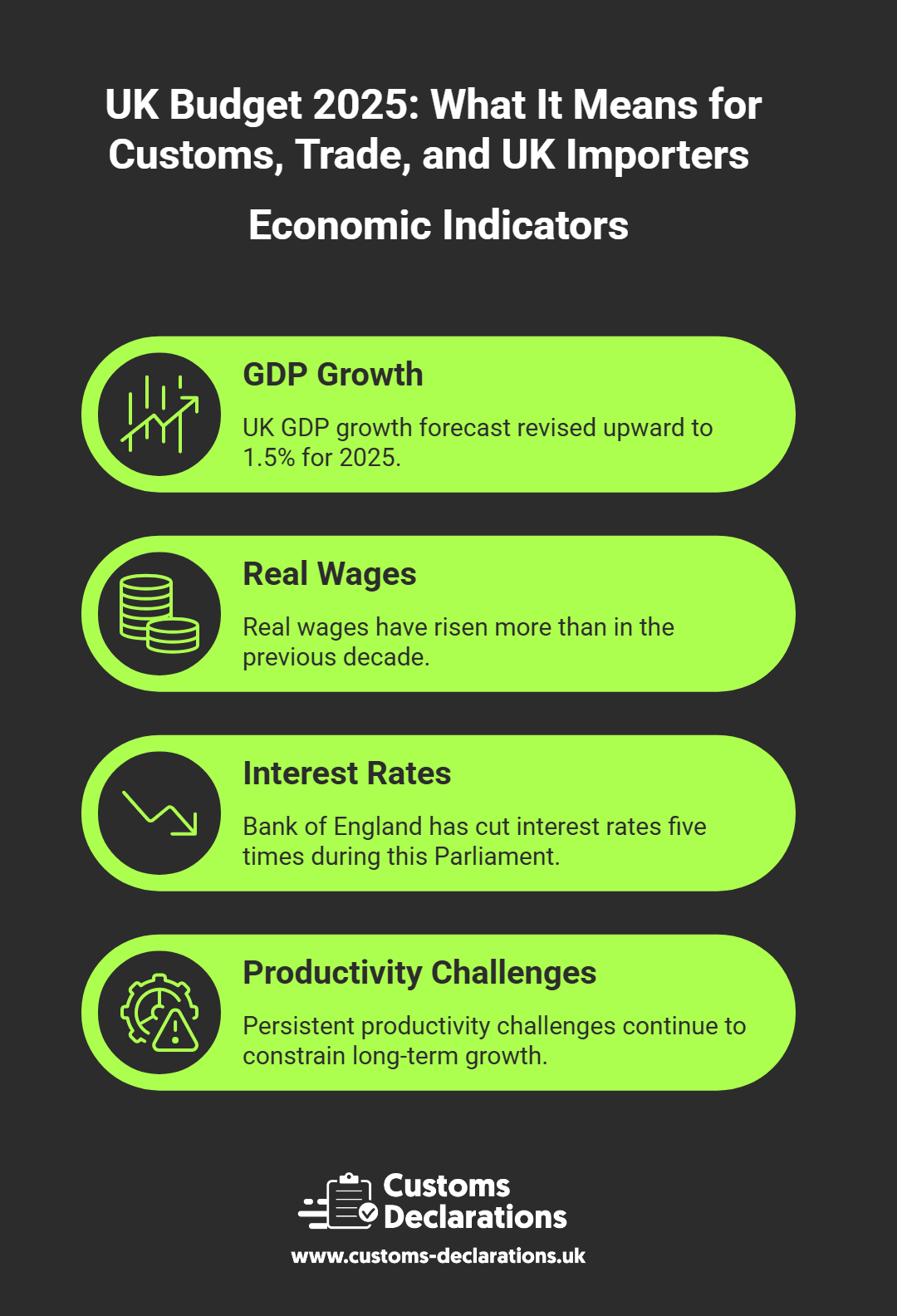
The Office for Budget Responsibility has revised UK GDP growth forecasts upward to 1.5% for 2025, positioning the UK to be the second-fastest growing economy among G7 nations. Real wages have risen more than in the previous decade, and the Bank of England has cut interest rates five times during this Parliament. Despite these positive indicators, persistent productivity challenges continue to constrain long-term growth. Annual productivity growth averaged only 0.6% between 2010 and 2019, significantly below pre-Global Financial Crisis levels. The OBR estimates that if productivity had maintained its pre-2008 trajectory, GDP per capita could have been approximately £15,000 higher by 2024.

Major Trade Agreements: India, US, and EU Reset

One of the most substantive achievements highlighted in the Budget is the conclusion of three significant trade agreements: with India, the United States, and progress toward an enhanced relationship with the European Union. These agreements represent a fundamental shift in the UK’s post-Brexit trade architecture and will materially affect customs procedures, origin requirements, and preferential tariff treatment for importers and exporters.

UK-India Free Trade Agreement

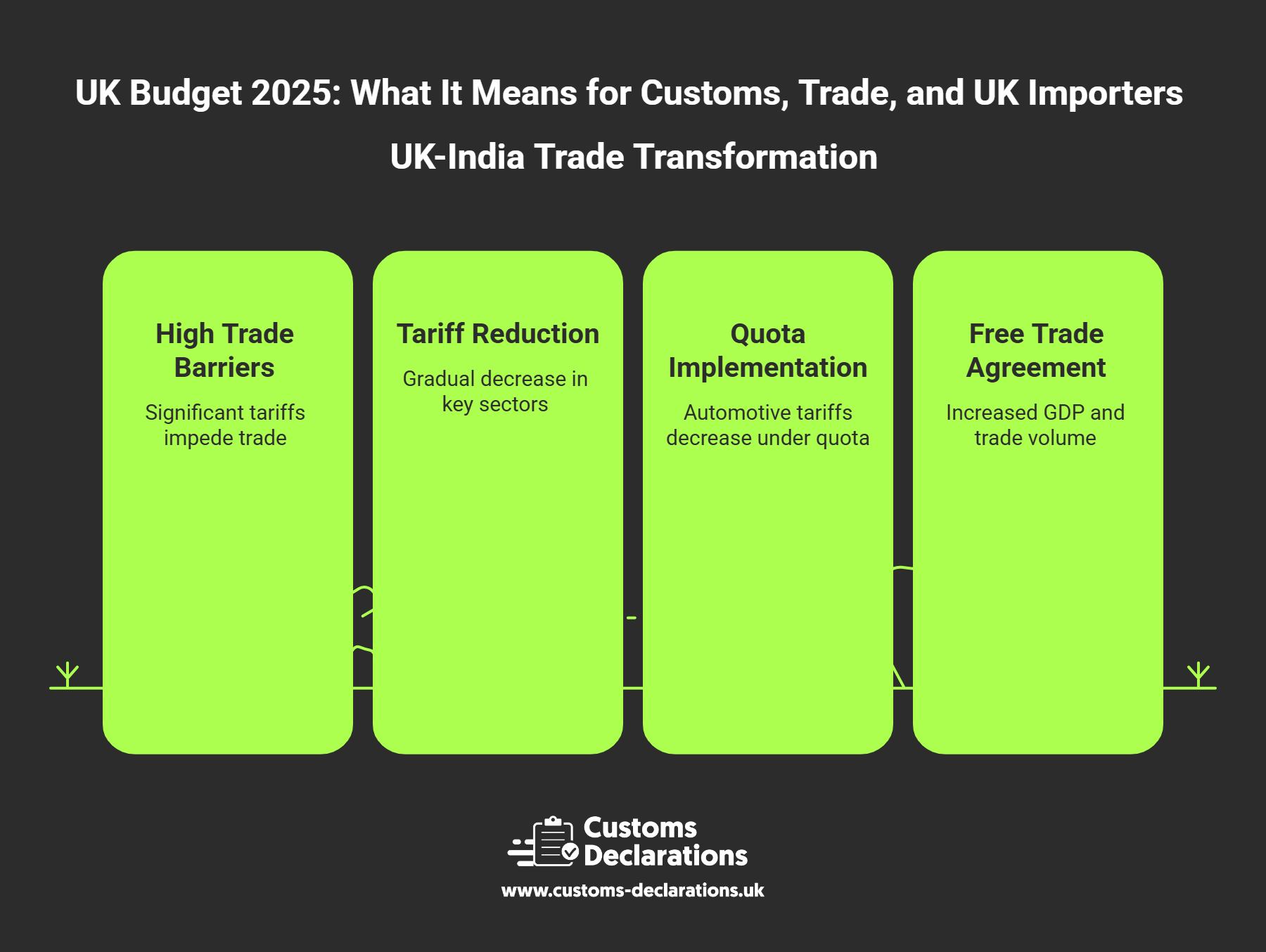
The UK-India FTA, signed in July 2025 after three years of negotiation, is described by the government as the biggest and most economically significant new bilateral trade agreement since Brexit. The agreement reduces tariffs on 90% of goods trade between the two countries, with particularly dramatic reductions in key sectors. Whisky tariffs will fall from 150% to 75% immediately upon implementation and further reduce to 40% over ten years. Automotive tariffs will decrease from over 100% to 10% under quota arrangements, eventually covering electric and hybrid vehicles. The government estimates the agreement will increase UK GDP by 0.13%, equivalent to £4.8 billion in the long run.

For customs professionals, this agreement introduces new preferential origin requirements, product-specific rules, and quota management obligations. The rules of origin stipulated in the UK-India agreement are notably more stringent than in comparable UK trade deals, particularly for non-passenger vehicles. Businesses seeking to benefit from preferential tariff treatment must prepare robust origin documentation, supplier declarations, and cumulation evidence. The agreement also includes provisions for faster customs processing and reductions in technical barriers to trade, although services coverage remains limited—a significant constraint given that services account for 60% of UK exports.

Importers should begin planning now for the agreement’s entry into force by mapping eligible products, assessing whether manufacturing processes meet the applicable rules of origin, securing supplier statements on origin, and establishing compliance documentation systems that can support HMRC audits. The UK-India agreement demonstrates that preference is earned through verifiable manufacturing evidence, not simply through the location of purchase or the supplier’s address.

UK-US Economic Prosperity Deal

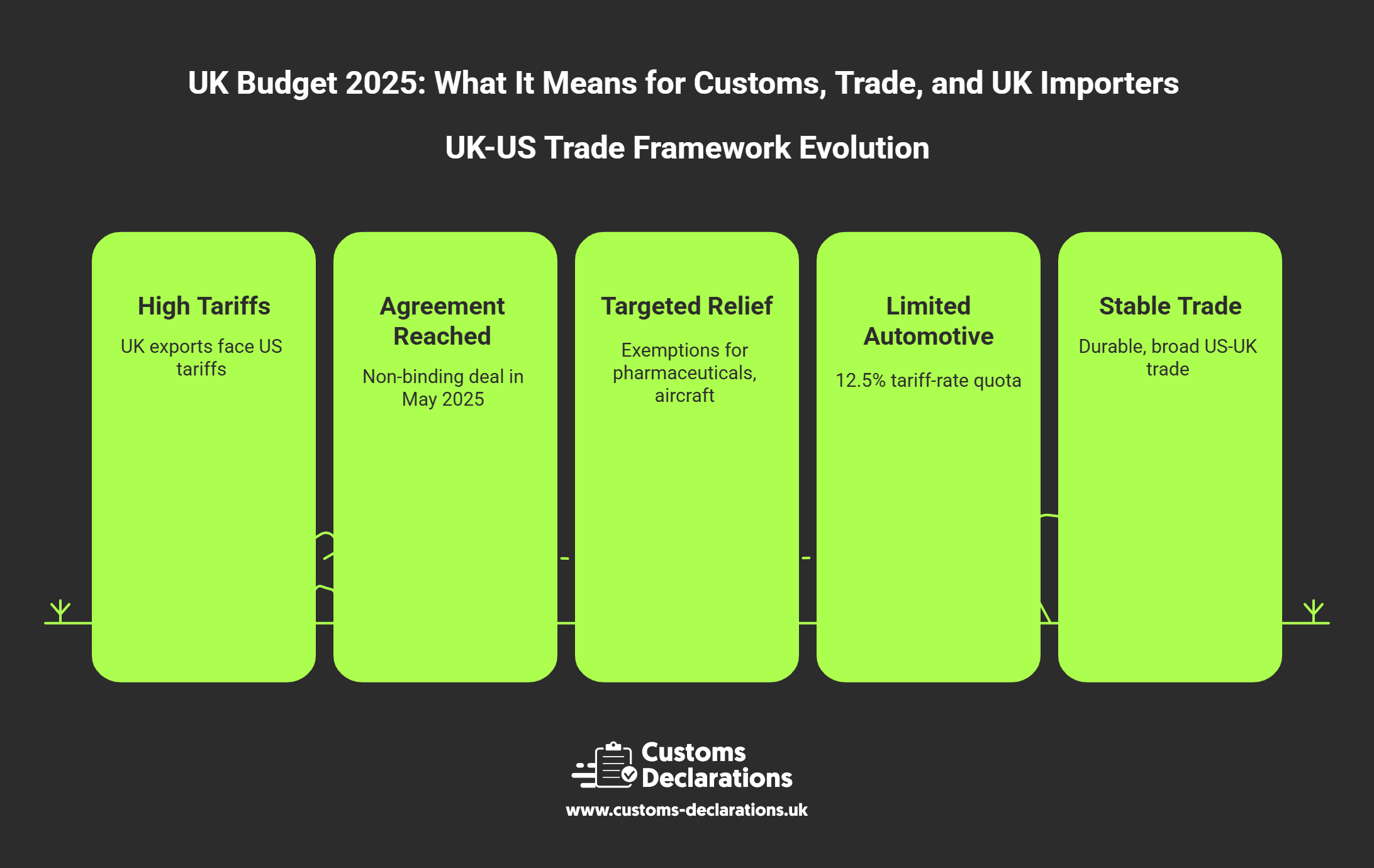
The UK and US reached agreement on general terms of a trade framework in May 2025, referred to as the Economic Prosperity Deal. This non-binding agreement seeks to lessen the impact of US tariffs on UK exports and has been partially implemented. While the arrangement does not constitute a comprehensive free trade agreement, it provides meaningful relief in targeted sectors. However, the agreement remains subject to ongoing negotiation and potential modification, particularly as US trade policy continues to evolve under the current administration.

Tariffs on UK goods entering the US are higher than at the start of 2025, and no deal is guaranteed permanent status in the current volatile trade environment. The UK has secured exemptions for general pharmaceuticals and aircraft, which provide measurable trade-weighted benefits. Automotive arrangements include a 12.5% tariff-rate quota, though this offers limited improvement compared to arrangements available to other partners. The agreement’s durability and scope will depend heavily on continued negotiation and political stability in the US-UK trade relationship.

Businesses exporting to the US should treat the Economic Prosperity Deal as a useful but provisional framework. Maintain flexibility in supply chain planning, monitor developments in US tariff policy closely, and avoid over-reliance on specific exemptions that may be revised or withdrawn. The agreement underscores the importance of having contingency strategies for sudden policy shifts in major export markets.

UK-EU Reset and Regulatory Alignment

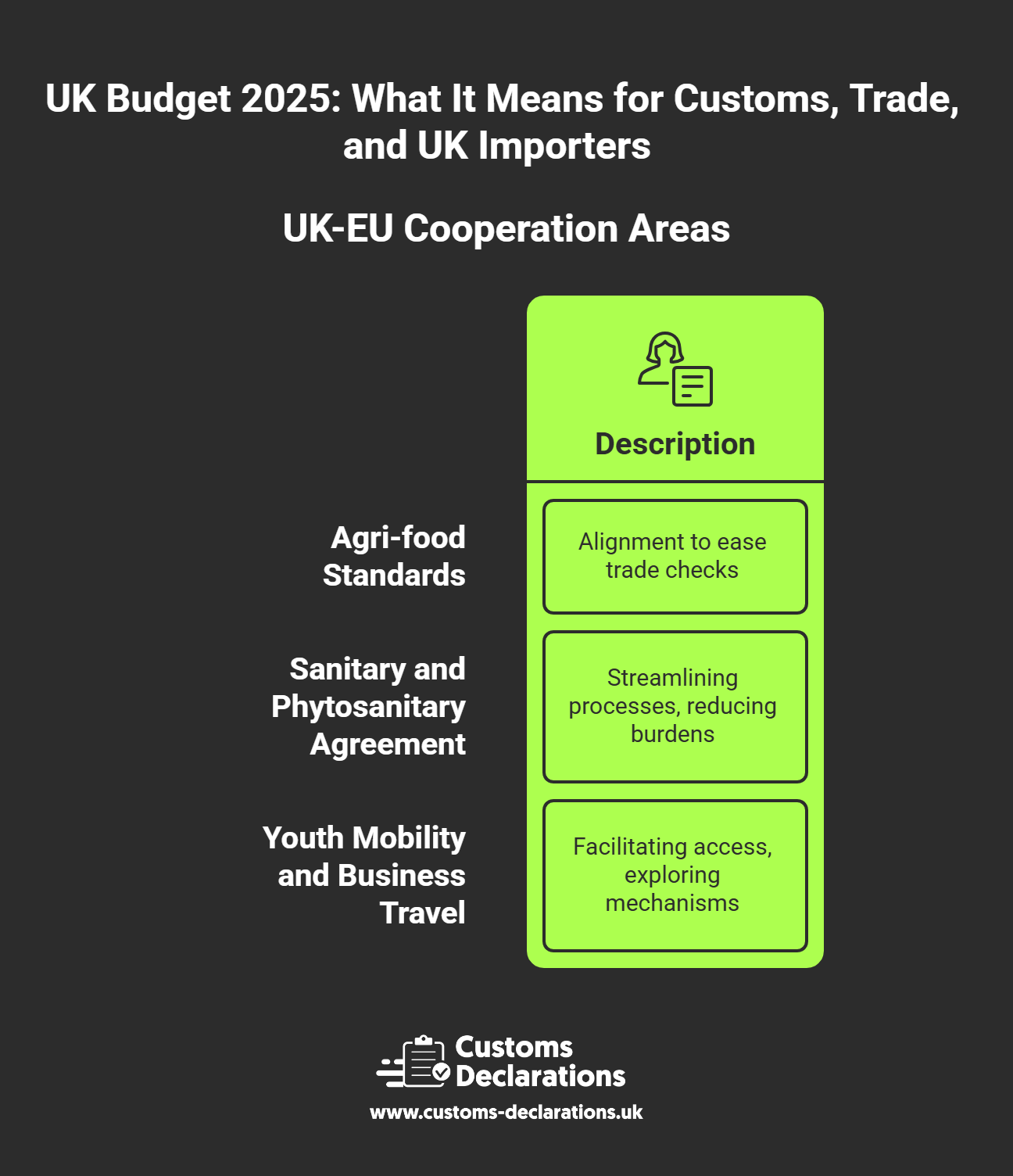
Progress toward a strengthened UK-EU relationship represents a critical element of the government’s trade strategy. In May 2025, the UK and EU held a summit meeting where they agreed to enhance cooperation in multiple areas, including alignment on agri-food standards. The government has committed to developing a sanitary and phytosanitary agreement to ease checks on trade in plant and animal products, addressing one of the most friction-intensive aspects of post-Brexit customs procedures.

UK exporters of food and agricultural products face rigorous EU border controls, health certification requirements, and veterinary checks that impose significant time and cost burdens. An SPS agreement could streamline these processes substantially, reducing documentary requirements and inspection frequencies for compliant traders. Additionally, the UK and EU are exploring mechanisms to facilitate youth mobility and business travel, including access to e-gates at European airports following implementation of the EU’s Entry/Exit System in October 2025.

While these developments fall short of restoring single market access or eliminating customs procedures entirely, they represent meaningful progress in reducing friction for goods movements. Traders should monitor consultations and implementation timelines for SPS arrangements and consider how regulatory alignment initiatives might affect product specifications, labelling requirements, and conformity assessment obligations in sectors where UK and EU standards are converging.

The End of Low-Value Import Duty Relief: A Watershed Moment for E-Commerce and Border Processing

The most consequential customs policy announcement in Budget 2025 is the removal of customs duty relief for low-value imports valued under £135. Currently, goods imported into the UK with a value of £135 or less are exempt from customs duty, though VAT has been applicable since 2021 reforms. The government has confirmed that this relief will be abolished by March 2029 at the latest, following a consultation process that closes on 6 March 2026.

Why This Change Matters

The volume of low-value imports has surged dramatically since the relief was introduced. HMRC sample data indicates that consignments processed through the Bulk Import Reduced Dataset System have more than tripled in the year to June 2024 compared with 2021 levels, averaging 1.6 million parcels per day. The total declared value of goods moving through this channel jumped from £3.8 billion in 2023-24 to £5.9 billion in 2024-25. This explosive growth has been driven primarily by cross-border e-commerce, particularly from Chinese marketplaces such as Shein and Temu, which have leveraged the duty-free threshold to offer dramatically lower prices than UK-based retailers.

The relief has created a fundamental competitive distortion. Non-UK sellers can deliver goods to UK consumers without incurring customs duty, while UK retailers selling identical products face full tariff costs on their imported inventory. This disparity has been widely criticised by domestic businesses, who argue that the arrangement undermines fair competition and enables the mass importation of low-quality goods that may not meet UK product safety standards. The removal of the relief is explicitly framed in the Budget as a measure to support Britain’s businesses and high streets by creating a level playing field.


Implementation Timeline and Consultation Process

The consultation launched alongside the Budget invites stakeholder input on several key design elements of the new arrangements: what data should be collected for low-value consignments, how tariffs should be applied, whether an additional administration fee should be levied to fund processing costs, and potential changes to VAT collection mechanisms to reflect the new duty obligations. The government has indicated that online marketplaces are likely to face increased obligations, particularly where non-established sellers are involved. Proposed rules would require a UK fiscal representative and introduce joint and several liability for customs debts.


Under the anticipated model, sellers would pay customs duty through quarterly submissions rather than at the point of import, mirroring current VAT processes for overseas sellers. Duty collection could be routed through online marketplaces or parcel operators, but the exact mechanism will be determined following consultation feedback. Importantly, gifts remain outside the scope of these reforms and will not attract UK customs duty.


Impact on Businesses and Border Operations

For importers, e-commerce platforms, and logistics providers, the removal of the £135 relief will require substantial operational changes. Small parcel customs declarations, currently processed through simplified bulk datasets, will need to capture full tariff classification, valuation, and origin data. Border processing volumes will increase significantly, requiring enhanced digital infrastructure to manage declaration flows without creating bottlenecks. Businesses that currently rely on duty-free thresholds for cost-competitive sourcing will face higher landed costs, which are likely to be passed through to consumers.

UK-based online retailers will benefit from the elimination of an unfair advantage enjoyed by foreign competitors, but the change also introduces compliance burdens for domestic sellers who import small quantities of goods for resale. SMEs, in particular, may struggle with the administrative overhead of preparing individual customs declarations for low-value stock replenishment shipments. Technology solutions that automate classification, valuation, and declaration preparation will become essential for businesses operating in this space.

The timeframe until March 2029 provides a window for businesses to adapt systems, train personnel, and establish relationships with customs intermediaries or software platforms that can manage the increased declaration workload. Early preparation is advisable—businesses should begin mapping their exposure to the relief removal now, modelling the impact on unit costs and pricing strategies, and evaluating whether process automation or outsourcing to brokers will be more cost-effective.


Infrastructure Investment and Border Modernisation

The Budget commits over £120 billion in additional capital investment across the Parliament, including £15.6 billion for major city-region transport infrastructure. While customs and border infrastructure is not itemised as a discrete line, the broader commitment to public investment and digital modernisation is expected to support continued enhancement of HMRC’s Customs Declaration Service and related border systems.

The removal of low-value import duty relief will place significant additional demand on CDS and related customs IT infrastructure. Effective implementation will require HMRC to scale processing capacity, improve data validation workflows, and integrate with parcel operator and marketplace systems to enable seamless transmission of declaration data. The government’s focus on digitisation and service delivery improvements across the public sector is likely to benefit customs operations, though the success of the low-value import reform will ultimately depend on robust system readiness and industry engagement during the transition period.

Business Rates Reform: Implications for Warehousing and Logistics

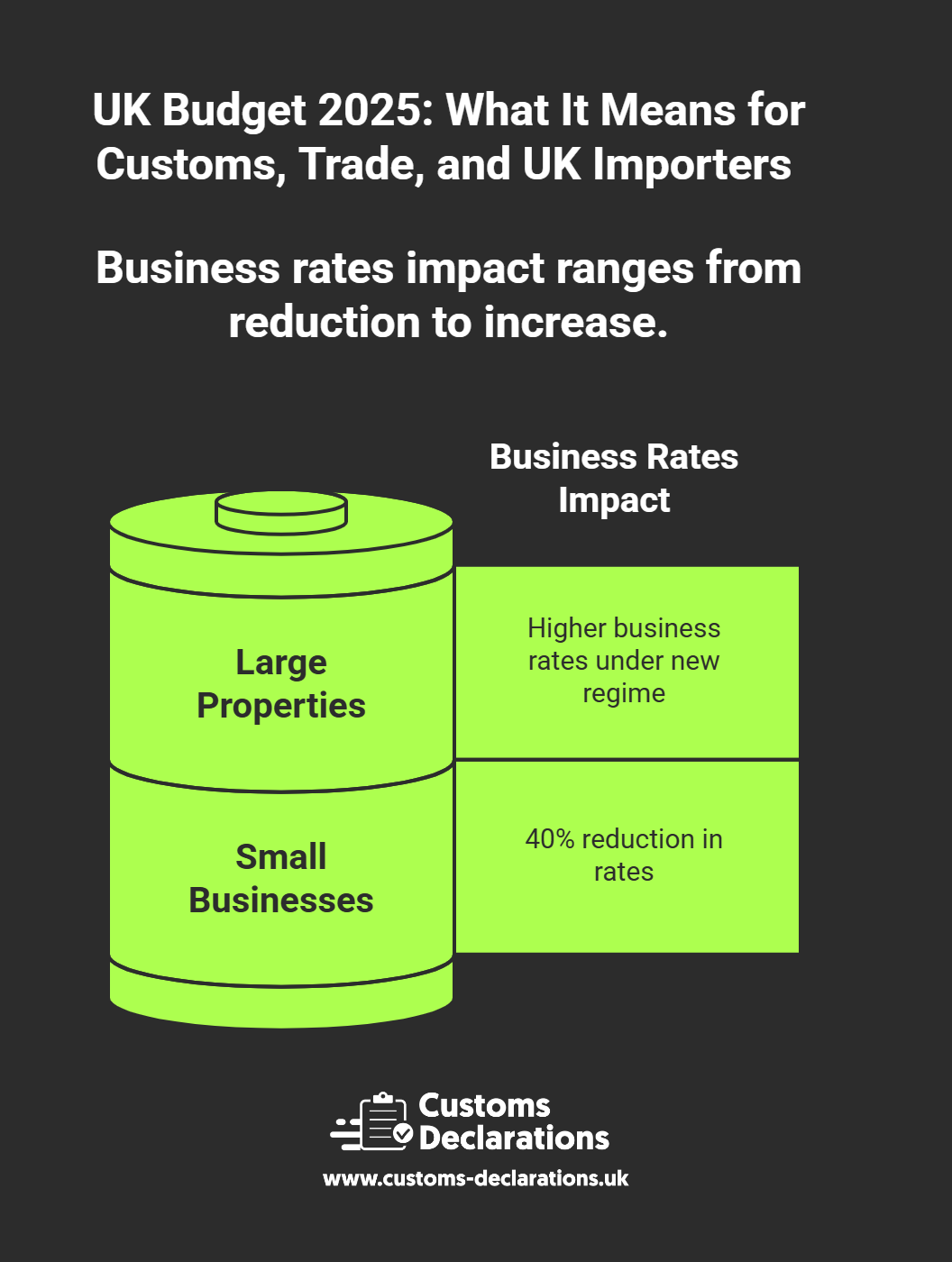
The Budget introduces significant business rates reforms, with reductions targeted at retail, hospitality, and leisure premises, funded by increases on properties valued over £500,000. Government modelling suggests that many small retail and hospitality businesses will see a 40% reduction in business rates for 2025-26, with further decreases from 2026 onward through new multiplier structures.

For logistics and warehousing operators, the reforms present a mixed picture. Large distribution centres and fulfilment warehouses typically have rateable values exceeding the £500,000 threshold, meaning they will face higher business rates under the new regime. This rebalancing is explicitly designed to shift the tax burden from high street retail premises to larger commercial properties, including those used by e-commerce operators and logistics providers.

Businesses operating large-scale warehousing or cross-docking facilities should review their property portfolios and assess the financial impact of the business rates changes. The increased cost burden may influence decisions about facility location, consolidation of operations, and whether to invest in automation or efficiency improvements that reduce the need for large physical footprints. Transitional relief provisions will soften the impact in the near term, but long-term planning should account for higher recurring property costs.

Northern Ireland: Targeted Support for Windsor Framework Compliance

The Budget allocates more than £16 million to help Northern Irish businesses manage the Windsor Framework, which governs post-Brexit trading arrangements between Northern Ireland and the rest of the UK and EU. This financial package includes establishing a business concierge service, a trade resolution centre, and AI-powered regulatory guidance to support businesses navigating the unique complexities of the Northern Ireland protocol.

The Windsor Framework, negotiated in 2023 to amend the original Northern Ireland Protocol, eases checks on some goods moving from Great Britain to Northern Ireland while ensuring that goods destined for Ireland comply with EU rules. Implementation has presented operational challenges for traders, particularly around customs documentation, regulatory alignment, and movement tracking requirements. The Budget’s targeted support recognises these ongoing frictions and aims to provide practical assistance to businesses affected by dual regulatory obligations.

Businesses trading with or through Northern Ireland should explore the new support services as they become available and ensure that their customs declaration systems can accommodate the specific data requirements and processes associated with movements under the Windsor Framework.

Conclusion: A Recalibrated Trade and Customs Landscape

UK Budget 2025 marks a decisive recalibration of the country’s trade and customs policy. The removal of low-value import duty relief represents the most significant structural change to UK customs operations in years, levelling the playing field for domestic retailers while imposing new compliance demands on importers, marketplaces, and logistics providers. New trade agreements with India, the US, and incremental progress toward EU regulatory alignment create opportunities for tariff reduction and smoother border processes, but only for businesses that invest in understanding preferential origin requirements and maintaining robust compliance documentation.

The broader fiscal context—higher taxes, increased employment costs, and continued public investment in infrastructure and productivity—shapes the environment in which customs professionals and traders operate. Success in this landscape requires a disciplined approach to compliance, strategic use of technology to manage declaration volumes efficiently, and close attention to evolving trade policy as agreements are implemented and refined.

For importers and exporters navigating these changes, the path forward is clear: prepare now for the low-value import reform by mapping exposure and upgrading declaration processes; take advantage of new preferential tariff opportunities by securing robust origin evidence and supplier statements; and embed compliance as a core operational discipline rather than an administrative afterthought. Platforms such as Customs Declarations UK provide the tools and workflows needed to manage these requirements with confidence, combining guided declaration preparation, real-time validation, and secure record retention in a single, user-friendly system.

The UK’s trade and customs environment is becoming more complex, but also more predictable. Businesses that treat compliance as a strategic capability and invest in the systems and knowledge to execute it well will find competitive advantage in a landscape where others struggle with friction and delay. With the right preparation, Budget 2025’s reforms can be navigated successfully—turning policy change into operational readiness and trade opportunity.

We value your feedback, and if you have any comments, suggestions or anything else that you would like to highlight to us, we will be delighted to hear from you and incorporate your feedback into our content.

Note: While we have made every attempt to ensure that the information contained in this Site has been obtained from reliable sources, Customs Declarations UK is not responsible for any errors or omissions, or for the results obtained from the use of this information. All information in this Site is provided “as is”, with no guarantee of completeness, accuracy, timeliness or of the results obtained from the use of this information, and without warranty of any kind, express or implied, including, but not limited to warranties of performance, merchantability and fitness for a particular purpose. Nothing herein shall to any extent substitute for the independent investigations and the sound technical and business judgment of the reader. In no event will Customs Declarations UK, or its partners, employees or agents, be liable to you or anyone else for any decision made or action taken in reliance on the information in this Site or for any consequential, special or similar damages, even if advised of the possibility of such damages. Certain links in this Site connect to other Web Sites maintained by third parties over whom Customs Declarations UK has no control. Customs Declarations UK makes no representations as to the accuracy or any other aspect of information contained in other Web Sites.