Pre-loader

Importing Medical Supplies from Germany to the United Kingdom: A Comprehensive Guide to Regulatory Compliance, Product Safety, and Customs Procedures

Introduction

The movement of medical supplies from Germany to the United Kingdom represents a critical component of healthcare supply chains, encompassing everything from diagnostic instruments and surgical equipment to personal protective equipment and laboratory consumables. While Germany remains one of Europe’s leading manufacturers of high-quality medical devices and the UK continues to be a significant market for these products, the post-Brexit regulatory landscape has introduced substantial changes to how these goods cross borders. Importers now face a dual challenge: navigating UK customs procedures through HMRC’s Customs Declaration Service while simultaneously ensuring full compliance with the UK’s evolving medical device regulatory framework. This guide provides a structured pathway through both disciplines, explaining how to prepare compliant customs declarations, satisfy product safety obligations, manage tariff and VAT treatment, and maintain the documentation standards required for audit-ready operations.

Understanding the Post-Brexit Import Framework

Following the UK’s departure from the European Union, goods arriving from Germany are now classified as imports requiring full customs declarations, even though preferential duty treatment applies under the UK-EU Trade and Cooperation Agreement. This fundamental shift means that every consignment must be declared to HMRC, with accurate data on classification, valuation, origin, and product compliance. The importer assumes legal responsibility as the party placing medical devices on the Great Britain market, which carries obligations extending well beyond customs clearance into ongoing product safety, vigilance reporting, and registration with the Medicines and Healthcare products Regulatory Agency.

The regulatory environment for medical devices has also evolved significantly. While the UK initially maintained close alignment with EU Medical Device Regulations, the establishment of the UKCA marking system and the introduction of UK-specific conformity assessment routes have created parallel pathways that importers must understand and navigate strategically. The government’s decision to continue recognizing CE marking for an extended period provides importers with flexibility, but this recognition is not indefinite for all device classes, and forward planning is essential to avoid market access disruptions.

Establishing Your Import Capability

Before importing medical supplies, ensure your business is properly registered and authorized to interact with UK customs and regulatory authorities. Obtain a GB EORI number through the GOV.UK portal, as this identifier is mandatory for all customs declarations and links your business to HMRC’s systems.

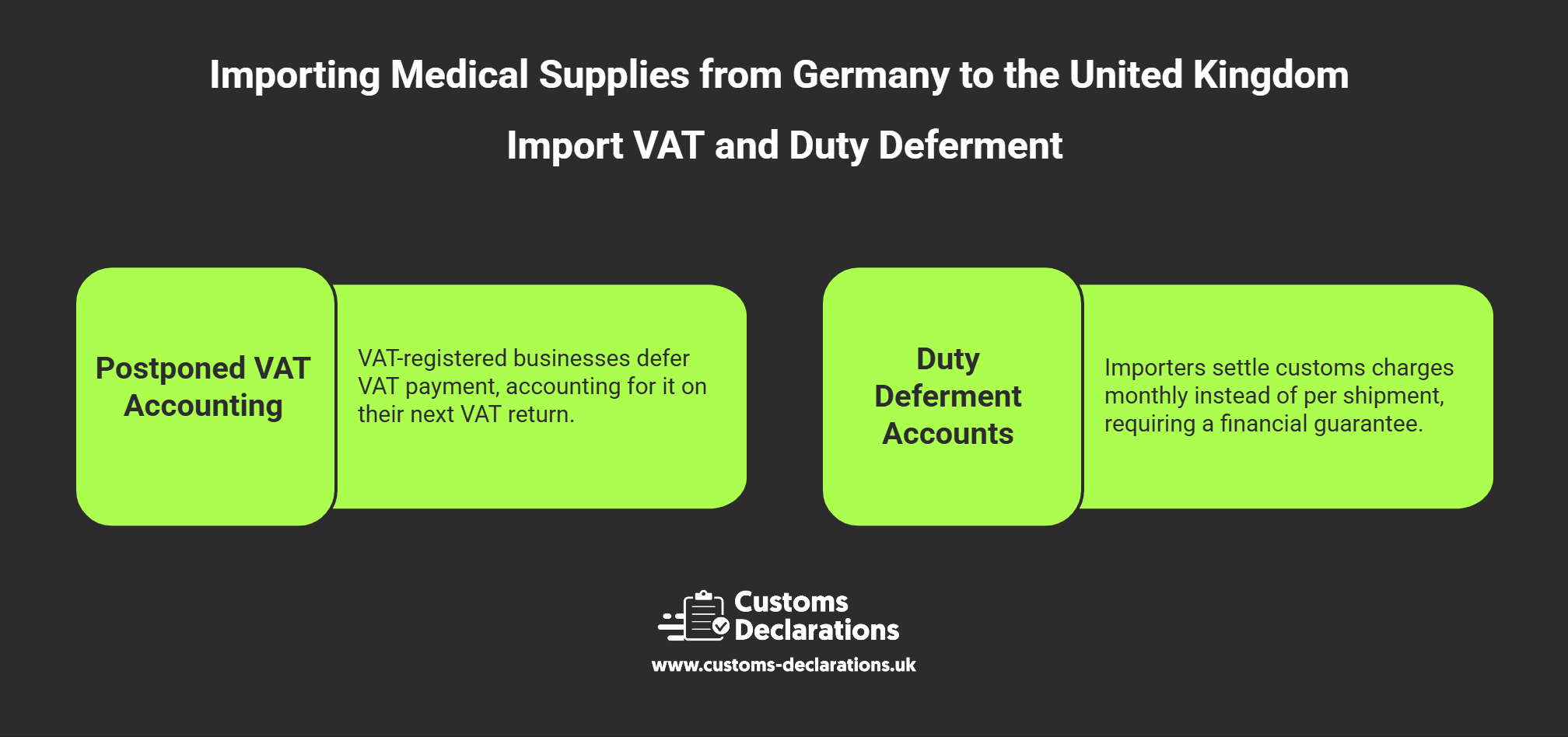
VAT registration is equally important, particularly for businesses that will be regularly importing medical supplies. VAT-registered importers can utilize Postponed VAT Accounting, a mechanism that allows import VAT to be accounted for on the VAT return rather than paid upfront at the border. This significantly improves cash flow and simplifies accounting processes, especially for high-value medical equipment where VAT charges can represent substantial sums. For businesses importing in large volumes or high values, establishing a Duty Deferment Account with HMRC enables monthly settlement of customs charges rather than payment per shipment, further enhancing working capital management.

Product Compliance and the UK Medical Device Framework

When importing medical devices into Great Britain, compliance with UK medical device regulations is non-negotiable and sits at the heart of your legal obligations as an importer. The UK regulatory framework is administered by the Medicines and Healthcare products Regulatory Agency, which oversees market surveillance, registration requirements, and enforcement activities. Medical devices are categorized into risk classes ranging from Class I (lowest risk, such as bandages and examination gloves) through Class IIa and IIb (medium risk, including powered surgical instruments and diagnostic imaging equipment) to Class III (highest risk, such as implantable devices and life-supporting equipment). The classification determines the conformity assessment route, the rigor of technical documentation required, and whether a UK Approved Body must be involved in the assessment process.

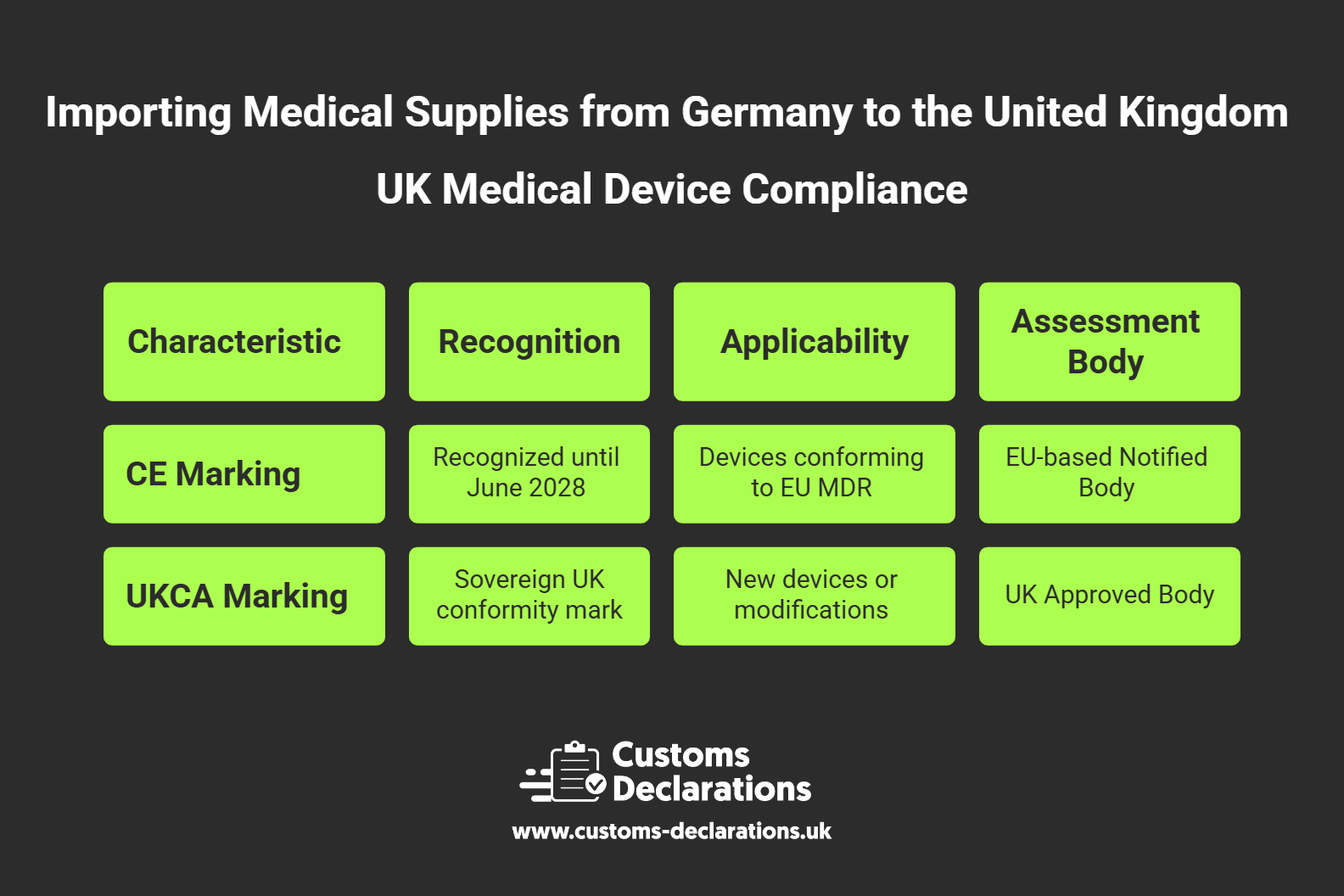
The UK currently operates a dual marking system. CE marking, which indicates conformity with EU Medical Device Regulations, remains recognized in Great Britain under a transitional arrangement that extends until June 2028 for most device classes. However, UKCA marking is the sovereign UK conformity mark and will eventually become mandatory. Importers should maintain awareness of which marking route applies to their specific devices and the timeline for any mandatory transition. For devices already carrying valid CE marking and supported by appropriate conformity assessment documentation, continued market access is generally assured within the transition period. For new devices or those undergoing significant modifications, importers may need to pursue UKCA marking directly, particularly if their conformity assessment was conducted by an EU-based Notified Body that is not recognized for UKCA purposes.

Device registration with MHRA is mandatory and must be completed before devices are placed on the market. The registration process captures essential information about the device, its classification, intended purpose, manufacturer details, and the UK Responsible Person. MHRA maintains an online portal for device registration, and importers should ensure registrations are kept current, particularly when device specifications, labeling, or instructions for use change. Failure to register is a criminal offense and can result in enforcement action, including prohibition notices and financial penalties.

Customs Classification and Tariff Treatment

Accurate classification under the UK Integrated Tariff is the foundation of compliant customs declarations. Medical supplies span multiple chapters of the tariff, with most falling under Chapter 90 for optical, photographic, medical, or surgical instruments and apparatus. However, the precise subheading depends on the device’s function, construction, and technical characteristics. Diagnostic equipment, surgical instruments, orthopedic appliances, syringes, needles, and catheter sets each have distinct classifications that determine applicable duty rates, regulatory measures, and statistical reporting requirements.

Under the UK-EU Trade and Cooperation Agreement, goods originating in the European Union attract zero-percent tariff duty when imported into the UK, provided the rules of origin are satisfied and appropriately evidenced. For medical devices manufactured in Germany using EU or UK-origin materials and components, claiming preferential treatment is generally straightforward. The importer must either hold a valid Statement on Origin from the supplier (for consignments valued over £1,000) or rely on Importer’s Knowledge for lower-value shipments, provided sufficient evidence of origin exists. Statements on Origin do not require certification by chambers of commerce and can be provided by the exporter on commercial invoices or standalone documents.

Customs Valuation for Medical Devices

HMRC applies the Transaction Value method for customs valuation, meaning the declared value is typically the price actually paid or payable for the goods when sold for export to the UK. This value must include all costs up to the UK frontier, including international freight, insurance, packing, and any charges that are conditions of the sale. Costs incurred after import, such as UK inland transportation, installation services, training, or warranty extensions, should be excluded from the customs value.

Medical devices often arrive with bundled elements such as software licenses, initial consumables, training packages, or extended warranties. Determining which elements form part of the customs value requires careful analysis. Software that is integral to the device’s operation and embedded in the hardware is generally dutiable. Optional software licenses sold separately and delivered electronically after import may be excluded, provided the commercial invoice clearly separates these charges. Similarly, training conducted post-import in the UK and separately invoiced is typically non-dutiable, whereas training delivered as a condition of sale and included in the transaction price must be included in the customs value.

Import VAT and Duty Deferment Arrangements

Import VAT is charged at the standard rate of twenty percent on a base comprising the customs value, any applicable duty, and other chargeable costs. For zero-duty imports from Germany under the Trade and Cooperation Agreement, this means VAT is calculated on the CIF value plus any non-dutiable but chargeable adjustments. VAT-registered businesses can use Postponed VAT Accounting to defer this payment, accounting for it on their next VAT return where it appears as both output tax and recoverable input tax, resulting in a net-neutral cash position for most importers.

Postponed VAT Accounting is activated by making a declaration on the customs entry and maintaining appropriate VAT records. Monthly statements from HMRC detail the postponed VAT amounts, which must be reported accurately on VAT returns. This mechanism is particularly valuable for medical device importers handling high-value diagnostic or imaging equipment where upfront VAT charges could otherwise tie up significant working capital for weeks.

Duty Deferment Accounts provide a further cash-flow advantage by allowing importers to settle customs charges monthly rather than per shipment. Although duty is zero-rated for qualifying EU-origin goods, other charges such as excise duty on certain products or anti-dumping duties if applicable may still arise. A Duty Deferment Account requires a financial guarantee, either through a cash deposit or a commercial guarantee from an approved institution. Once established, deferment applies automatically to eligible declarations, with monthly statements issued by HMRC showing all deferred charges and payment due dates.

Filing Customs Declarations Using Customs Declarations UK

The process of submitting accurate, compliant customs declarations is streamlined through the use of modern cloud-based platforms such as Customs Declarations UK, which provides importers with a structured, validated pathway into HMRC’s Customs Declaration Service. Rather than navigating complex government portals or relying entirely on third-party brokers, importers can manage their own import declarations through an intuitive, wizard-based interface that guides users through each data element required by HMRC.

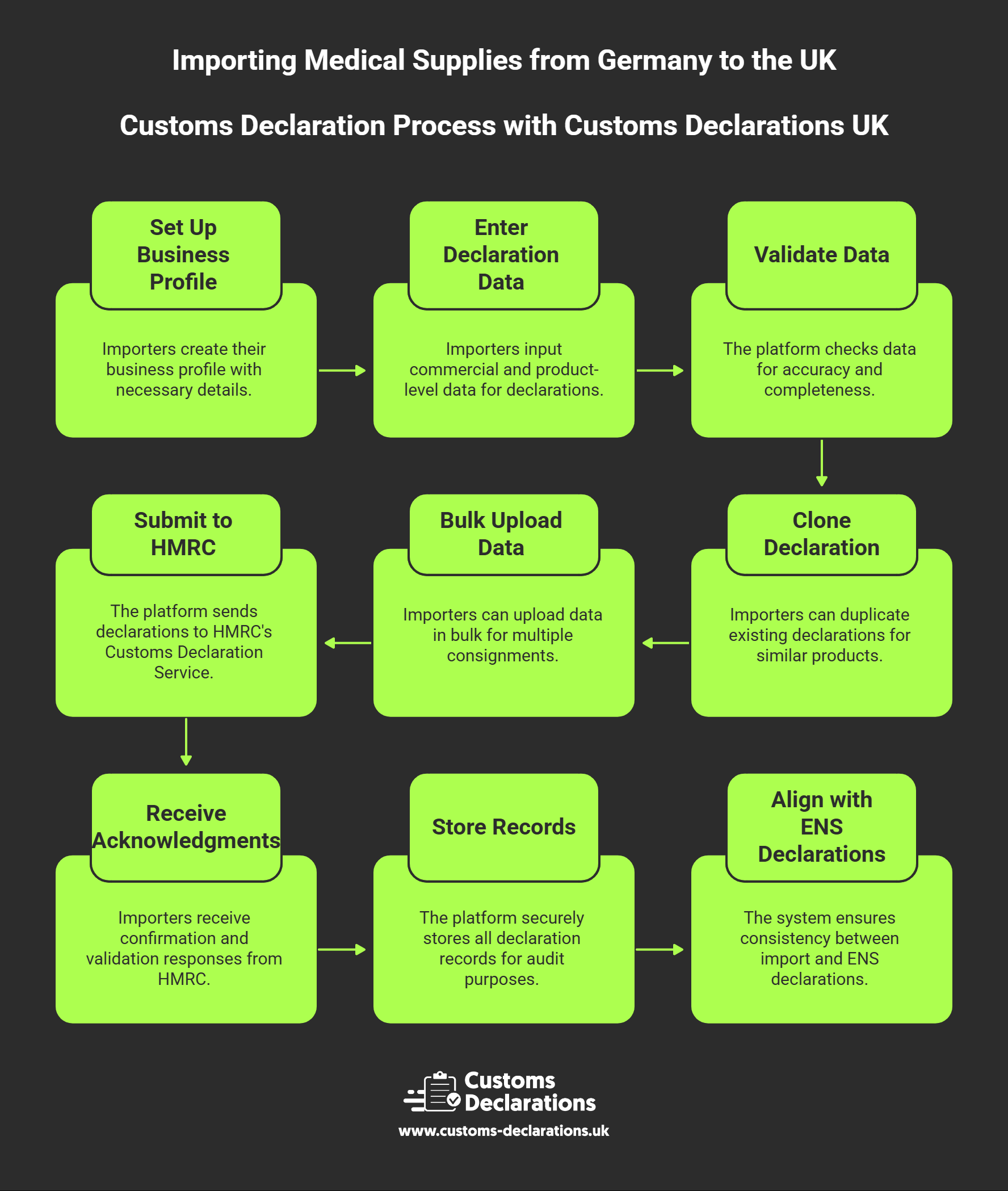
Using Customs Declarations UK, importers begin by setting up core business profiles, capturing EORI numbers, addresses, and contact details for reuse across multiple declarations. The platform then presents guided workflows for each declaration type, prompting users to enter commercial information such as supplier and consignee details, invoice values, and Incoterms. Product-level data is captured through dedicated sections where users specify commodity codes, commercial descriptions, quantities, packaging types, and net and gross masses. Real-time validation checks ensure that mandatory fields are completed, codes are formatted correctly, and declared values reconcile with supporting documentation before submission to CDS declarations systems.

For importers managing regular flows of similar medical devices, the platform’s cloning functionality significantly accelerates data entry. Once a declaration for a particular product line is created and accepted, future shipments can clone the original entry, with only variable elements such as quantities, values, and transport references requiring updates. This approach reduces manual keying, minimizes transcription errors, and ensures consistency in how products are described and classified over time. Bulk upload capabilities also support high-volume importers, allowing customs declaration data to be imported via CSV or Excel files for rapid processing of multiple consignments.

Upon submission, Customs Declarations UK communicates directly with HMRC’s Customs Declaration Service, receiving acknowledgments, validation responses, and ultimately the Movement Reference Number that confirms acceptance. These references are stored securely within the platform, creating an audit-ready archive of all submissions that satisfies HMRC’s six-year record retention requirement. The system also enables alignment between import declarations and ENS declarations, ensuring that safety and security data lodged by carriers matches the customs entry, thereby preventing common causes of border delays.

Supporting Documentation and Record Retention

Every import must be supported by a comprehensive document pack that substantiates the declared data and demonstrates compliance with both customs and product regulations. At minimum, this includes the commercial invoice clearly showing buyer and seller details, description of goods, unit prices, total value, currency, and Incoterms; a packing list detailing quantities, packaging types, and weights; and transport documents such as the Bill of Lading or Air Waybill evidencing the movement of goods.

For medical devices, additional documentation is essential. Declarations of Conformity issued by the manufacturer must be held and made available to MHRA or HMRC upon request. These documents declare that the device meets applicable regulatory requirements and list the standards and directives with which the device complies. Technical files or design dossiers, while not typically submitted with each import, must be maintained by the UK Responsible Person and accessible for regulatory inspections. Instructions for use in English, labels showing CE or UKCA marking as applicable, and evidence of device registration with MHRA complete the compliance file.

Common Challenges and How to Address Them

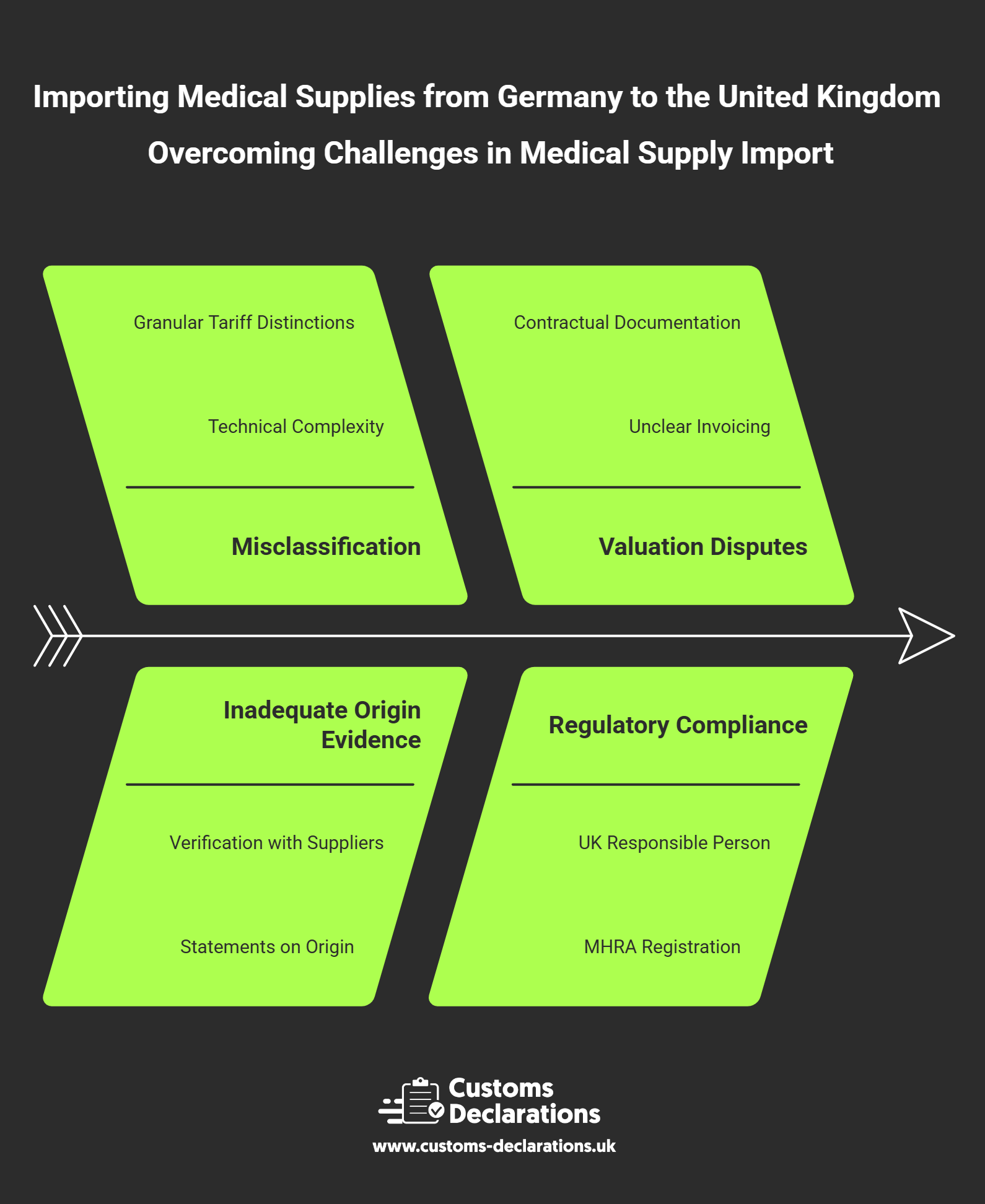
Importers of medical supplies frequently encounter several recurring challenges. Misclassification remains one of the most common errors, driven by the technical complexity of medical devices and the granular distinctions within tariff headings. Investing time in understanding the classification criteria, consulting HMRC guidance, and seeking Binding Tariff Information rulings for novel or ambiguous products reduces the risk of incorrect declarations and subsequent duty adjustments.

Inadequate origin evidence is another frequent pitfall. Assuming that goods shipped from Germany are automatically of EU origin overlooks cases where devices are manufactured elsewhere and merely distributed through German wholesalers. Always verify the manufacturing origin with suppliers and secure appropriate Statements on Origin before claiming preferential treatment. Retrospective correction of origin errors is cumbersome and may result in interest charges on underpaid duty.

Valuation disputes often arise from unclear invoicing, particularly when devices are bundled with training, installation, or software components. Proactively requesting itemized invoices and maintaining clear contractual documentation about what is included in the purchase price versus what is supplied separately after import prevents valuation disagreements and streamlines the declaration process.

On the regulatory side, failure to appoint a UK Responsible Person or register devices with MHRA before market placement is a critical compliance gap that can halt sales and trigger enforcement action. Importers should ensure these obligations are addressed well in advance of the first shipment, allowing time for registration processes and any queries from MHRA to be resolved.

Conclusion

Importing medical supplies from Germany to the United Kingdom requires diligent coordination across customs procedures, product regulatory compliance, and documentation management. By understanding the post-Brexit framework, accurately classifying and valuing goods, leveraging preferential duty treatment under the UK-EU Trade and Cooperation Agreement, and ensuring full compliance with MHRA medical device regulations, importers can achieve efficient border clearance while maintaining the highest standards of product safety and legal accountability.

Filing customs declarations through platforms such as Customs Declarations UK provides importers with the tools to manage submissions accurately, efficiently, and in full compliance with HMRC requirements, while maintaining the audit-ready records essential for regulatory confidence. With robust processes in place for supplier verification, documentation retention, and ongoing regulatory monitoring, importing medical devices from Germany becomes a repeatable, low-risk operation that supports the delivery of essential healthcare products to UK patients and practitioners.

We value your feedback, and if you have any comments, suggestions or anything else that you would like to highlight to us, we will be delighted to hear from you and incorporate your feedback into our content.

Note: While we have made every attempt to ensure that the information contained in this Site has been obtained from reliable sources, Customs Declarations UK is not responsible for any errors or omissions, or for the results obtained from the use of this information. All information in this Site is provided “as is”, with no guarantee of completeness, accuracy, timeliness or of the results obtained from the use of this information, and without warranty of any kind, express or implied, including, but not limited to warranties of performance, merchantability and fitness for a particular purpose. Nothing herein shall to any extent substitute for the independent investigations and the sound technical and business judgment of the reader. In no event will Customs Declarations UK, or its partners, employees or agents, be liable to you or anyone else for any decision made or action taken in reliance on the information in this Site or for any consequential, special or similar damages, even if advised of the possibility of such damages. Certain links in this Site connect to other Web Sites maintained by third parties over whom Customs Declarations UK has no control. Customs Declarations UK makes no representations as to the accuracy or any other aspect of information contained in other Web Sites.