Pre-loader

Importing Fresh Fruit and Vegetables from Spain to the United Kingdom: A Comprehensive Compliance Guide

Introduction

Importing fresh fruit and vegetables from Spain to the United Kingdom remains a commercially vital trade corridor despite the operational changes introduced by Brexit. Spain continues to be one of the UK’s leading suppliers of fresh produce, including tomatoes, peppers, cucumbers, citrus fruits, stone fruits, and salad vegetables. However, since the end of the Brexit transition period, goods arriving from the European Union are treated as imports requiring full compliance with UK customs procedures, plant health regulations, and VAT rules. While the UK-EU Trade and Cooperation Agreement ensures tariff-free access for goods meeting rules of origin requirements, importers must now navigate phytosanitary certification, customs declarations, border controls, and marketing standards that were previously not required for intra-EU movements.

This guide provides a structured pathway through the entire import process, from understanding preferential duty treatment and phytosanitary requirements to filing accurate declarations and managing post-import compliance obligations. By combining regulatory awareness with operational discipline, UK importers can maintain efficient supply chains while meeting HMRC and plant health authority expectations.

Understanding the UK-EU Trade and Cooperation Agreement

The Trade and Cooperation Agreement between the United Kingdom and the European Union, which provisionally entered into force on 1 January 2021, provides for zero tariffs and zero quotas on goods that comply with appropriate rules of origin. For fresh fruit and vegetables grown or produced in Spain, this means that provided the products originate in the EU under the agreement’s rules of origin provisions, no import duty is payable when they enter Great Britain. The agreement allows traders to self-certify compliance with origin requirements through a Statement on Origin, which the exporter provides and the importer uses to support the preferential claim at the time of import.

It is important to understand that while tariffs do not apply to qualifying EU goods, customs formalities are fully required. Every consignment from Spain must be declared to HMRC via the Customs Declaration Service, and all associated documentation, valuation, classification, and origin evidence must be maintained for audit purposes. The zero-tariff benefit applies only when goods truly originate in the EU, which for agricultural products generally means they were wholly obtained there. Where non-EU inputs are used or processing takes place outside the EU-UK area, careful consideration of product-specific rules may be necessary to confirm whether preferential treatment can be claimed.

Phytosanitary Requirements and Plant Health Controls

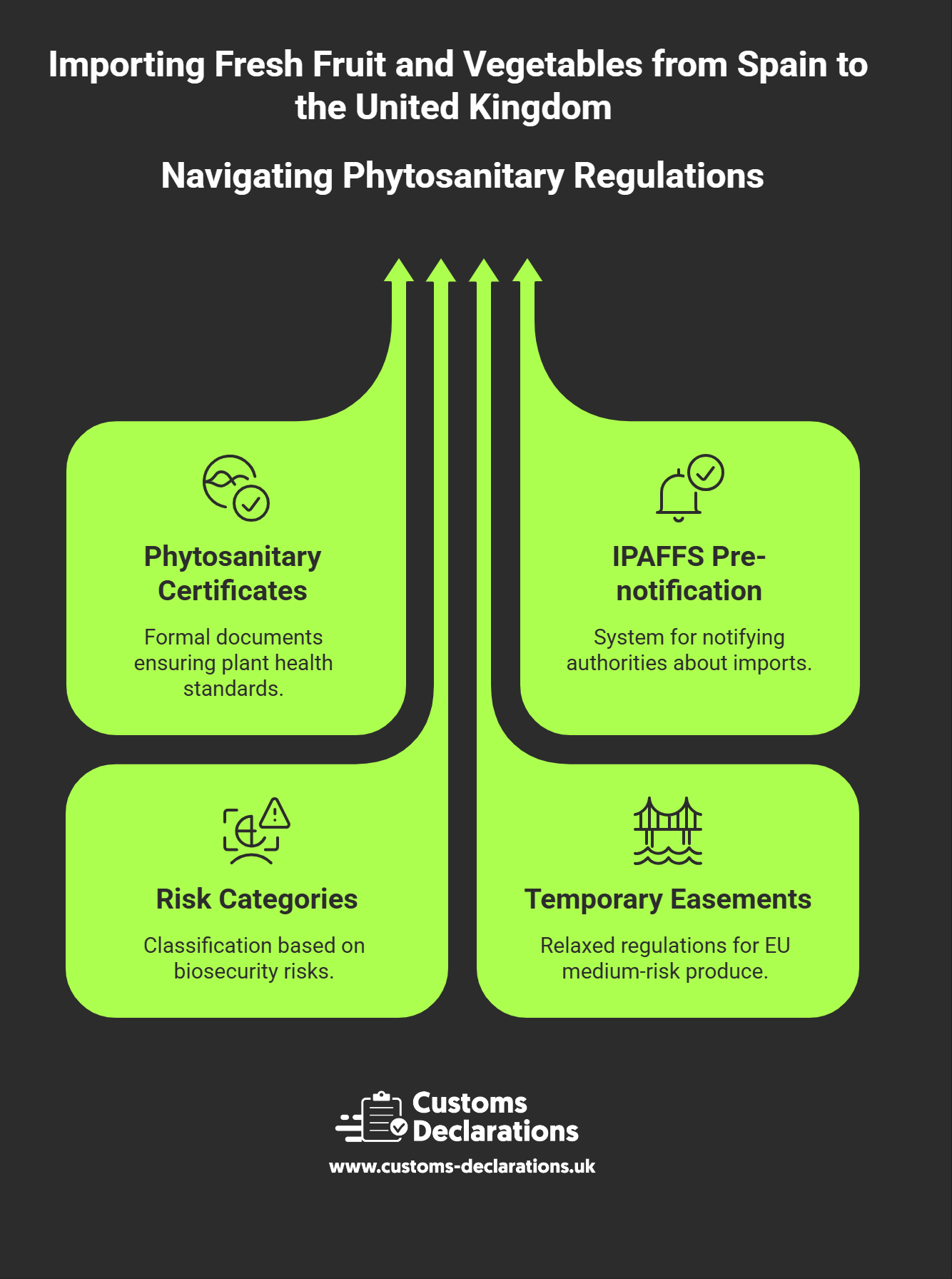
Fresh fruit and vegetables are categorised under the UK’s plant health regime according to their biosecurity risk. The UK classifies plant products as high risk, medium risk A, medium risk B, or low risk, with each category subject to different control measures. Most fresh produce from Spain falls within the medium risk category, which historically required phytosanitary certificates and pre-notification via the Import of Products, Animals, Food and Feed System known as IPAFFS. However, recognising the practical challenges and the continued alignment of EU phytosanitary standards with UK expectations, the UK government has implemented temporary easements for EU medium-risk fruit and vegetables.

As confirmed by recent government announcements, the requirement for phytosanitary certificates and IPAFFS pre-notification for medium-risk fresh fruit and vegetables from the EU has been postponed until 31 January 2027. This means that for the period through early 2027, Spanish exporters and UK importers can continue to move medium-risk produce without obtaining formal phytosanitary certificates for each consignment. This easement provides critical breathing space for supply chains to adapt to the longer-term requirements that will eventually apply.

For high-risk plant products, full controls are already in place and must be complied with immediately. High-risk goods require phytosanitary certificates from the exporting country’s plant health authority, advance notification via IPAFFS, and physical checks at designated Border Control Posts. Importers should verify the risk classification of their specific products using the UK Plant Health Information Portal to confirm which regime applies.

IPAFFS Registration and Compliance

Even though the easement currently applies to most Spanish fresh produce, importers should familiarise themselves with IPAFFS in preparation for future requirements. IPAFFS is the online system used to notify UK plant health authorities about incoming consignments of regulated plants and plant products. Registration on IPAFFS establishes the importer as a professional operator and creates the digital identity needed to submit import notifications.

Once full controls are implemented in 2027, importers will need to submit pre-notifications via IPAFFS at least four working hours before goods arrive in Great Britain for air and roll-on-roll-off freight, and at least one working day in advance for all other freight modes. The notification must include details of the consignment, a scanned copy of the phytosanitary certificate issued by Spanish authorities, and accompanying transport documentation. IPAFFS will generate instructions on whether the consignment requires documentary checks, identity checks, or physical checks, and will specify the Border Control Post or Control Point where these checks must take place.

The phytosanitary certificate issued by Spain’s national plant protection organisation certifies that the plants or plant products have been inspected, are free from quarantine pests, meet the requirements for regulated non-quarantine pests, and are practically free from other harmful organisms. Spain participates in the ePhyto system, which allows electronic exchange of phytosanitary certificates. Using ePhyto streamlines the process by enabling the certificate data to be cloned directly into the IPAFFS notification, reducing manual data entry and ensuring consistency between the certificate and the UK import notification.

Customs Classification and Valuation

Accurate classification of fresh fruit and vegetables under the UK Integrated Tariff is the foundation of compliant import declarations. Fresh produce typically falls under Chapter 07 for vegetables and Chapter 08 for fruit, with detailed subheadings based on the specific type of product. For example, tomatoes are classified under heading 0702, peppers under 0709 20, cucumbers under 0707 00, and oranges under 0805. Each subheading may have further breakdowns based on characteristics such as whether the goods are fresh or chilled, the time of year they are imported, or their intended use.

Classification determines not only the applicable duty rate, which for EU-origin goods under the Trade and Cooperation Agreement is zero percent, but also any measures, restrictions, or additional data requirements that apply. Misclassification can lead to incorrect declarations even when no duty is due, and may trigger post-clearance assessments or compliance queries from HMRC. Importers should use the UK Trade Tariff tool on GOV.UK to confirm the correct commodity code and to verify that their goods are eligible for preferential treatment under the agreement.

Customs valuation for fresh produce follows the transaction value method, which is the price actually paid or payable for the goods when sold for export to the UK. This value must include all costs up to the UK frontier, such as international freight, insurance, and any packing or handling charges that are conditions of the sale. It should exclude costs incurred after the goods have crossed into the UK, such as domestic inland transport, warehouse storage, or retail distribution expenses. For perishable goods like fruit and vegetables, clear documentation separating pre-import and post-import costs is essential to defend the declared customs value during audits.

Because Spanish suppliers often quote prices on different Incoterms, importers must carefully adjust the invoice value to reflect the correct customs valuation basis. For instance, if goods are sold on an Ex Works basis, the importer must add international freight and insurance to calculate the customs value. If sold on a Cost Insurance Freight basis to a UK port, that total typically represents the correct customs value. Maintaining transparent calculation sheets that show how the customs value was built up from the invoice price, along with supporting freight and insurance invoices, ensures audit readiness and reduces the risk of valuation disputes.

Import VAT and Postponed VAT Accounting

UK import VAT applies to all goods entering Great Britain from the European Union, calculated at the standard rate of twenty percent on a base that includes the customs value plus any applicable duty. For Spanish produce entering under the Trade and Cooperation Agreement with zero tariff, import VAT is simply twenty percent of the customs value. However, duty-free does not mean VAT-free, and importers must account for this charge either at the border or through an approved deferment mechanism.

VAT-registered businesses importing goods into the UK can use Postponed VAT Accounting to manage import VAT obligations more efficiently. Under this system, instead of paying import VAT to HMRC or a customs intermediary at the time of import, the importer accounts for the VAT on their VAT return. The import VAT is simultaneously declared as output tax due to HMRC and reclaimed as input tax, provided the business is entitled to recover VAT on its purchases. This creates a neutral cash flow impact on the VAT return while eliminating the need for upfront cash payments at the border.

Postponed VAT Accounting is activated automatically for VAT-registered importers in Great Britain and appears on monthly statements provided by HMRC. Importers using this facility must ensure that their accounting systems correctly capture the postponed VAT figures from the monthly statements and transfer them accurately to the relevant VAT return boxes. Maintaining the monthly postponed VAT statements as part of the import documentation archive is critical for demonstrating compliance during VAT audits or HMRC reviews.

Marketing Standards and Certificates of Conformity

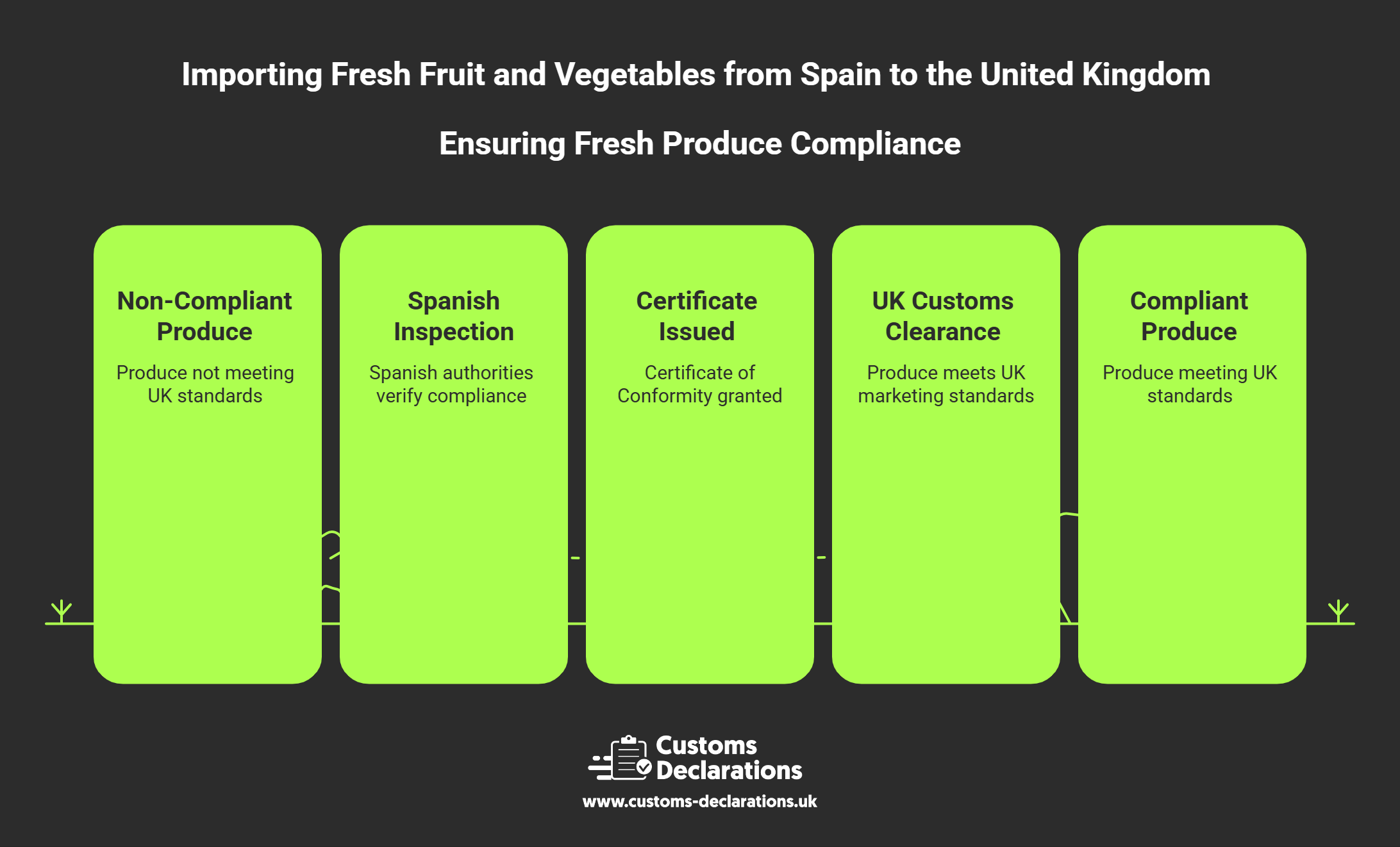
Certain fresh fruit and vegetables sold in the UK are subject to marketing standards that govern quality, sizing, labelling, and presentation. The UK maintains both Specific Marketing Standards, which apply to ten product groups including apples, citrus fruit, kiwifruit, lettuces, peaches and nectarines, pears, strawberries, sweet peppers, table grapes, and tomatoes, and General Marketing Standards that apply to all other fresh produce. These standards ensure that products meet minimum quality thresholds and are accurately described to consumers.

For goods subject to Specific Marketing Standards arriving from Spain, a Certificate of Conformity may be required to demonstrate compliance before the goods can clear UK customs. Spain has UK Approved Inspection Service status, which means that Spanish authorities can issue Certificates of Conformity that are recognised in the UK. When a conformity certificate issued by a Spanish inspection body accompanies the consignment, UK authorities will generally accept this as evidence that the goods meet the required marketing standards.

If the goods are not accompanied by a certificate from an approved inspection service, or if they are being imported from a country without such status, the importer must request an inspection and certificate from the UK’s Horticultural Marketing Inspectorate before customs clearance can proceed. Importers can apply for this through IPAFFS. For goods subject to General Marketing Standards, formal certification is typically not required at import, but the goods must still be sound, of merchantable quality, and properly labelled.

The UK also operates an Approved Trader Scheme for fresh fruit and vegetables, which grants lower-risk status to importers who demonstrate consistent compliance with marketing standards. Approved traders benefit from reduced inspection frequencies, which can expedite clearance and lower administrative burdens. Businesses importing significant volumes of Spanish produce should consider applying for this status once they have established a track record of compliant imports.

Filing Customs Declarations Using Customs Declarations UK

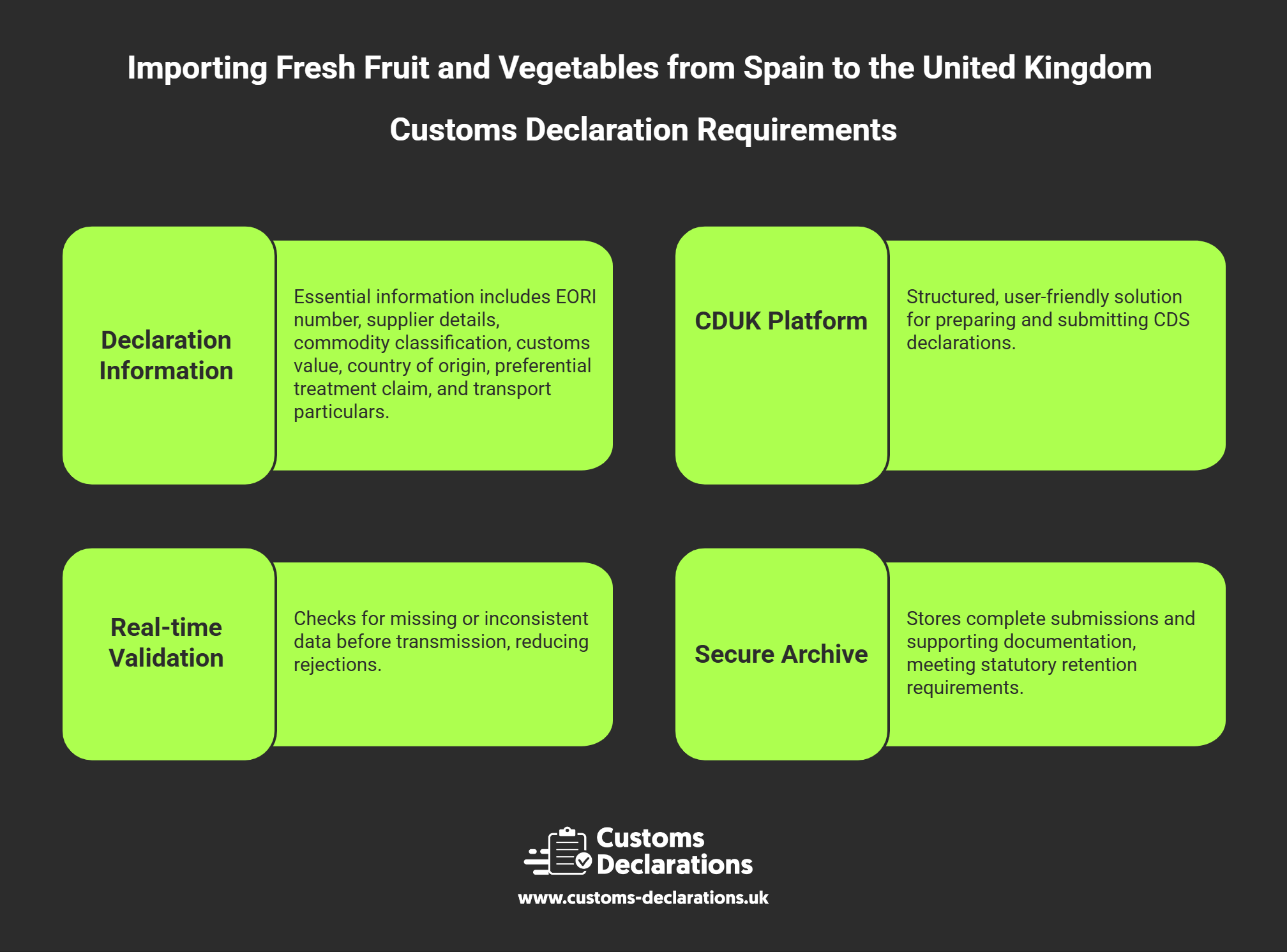
Every import of fresh fruit and vegetables from Spain requires a formal customs declaration submitted to HMRC’s Customs Declaration Service. The declaration captures essential information including the importer’s EORI number, the supplier’s details, commodity classification, customs value, country of origin, preferential treatment claim, and transport particulars. Accurate and complete declarations are mandatory for legal import and form the foundation of audit-ready records that HMRC may review up to six years after the import date.

The Customs Declarations UK (CDUK) platform provides a structured, user-friendly solution for preparing and submitting CDS declarations. CDUK guides importers through plain-English workflows that align with HMRC requirements, reducing the complexity associated with direct CDS submissions. Within the platform, users set up importer and supplier identities once and reuse them across multiple declarations, select the appropriate customs procedure for standard imports, and enter commercial details including product descriptions, quantities, values, and origin information.

Real-time validation within CDUK checks for missing or inconsistent data before the declaration is transmitted to HMRC, significantly reducing the risk of rejections or follow-up queries. When HMRC accepts the declaration, CDUK captures the Movement Reference Number and stores the complete submission along with all supporting documentation in a secure archive that meets statutory retention requirements. This centralised record-keeping is invaluable during audits, post-clearance reviews, or when responding to queries about specific consignments.

For Spanish fresh produce entering under the Trade and Cooperation Agreement, the CDUK platform allows importers to clearly indicate the EU origin of the goods and the preference claim that supports zero-tariff treatment. The system prompts users to confirm that they hold the necessary Statement on Origin or other origin evidence, ensuring that preferential claims are made only when properly supported. By embedding compliance checks into the declaration workflow, CDUK helps importers avoid common errors such as incorrect commodity codes, missing origin claims, or incomplete valuation information.

In addition to import declarations, the CDUK platform supports ENS declarations for safety and security purposes. Although carriers typically file Entry Summary Declarations for goods arriving in the UK, ensuring alignment between the carrier’s ENS data and the importer’s customs declaration reduces the risk of holds or discrepancies at the border. Importers can use the CDUK platform to review and coordinate ENS filings with their customs declarations, creating a seamless end-to-end submission process.

Documentation and Record-Keeping

Maintaining a complete and consistent documentation package for each import is essential for demonstrating compliance with UK customs, VAT, and plant health regulations. At minimum, importers should retain the commercial invoice showing the transaction value and the terms of sale, the packing list detailing the contents and weights of each package, transport documentation such as the bill of lading or CMR note, any Statement on Origin or other origin evidence used to support the preferential tariff claim, the accepted customs declaration and Movement Reference Number from HMRC, and once full phytosanitary controls resume in 2027, the phytosanitary certificate and IPAFFS notification confirmation.

Common Pitfalls and How to Avoid Them

Importing fresh produce from Spain presents several recurring challenges that can lead to delays, additional costs, or compliance issues. One frequent error is assuming that because goods are tariff-free under the Trade and Cooperation Agreement, no customs formalities are required. Full customs declarations must be submitted for all imports, regardless of whether duty is payable. Failing to declare goods or submitting incomplete declarations can result in penalties, seizure of goods, or post-clearance demands for unpaid VAT.

Another common pitfall is misunderstanding the current easement on phytosanitary certificates. While medium-risk fruit and vegetables from Spain are temporarily exempt from requiring phytosanitary certificates and IPAFFS notifications until 2027, this does not mean that plant health rules are irrelevant. Importers must still ensure that their goods are free from pests and diseases, comply with packaging requirements such as ISPM 15 for wood packaging material, and are prepared to demonstrate compliance if challenged by UK authorities. When the easement ends, sudden operational disruptions can occur if importers have not established the necessary certification and notification processes in advance.

Valuation errors also create unnecessary risk. Fresh produce pricing often includes complex logistics arrangements, with costs shared between the supplier and the importer. Importers must clearly identify which costs are includable in the customs value and which are not. Including post-import costs such as UK inland haulage or distribution centre fees inflates the customs value and results in overpaid VAT. Conversely, excluding costs that should be included, such as freight to the UK border or packing charges, understates the customs value and can trigger penalties if discovered during an audit.

Finally, poor coordination between the importer’s customs declaration and the carrier’s safety and security data can cause goods to be held at the border. Entry Summary Declarations filed by carriers must align with the details on the customs declaration, including product descriptions, weights, package counts, and consignee information. Discrepancies between these datasets frequently lead to queries from port authorities, resulting in delays that are particularly damaging for perishable fresh produce with short shelf lives.

Conclusion

Importing fresh fruit and vegetables from Spain to the United Kingdom is entirely manageable when approached with regulatory awareness, accurate documentation, and structured processes. The UK-EU Trade and Cooperation Agreement ensures that Spanish produce can enter tariff-free, provided that origin requirements are met and properly evidenced. While current easements on phytosanitary controls simplify operations in the short term, importers must prepare for the full Border Target Operating Model requirements that will take effect in 2027.

By using the Customs Declarations UK platform to prepare validated import declarations, maintaining comprehensive documentation that supports classification, valuation, and origin claims, and coordinating closely with Spanish suppliers and UK logistics providers, importers can build resilient supply chains that deliver fresh produce efficiently and compliantly. With proper planning and robust systems in place, UK businesses can continue to source high-quality fruit and vegetables from Spain while meeting all regulatory obligations and avoiding costly delays or penalties.

We value your feedback, and if you have any comments, suggestions or anything else that you would like to highlight to us, we will be delighted to hear from you and incorporate your feedback into our content.

Note: While we have made every attempt to ensure that the information contained in this Site has been obtained from reliable sources, Customs Declarations UK is not responsible for any errors or omissions, or for the results obtained from the use of this information. All information in this Site is provided “as is”, with no guarantee of completeness, accuracy, timeliness or of the results obtained from the use of this information, and without warranty of any kind, express or implied, including, but not limited to warranties of performance, merchantability and fitness for a particular purpose. Nothing herein shall to any extent substitute for the independent investigations and the sound technical and business judgment of the reader. In no event will Customs Declarations UK, or its partners, employees or agents, be liable to you or anyone else for any decision made or action taken in reliance on the information in this Site or for any consequential, special or similar damages, even if advised of the possibility of such damages. Certain links in this Site connect to other Web Sites maintained by third parties over whom Customs Declarations UK has no control. Customs Declarations UK makes no representations as to the accuracy or any other aspect of information contained in other Web Sites.