Pre-loader

EU Import Control System 2 (ICS2) List of Stop Words – A Quick Guide on Entering Goods Description, Consigner/Consignee and Party Information on Declarations

Introduction

The EU Import Control System 2 (ICS2) represents a significant modernization of customs security processes across the European Union and the United Kingdom. At the heart of this system lies a critical requirement: accurate, specific, and meaningful descriptions of goods, parties, and addresses in customs declarations. Generic or vague terms—known as “stop words”—are systematically rejected by the system, leading to declaration failures, delays, and potential penalties.

This comprehensive guide explains what stop words are, why they matter, how to avoid them, and provides the complete official list of unacceptable terms for goods descriptions and party information. Whether you’re filing import declarations, export declarations, or safety and security (ENS) declarations through platforms like Customs Declarations UK, understanding and avoiding stop words is essential for smooth, compliant cross-border trade.

Why Stop Words Matter: The Risk-Analysis Foundation

The legal requirement for precise goods descriptions stems from customs administrations’ need to conduct effective risk analysis on all consignments entering or leaving the EU and UK. According to the European Commission’s guidance (Commission Delegated Regulation (EU) 2015/2446), descriptions must be “precise enough for Customs services to be able to identify the goods.”

A vague description prevents customs from:

  • Identifying potential security threats
  • Detecting prohibited or restricted goods
  • Assessing duty and tax liabilities accurately
  • Prioritizing inspections effectively


When descriptions are too generic, customs must resort to physical examinations of consignments to determine their true nature—causing unnecessary delays, increased costs, and supply chain disruptions for compliant traders.

Key principle: If a commodity code is not provided (common in safety and security declarations), the plain-language description becomes the primary risk-assessment tool. Generic terms like “consolidated cargo,” “general goods,” “parts,” or “freight of all kinds” are explicitly prohibited.

Legal Framework and Official Guidance

The requirement for acceptable goods descriptions is established in:

  • Commission Delegated Regulation (EU) 2015/2446 (Annex B and Annex D)
  • Data Element 18 05 000 000 (‘Description of goods’)
  • Data Element 6/8 (goods description for certain procedures)


The regulation states: “General terms (i.e. ‘consolidated’, ‘general cargo’, ‘parts’ or ‘freight of all kinds’) cannot be accepted. A non-exhaustive list of such general terms and descriptions is published by the Commission.”

Important note: The list of stop words is dynamic and non-exhaustive. As everyday customs practice reveals new unacceptable terms, the Commission updates the list in coordination with Member States. This means declarants must stay vigilant and apply the underlying principle: be specific, be clear, be accurate.

Fundamental Principles for Acceptable Descriptions

For Goods Descriptions:

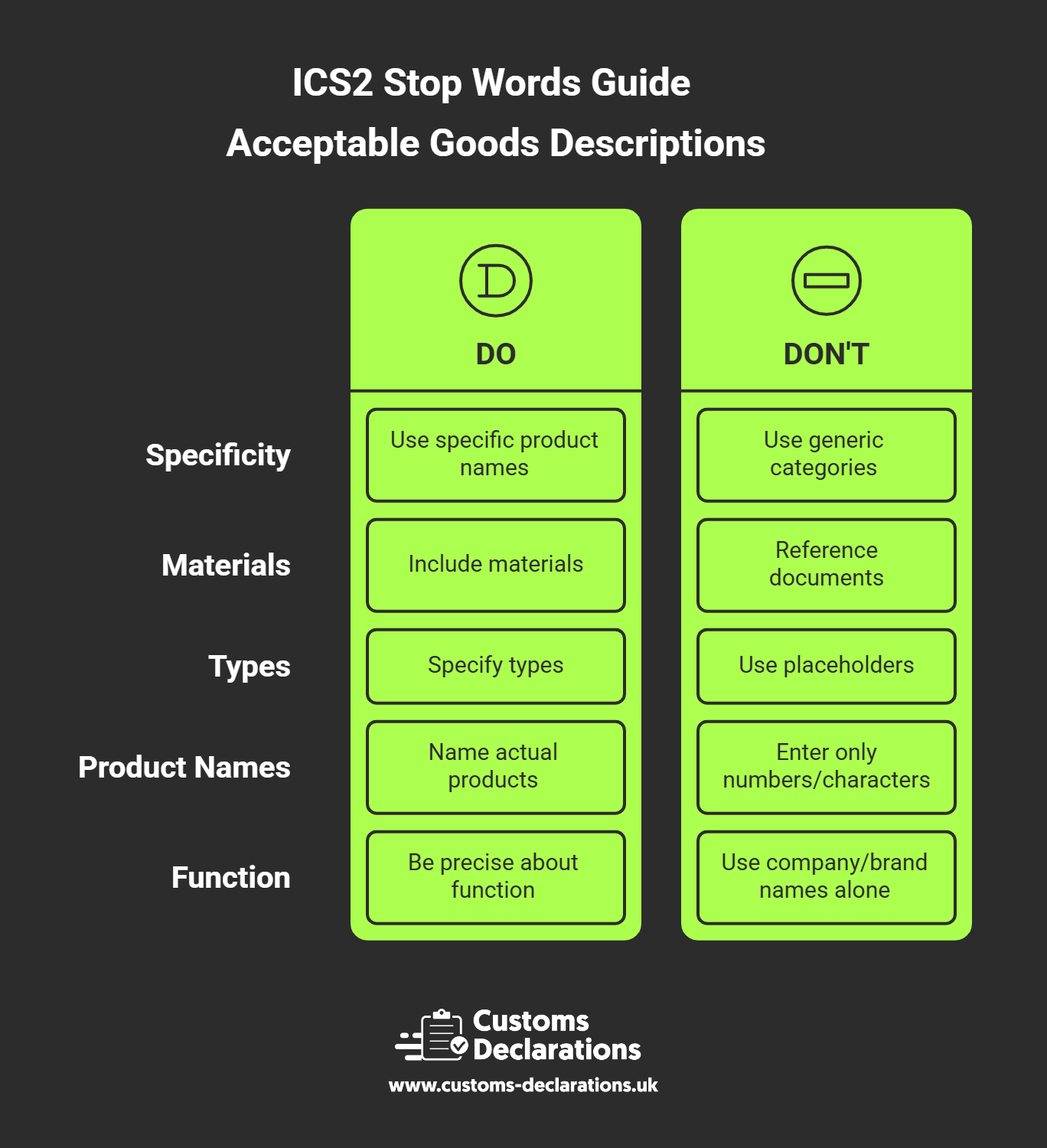
DO:

  • Use specific product names: “Men’s cotton T-shirts” instead of “Clothing”
  • Include materials: “Plastic kitchenware” instead of “Kitchen items”
  • Specify types: “Lithium batteries” instead of “Batteries”
  • Name actual products: “Apple iPhone 13” instead of “Electronics”
  • Be precise about function: “Medical ventilator” instead of “Medical equipment”

DON’T:

  • Use generic categories (e.g., “Goods,” “Products,” “Items,” “Materials”)
  • Reference documents (“See invoice,” “As per manifest,” “AWB”)
  • Use placeholders (“Various,” “Mixed,” “Misc,” “Consolidated”)
  • Enter only numbers, file extensions, or special characters
  • Use company names or brand names alone without product description

For Party Information (Consignor/Consignee/Notify Party):

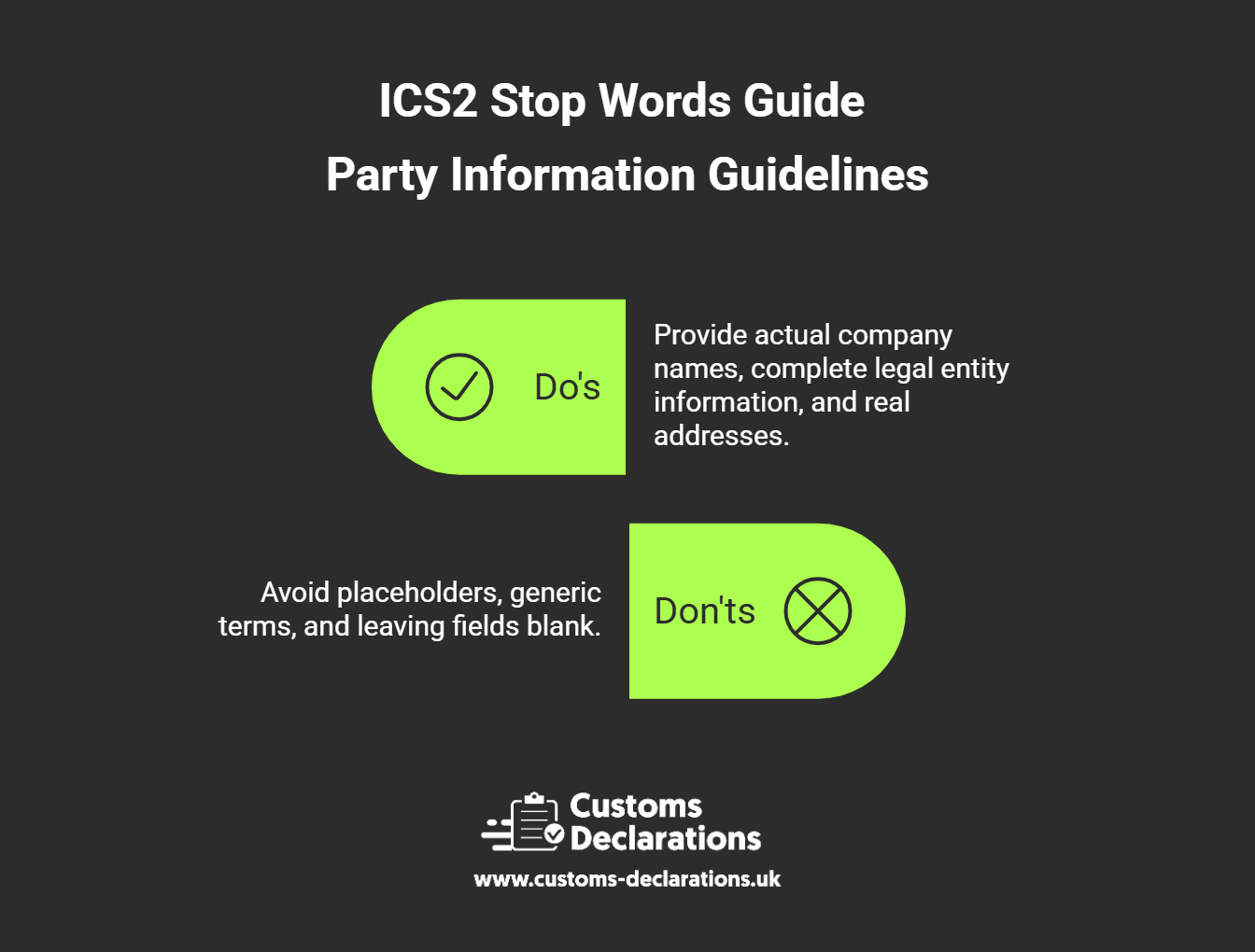
DO:

  • Provide actual company names and registered business names
  • Include complete legal entity information
  • Use real addresses with proper street names and numbers

DON’T:

  • Use placeholders like “N/A,” “Unknown,” “Not available,” “Please select”
  • Enter “Private,” “Private individual,” “xxxx,” or “2checkout”
  • Leave fields blank or use generic terms

For Addresses and Cities:

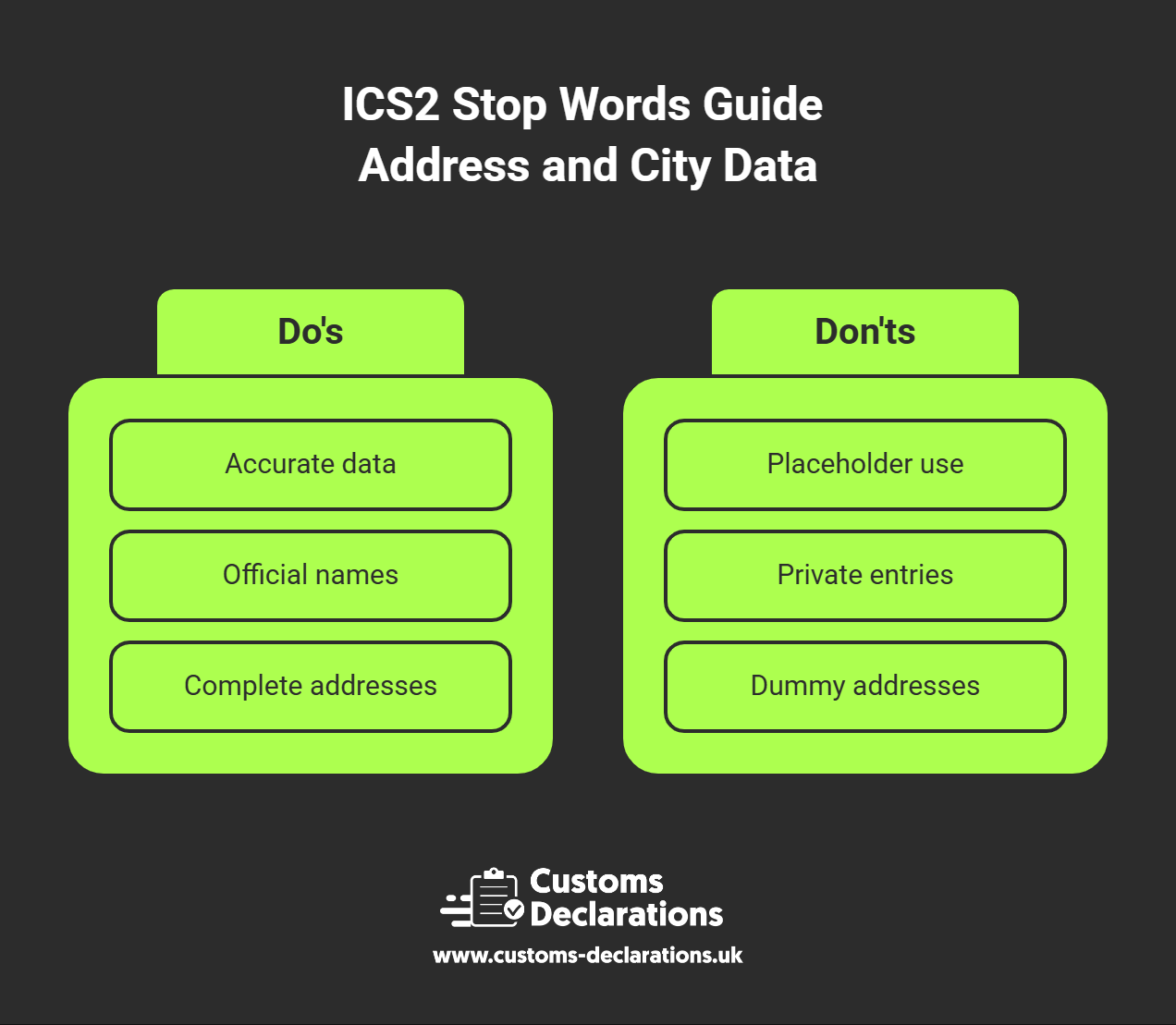
DO:

  • Provide actual city names and postal codes
  • Include complete street addresses
  • Use officially recognized place names

DON’T:

  • Use “N/A,” “Unknown,” “Not available,” “Please select”
  • Enter “Private,” “xxxx,” or “2checkout”
  • Use placeholder or dummy addresses

Examples: Unacceptable vs. Acceptable Descriptions

Let’s look at practical examples drawn from the official EU Commission guidance:

Unacceptable

Acceptable

Why It Matters

ElectronicsComputer monitors, Samsung tablets, iPhone 13 Pro“Electronics” could refer to anything from toys to weapons.
MachineryCNC milling machines, industrial sewing machinesDuty rates vary significantly by machinery type.
PartsAutomobile brake pads, laptop replacement screens“Parts” gives no indication of what’s actually being shipped.
ChemicalsSodium hydroxide (CAS 1310-73-2), AcetoneSafety and hazard classification depends on the exact substance.
FoodPackaged rice, frozen chicken breasts, tomato sauceSanitary controls differ by food type.
TextilesMen’s cotton shirts (HS 6205.20), polyester curtainsQuota and preference rules depend on textile classification.
ConsolidatedToys (dolls), Books (novels), Kitchen utensils (spatulas)Risk assessment requires knowing each item’s actual contents.
General cargoSteel pipes, wooden furniture, plastic containersEach item has different duty, safety, and import requirements.
AccessoriesSmartphone charging cables, tablet protective cases“Accessories” is too vague for accurate tariff classification.

Complete ICS2 Stop Words Reference Table

Below is the comprehensive official list of stop words that are unacceptable in customs declarations. This list is based on the European Commission’s published guidance (TAXUD b.1(2021)1688480) and is updated regularly.


Goods Description Stop Words

Category

Unacceptable Terms

Source

Generic Goods TermsAccessoriesInitial list
 AdapterInitial list
 Agricultural productsInitial list
 Aid consignmentInitial list
 All kind of CargoInitial list
 All kind of GoodsInitial list
 ApparelInitial list
 AppliancesInitial list
 ArticlesInitial list
 ArtworkInitial list
 As ordered […]Initial list
 As per attached [invoice]Initial list
 Attached [manifest]Initial list
 AutoInitial list
 Auto PartsInitial list
 AutomobilesInitial list
 AWB/HAWBInitial list
 BaggageInitial list
 Bags (or other types of packaging)Initial list
 BatteryInitial list
 Bazaar goodsInitial list
 Biological SubstancesInitial list
 Birthday giftsInitial list
 BitsInitial list
 BoardsInitial list
 BoxInitial list
 CablesInitial list
 CarsInitial list
 CaseInitial list
 CapsInitial list
 Cartons, CTNInitial list
 CharityInitial list
 ChemicalsInitial list
 Chemicals, flammableInitial list
 Chemicals, hazardousInitial list
 Chemicals, non-hazardousInitial list
 Cleaning productsInitial list
 Wooden articlesInitial list

Party Name Stop Words (Consignor, Consignee, Notify Party, etc.)


Unacceptable Terms

Source

2checkoutInitial list
Please selectInitial list
PrivateInitial list
Private individualInitial list
N/AInitial list
Not availableInitial list
UnknownInitial list
xxxxInitial list

Party Address/City Stop Words


Unacceptable Terms

Source

2checkoutInitial list
N/AInitial list
Not availableInitial list
Please selectInitial list
PrivateInitial list
UnknownInitial list
xxxxInitial list

Unacceptable Characters in Descriptions


Type

Examples

Rule

Only numbers1004, 1005, etc.Not accepted to be only numbers
File extensionsWPX, .wpxFile extensions not accepted
Repeated symbols / lettersXXX, …Not accepted to be only 3 or more equal symbols or letters
Empty characters“.”, “-“, ” “Not accepted to be only empty characters
Special characters$%^&<> : ” / \ ? *Not accepted to be only special characters
Special characters + numbers!£12Not accepted to be only special characters and numbers

Acceptable Alternatives: How to Get It Right

The Commission’s guidance provides clear alternatives for each unacceptable term. Here are key examples:

Instead of Generic Terms, Use Specific Descriptions:

“Electronics” → Specify the actual items:

  • Computer monitors
  • Samsung Galaxy tablets
  • Apple iPhone 13 Pro
  • CD players
  • Desktop printers
  • LED televisions
 

“Chemicals” → Use ECICS database names or actual chemical names:

  • Sodium hydroxide (CAS 1310-73-2)
  • Acetone
  • Hydrochloric acid
  • Isopropyl alcohol
 

“Food” → Describe the actual food products:

  • Packaged basmati rice
  • Frozen chicken breasts
  • Tomato pasta sauce
  • Powdered whole eggs
 

“Parts” → Specify what parts and for what:

  • Automobile brake pads
  • Laptop replacement keyboards
  • Industrial pump seals
  • Aircraft engine components
 

“Textile goods” → Be specific about fabric and use:

  • Cotton fabric in rolls (grey fabric, unbleached)
  • Polyester curtains (ready-made)
  • Cotton bed sheets (queen size)
  • Men’s cotton T-shirts (HS 6109.10)
 

“Machinery” → Name the actual machines:

  • CNC metal-working lathes
  • Industrial sewing machines (lockstitch)
  • Cigarette-making machines
  • Offset printing presses
 

Special Considerations for Different Declaration Types

Import Declarations (CDS)

When filing import declarations, you typically provide:

  • Commodity Code (HS/CN code): 10-digit classification
  • Goods Description: Plain-language description supporting the code

Even with a commodity code, the description must be specific. Avoid relying solely on the code to justify vague descriptions.

Export Declarations

Export declarations follow the same principles. Descriptions must enable customs to:

  • Verify export controls and licensing requirements
  • Apply appropriate export procedures
  • Conduct risk assessment for security screening


Safety and Security Declarations (ENS/Entry Summary)

ENS declarations often do not require commodity codes in advance of arrival. This makes the plain-language description absolutely critical:

  • It’s the primary tool for risk assessment
  • Generic terms will result in rejection or holds
  • Declarations must enable pre-arrival targeting and risk screening
  • On the Customs Declarations UK platform, you can easily clone import declarations to create ENS submissions, ensuring consistency between customs and safety/security data.
 

Practical Filing Tips for Customs Declarations UK Users

Use Built-In Validation

The Customs Declarations UK platform performs real-time validation against HMRC requirements, including checks for generic or incomplete descriptions. The system will flag potential issues before submission, helping you correct errors immediately.

Create and Reuse Templates

For repeat shipments of the same products:

  • Set up reusable templates with complete, compliant descriptions
  • Clone previous declarations and update only the variable details (quantities, values, dates)
  • Maintain a library of product descriptions that have been accepted

Use the Cloning Feature

When creating ENS declarations:

  • Clone your import declaration to auto-populate goods descriptions
  • Ensure consistency between your customs entry and safety/security filing
  • Reduce manual entry and minimize risk of mismatches

Maintain a Description Reference Document

Keep an internal reference document with:

  • Approved descriptions for your regular products
  • Acceptable alternatives for common items
  • HS codes paired with verified descriptions

Train Your Team

Ensure everyone involved in declarations understands:

  • Why stop words are rejected
  • How to describe goods specifically
  • Where to find official guidance and examples
 

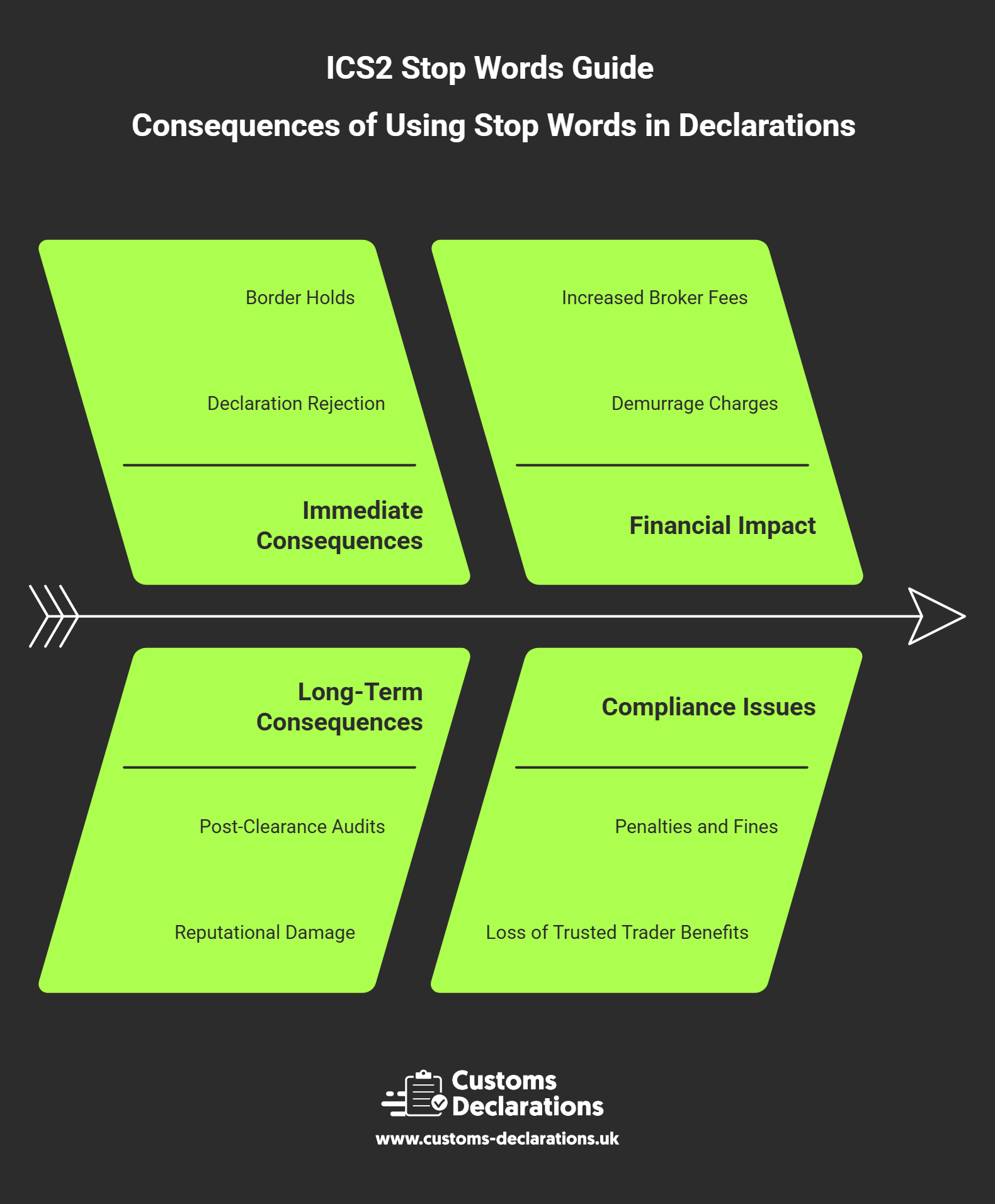
Consequences of Using Stop Words

Declaring goods with stop words or generic descriptions can result in:

Immediate Consequences:

  • Declaration rejection by the customs system
  • Holds and delays at the border while goods are physically examined
  • Missed vessel/flight connections due to clearance delays
  • Storage charges accumulating at ports or warehouses


Long-Term Consequences:

  • Post-clearance audits and retrospective assessments
  • Penalties and fines for non-compliance
  • Reputational damage with customs authorities
  • Risk profiling leading to increased scrutiny on future shipments
  • Loss of trusted trader benefits (AEO status implications)


Financial Impact:

  • Demurrage and detention charges
  • Expedited freight costs to recover delays
  • Increased broker or agent fees for corrections
  • Potential duty and VAT reassessments
 

Best Practices Summary

For Goods Descriptions:

  1. Be specific: Use actual product names, not categories
  2. Include materials: “Cotton T-shirts,” not just “T-shirts”
  3. Specify function: “Medical ventilator,” not “Medical equipment”
  4. Name brands/models when relevant: “Apple iPhone 13,” not “Smartphone”
  5. Use technical terms when appropriate: Chemical names, scientific species names
  6. Reference the HS code: But don’t use it as a substitute for description


For Party Information:

  1. Use legal entity names: Registered company names, not placeholders
  2. Provide complete addresses: Street, city, postal code, country
  3. Verify information accuracy: Match against official business registers
  4. Never use “N/A” or “Unknown”: Find the actual information
  5. Coordinate with your supply chain: Ensure all parties provide real details


For System Use (Customs Declarations UK):

  1. Leverage validation: Use real-time checks to catch errors early
  2. Build templates: Create reusable compliant descriptions
  3. Clone declarations: Ensure consistency across CDS and ENS filings
  4. Archive properly: Store declarations for statutory 6-year retention
  5. Update regularly: As stop word lists evolve, update your templates
 

Conclusion

Understanding and avoiding stop words is not merely a technical compliance requirement—it’s fundamental to efficient, cost-effective international trade. By providing specific, accurate descriptions of goods and parties, you:

  • Enable customs to conduct effective risk analysis
  • Facilitate faster clearance of legitimate cargo
  • Reduce physical examination rates
  • Minimize delays and costs
  • Build credibility with customs authorities
  • Maintain compliance with evolving regulations


The Customs Declarations UK platform is designed to help you navigate these requirements seamlessly. With built-in validation, reusable templates, interactive wizards, and real-time compliance checks, the platform ensures your declarations meet all ICS2 and HMRC standards—keeping your goods moving smoothly across borders.

Remember: The stop words list is dynamic and non-exhaustive. When in doubt, apply the fundamental principle: be specific, be clear, and be accurate. If a term seems too generic or vague to identify the goods, it probably is—and customs systems will reject it.

By following the guidance in this article and leveraging modern filing tools like Customs Declarations UK, you can turn customs compliance from a challenge into a competitive advantage.


We value your feedback, and if you have any comments, suggestions or anything else that you would like to highlight to us, we will be delighted to hear from you and incorporate your feedback into our content.

Note: While we have made every attempt to ensure that the information contained in this Site has been obtained from reliable sources, Customs Declarations UK is not responsible for any errors or omissions, or for the results obtained from the use of this information. All information in this Site is provided “as is”, with no guarantee of completeness, accuracy, timeliness or of the results obtained from the use of this information, and without warranty of any kind, express or implied, including, but not limited to warranties of performance, merchantability and fitness for a particular purpose. Nothing herein shall to any extent substitute for the independent investigations and the sound technical and business judgment of the reader. In no event will Customs Declarations UK, or its partners, employees or agents, be liable to you or anyone else for any decision made or action taken in reliance on the information in this Site or for any consequential, special or similar damages, even if advised of the possibility of such damages. Certain links in this Site connect to other Web Sites maintained by third parties over whom Customs Declarations UK has no control. Customs Declarations UK makes no representations as to the accuracy or any other aspect of information contained in other Web Sites.