Pre-loader

Importing Coffee, Tea and Cocoa from Vietnam to the United Kingdom: A Complete Compliance and Customs Guide

Vietnam has emerged as one of the world’s most significant producers of coffee, tea, and cocoa, supplying importers across Europe and beyond with consistently high volumes and increasingly diversified product profiles. For UK businesses — whether specialist roasters, wholesale distributors, food manufacturers, or commodity traders — Vietnam represents a compelling sourcing destination. However, importing agricultural goods from a non-EU country into Great Britain demands careful attention to customs classification, food safety compliance, phytosanitary certification, and accurate declaration filing. This guide walks through every stage of the process in a structured, practical manner, helping importers avoid costly delays and maintain full compliance with HMRC and the relevant UK regulatory authorities.

Establishing Your Import Framework

Before a single shipment can be arranged, your business must be properly set up to operate as a UK importer of goods from a third country.

EORI Registration: Every business that imports goods into Great Britain must hold a GB EORI number (Economic Operators Registration and Identification). This identifier links your business to all customs activity and is required whether you file your own import declarations or appoint a customs broker to act on your behalf. Applications are made through GOV.UK and are typically processed within a few working days.

VAT Registration: If your business is VAT-registered, you are eligible to use Postponed VAT Accounting (PVA), which allows you to account for import VAT on your periodic VAT return rather than paying it upfront at the point of importation. For businesses importing regularly in volume, this provides a meaningful cash flow benefit and simplifies reconciliation.

Import Licences and Notifications: Vietnam is not currently subject to any general import ban or quota restriction for coffee, tea, or cocoa into the UK. However, certain product categories — particularly those subject to phytosanitary controls — require advance notification through the Import of products, animals, food and feed system (IPAFFS), administered by the Animal and Plant Health Agency (APHA). Importers must pre-notify arrivals before goods reach the UK border. Failure to do so is a common and costly mistake.

Understanding the UK-Vietnam Trade and Tariff Position

The United Kingdom and Vietnam are parties to the UK-Vietnam Free Trade Agreement (UKVFTA), which entered into force in January 2021. This agreement creates a framework for preferential tariff rates on qualifying goods of Vietnamese origin, which is directly relevant to coffee, tea, and cocoa importers.

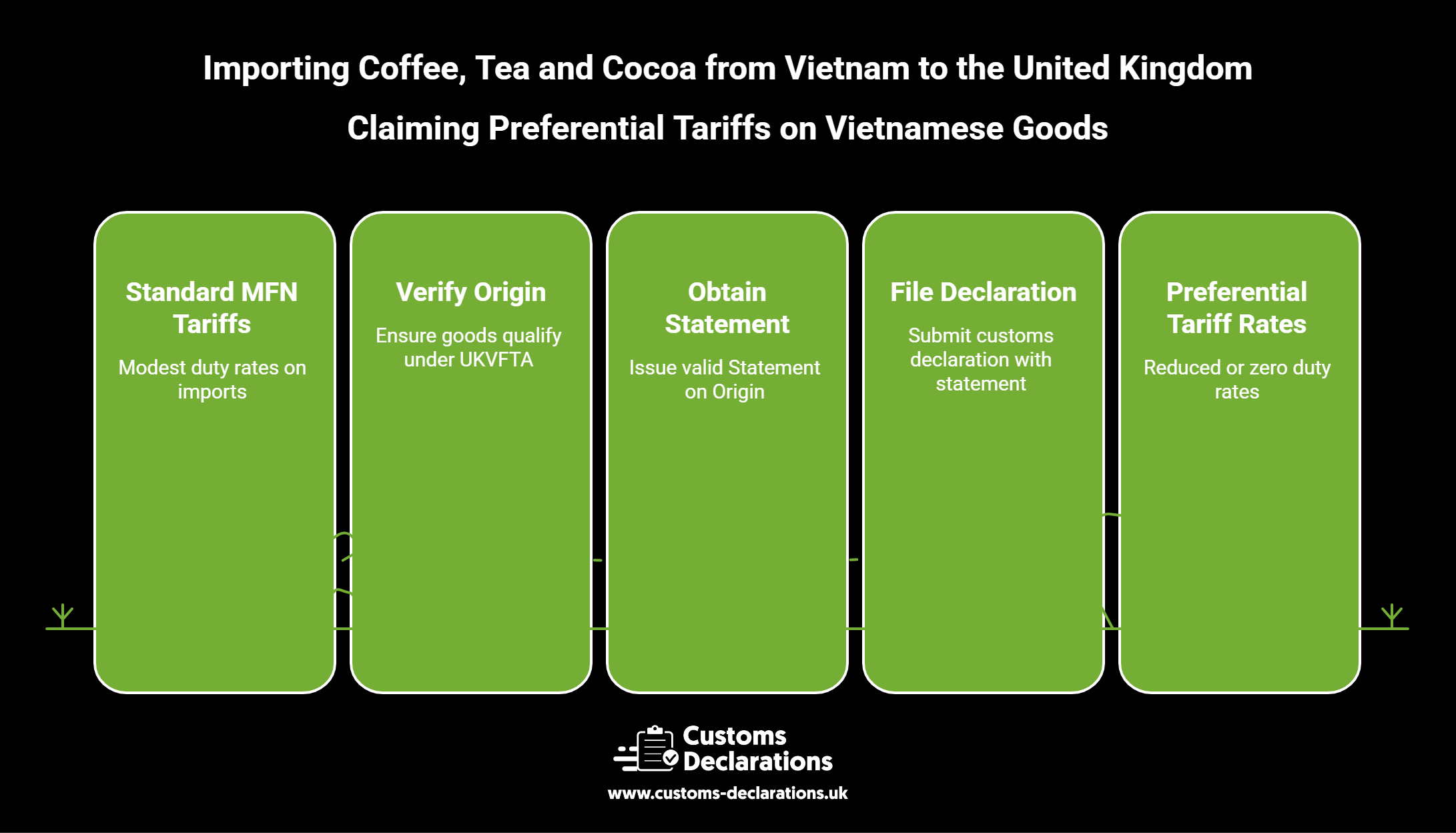
Under standard Most-Favoured-Nation (MFN) terms, unprocessed or minimally processed agricultural commodities from Vietnam attract relatively modest duty rates, but the UKVFTA can reduce these further — in some cases to zero — depending on the product and its classification. To benefit from the preferential rate, the goods must qualify as originating in Vietnam under the agreement’s Rules of Origin. This generally requires the product to have been wholly obtained or sufficiently processed in Vietnam. The exporter must issue a valid Statement on Origin (for consignments over £5,500, this must be made by an approved exporter or accompanied by a REX declaration). Importers should verify the applicable preferential rate in the UK Trade Tariff tool before each shipment and ensure the Statement on Origin is in their possession before filing the customs declaration.

Where origin cannot be demonstrated, the full MFN rate applies. Do not claim preference speculatively — HMRC takes a firm position on misdeclaration of origin, and retrospective correction attracts penalties.

Customs Classification: Getting the Commodity Code Right

Accurate tariff classification is the foundation of every compliant customs declaration. It determines the duty rate, any applicable import controls, and the supporting documentation that must accompany the goods.

Coffee, tea, and cocoa are classified within Chapter 09 of the UK Integrated Tariff, which covers coffee, tea, maté, and spices. Cocoa and cocoa preparations fall primarily under Chapter 18.

Within Chapter 09, the distinction between roasted and unroasted coffee is significant: green (unroasted) coffee beans are classified under heading 0901, while roasted coffee (with or without caffeine) falls under a separate subheading. Tea is classified under heading 0902, with further distinctions between green tea (not fermented) and black tea (fermented or partly fermented). Cocoa beans — whole or broken, raw or roasted — sit under heading 1801 of Chapter 18, while cocoa paste, butter, powder, and preparations occupy headings 1803 through 1806.

The correct ten-digit commodity code must appear on every import declaration. Using an incorrect code — for instance, classifying roasted coffee as unroasted — can trigger a customs hold, post-clearance duty assessment, and HMRC penalties. Where classification is genuinely uncertain, importers may apply to HMRC for a Binding Tariff Information (BTI) ruling, which provides legal certainty for a period of three years.

Food Safety and Phytosanitary Requirements

Importing food products from Vietnam into Great Britain subjects those goods to the controls of the Food Safety Act 1990, the General Food Law (Retained EU Law), and associated regulations administered by the Food Standards Agency (FSA) and local authorities. These requirements operate in parallel with — and are independent of — the customs process.

Import Pre-Notification (IPAFFS): Consignments of coffee, tea, and cocoa from Vietnam must be pre-notified through IPAFFS before arrival. The notification must be submitted with sufficient advance notice to allow the port health authority to arrange any inspection that may be required. The precise lead time depends on the commodity and port, but a minimum of one working day prior to arrival is standard practice.

Phytosanitary Certificates: Goods of plant origin — which coffee, tea, and cocoa all are — require a Phytosanitary Certificate issued by the competent authority in Vietnam (the Plant Protection Department). This certificate confirms that the goods have been inspected and found free of regulated pests and diseases. Without a valid phytosanitary certificate, goods will be detained or rejected at the UK border.

Maximum Residue Levels (MRLs): Agricultural commodities from Vietnam are subject to UK MRL requirements for pesticide residues. Importers should request pesticide residue test reports from their Vietnamese supplier prior to shipment, particularly for products destined for the retail food chain. Non-compliance with MRLs can result in goods being prohibited from sale, destroyed, or returned at the importer’s cost.

Aflatoxin and Contaminant Checks: Cocoa, in particular, is subject to monitoring for aflatoxin contamination. Importers of cocoa and cocoa products should obtain relevant mycotoxin analysis from an accredited laboratory as part of their supplier due diligence process.

Shipping, Incoterms, and Documentation

Vietnam is served by several major international shipping routes into the UK, with the primary options being sea freight and air freight.

Sea Freight is the most cost-effective method for bulk shipments of green coffee beans, tea, or raw cocoa. Transit times from Vietnamese ports (Ho Chi Minh City and Hai Phong being the principal export gateways) to UK ports such as Felixstowe, Southampton, or Tilbury typically range from 25 to 35 days. Coffee and cocoa are commonly shipped in 20-foot or 40-foot containers, often in jute or grain-pro lined bags to maintain quality in transit.

Air Freight is used for high-value specialty lots, urgent orders, or smaller consignments of processed or roasted products where freshness is commercially critical. Transit times are typically 3 to 5 days.

Regardless of the shipping method chosen, the correct Incoterm® must be agreed with the Vietnamese exporter and clearly stated on the commercial invoice. FOB (Free on Board) is common for sea shipments from Vietnam, with the UK importer assuming responsibility for freight and insurance from the point of loading. CIF (Cost, Insurance and Freight) shifts those costs to the exporter but reduces the importer’s control over carrier selection. The chosen Incoterm directly affects the customs value declared to HMRC, as costs to the UK frontier (freight and insurance) must be included in the transaction value.

Essential shipping documents for every consignment include the commercial invoice, packing list, bill of lading or airway bill, phytosanitary certificate, certificate of origin (or Statement on Origin for preference claims), and any relevant test reports or certificates of analysis. All documents must be consistent in their description of the goods, quantities, weights, and parties — discrepancies across documents are a frequent cause of HMRC queries and border delays.

Customs Valuation and Duty Calculation

HMRC determines customs duty using the transaction value method — the price actually paid or payable for the goods when sold for export to the United Kingdom. This value must include freight and insurance costs to the UK frontier (in accordance with the Incoterm) but must exclude post-import costs such as UK inland delivery, storage, or processing.

For coffee, tea, and cocoa, typical MFN duty rates under the UK Integrated Tariff are modest but not trivial — particularly for processed or value-added products, which often attract higher rates than raw commodities. Where UKVFTA preferential rates apply and origin is properly evidenced, duty savings can be material, especially at volume. Import VAT at the standard rate of 20% is applied to a base that includes the customs value plus any duty payable. VAT-registered importers using Postponed VAT Accounting avoid the upfront cash payment, accounting instead through their VAT return.

For high-volume importers, a Duty Deferment Account allows consolidated monthly duty payments rather than per-shipment settlement, which can provide additional working capital relief.

Filing Customs Declarations Using Customs Declarations UK

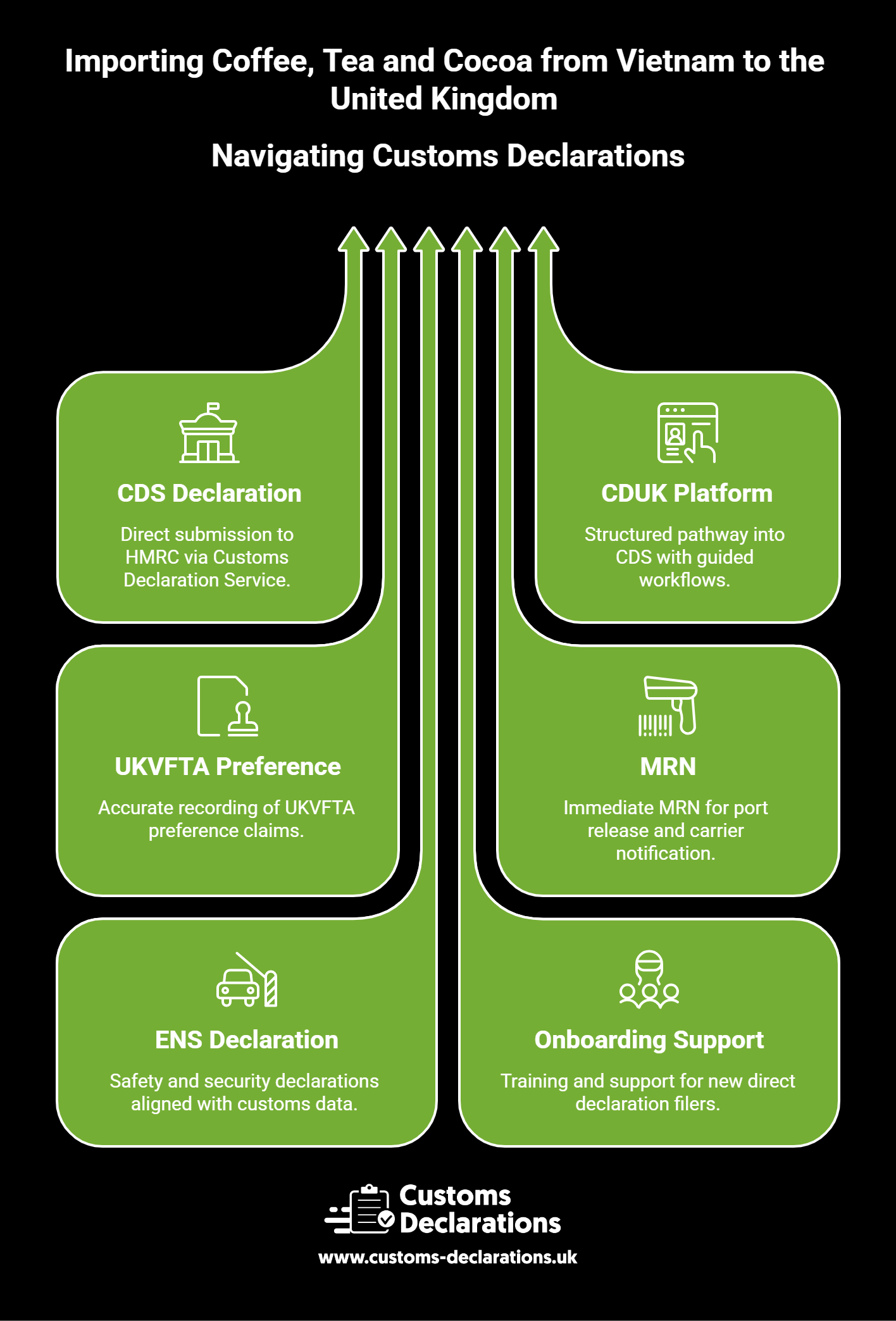
At the heart of every compliant UK import is a correctly filed CDS declaration — submitted to HMRC through the Customs Declaration Service (CDS). The Customs Declarations UK (CDUK) platform provides importers with a structured, validated pathway into CDS, removing much of the complexity from the declaration process.

Using CDUK, importers of coffee, tea, and cocoa from Vietnam can:

Prepare and submit full import declarations directly to HMRC’s CDS through guided, plain-English workflows that prompt for all required data elements — importer and exporter identity, commodity code, customs value, Incoterms, country of origin, and preference claim details. The platform’s real-time validation engine checks for missing or inconsistent data before transmission, catching errors that would otherwise result in rejection or post-clearance HMRC queries.

Record the UKVFTA preference claim accurately, including the basis for that claim (Statement on Origin or importer’s knowledge) and the associated documentary reference. This creates an audit-ready record that can be produced promptly if HMRC requests verification.

Receive the Movement Reference Number (MRN) immediately upon HMRC acceptance, which serves as the gateway notification for port release and must be provided to the carrier and port Community System Provider (CSP).

In addition to import declarations, CDUK supports the filing of ENS declarations — Entry Summary Declarations required for safety and security purposes on goods arriving into the UK. These must be aligned with the customs declaration in terms of goods description, weights, and consignee details. Mismatches between ENS and customs data are a frequent and avoidable cause of border holds. CDUK’s integration with leading Community System Providers — CNS, MCP, and CCS-UK — helps ensure seamless data flow across the port and HMRC systems.

For businesses new to direct declaration filing, CDUK offers onboarding support and training, enabling importers to manage their customs filings in-house and reduce dependence on third-party brokers. The platform’s pay-as-you-go pricing model, with declarations available from £4, makes it commercially accessible even for lower-volume importers.

Common Pitfalls and How to Avoid Them

Several recurring errors affect importers of agricultural commodities from Vietnam and can be avoided with straightforward controls.

Failing to pre-notify through IPAFFS before goods arrive at the UK border is one of the most common causes of costly detention. Pre-notification must be completed in advance, not on the day of arrival. Importers should build IPAFFS submission into their standard pre-shipment checklist alongside the customs declaration.

Claiming UKVFTA preference without a valid Statement on Origin or adequate importer’s knowledge evidence is a serious misdeclaration. If the exporter cannot or will not provide an origin statement, the shipment should be declared at the MFN rate. The duty saving does not justify the compliance risk.

Understating the customs value by omitting freight or insurance from the declared transaction value is a common valuation error that HMRC auditors specifically look for. Maintaining a clear, documented valuation calculation for each shipment — showing which costs have been included and which excluded — is both good practice and an effective audit defence.

Inconsistent documentation — where the commercial invoice, phytosanitary certificate, and customs declaration describe the goods in slightly different terms or show different quantities — is a routine trigger for HMRC or port health queries. All parties in the supply chain should be briefed to ensure documents are consistent before shipment.

Conclusion: Building a Compliant and Scalable Import Framework

Importing coffee, tea, and cocoa from Vietnam to the United Kingdom is a commercially attractive and operationally manageable proposition when approached with the right preparation. The UKVFTA creates genuine tariff advantages for qualifying goods, but those advantages are only available to importers who invest in understanding the Rules of Origin and maintaining the requisite documentation.

The customs and food safety frameworks are complementary disciplines — both require accurate data, well-organised documents, and timely action at the border. Filing customs declarations through the Customs Declarations UK platform ensures that your CDS submissions are validated, compliant, and audit-ready, while the platform’s ENS capability keeps your safety and security data aligned with your import entries. By combining rigorous supplier due diligence, structured logistics, correct classification, and disciplined record-keeping, UK importers can develop a repeatable, low-friction import lane from Vietnam that delivers both commercial value and regulatory confidence.

We value your feedback, and if you have any comments, suggestions or anything else that you would like to highlight to us, we will be delighted to hear from you and incorporate your feedback into our content.

Note: While we have made every attempt to ensure that the information contained in this Site has been obtained from reliable sources, Customs Declarations UK is not responsible for any errors or omissions, or for the results obtained from the use of this information. All information in this Site is provided “as is”, with no guarantee of completeness, accuracy, timeliness or of the results obtained from the use of this information, and without warranty of any kind, express or implied, including, but not limited to warranties of performance, merchantability and fitness for a particular purpose. Nothing herein shall to any extent substitute for the independent investigations and the sound technical and business judgment of the reader. In no event will Customs Declarations UK, or its partners, employees or agents, be liable to you or anyone else for any decision made or action taken in reliance on the information in this Site or for any consequential, special or similar damages, even if advised of the possibility of such damages. Certain links in this Site connect to other Web Sites maintained by third parties over whom Customs Declarations UK has no control. Customs Declarations UK makes no representations as to the accuracy or any other aspect of information contained in other Web Sites.