If you move road freight between the UK and France, two acronyms now define your compliance obligations at the Channel crossing: ICS2 and ELO. Both became mandatory in 2026. Both affect every loaded truck, every empty trailer, and every freight forwarder managing UK–France movements. And critically, one cannot work without the other.
This article explains exactly how ICS2 and ELO connect, why the Entry Summary Declaration (ENS) must be filed first, and what the end-to-end process looks like for operators on the ground.
What Is ICS2?
ICS2 — the EU’s Import Control System 2 — is the EU’s advance cargo information platform. It replaced the legacy ICS1 system and became fully mandatory for all transport modes, including road and rail, from 1 January 2026.
Its core function is the Entry Summary Declaration (ENS): a pre-arrival safety and security filing that provides EU customs authorities with advance information about goods entering or transiting EU territory. For goods moving from Great Britain to France, the carrier or their freight forwarder must submit the ENS to ICS2 before the goods reach the French border.
ICS2 is the EU’s advance cargo information and risk analysis platform, mandatory for non-Union goods entering the EU customs territory. Since 1 April 2025, ICS2 has been operational for goods entering the EU by truck, train, or as unaccompanied trailers on ships.
When the ENS is accepted by ICS2, the system issues a Movement Reference Number (MRN). That MRN is your proof that the safety and security declaration has been received and processed. It is also the link that connects ICS2 to the ELO — and this is where the two systems become inseparable.
What Is the ELO?
The ELO — Enveloppe Logistique Obligatoire, or Obligatory Logistics Envelope — is a French customs instrument that is part of the Smart Border system governing UK–France freight movements.
Think of the ELO as a digital folder. It consolidates all declarative reference numbers and cargo information for a given crossing into a single, scannable barcode. Its purpose is to secure and streamline the processing of goods at the Smart Border.
When a truck is loaded, the ELO must group all the EU-side formalities necessary for crossing the Smart Border. For goods moving in the UK-to-EU direction, this includes EU import declarations, transit declarations, export declarations, and the ENS filed via ICS2 along with its Movement Reference Number.
The ELO became fully mandatory on 20 April 2026. For imports, economic operators including road transport operators are obliged to put at least one Entry Summary Declaration into the ELO when ICS2 rules apply.
One important point: UK formalities — specifically the Goods Movement Reference (GMR) generated under the UK’s GVMS system — are not included in the ELO. Those remain a separate UK obligation. The ELO is purely an EU-side instrument.
Why the ENS Must Come First
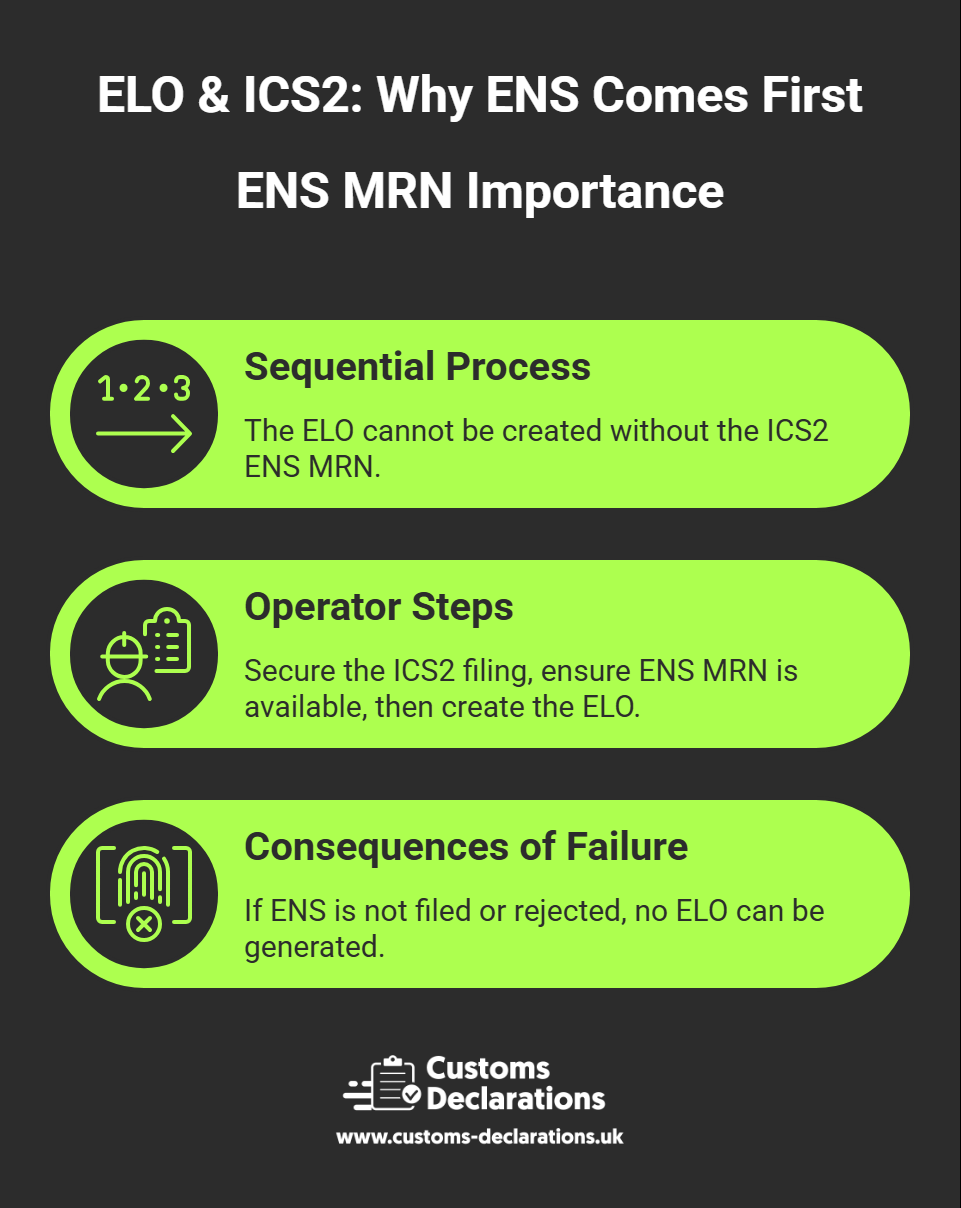
Here is where many operators misunderstand the relationship between the two systems: the ELO cannot be created without the ICS2 ENS MRN. The two are not parallel processes. They are sequential.
The practical sequence is straightforward, but it leaves little room for error. The operator must first secure the ICS2 safety and security filing, then make sure the relevant ENS MRN is available, and then create the ELO, which must include the ENS MRN reference.
This means that if your ENS has not been filed — or has been rejected — no ELO barcode can be generated, and no compliant border crossing can take place. If the ENS is filed too late, the driver can arrive ready to board but still be stuck waiting for the MRN and ELO chain to complete.
The End-to-End Process: Step by Step
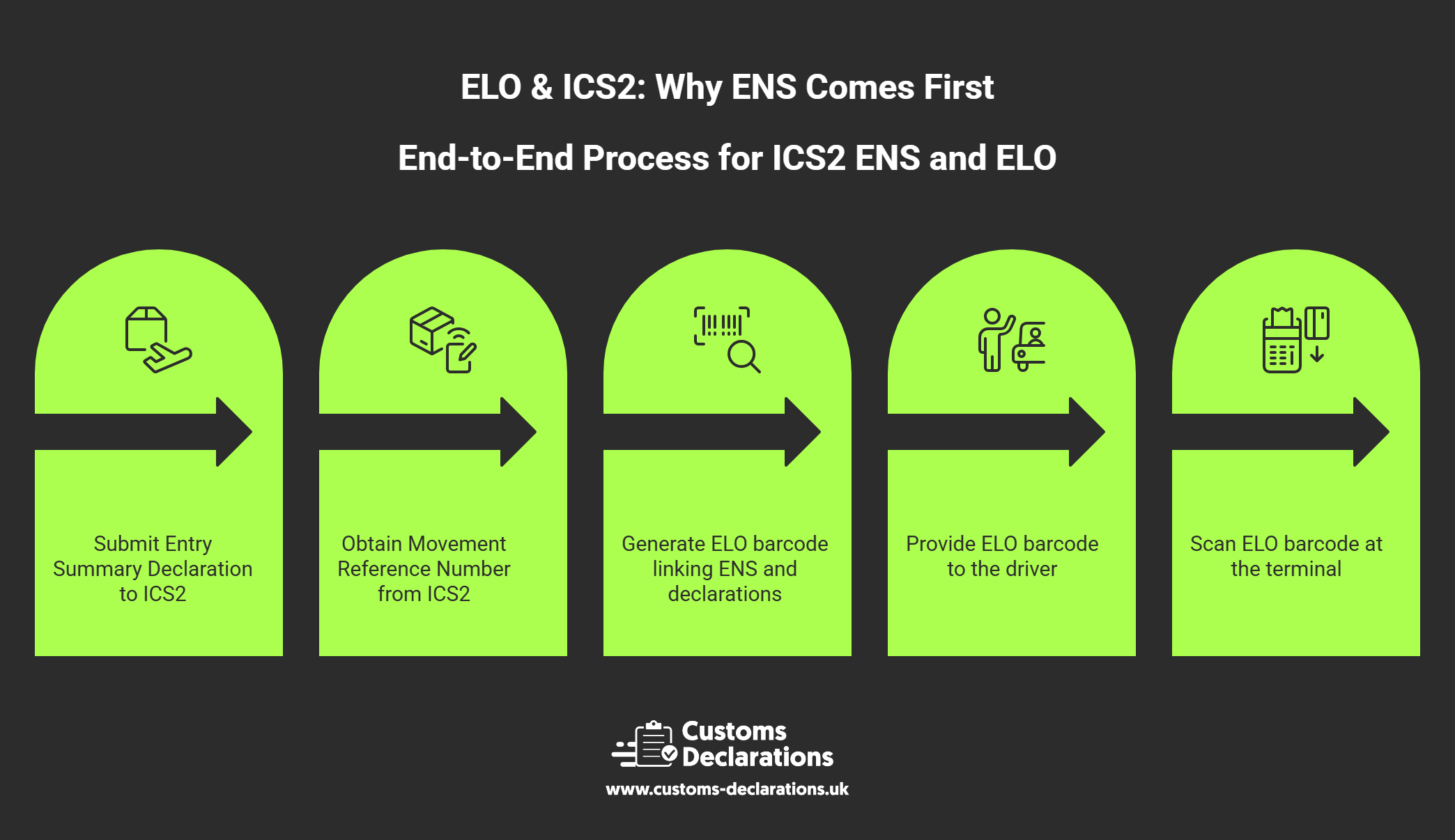
Here is the complete filing sequence every freight forwarder, exporter, and haulier operating on the UK–France corridor needs to follow:
Step 1 — File the ICS2 ENS Submit the Entry Summary Declaration to ICS2 ahead of the goods departing for the port. The ENS must contain accurate goods descriptions (no vague terms — ICS2 uses automated stop-word validation), correct 6-digit HS codes, valid EU or XI EORI numbers, and the correct transport mode code. For Channel Tunnel shuttle movements, the transport mode is coded as road (code 3), not rail, even though the truck travels on a train.
Step 2 — Receive your MRN Once ICS2 accepts the ENS, a Movement Reference Number is issued. This MRN is the essential link between the two systems. Without it, you cannot proceed to Step 3.
Step 3 — Create the ELO The ELO creator links the ICS2 ENS and the various customs declaration references — import, export, and transit declarations — to the haulier’s details through the Prodouane interface, generating a single, unique ELO barcode. The ELO creator is typically the freight forwarder or logistics operator — not the driver.
Step 4 — Share the barcode with the driver The driver receives the ELO barcode before departing for the port. This is their single reference document for the crossing — covering all EU-side declarations in one scannable code.
Step 5 — Present at the terminal At the ferry terminal or Channel Tunnel terminal, the ELO barcode is scanned and paired with the crossing. The Smart Border system then determines the vehicle’s routing, including whether it can continue or is directed to customs controls.
The entire chain — ENS filed, MRN received, ELO created, barcode with driver — must be complete before the truck reaches the terminal. There is no opportunity to catch up at the border.
What Happens Without a Valid ELO?
The consequences of arriving at Calais, Dunkirk, or the Channel Tunnel terminal without a valid, closed ELO barcode are immediate and operational. Vehicles may be refused boarding by the ferry or shuttle operator, directed to secondary inspection, or face formal notification of non-compliance to customs authorities. In any of these scenarios, the cost — in delays, missed delivery windows, and customer impact — is entirely avoidable.
Who Creates the ELO?
French Customs specifies that any actor within the logistics chain with the capacity to centralise all the necessary information for the border crossing may create an ELO. This can change from crossing to crossing.
In practice, the ELO is most commonly created by the freight forwarder or customs agent who also manages the ENS filing, since they already hold the MRN. Clear communication between all parties in the supply chain — exporter, forwarder, haulier, and driver — is essential to ensure the barcode reaches the driver before departure.
The Bottom Line
ICS2 and ELO are not two separate compliance tasks that can be managed independently. They are a single sequential workflow, and the ENS is the foundation. For operators managing the transition to mandatory ELO requirements, the ICS2 ENS MRN is the essential prerequisite for ELO barcode generation. Filing the ENS therefore directly supports the end-to-end Smart Border crossing workflow, from ENS submission through to driver check-in.
If your ENS process is manual, inconsistent, or not yet in place, that is the single most urgent action to address. The ELO will not function without it — and from 20 April 2026, neither will your UK–France freight movements.