Brazil is the world’s largest coffee producer, accounting for approximately one-third of global supply. From specialty single-origin beans to large-scale commercial blends, Brazilian coffee represents an exceptional commercial opportunity for UK importers. However, bringing coffee into Great Britain involves navigating a precise set of customs, food safety, phytosanitary, and documentation requirements. Getting these right from the outset is the difference between smooth clearance and costly delays at the border.
This guide walks through every stage of the import process—from business registration and supplier due diligence to product compliance, customs valuation, and filing your import declarations through a compliant, validated platform.
Preparing Your Business for Import
Before the first shipment can move, your business must be properly registered and authorised to engage in cross-border trade with HMRC.
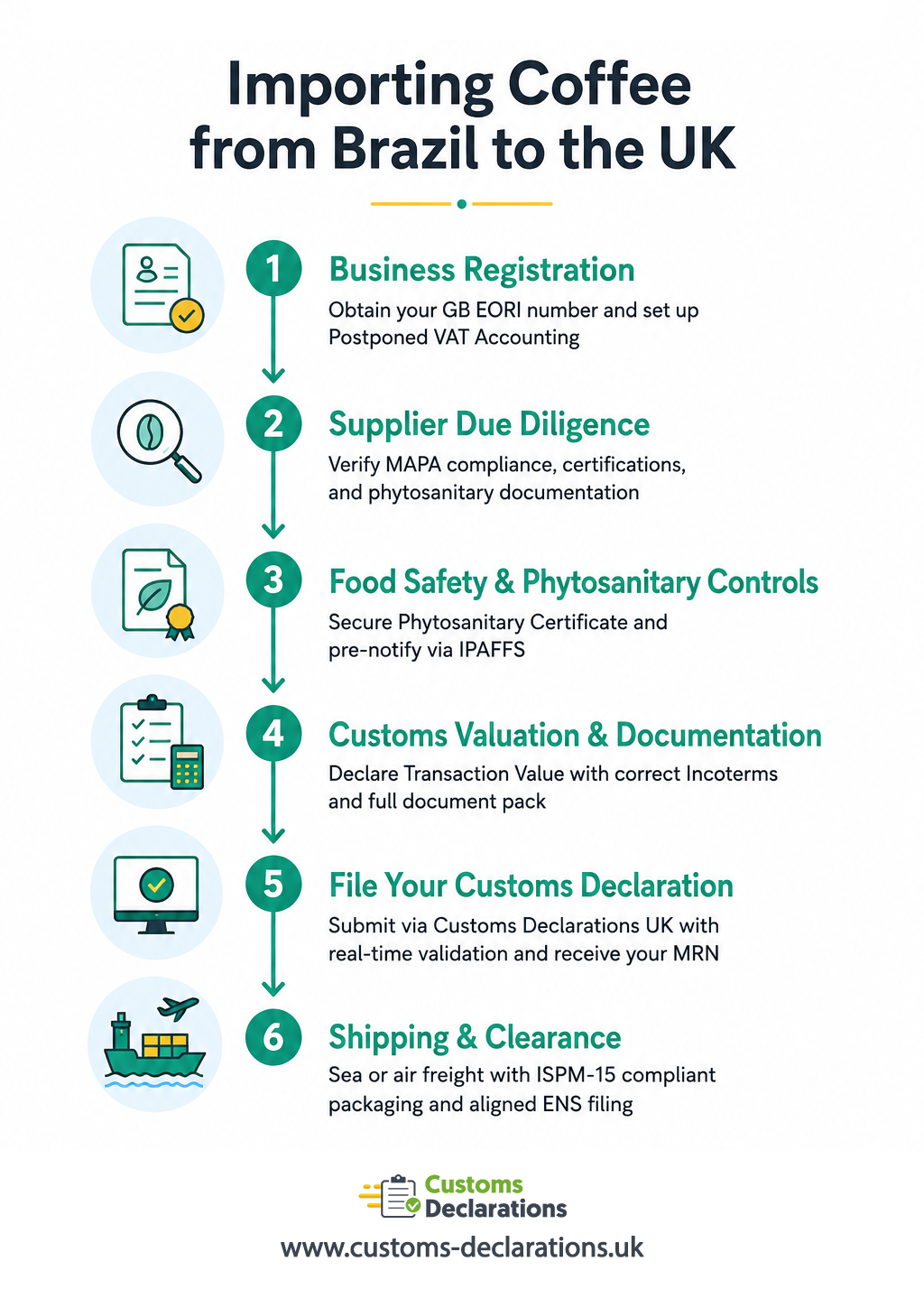
You will need a GB EORI number (Economic Operators Registration and Identification), which is the identifier that connects your business to every customs declaration, clearance, and import activity. Without it, no declaration can be submitted. Applications are made through GOV.UK and are typically issued within a few working days.
If your business is VAT-registered, you should set up Postponed VAT Accounting (PVA). Rather than paying import VAT at the frontier, PVA allows you to account for it on your periodic VAT return—improving cash flow significantly on high-volume import programmes. For larger or more frequent shipments, a Duty Deferment Account enables monthly payment of customs duty, further reducing transactional friction.
Sourcing Coffee and Conducting Supplier Due Diligence
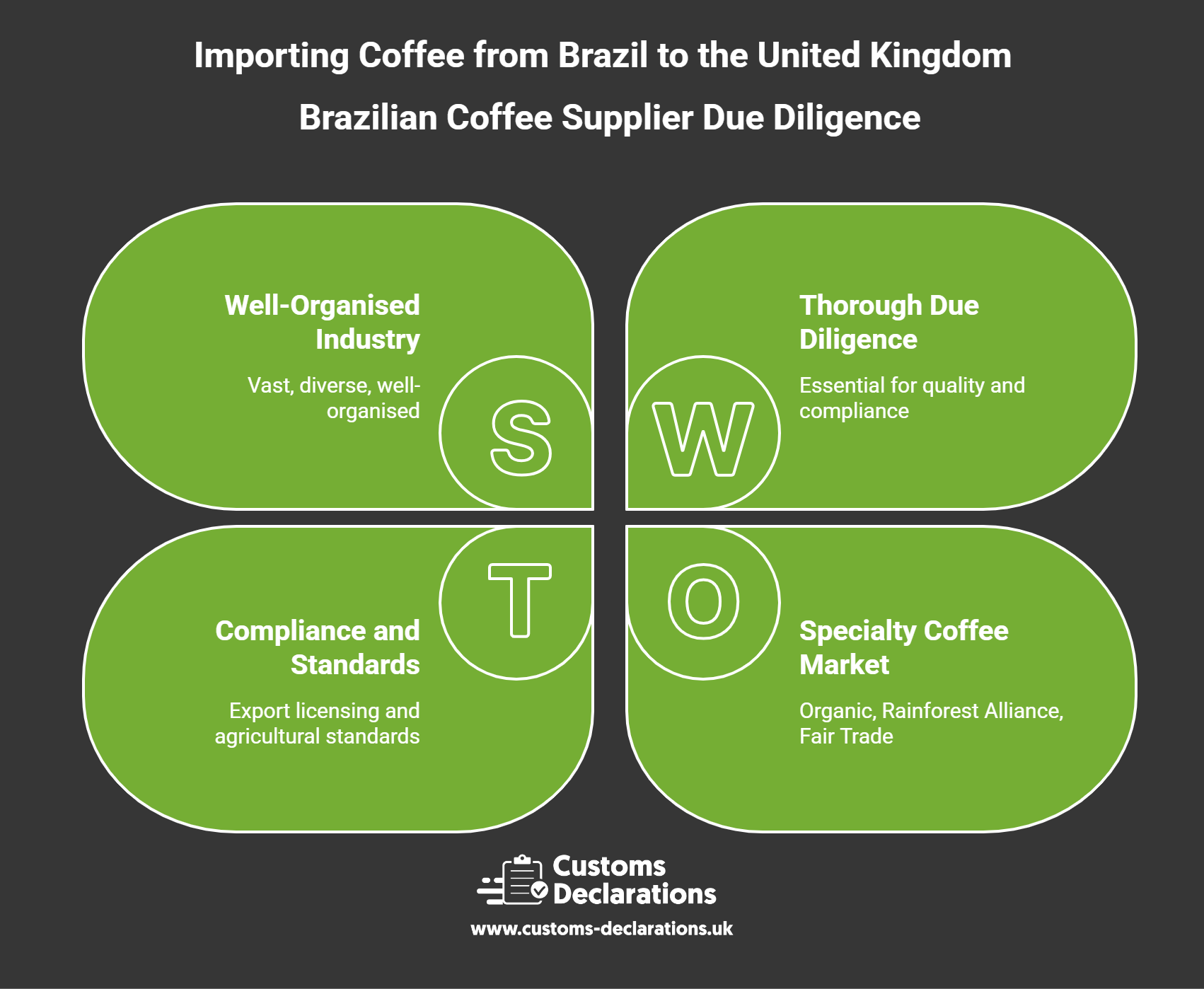
Brazil’s coffee industry is vast, diverse, and well-organised, but thorough due diligence remains essential. The principal growing regions—Minas Gerais, São Paulo, Espírito Santo, and Bahia—produce a range of arabica and robusta beans with distinct profiles. Whether sourcing green beans for roasting or finished roasted product, the selection of supplier directly affects both quality and compliance.
When evaluating Brazilian suppliers, verify their export licensing and compliance with Brazilian agricultural export standards governed by the Ministry of Agriculture, Livestock and Food Supply (MAPA). Request documentation such as phytosanitary certificates issued at origin, proof of farm or cooperative registration, and evidence of compliance with residue testing programmes. For specialty or certified coffee (organic, Rainforest Alliance, Fair Trade), ensure the supplier holds and can transfer valid third-party certifications that will be recognised by UK certification bodies.
Establish clear commercial terms including payment structure, Incoterms, quality standards, and complaint resolution. Requesting green sample lots before committing to full container volumes is standard practice and advisable for first-time lanes.
Commodity Classification and Duty Rates
Accurate classification under the UK Integrated Tariff is the foundation of every compliant customs entry. Coffee and coffee products fall under Chapter 9 of the tariff schedule, and the correct subheading depends on the form of the goods:
Green (unroasted) coffee, not decaffeinated, is classified under heading 0901.11. Roasted coffee, not decaffeinated, falls under 0901.21. Decaffeinated variants and coffee husks or extracts have their own subheadings. Coffee preparations and extracts move under heading 2101.
Getting the classification right is not merely a formality. It determines the applicable duty rate, any trade measures, and the regulatory controls attached to the entry. There is currently no free trade agreement between the UK and Brazil, meaning imports are subject to Most-Favoured-Nation (MFN) duty rates. Green coffee beans generally attract 0% duty under MFN terms, while roasted coffee and preparations may attract low positive rates depending on the subheading.
Food Safety, Phytosanitary, and Import Controls
Coffee is a regulated food product, and imports from Brazil into Great Britain are subject to a multi-layered set of controls administered by the Food Standards Agency (FSA), Animal and Plant Health Agency (APHA), and port health authorities.
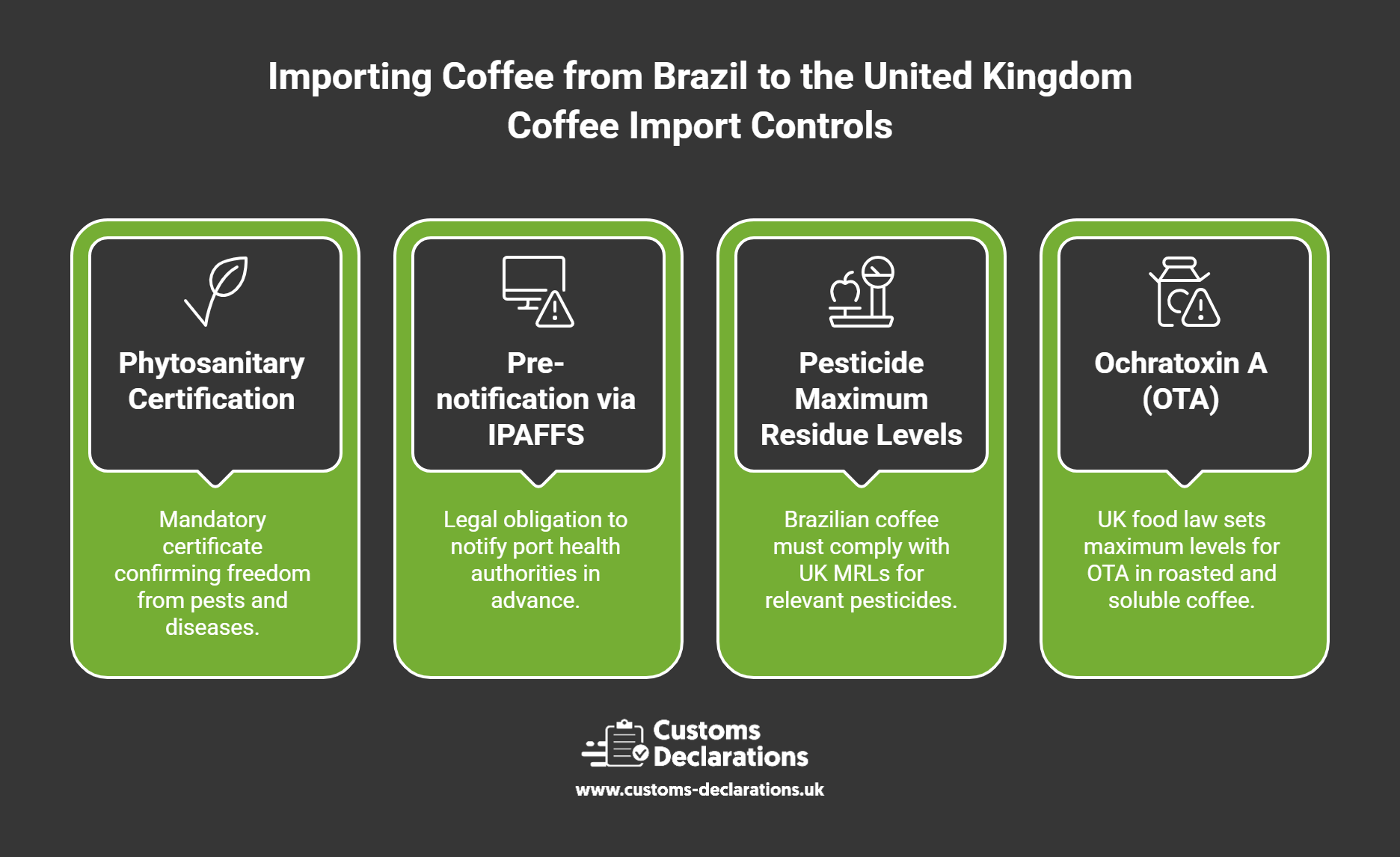
Phytosanitary certification is a mandatory requirement. Green coffee beans are plant products and must be accompanied by a Phytosanitary Certificate issued by MAPA in Brazil, confirming the consignment is free from quarantine pests and diseases. This certificate must be presented alongside the commercial documentation at the UK border. Failure to produce it will result in the consignment being held, subjected to official controls, or refused entry.
Pre-notification via IPAFFS (the Import of Products, Animals, Food and Feed System) is required for plant and plant product imports. Importers or their agents must notify the relevant port health authority in advance of arrival, using IPAFFS, so that checks can be scheduled. This is a legal obligation, not an optional step.
Pesticide Maximum Residue Levels (MRLs) represent another critical area. The UK maintains its own MRL schedule, which broadly mirrors Codex Alimentarius standards but has specific variations. Brazilian coffee must comply with UK MRLs for relevant pesticides. Where residue testing has been conducted, retain the certificates of analysis as part of your compliance file.
Ochratoxin A (OTA) is a naturally occurring mycotoxin associated with coffee. UK food law sets maximum levels for OTA in roasted coffee and soluble coffee products. Importers should ensure that pre-shipment testing is carried out and that results are retained for due diligence purposes.
For roasted or processed coffee imported in final packaging for consumer sale, food labelling obligations under UK food law apply. Labels must be in English, must state the country of origin, and must meet compositional and allergen declaration requirements as applicable.
Customs Valuation and Documentation
HMRC uses the Transaction Value method as the primary basis for customs valuation—the price actually paid or payable for the goods when sold for export to the UK. This value must include freight and insurance costs to the UK border, packing charges, and any commissions or other charges that are conditions of sale.
It is important to select and declare the correct Incoterm® for the shipment, as this defines which costs are included in the commercial invoice price and which are added for customs valuation purposes. FOB (Free on Board) is commonly used for coffee shipments from Brazil, placing freight and insurance costs on the importer. Under CIF (Cost, Insurance and Freight) terms, these are already embedded in the seller’s price. Whichever Incoterm is agreed, the customs value must represent the full cost to the UK frontier consistently across all commercial documents.
The essential documentation set for a compliant import of coffee from Brazil includes the commercial invoice and packing list; a bill of lading or airway bill; a certificate of origin; the phytosanitary certificate issued by MAPA; any organic, Fair Trade, or other third-party certification as applicable; pre-shipment residue analysis or quality certificates; and the customs declaration submitted via CDS.
All documents must be internally consistent. Discrepancies between the invoice value, packing list quantities, and the declared customs value are a common trigger for HMRC queries and port health holds.
Filing Customs Declarations with Customs Declarations UK
Submitting accurate, validated CDS declarations to HMRC is where preparation and compliance converge into a live border process. The Customs Declarations UK (CDUK) platform is a cloud-based, HMRC-integrated solution purpose-built to guide importers, freight forwarders, and customs agents through the entire declaration process.
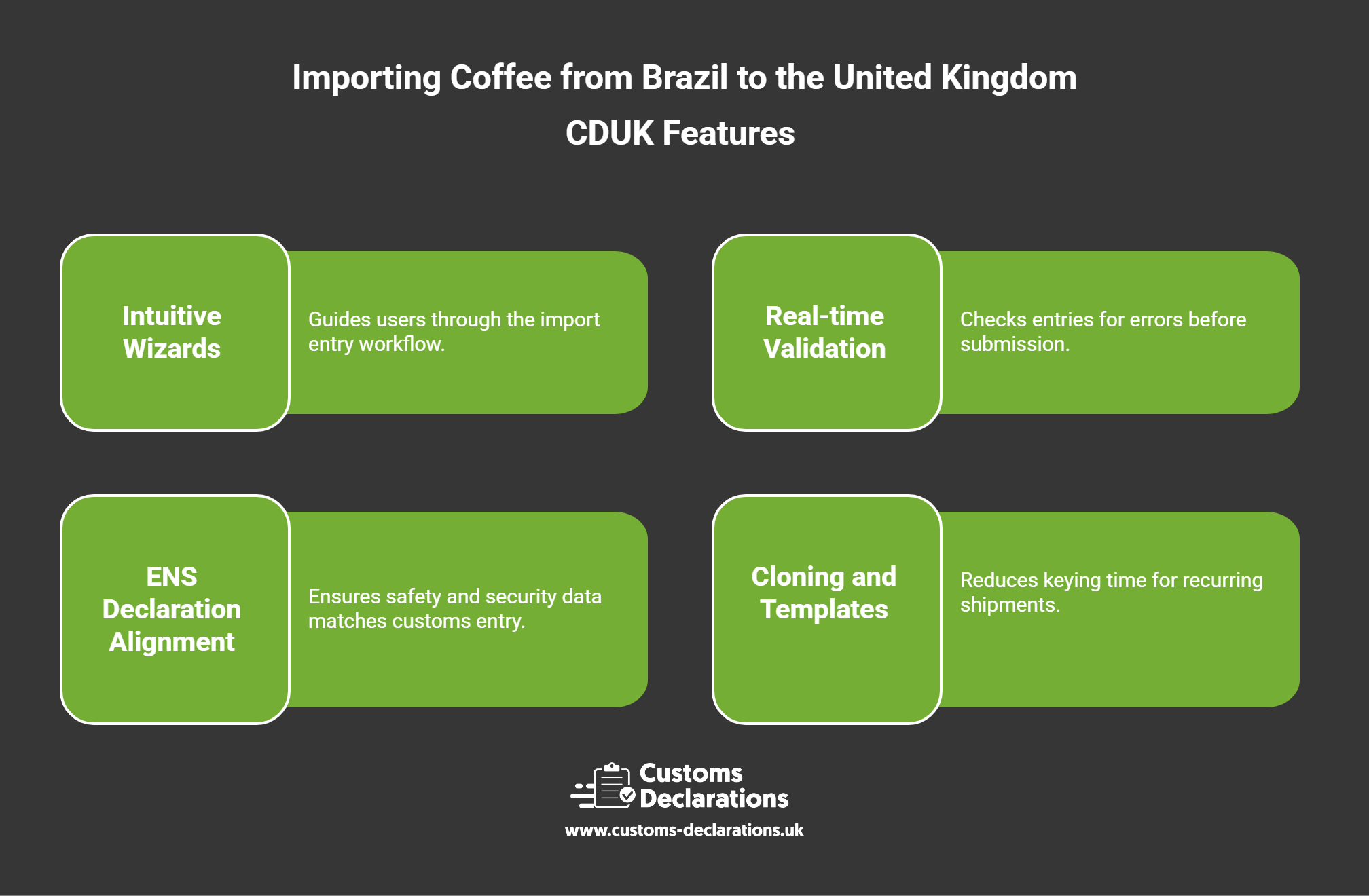
Using CDUK, importers of Brazilian coffee can complete the full import entry workflow through intuitive, plain-English wizards that map directly to HMRC’s Customs Declaration Service data requirements. The platform guides users through inputting importer and supplier identities, commodity classification, customs value and Incoterms, country of origin, and any supporting document references—including the phytosanitary certificate and any preference or licence references applicable to the consignment.
One of CDUK’s most operationally valuable features is real-time validation, which checks entries for missing fields, inconsistent data, and classification errors before the declaration is transmitted to HMRC. For food imports where the cost of a border hold is high, this pre-submission check dramatically reduces the risk of avoidable clearance failures. On acceptance by HMRC, the platform instantly generates the Movement Reference Number (MRN), which serves as the formal release confirmation and must be shared with the carrier and port authority.
Where shipments also require an ENS (Entry Summary Declaration) for safety and security purposes—as is the case for most sea freight movements into UK ports—CDUK enables importers and their forwarders to ensure that safety and security data aligns precisely with the customs entry. Mismatches between ENS and customs declaration data are one of the most common, and most avoidable, causes of port holds. You can explore the full range of CDUK’s ENS declaration services alongside its import and export capabilities.
For businesses managing recurring Brazil-to-UK coffee lanes, CDUK’s cloning and template functionality allows previously submitted declarations to be reused and adapted for new shipments, reducing keying time significantly for repeat commodity codes, supplier relationships, and port corridors.
Shipping and Logistics Considerations
The majority of commercial coffee shipments from Brazil to the UK travel by sea freight, typically in 20-foot or 40-foot containers or as groupage (LCL) for smaller volumes. Transit times from Brazilian ports such as Santos, Rio de Janeiro, or Paranaguá to UK ports typically range from 18 to 28 days depending on routing and whether the service is direct or transshipment.
Green coffee beans travel well in standard dry containers, though temperature and humidity management are important considerations for longer voyages or during periods of extreme weather. Roasted coffee, being more sensitive to oxidation, is typically exported in sealed, vacuum-packed or nitrogen-flushed packaging to preserve freshness during transit.
For smaller, high-value, or urgent specialty coffee consignments, air freight offers significantly shorter transit times of 1 to 3 days but at considerably higher cost. Many specialty roasters and importers use air freight for small trial lots or limited micro-lot releases.
Wooden pallets and packaging materials used in the shipment must comply with ISPM-15 (the International Standards for Phytosanitary Measures), which requires heat treatment or methyl bromide fumigation and the appropriate stamp markings. Non-compliant timber packaging can result in the entire consignment being stopped at the UK border, regardless of the condition of the goods themselves.
Conclusion: Building a Compliant, Scalable Import Programme
Importing coffee from Brazil to the United Kingdom is a commercially rewarding and operationally achievable undertaking when approached with the right level of preparation. The regulatory landscape spans customs duties, phytosanitary controls, food safety standards, and residue compliance—each of which carries its own documentation requirements and potential consequences for non-compliance.
The businesses that operate this lane most efficiently are those that treat documentation, classification, and declaration accuracy as integrated disciplines rather than separate administrative tasks. Investing in robust supplier relationships, consistent valuation practices, timely IPAFFS pre-notification, and a validated declaration process through the Customs Declarations UK platform positions importers to clear goods predictably, satisfy HMRC audit requirements, and scale their import programme with confidence.
From a single specialty micro-lot to full container programmes, the framework outlined in this guide provides the compliance foundation every importer needs to make Brazilian coffee a reliable and well-governed part of their UK trade operation.