Pre-loader

Importing Organic Food Products from France to the United Kingdom: Certification, Labelling, and Customs Compliance

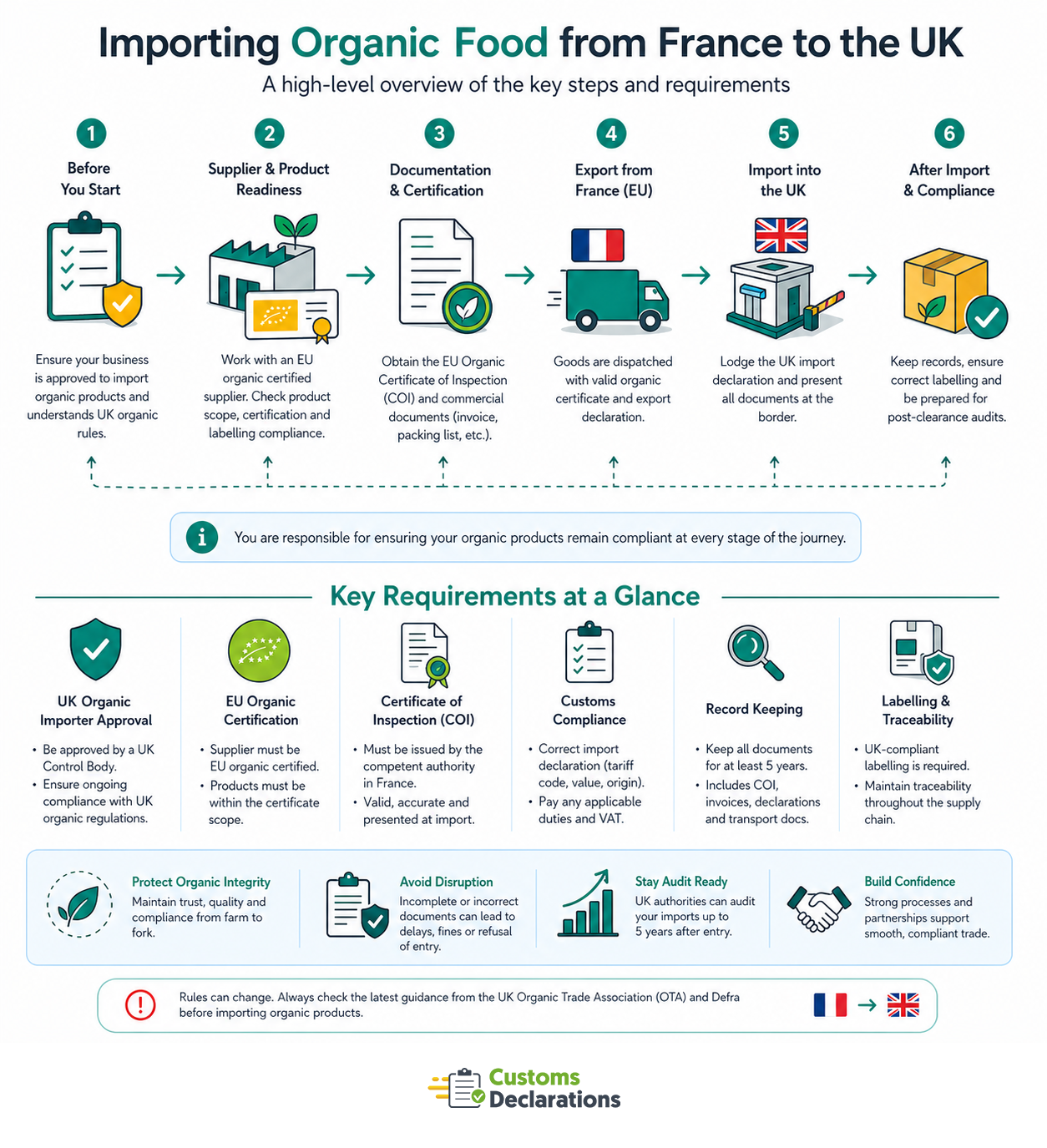
Importing organic food products from France to the United Kingdom has become a more structured and documentation-intensive process since Brexit. What was once a seamless transaction within the European single market now requires full compliance with UK customs procedures, organic certification recognition frameworks, import health controls, and product labelling obligations. For importers navigating this landscape, understanding each layer of regulation is essential—not only to avoid costly delays at the border but to protect the integrity of the organic designation that commands premium pricing in the UK market.

This guide walks through the entire process, from certification and labelling through to filing your import declarations via HMRC’s Customs Declaration Service.

1. Establishing Your Import Framework After Brexit

Since the end of the Brexit transition period, goods travelling from France into Great Britain are treated as imports in the full legal sense. There is no longer any simplified or friction-free movement based on EU single market membership. Importers must hold a valid GB EORI number (Economic Operators Registration and Identification), which is the unique identifier linking your business to all customs activity with HMRC. If you have not already obtained one, you can apply via GOV.UK.

The UK–EU Trade and Cooperation Agreement (TCA) provides for zero tariffs on goods of EU preferential origin, which applies to most food products originating in France, provided that appropriate proof of origin is maintained and declared. However, zero tariffs do not eliminate the obligation to submit full customs declarations, comply with import health conditions, or meet organic-specific regulatory requirements. These remain entirely separate obligations that must be satisfied before goods can be released to the UK market.

2. UK Organic Certification Recognition: What Importers Must Know

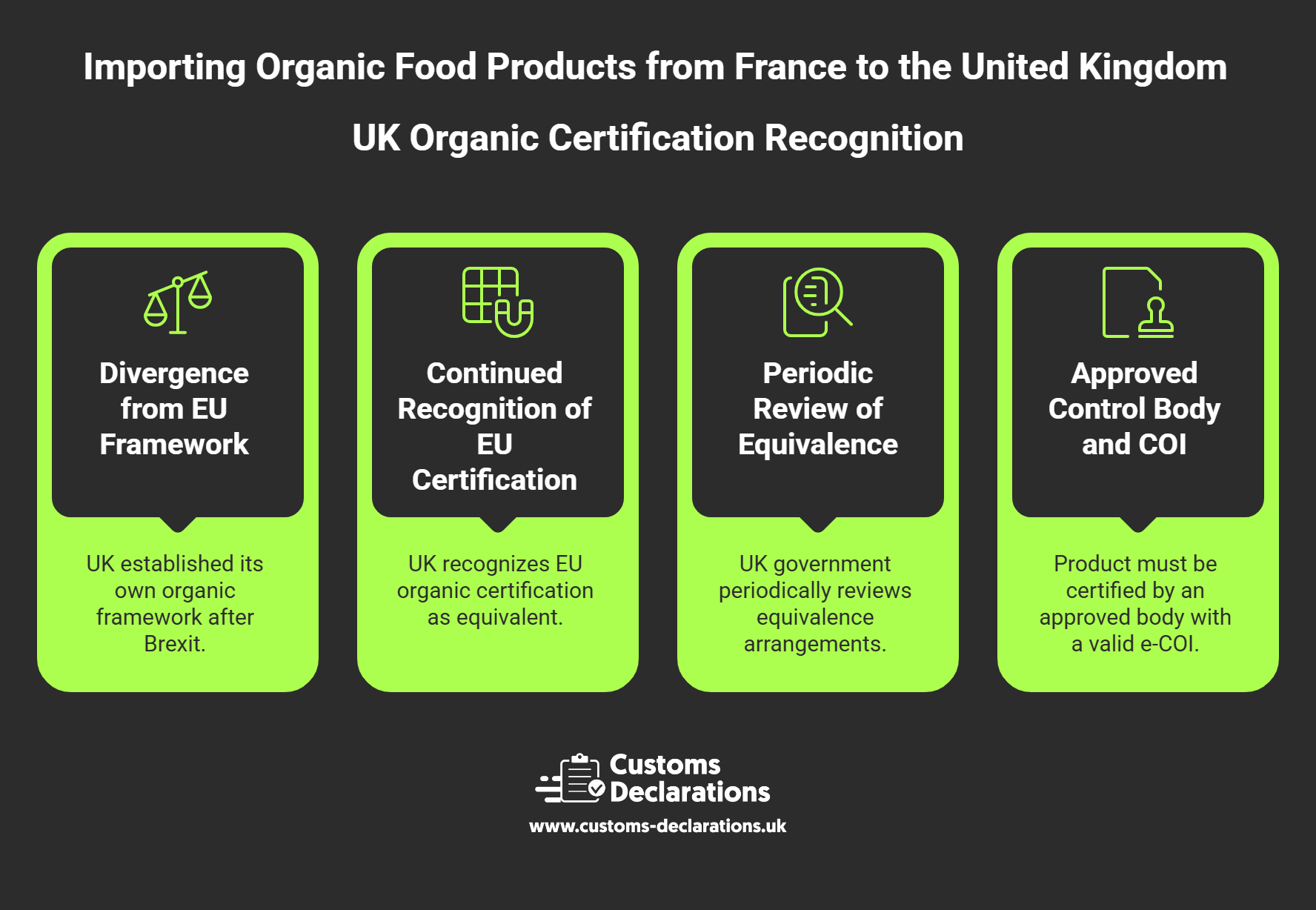
One of the most consequential changes for organic food importers is the UK’s divergence from the EU’s organic regulatory framework. Prior to Brexit, EU Regulation 2018/848 governed organic production and labelling across all member states, including France. Following the UK’s departure, Great Britain established its own organic framework under the Organic Products Regulations 2009 (as retained and amended in UK law), with oversight resting with the UK Organic Control Bodies, which are approved by Defra.

Critically, the UK government has confirmed that it continues to recognise EU organic certification for imports from EU member states, including France, as equivalent to UK standards. This means that organic goods certified by an EU-approved control body—such as Ecocert, Bureau Veritas Certification (BVC), or any of the bodies recognised by the French national authority—are accepted for sale in Great Britain under the UK organic mark, subject to appropriate documentation.

Importers should not treat this recognition as permanent or unconditional. The UK government periodically reviews equivalence arrangements, and any regulatory divergence between UK and EU organic standards in the future could affect market access. Monitoring updates from Defra and the UK’s Organic Control Bodies is essential for businesses relying on French-sourced organic goods as a significant part of their supply chain.

To lawfully sell organic food in the UK, the product must have been certified by an approved organic control body and be accompanied by a valid Certificate of Inspection (COI)—now issued as an electronic COI (e-COI) via the TRACES NT system. This document must be presented at the border and forms a core part of the import documentation pack.

3, Labelling Requirements for Organic Food Products

Labelling is a compliance area where importers frequently encounter problems, particularly when repacking or relabelling goods after importation. Under UK organic rules, any product sold as organic in Great Britain must display the UK Organic logo (or an approved logo from a recognised UK or EU control body), alongside the certification code of the relevant control body.

For goods imported from France and sold directly in their original EU-certified packaging, the EU organic logo may be used on products placed on the GB market provided the underlying EU certification remains valid and the product meets UK organic standards through the equivalence arrangement. However, it is good practice to include UK importer details—your business name, trade name, and UK address—either on the product itself, the packaging, or on an attached label. This is a legal requirement under UK product-law frameworks applicable to imported goods and mirrors obligations that apply across other product categories.

Where goods are repacked or relabelled in the UK before retail, the importer takes on the role of the last operator in the organic chain and must ensure the repackaging operation is notified to and approved by a UK-authorised control body. Failure to notify a change of packaging can result in loss of the organic designation, which carries significant commercial consequences.

Labels must also accurately state the country of origin where required by food labelling law, and the language must be in English. Bilingual or French-only labels are not acceptable for products sold to end consumers in Great Britain.

4. Import Controls and Border Health Requirements

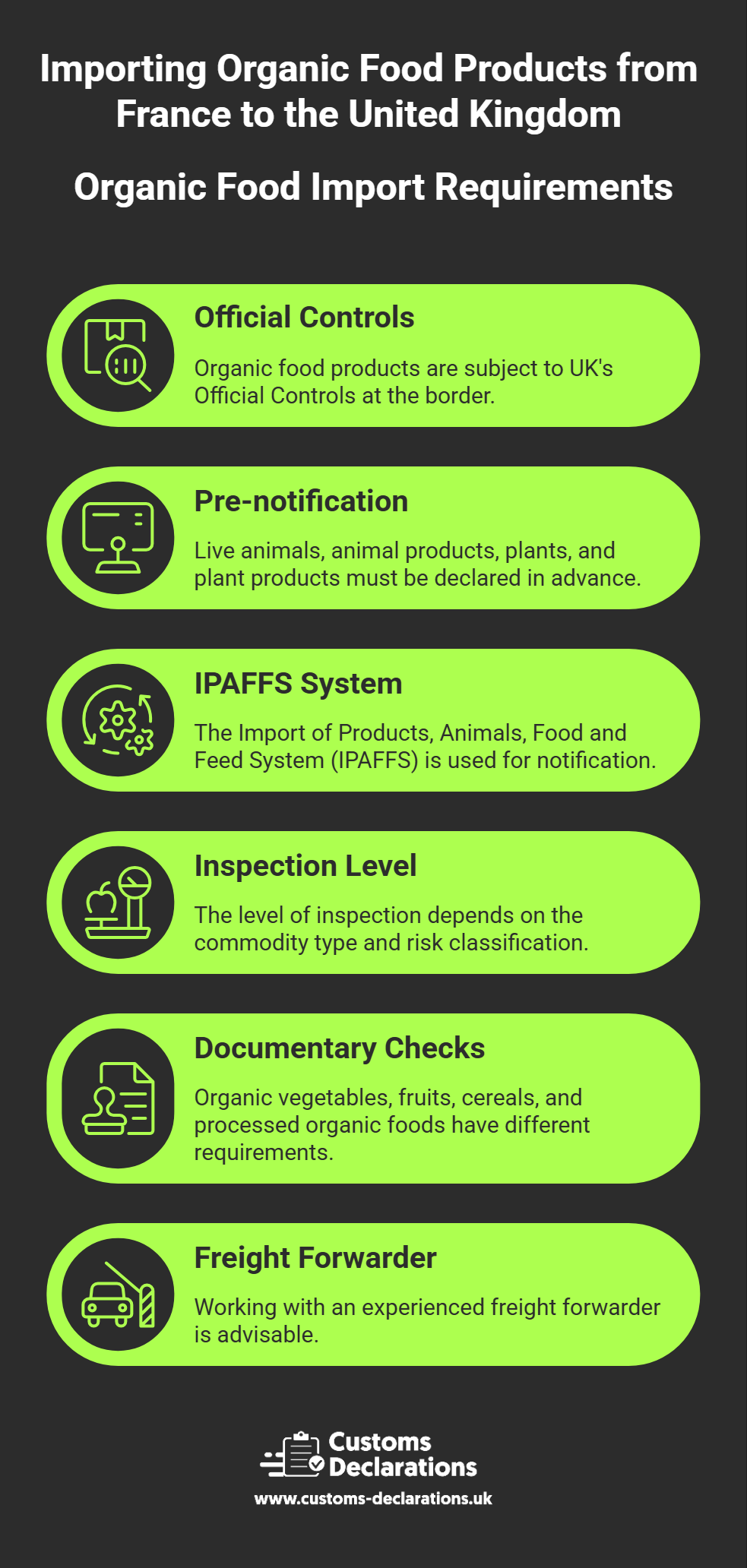
Organic food products imported from France are subject to the UK’s Official Controls at the border, which require pre-notification of certain categories of goods. Live animals, animal products, plants, and plant products must be declared in advance using the Import of Products, Animals, Food and Feed System (IPAFFS), which is HMRC’s and Defra’s coordinated notification platform for sanitary and phytosanitary controls.

The level of physical inspection and documentary checking at the border depends on the commodity type and the risk classification applied to it. Organic vegetables, fruits, cereals, and processed organic foods are subject to different documentary and identity-check requirements. Importers are strongly advised to establish which category their goods fall into and to pre-notify correctly in IPAFFS before the goods arrive at the UK border. Failure to pre-notify is itself a legal offence and can result in the goods being detained or returned.

Working with a suitably experienced freight forwarder or customs broker who is familiar with the combined organic and sanitary control requirements for French food imports is advisable, particularly during the first shipments of a new product line.

5. Customs Classification, Valuation, and Duty

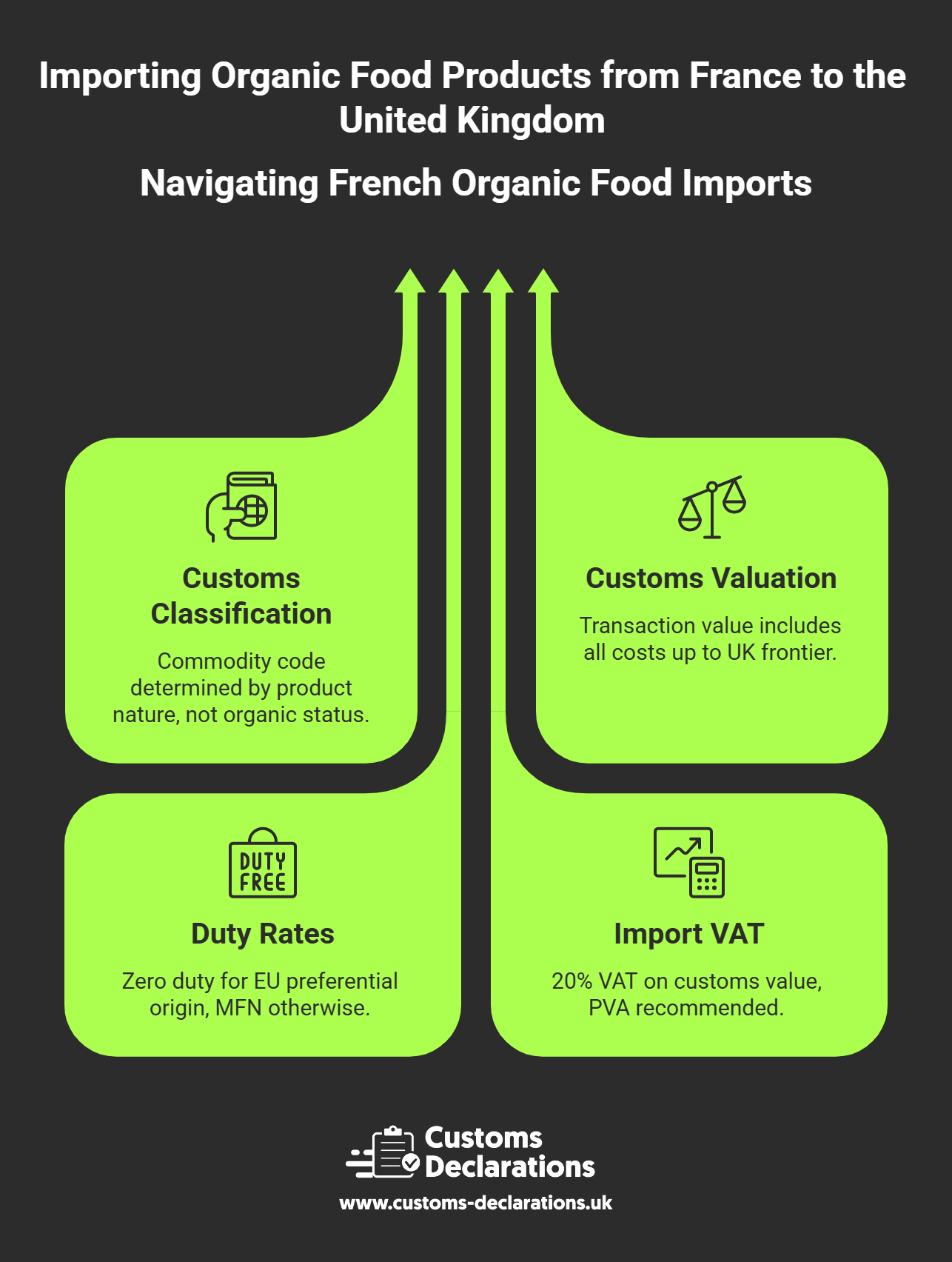
Accurate tariff classification is foundational to every compliant customs declaration. Organic food products are not treated as a distinct category within the UK Integrated Tariff; the commodity code is determined by the nature of the product itself—whether it is fresh fruit, processed grain, dairy, or a packaged food product. Each falls within a specific chapter of the tariff schedule, and the organic designation does not alter the commodity code or the duty rate.

Customs valuation for organic food imports follows the transaction value method—the price actually paid or payable for the goods sold for export to the UK. This must include freight, insurance, and any charges up to the UK frontier. Importers should ensure that their commercial invoice clearly identifies the goods, the quantity, the unit price, and the Incoterms agreed with the French supplier. Where the price paid reflects a premium for organic certification, this does not create a separate valuation obligation; the transaction value is simply the agreed price.

Under the UK–EU Trade and Cooperation Agreement, goods of EU preferential origin attract zero customs duty. For most organic food products originating in France—meaning they have been produced in accordance with EU origin rules, not merely shipped through France—the applicable duty rate will be zero. However, the origin must be declared correctly on the customs declaration and supported by a Statement on Origin from the French exporter or, in certain cases, by the importer’s own knowledge of the goods’ origins. Without adequate origin evidence, goods must be declared at the applicable Most-Favoured-Nation (MFN) duty rate, which for some food categories can be substantial.

Import VAT at the standard rate of 20% applies to the customs value, including any applicable duty. VAT-registered businesses can make use of Postponed VAT Accounting (PVA), which allows import VAT to be accounted for on the VAT return rather than paid at the frontier, improving cash flow without compromising the audit trail. This is the recommended approach for regular importers of French organic food.

6. Documentation Requirements

A complete and consistent documentation pack is essential for every shipment of organic food from France. The core documents that importers must prepare and retain include the commercial invoice and packing list, the bill of lading or CMR road transport document, the electronic Certificate of Inspection confirming organic certification, the Statement on Origin for TCA preference purposes, the IPAFFS pre-notification reference, and the accepted customs declaration with its Movement Reference Number (MRN). All records should be retained for a minimum of six years in accordance with HMRC’s statutory requirements, and should be organised so that the customs declaration, the organic certificate, and the commercial documentation can be reconciled instantly during an audit.

7. Filing Customs Declarations with Customs Declarations UK

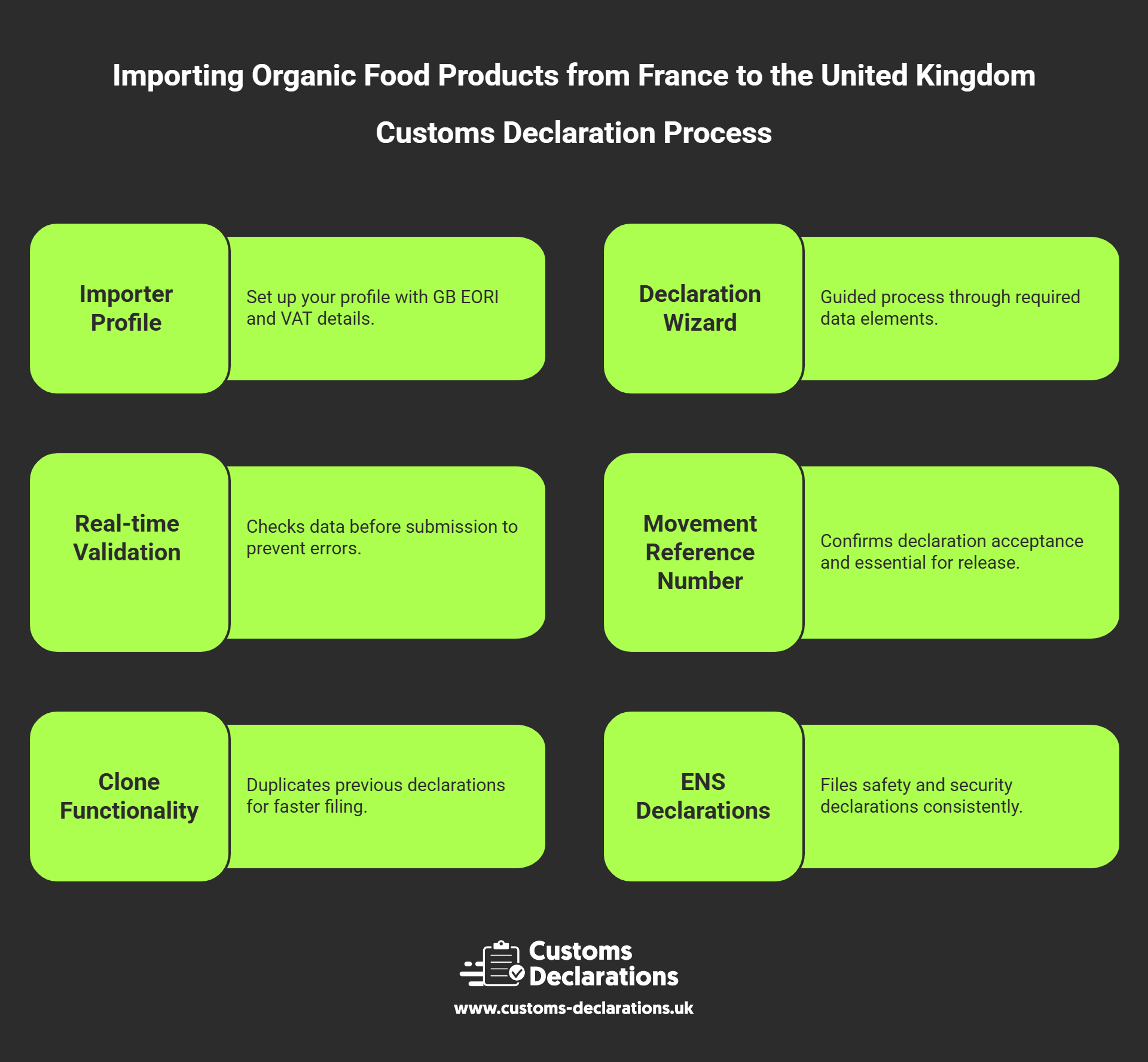
Filing a CDS declaration for organic food imports from France is a structured process that requires accuracy across all data elements. The Customs Declarations UK platform provides importers with a guided, validated pathway into HMRC’s Customs Declaration Service, making this process accessible and audit-ready even for businesses managing declarations in-house without specialist customs staff.

Within the platform, importers begin by setting up their importer profile, including their GB EORI number and VAT registration details. These are reused across all declarations, eliminating repetitive data entry. When creating a new import declaration for a shipment of French organic food, the wizard guides the user through each required data element: the commodity code, the commercial description of the goods, the customs value and its components, the Incoterms agreed with the French supplier, the country of origin, and the preference claim under the TCA where applicable.

One of the most valuable features for organic food importers is the real-time validation engine, which checks each data element before the declaration is transmitted to HMRC. Common errors—such as mismatches between declared values and invoice totals, missing supporting document references, or incomplete party identifiers—are flagged at the point of entry rather than after submission, preventing rejections that cause border delays. For organic imports specifically, the IPAFFS pre-notification reference can be recorded in the relevant documentary field, ensuring that the declaration and the health control notification are aligned.

Upon acceptance by HMRC, Customs Declarations UK platform immediately returns the Movement Reference Number (MRN), which confirms that the declaration has been lodged and accepted. This number is essential for port release procedures and must be shared with the freight forwarder and carrier. The full declaration record is then archived securely within the platform for the statutory six-year retention period, providing a single, accessible source of truth for any subsequent HMRC audit or market surveillance enquiry.

For importers managing multiple regular lanes—such as weekly shipments of organic produce from a consistent French supplier— Customs Declarations UK platform’s clone functionality allows a previously accepted declaration to be duplicated and updated, dramatically reducing the time required to prepare each new filing. Combined with bulk data upload capabilities for high-volume operators, this makes the platform well suited to the operational rhythm of businesses importing organic food at commercial scale.

Additionally, where safety and security ENS declarations are required—as is the case for certain movements into GB ports operating under the GVMS regime—the platform allows these to be filed consistently with the import declaration data, reducing the risk of mismatches between the carrier’s safety and security filing and the customs entry that are a frequent cause of avoidable holds at the border.

Conclusion: A Compliant and Scalable Framework for Organic Food Imports

Importing organic food products from France to the United Kingdom demands precision across certification, labelling, border health controls, customs valuation, and declaration filing. Each layer of regulation is connected: an error in organic documentation affects the product’s marketability; an error in the customs declaration affects its release from the border. Treating these as a single, integrated compliance workflow—rather than separate administrative tasks—is the most reliable approach.

For businesses ready to manage declarations efficiently and in-house, the Customs Declarations UK platform provides the guided workflows, real-time validation, and secure archiving needed to file confidently with HMRC’s Customs Declaration Service. Pair this with robust supplier documentation practices, a clear origin strategy under the TCA, and timely IPAFFS pre-notifications, and organic food imports from France can become a well-governed, repeatable, and commercially efficient part of your supply chain.

We value your feedback, and if you have any comments, suggestions or anything else that you would like to highlight to us, we will be delighted to hear from you and incorporate your feedback into our content.

Note: While we have made every attempt to ensure that the information contained in this Site has been obtained from reliable sources, Customs Declarations UK is not responsible for any errors or omissions, or for the results obtained from the use of this information. All information in this Site is provided “as is”, with no guarantee of completeness, accuracy, timeliness or of the results obtained from the use of this information, and without warranty of any kind, express or implied, including, but not limited to warranties of performance, merchantability and fitness for a particular purpose. Nothing herein shall to any extent substitute for the independent investigations and the sound technical and business judgment of the reader. In no event will Customs Declarations UK, or its partners, employees or agents, be liable to you or anyone else for any decision made or action taken in reliance on the information in this Site or for any consequential, special or similar damages, even if advised of the possibility of such damages. Certain links in this Site connect to other Web Sites maintained by third parties over whom Customs Declarations UK has no control. Customs Declarations UK makes no representations as to the accuracy or any other aspect of information contained in other Web Sites.