Pre-loader

ICS2 Stop Words Update: What the 4 May 2026 Changes Mean for Your ENS Declarations

The European Commission’s Directorate-General for Taxation and Customs Union has published a further update to the list of stop words and phrases prohibited in Entry Summary Declaration (ENS) goods descriptions under the Import Control System 2 (ICS2). Nine new terms become enforceable on 4 May 2026, adding to the growing body of banned language already active since the system’s initial deployment. Carriers, freight forwarders, customs agents, and anyone filing ENS declarations must audit their commodity description templates and standard operating procedures before that date to avoid automatic rejection by the ICS2 Common Repository.

What Are ICS2 Stop Words and Why Do They Exist?

ICS2 is the EU’s advance cargo information and risk management system, requiring traders and carriers to lodge Entry Summary Declarations before goods arrive at an EU border crossing. A central objective of ICS2 is the improvement of ENS data quality — specifically, the accuracy and specificity of goods descriptions that customs authorities use for pre-arrival risk assessment and safety screening.

Stop words and phrases are terms that the European Commission has identified as too vague, generic, or ambiguous to serve any meaningful purpose in a goods description field. When a prohibited term appears in a submitted ENS declaration — whether as the sole description or embedded within a longer entry — the ICS2 Common Repository rejects or flags the filing. The underlying principle is straightforward: a goods description must enable a customs officer to understand, at a glance, what is actually being transported. Terms such as “Miscellaneous,” “Unknown,” or “Goods” provide no actionable intelligence and therefore have no place in a compliant ENS submission.

The stop word initiative is issued under reference TAXUD.A.3.003/TA from the Commission’s Risk Management and Security unit. It applies uniformly across all ICS2 participating countries and across all ENS filing types, with singular and plural forms treated interchangeably.

What Was Already in Force

Before examining the 4 May 2026 additions, it is helpful to understand the scale and scope of what has already been implemented. The initial list, introduced in Spring 2025, prohibited a wide range of generic goods description terms. These included broad category words such as “Accessories,” “Chemicals,” “Electronics,” “Equipment,” “Machinery,” “Materials,” “Parts,” “Products,” “Spare parts,” “Textiles,” “Vehicles,” and “Goods” itself. Also banned were terms describing shipment handling rather than cargo content — “Consolidated cargo,” “General cargo,” “Courier goods,” and “Said to Contain” — along with placeholder language such as “Unknown,” “Not available,” “N/A,” and “See invoice.”

A further update effective 2 February 2026 extended the list to include terms such as “Aid products,” “Comercial,” “Consumption,” “Ensemble,” “Fake,” “Headwear,” “Item,” “Miscellaneous,” “N/A,” “Oddments,” “Promotional,” and “Vegan,” among others. At the same time, restrictions were applied to party name and address fields, prohibiting placeholder entries such as “00200,” “NA,” “N/A,” “Name,” “Not available,” “Numbers,” “Please select,” “Private,” “Sir,” “Sr,” “To order,” “Unknown,” and “xxxx.”

The declaration for an empty movement differs in content from that of a loaded one, but the obligation to file in advance remains identical. Operators should not interpret the absence of cargo as an exemption from the pre-arrival declaration process.

The 4 May 2026 Update: What Is New

The additions taking effect on 4 May 2026 are concentrated in a specific category of shipping shorthand that has long been common practice in the freight industry but which the Commission has now formally prohibited in ENS goods description fields. All nine new terms relate to shipper-loaded container conventions and acknowledgements of limited cargo visibility at the time of filing. They are as follows.

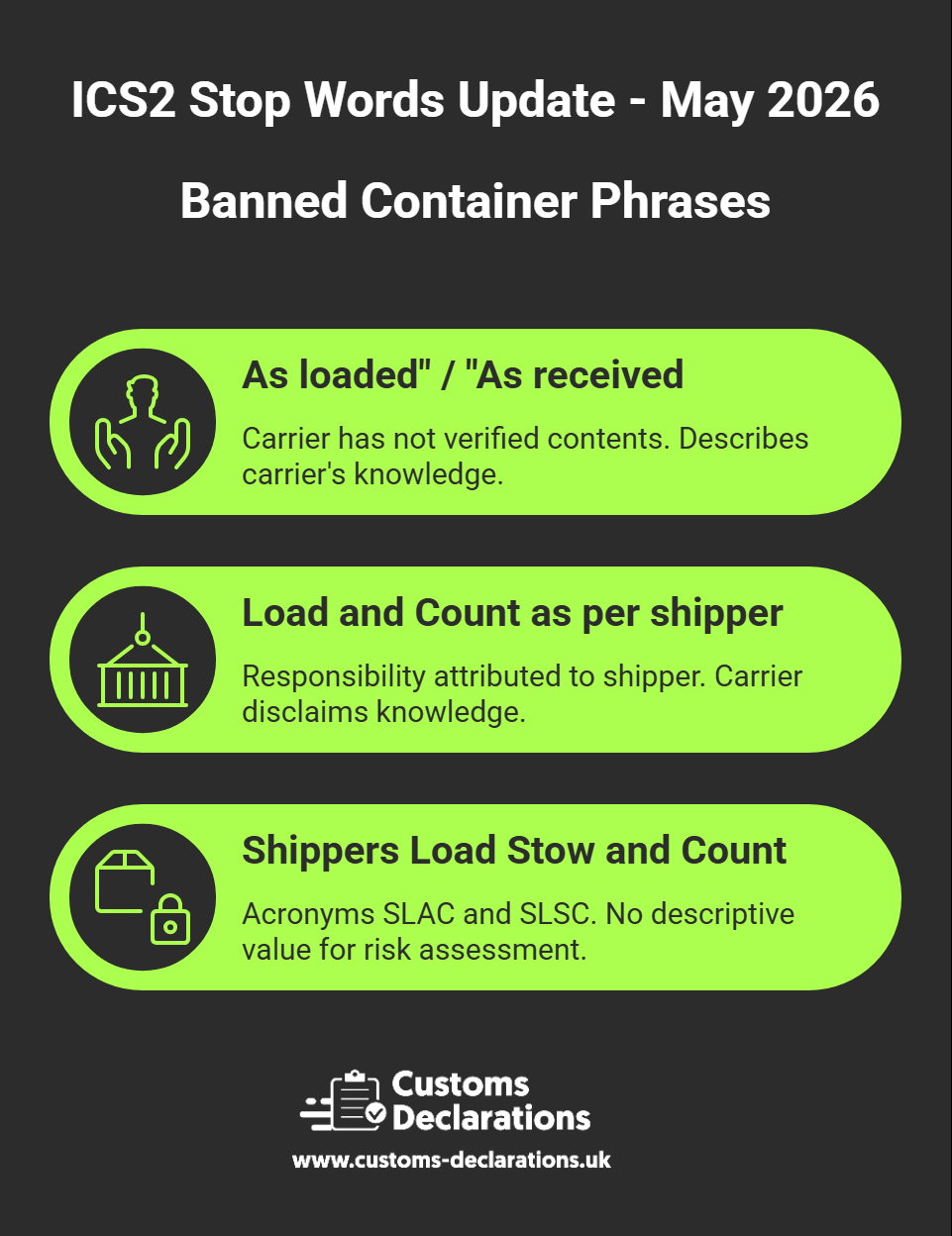
“As loaded” and “As received” — both individually and in the combined form “As loaded / as received” — are phrases typically used when a carrier has not verified the contents of a container or consignment. They describe the carrier’s state of knowledge rather than the nature of the goods, and are now banned accordingly.

“Load and Count as per shipper”, “Loaded by shipper”, and “Shipper Load and Count” are variations of the same concept: responsibility for the load being attributed to the shipper, with the carrier disclaiming direct knowledge of the cargo. These phrases, often used for shipper-packed containers (SPCs) and full container loads (FCLs), may reflect operational reality but are not acceptable as goods descriptions in ENS filings.

“Shippers Load Stow and Count”, along with its common abbreviations “SLAC” and “SLSC”, completes the new set. These acronyms are well-established in container shipping documentation but have no descriptive value from a customs and security risk assessment perspective.

The common thread across all nine terms is that they describe how a consignment was loaded rather than what the consignment contains. Under ICS2, the goods description field must answer the latter question. From 4 May 2026, the Common Repository will treat any ENS submission containing these terms as non-compliant.

Understanding the Broader Principle

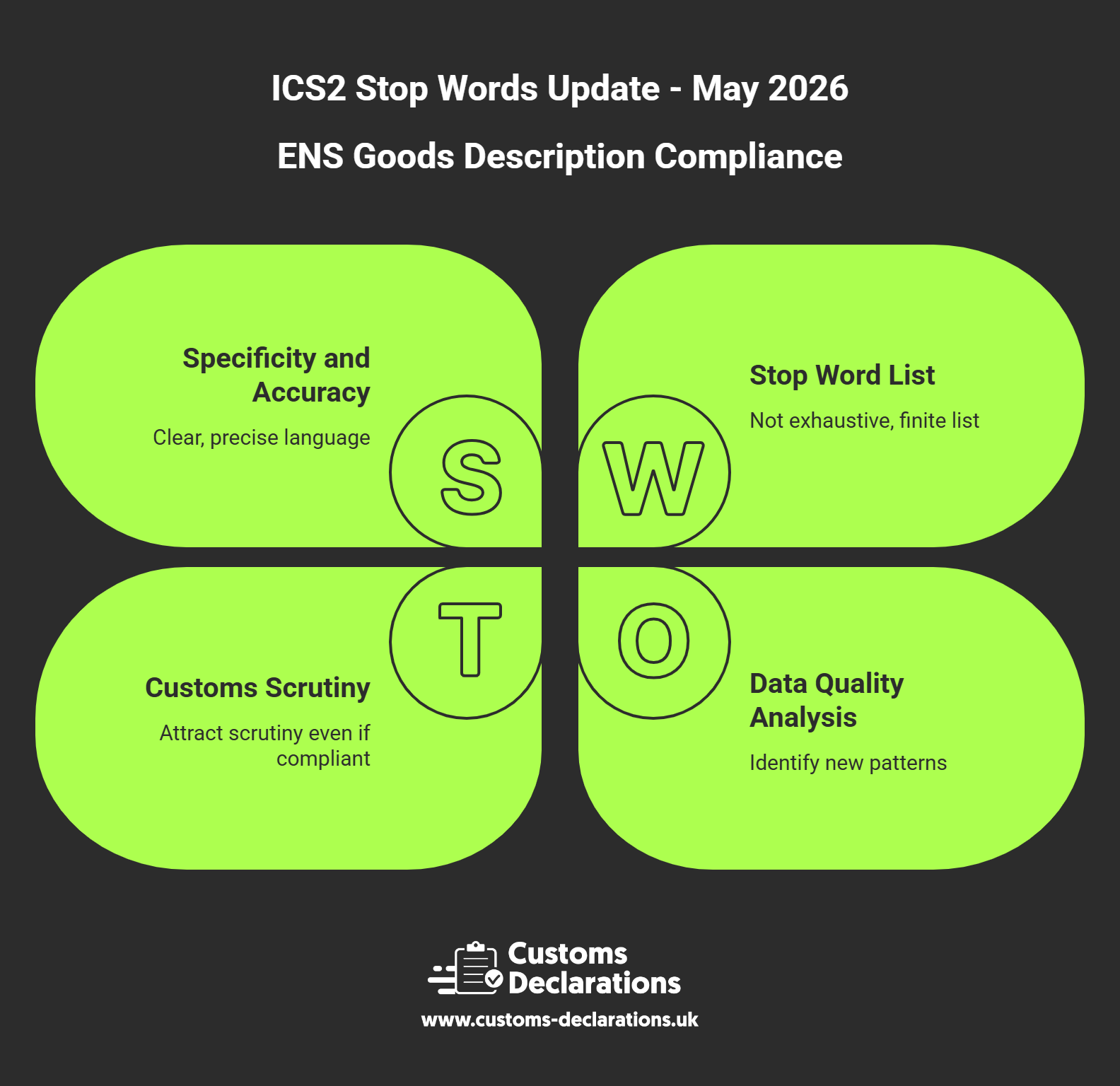
It is important to approach the stop word list not as an exhaustive register of banned vocabulary, but as an illustration of a broader compliance principle. The European Commission has been explicit that the list is not finite. Terms may be added over time as data quality analysis identifies new patterns of vague or evasive language entering the ICS2 system.

The guiding standard for any ENS goods description is specificity and accuracy. A compliant description should identify what the goods actually are — their nature, composition, or function — in plain, precise language. A shipment of inkjet printer cartridges should be described as such, not as “Electronic items” or “Office supplies.” A consignment of stainless steel industrial valves should be named specifically, not described as “Machine parts” or “Hardware.” Where a single ENS covers multiple commodity lines, each line should carry its own precise description rather than a catch-all entry covering the whole consignment.

This standard applies regardless of whether the specific term appears on the published stop word list. If a description would not allow a customs officer to form a clear picture of the cargo, it is likely to attract scrutiny even if no individual word has been formally prohibited.

Practical Impact on Filing Operations

For carriers and logistics operators, the 4 May 2026 changes have immediate operational implications. Any ENS filing template, customs management system, or booking-to-filing data pipeline that currently uses “SLAC,” “SLSC,” “As loaded,” “As received,” or any variant of “Shipper Load and Count” in the goods description field must be updated before that date.

The challenge is particularly acute for consolidation and groupage operators, where a single master ENS may cover dozens of shipment lines from different shippers, some of which may not have provided specific cargo descriptions at the time of booking. In these cases, the responsibility lies with the filing party to obtain adequate cargo descriptions from shippers or to apply best-available knowledge to generate compliant entries. Blanket use of carrier-loaded disclaimers is no longer an acceptable workaround.

Customs brokers and agents should also review the standard description text used in any system pre-population or auto-fill rules. A description that was previously tolerated — or that passed validation under earlier versions of the Common Repository rules — may now trigger a rejection if it contains one of the newly prohibited terms.

How to Write Compliant ICS2 Goods Descriptions

Writing an ICS2-compliant goods description does not require technical expertise, but it does require deliberate attention to specificity. The following guidance reflects the principles embedded in the Commission’s stop word initiative.

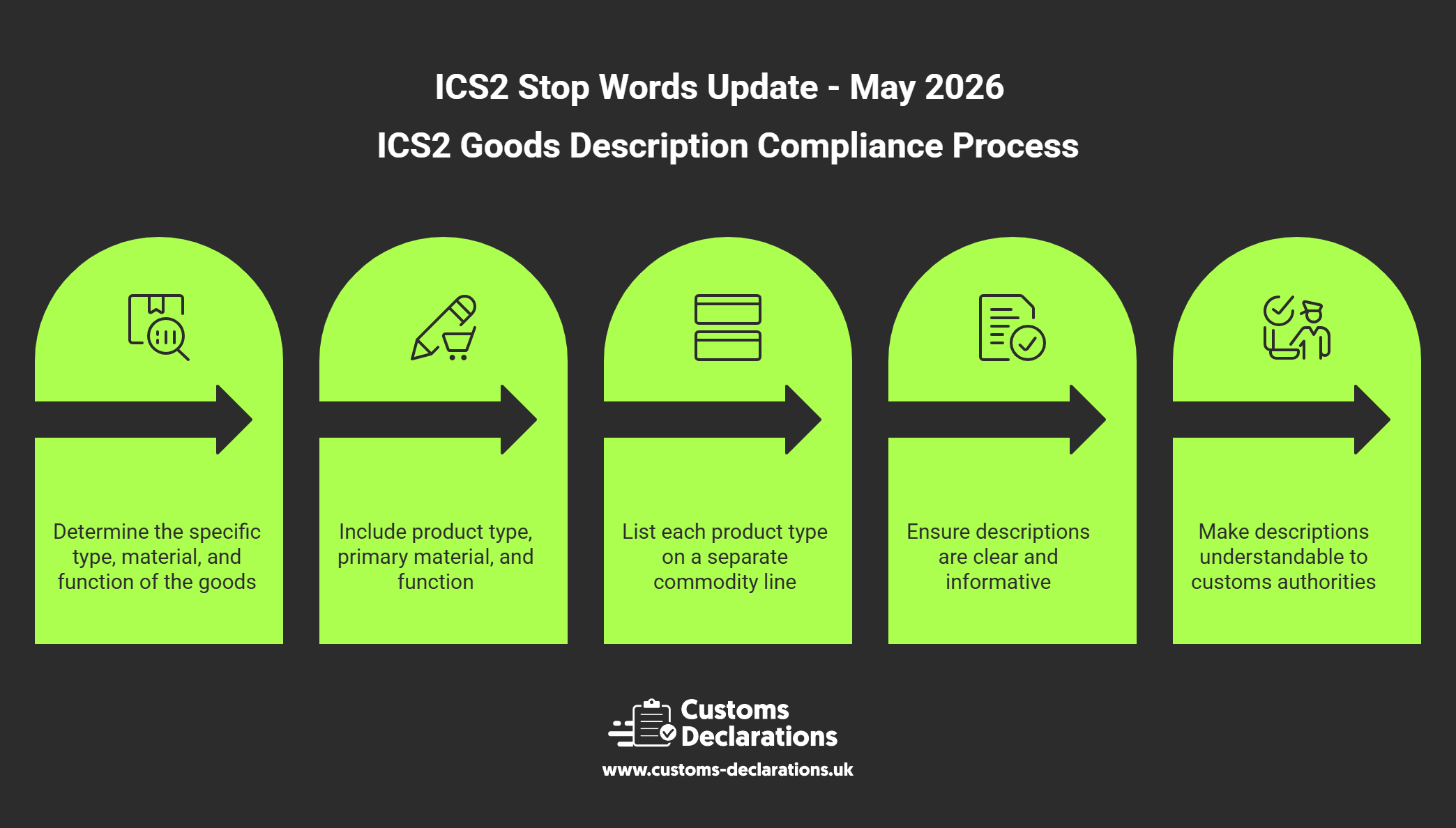
The description should identify the actual nature of the goods. For manufactured items, this typically means naming the product type, its primary material or composition where relevant, and its function or application. “Polypropylene injection moulding pellets” is compliant; “Plastic goods” is not. “Printed cotton T-shirts” is compliant; “Clothing” is not. “Lithium-ion battery cells for portable electronics” is compliant; “Batteries” or “Electronics” is not.

Where a consignment genuinely contains multiple product types, each should be declared on a separate commodity line with its own specific description. Consolidating them under a single vague line is the root cause of many stop word violations and should be avoided as a matter of routine practice rather than exceptional compliance effort.

Commercial invoice descriptions provide a useful starting point, but they should be verified. Some supplier invoices use abbreviated or internal product codes that would not be meaningful to a customs authority. The goods description in the ENS should be legible and informative to someone with no prior knowledge of the commercial relationship.

Filing ENS Declarations Through Customs Declarations UK

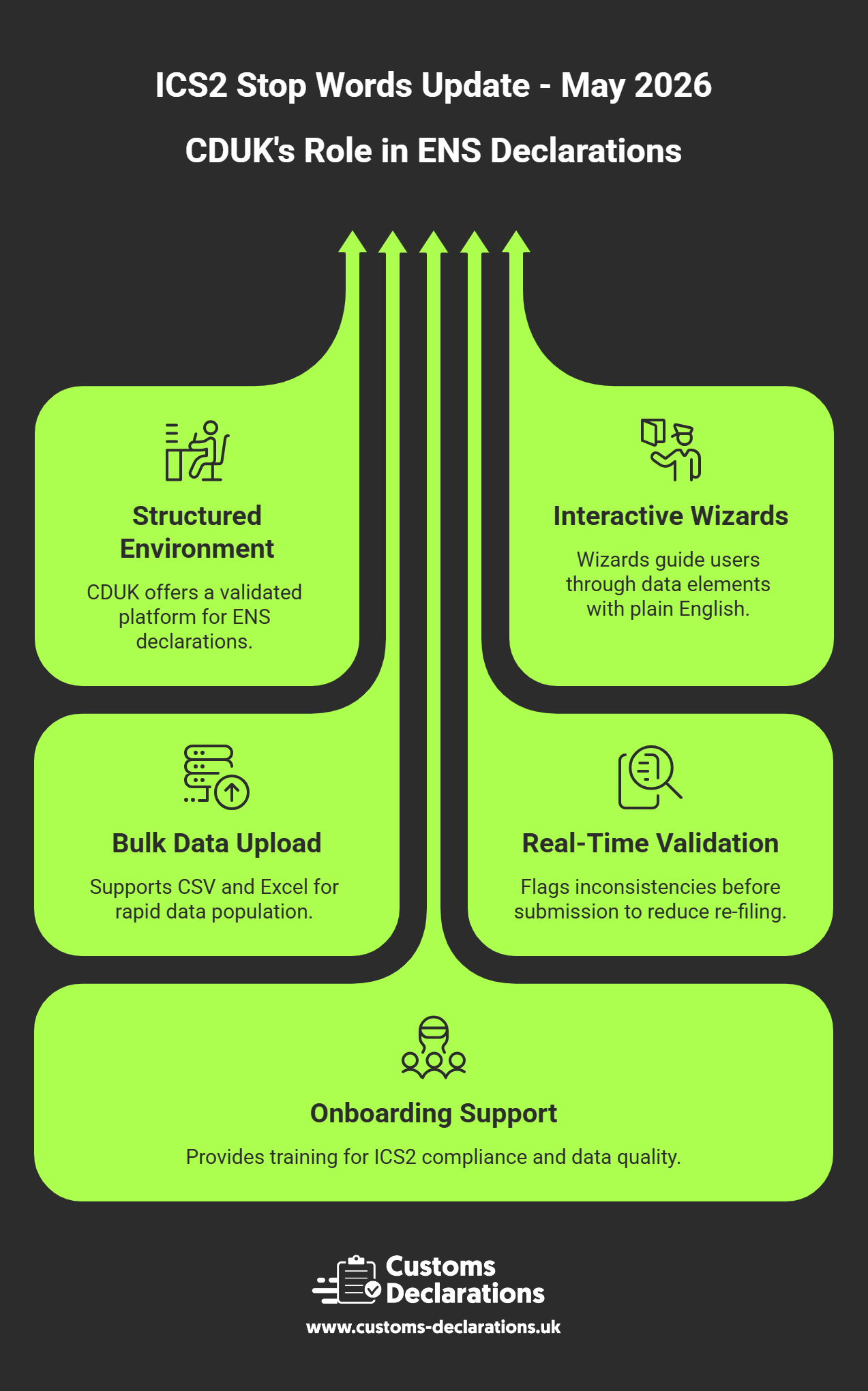
The Customs Declarations UK (CDUK) platform provides a structured, validated environment for filing ENS declarations that aligns directly with ICS2 data quality requirements. The platform’s interactive wizards guide users through each data element, including goods descriptions, with plain-English prompts that encourage the kind of specific, accurate entries the Common Repository expects.

For operators managing high volumes of ENS submissions, CDUK supports bulk data upload via CSV and Excel, enabling rapid population of declaration lines without repetitive manual entry. Goods description fields benefit from real-time validation that can flag inconsistencies and missing data before submission — reducing the risk of outright rejection by ICS2 and the administrative burden of re-filing corrected entries after the fact.

For businesses new to ICS2 obligations, the platform offers onboarding support and training resources to ensure teams understand not only how to use the system but also why compliance with data quality standards — including stop word avoidance — matters for seamless cross-border operations.

Conclusion

The European Commission’s 4 May 2026 stop word update is a targeted but significant step in the ongoing drive to improve ENS data quality under ICS2. The nine newly prohibited terms — covering “As loaded,” “As received,” shipper loading disclaimers, and the abbreviations SLAC and SLSC — reflect a clear policy direction: carrier-loaded shorthand has no place in the goods description field of a safety and security declaration. The field exists to describe cargo, not logistics conventions.

Compliance with ICS2 stop word rules is not merely a technical filing requirement. It reflects a commitment to the safety and security principles that underpin advance cargo information systems across the EU — and it is increasingly the baseline expectation for every business participating in cross-border trade.

We value your feedback, and if you have any comments, suggestions or anything else that you would like to highlight to us, we will be delighted to hear from you and incorporate your feedback into our content.

Note: While we have made every attempt to ensure that the information contained in this Site has been obtained from reliable sources, Customs Declarations UK is not responsible for any errors or omissions, or for the results obtained from the use of this information. All information in this Site is provided “as is”, with no guarantee of completeness, accuracy, timeliness or of the results obtained from the use of this information, and without warranty of any kind, express or implied, including, but not limited to warranties of performance, merchantability and fitness for a particular purpose. Nothing herein shall to any extent substitute for the independent investigations and the sound technical and business judgment of the reader. In no event will Customs Declarations UK, or its partners, employees or agents, be liable to you or anyone else for any decision made or action taken in reliance on the information in this Site or for any consequential, special or similar damages, even if advised of the possibility of such damages. Certain links in this Site connect to other Web Sites maintained by third parties over whom Customs Declarations UK has no control. Customs Declarations UK makes no representations as to the accuracy or any other aspect of information contained in other Web Sites.