A widely held assumption among road freight operators is that an unloaded trailer crossing an international border falls outside the scope of customs formalities. There is, after all, nothing to declare. Under France’s mandatory Obligatory Logistics Envelope (ELO) procedure, which came into force in April 2026, that assumption is incorrect — and the consequences of acting upon it are material.
This article sets out the regulatory position clearly, addresses the most common misconceptions, and provides a structured overview of the steps road freight operators must take to ensure compliance on every crossing into France, regardless of whether a trailer is loaded or empty.
Understanding the ELO Requirement
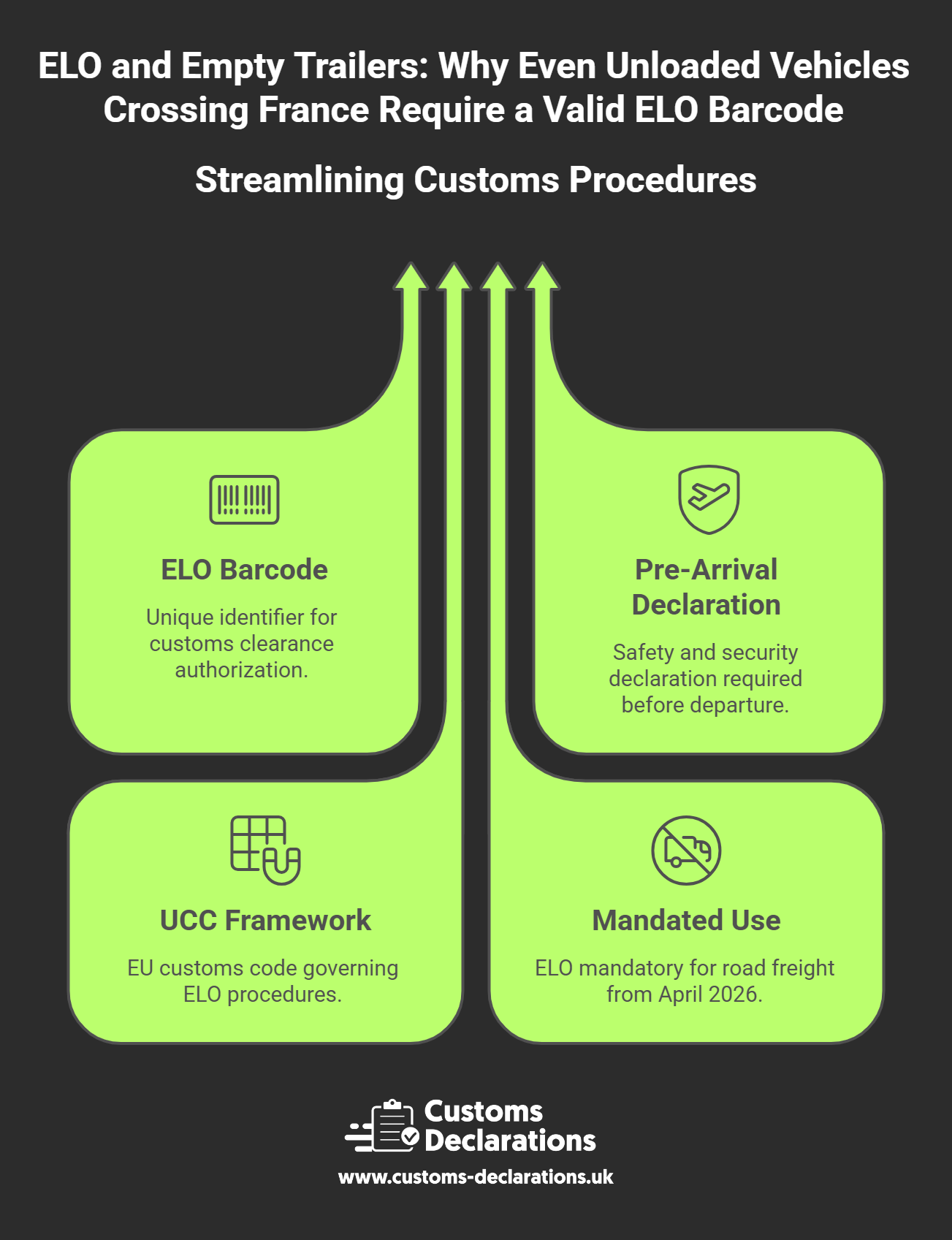
ELO — Obligatory Logistics Envelope — is a simplified customs procedure operating under the framework of the European Union’s Union Customs Code (UCC). It permits authorised operators to record goods movements in their own systems rather than submitting a full customs declaration at the border. In France, use of the ELO procedure has been mandated for road freight movements from April 2026, including those arriving from the United Kingdom via the Channel crossing.
Central to the ELO process is the ELO barcode: a unique movement identifier issued by French customs once the required pre-arrival safety and security declaration has been successfully submitted and accepted. This barcode must be in the possession of the driver before the vehicle departs for the French crossing point. It is not a document that can be obtained at the border, nor one that can be substituted with alternative paperwork at the point of entry.
In practical terms, the ELO barcode functions as customs clearance authorisation for that specific vehicle movement. Without it, the movement is non-compliant from the moment it enters French territory.
The Position on Empty Trailers: A Regulatory Clarification
The most persistent misconception in the road haulage sector concerns the applicability of ELO to empty trailer movements. Operators repositioning equipment, returning after a delivery, or deadheading to collect a load frequently assume that the absence of cargo removes any obligation to comply with customs pre-arrival procedures. Under the current ELO framework, this is not the case.
French customs requires an ELO barcode for the vehicle movement itself, not solely for the cargo it carries. The rationale is grounded in risk assessment: customs authorities require advance visibility of all cross-border vehicle movements in order to allocate resource, identify anomalies, and maintain the integrity of the border process. An empty trailer represents a vehicle crossing an EU external border and, as such, falls within the scope of the mandatory pre-arrival declaration requirement.
The declaration for an empty movement differs in content from that of a loaded one, but the obligation to file in advance remains identical. Operators should not interpret the absence of cargo as an exemption from the pre-arrival declaration process.
Why This Presents a Compliance Risk for UK Hauliers
The introduction of ELO as a mandatory requirement coincides with a broader set of UK customs tariff updates effective April 2026, creating a more complex compliance environment than many operators have previously encountered. UK hauliers have, in the main, developed robust processes for fully documented loaded movements — those supported by commercial invoices, commodity codes, and export declarations. Empty trailer runs, however, have historically required minimal documentation and have not been subject to the same procedural rigour.
It is precisely this gap that presents the most significant compliance risk in 2026. Operators who have not reviewed their internal despatch procedures to incorporate ELO barcode generation for all vehicle crossings — including empty movements — are exposed to delays, inspections, and potential penalties that are entirely avoidable.
Smaller haulage operators and owner-drivers, who may lack dedicated compliance functions, face a particular risk of non-awareness. The regulatory obligation applies uniformly, irrespective of fleet size or the frequency of crossings.
The ICS2 Entry Summary Declaration: The Mandatory First Step
Before a valid ELO barcode can be generated for any vehicle movement, an Entry Summary Declaration (ENS) must be submitted through the EU’s Import Control System 2 (ICS2). This is a pre-arrival safety and security filing that provides French and EU customs with the information necessary to conduct a risk assessment of the incoming movement. It is mandatory for all road freight entering the EU from the United Kingdom, and it must be completed before the vehicle departs — not at the port of embarkation and not at the point of entry into France.
The ENS submission is the foundational step in the ELO process. Once filed and accepted by customs, the ELO barcode is generated and made available to the operator. The sequence is fixed and cannot be reversed or circumvented:
Any break in this sequence — most commonly, a failure to file the ENS in advance or a filing error that results in rejection — means no ELO barcode is available. A driver arriving at the crossing without a valid barcode is not in a position to complete the process retrospectively at the border.
Data Requirements for an Empty Movement Declaration
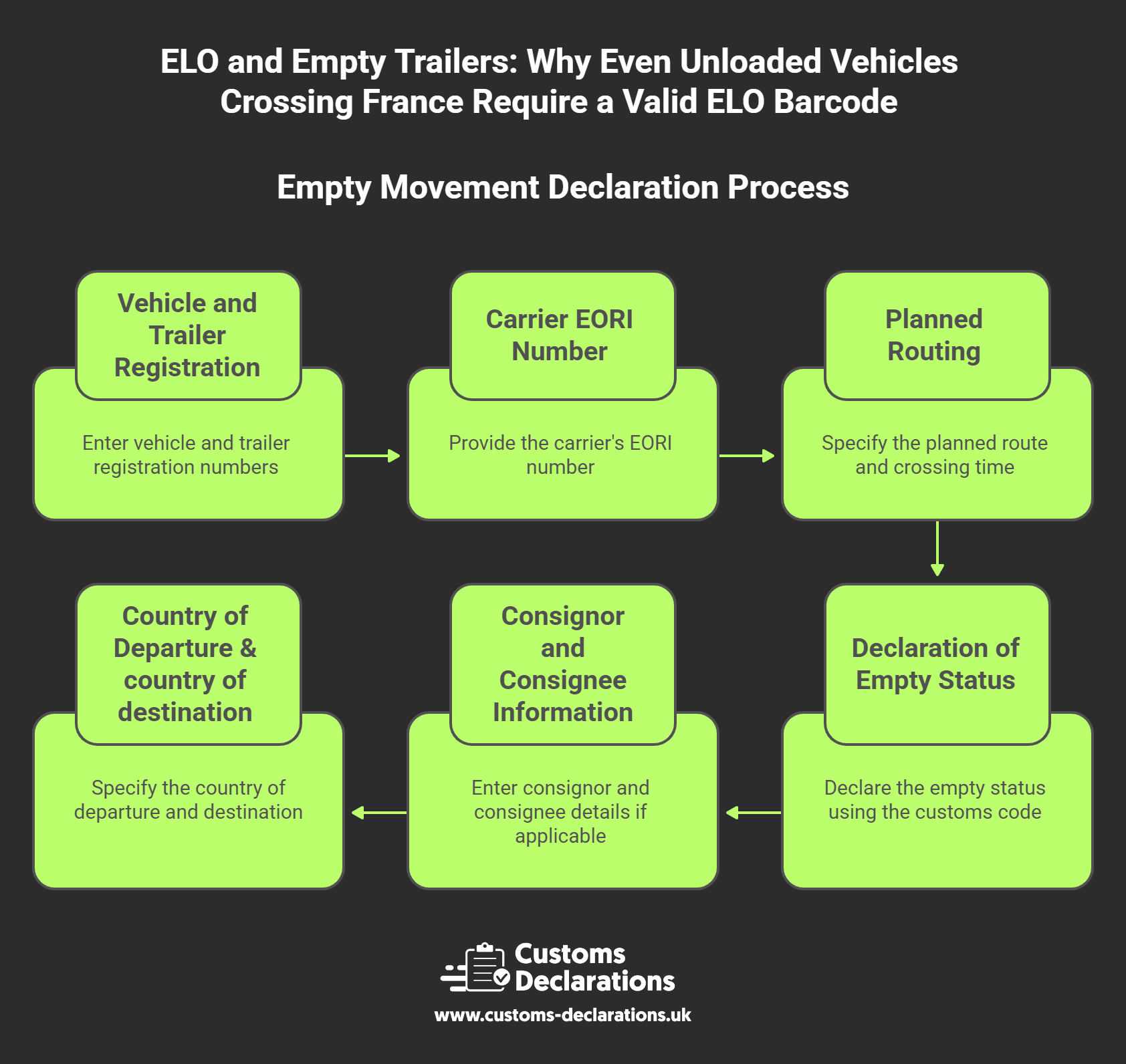
A question frequently raised by operators is what information is required when filing an ENS for an empty trailer movement. The absence of goods does not reduce the data fields that must be completed; it changes only the nature of the content within those fields. The following information is required as a minimum:
- Vehicle and trailer registration numbers
- Carrier EORI (Economic Operators Registration and Identification) number
- Planned routing and expected date and time of crossing
- Declaration of empty status, using the applicable customs code for an unloaded movement
- Consignor and consignee information, where applicable to the movement type
- Country of departure and country of destination
Customs filing platforms such as CDUK are configured to guide operators through the correct data fields for empty movement declarations, ensuring that submissions are complete, accurate, and formatted in accordance with ICS2 system requirements.
Consequences of Non-Compliance
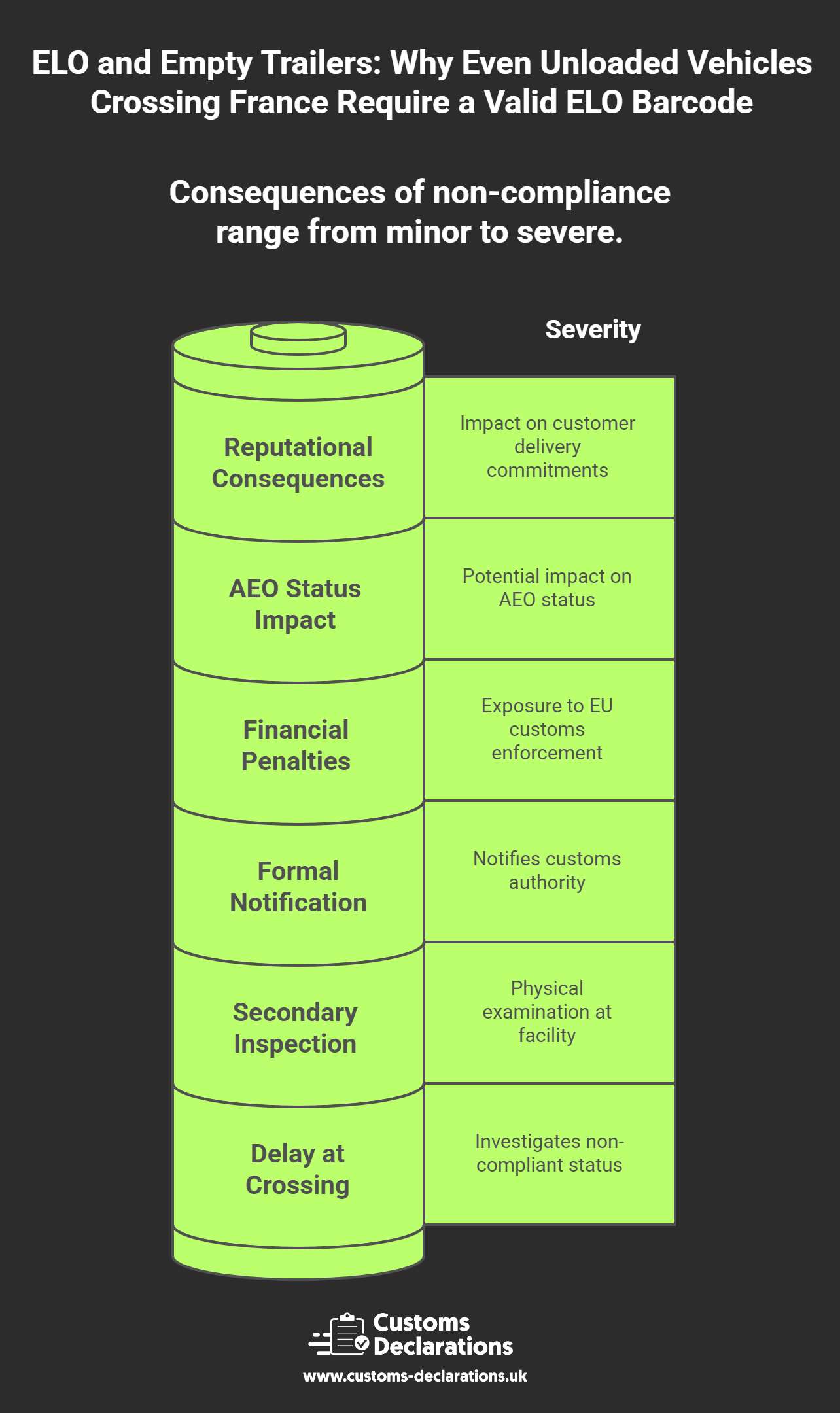
Road freight operators who proceed to the French crossing without a valid ELO barcode face a range of operational and regulatory consequences. These are not theoretical risks; they are the direct and foreseeable outcomes of a failure to comply with a mandatory pre-arrival filing obligation:
- Delay at the crossing point while the non-compliant status of the movement is investigated
- Direction of the vehicle to a secondary inspection facility for physical examination
- Formal notification of the non-compliance to the relevant customs authority
- Exposure to financial penalties under EU customs enforcement provisions
- Potential impact on Authorised Economic Operator (AEO) status, where applicable
- Reputational and commercial consequences where customer delivery commitments are not met
For operators running time-critical or return-load operations, a single avoidable delay at the French border carries costs that extend well beyond the immediate crossing. Compliance with the ELO requirement must be treated as an operational prerequisite, not an administrative afterthought.
Recommended Action for Transport Managers and Operators
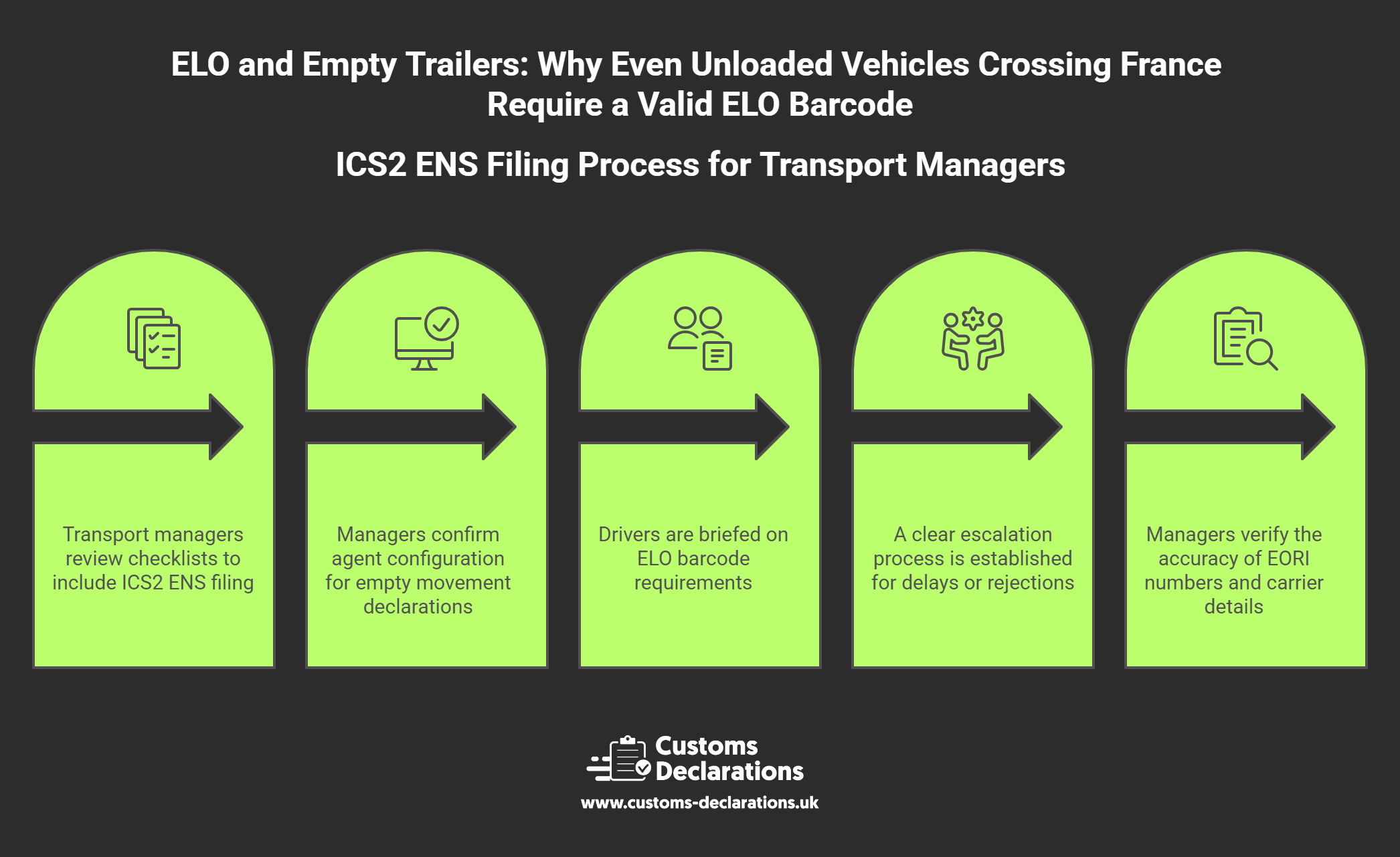
Transport managers and logistics compliance leads should take the following steps immediately to ensure that all crossings — including empty trailer movements — are fully compliant with the ELO requirement from April 2026:
- Review all despatch and pre-departure checklists to incorporate ICS2 ENS filing as a mandatory step for every crossing, including empty runs
- Confirm that your customs filing agent or software provider is configured to handle empty movement declarations under ICS2 / ELO
- Ensure that drivers are briefed on the requirement to carry a valid ELO barcode and understand that this document must be obtained before departure
- Establish a clear escalation process for instances where barcode generation is delayed or the ENS is rejected
- Verify that your EORI number and carrier registration details are current and correctly recorded in your filing system
Operators who have not yet established an ICS2 ENS filing process are advised to engage with CDUK without delay. Filing your ENS through CDUK is the mandatory first step before any ELO barcode can be created, and it is the foundation upon which compliant road freight entry into France now rests.
Filing Your ICS2 ENS and Generating Your ELO Barcode with Customs Declarations UK
Customs Declarations UK (CDUK) provides road freight operators with a single, integrated workflow for both the ICS2 Entry Summary Declaration and the ELO barcode that depends on it. Once you have completed your ENS submission through the CDUK platform and received confirmation of acceptance from French and EU customs authorities, CDUK automatically generates the ELO barcode directly within the platform — eliminating the need to manage separate systems, chase third parties, or handle manual barcode retrieval. The process is guided by a structured, plain-English wizard that walks operators through the correct data fields for each movement type, including empty trailer runs, ensuring submissions are complete and formatted to ICS2 system requirements before they are transmitted. Real-time validation catches errors and omissions before filing, reducing the risk of rejection and the cascading compliance failure that follows when a driver departs without a valid barcode. For transport managers overseeing multiple crossings, CDUK’s declaration archive provides a full audit trail of every ENS submission and its corresponding ELO output, supporting compliance reviews and any regulatory enquiries that may arise. Operators who are not yet set up on CDUK are advised to register without delay: every crossing into France now begins with a filed ENS, and every ELO barcode begins with that filing being accepted.