HMRC published Statutory Instrument 2026/253 on 3 March 2026, introducing five significant changes to the UK’s customs tariff regime. From Ukraine trade liberalisation to offshore wind duty relief, these updates affect importers, exporters, customs agents, and logistics operators across multiple sectors — and take effect immediately.
What Has Changed and Why It Matters
The March 2026 tariff update is one of the most substantively varied statutory instruments published this year. It spans five distinct changes — extending a trade liberalisation arrangement supporting Ukraine, updating annual tariff rates under the UK–Japan CEPA, introducing new duty relief for the offshore wind energy sector, and correcting technical errors affecting Iceland–Norway and North Macedonia trade references. Together, these changes affect a broad cross-section of UK trade activity.
Understanding which changes apply to your business — and acting on them correctly — is essential to claiming the right preferential rates, avoiding unnecessary duty costs, and maintaining compliant customs declarations from 3 March 2026 onwards.
UK–Ukraine Trade Liberalisation Extended to 2028
The preferential tariff reference document for Ukraine has been updated to give effect to the temporary liberalisation of tariffs on imports of Ukrainian egg and poultry products. This extension runs until 31 March 2028, building on the agreement between the UK and Ukraine to support Ukrainian agricultural exports during the ongoing conflict.
The measure provides zero or reduced tariffs on specified egg and poultry product lines, and represents a continuation of the UK’s post-Brexit trade support arrangements with Ukraine. The two-year extension — beyond the previous temporary measures — provides a meaningful forward planning horizon for importers operating in these categories.
UK–Japan CEPA: 2026 Annual Tariff Rates Now in Effect
The preferential tariff reference document for Japan has been updated for structural clarity and to reflect the 2026 tariff rates under the UK–Japan Comprehensive Economic Partnership Agreement. The annual tariff reduction schedule under CEPA continues as planned, meaning some goods now face lower duties in 2026 than they did in 2025. The document has also been reorganised for easier navigation.
Offshore Wind Energy: New Authorised Use Duty Relief
This is the most strategically significant of the five changes in SI 2026/253. New authorised use measures have been introduced to reduce import duty on goods used in the manufacture of offshore wind turbines. The measure is implemented through amendments to the Customs (Special Procedures and Outward Processing) (EU Exit) Regulations 2018 and a new version of the “Authorised Use: Eligible Goods and Rates” document (version 1.23, dated 3 March 2026).
The policy reflects the UK’s broader commitment to offshore wind expansion and Net Zero objectives, reducing the import cost burden on businesses supplying components into the renewable energy supply chain.
🔌Cables linking wind farms to mainland substations
⚙️Auxiliary systems for incorporation in onshore substations
🔋Low-voltage systems for offshore substations
🌊Other components used in offshore wind energy production
Iceland–Norway and North Macedonia: Technical Corrections
The preferential tariff reference document for Iceland and Norway has been updated to correct technical errors identified in the previous version. Operators importing from these countries should ensure they are working from the updated document to avoid applying incorrect rates or conditions.
Separately, the origin reference document for North Macedonia has been updated to give effect to the latest decisions under the UK–North Macedonia Partnership, Trade and Cooperation Agreement. Importers and exporters trading under this agreement should verify their origin documentation and declaration data against the updated reference.
What These Changes Mean for Your Business
The practical implications of SI 2026/253 vary significantly depending on your role in the supply chain. Select your category below to see the actions most relevant to you.
Filing Compliant Declarations Across Every Affected Trade Lane
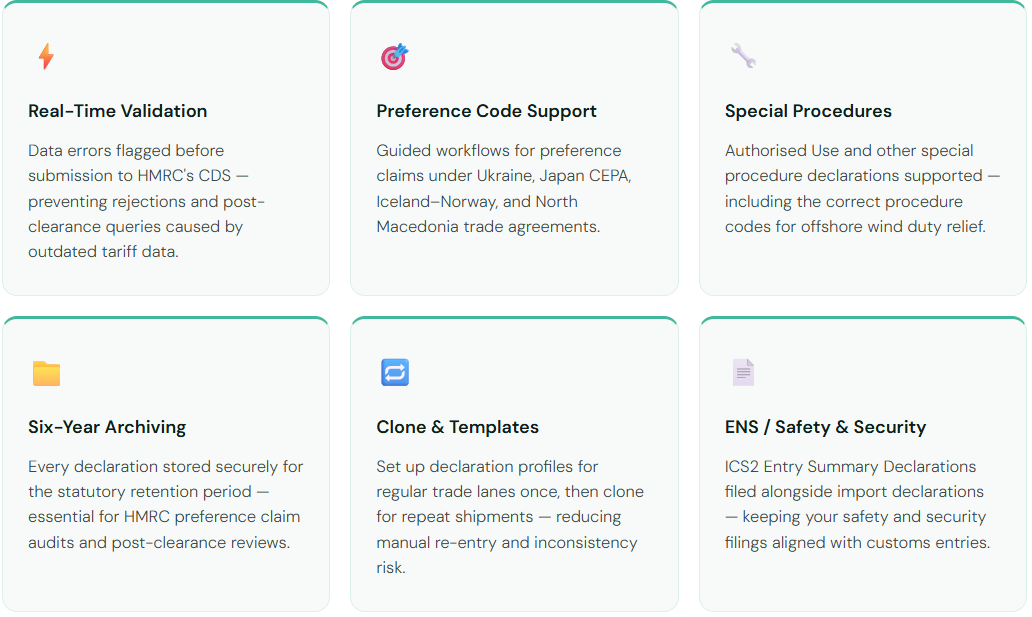
The changes introduced by SI 2026/253 — new preferential rates, extended trade liberalisation, and a new special procedure for offshore wind — all require accurate, up-to-date customs declarations filed through HMRC’s Customs Declaration Service. Customs Declarations UK (CDUK) provides the platform, guidance, and validation tools to ensure your declarations reflect the latest tariff rules from day one.
Whether you are an importer claiming CEPA preference on Japanese goods, a customs agent managing Ukraine preference claims, or an offshore wind developer setting up an Authorised Use procedure, CDUK’s guided workflows and real-time compliance checks reduce the risk of errors and ensure every declaration is audit-ready.