
Global supply chains are in the midst of their most significant transformation in decades. What once required armies of logistics coordinators, reactive decision-making, and paper-heavy customs processes is rapidly being replaced by autonomous, data-driven systems capable of predicting disruptions before they happen, optimising routes in real time, and ensuring regulatory compliance without manual intervention.
For customs professionals, freight forwarders, hauliers, and importers, this shift is not a distant horizon — it is already reshaping the operational landscape. The four trends examined in this analysis represent the frontline of that change: agentic AI systems, predictive analytics at scale, real-time supply chain visibility, and sustainability-embedded logistics.
Understanding these forces — and how they intersect with customs compliance obligations — is essential for any business that moves goods across borders in 2026 and beyond.
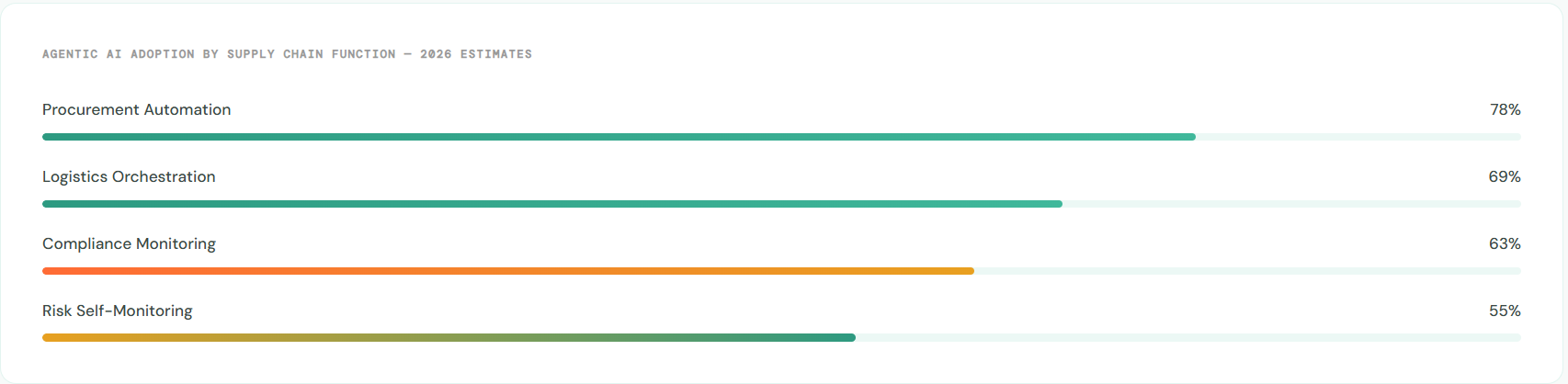
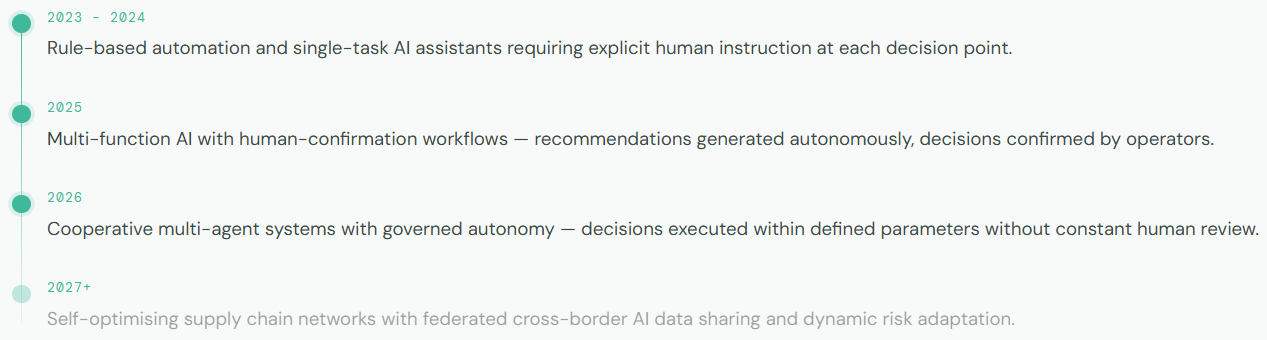
Autonomous, cooperative programmes managing procurement, compliance, and self-monitoring — without human prompting at each step.
The defining shift in 2026 supply chain AI is the move from assistive tools to agentic systems — AI programmes that not only analyse data but independently execute decisions across interconnected workflows. Rather than surfacing recommendations for a human to act on, agentic AI acts: it adjusts purchase orders, reroutes shipments, flags compliance anomalies, and escalates risks — all within pre-defined governance parameters.
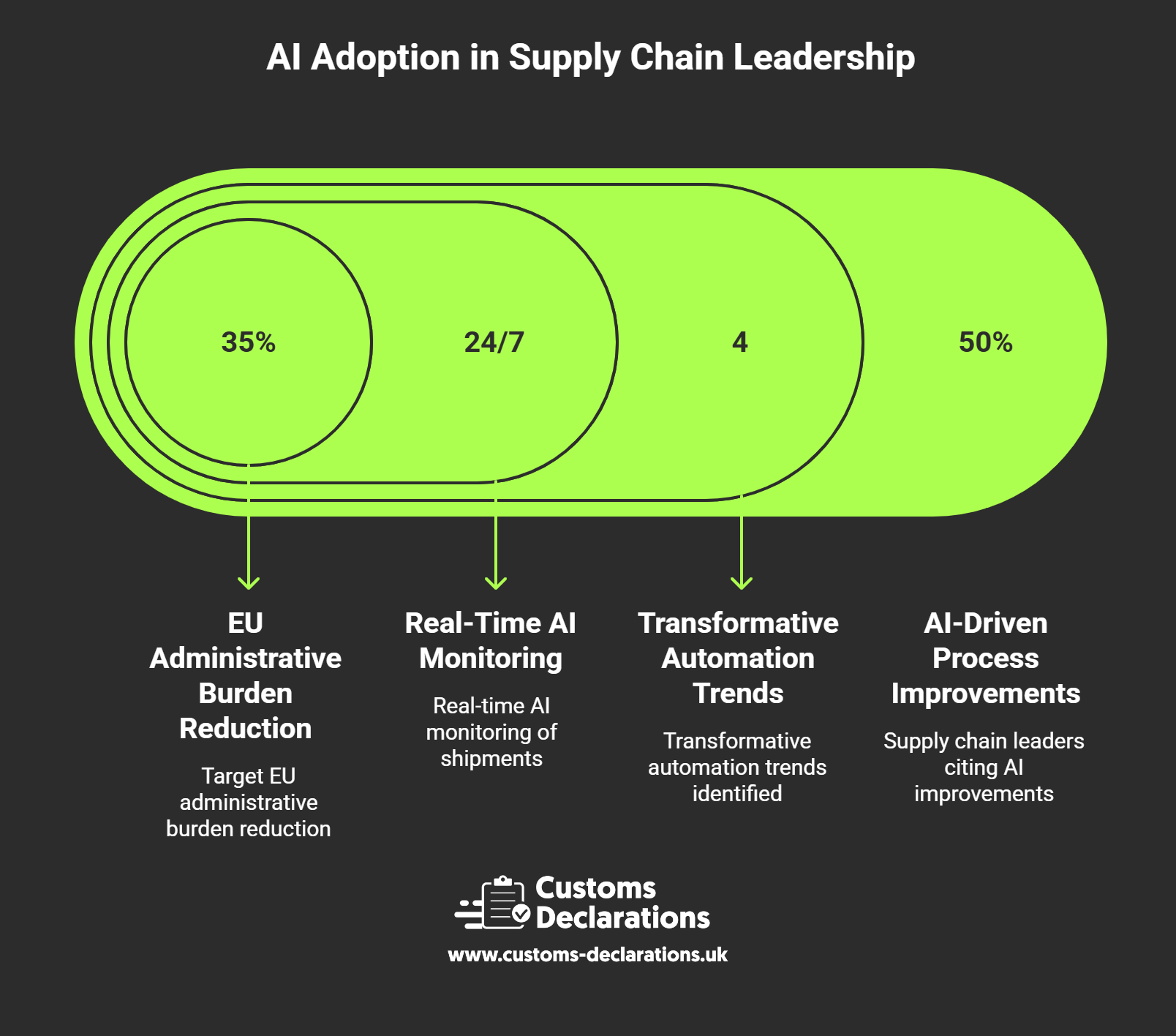
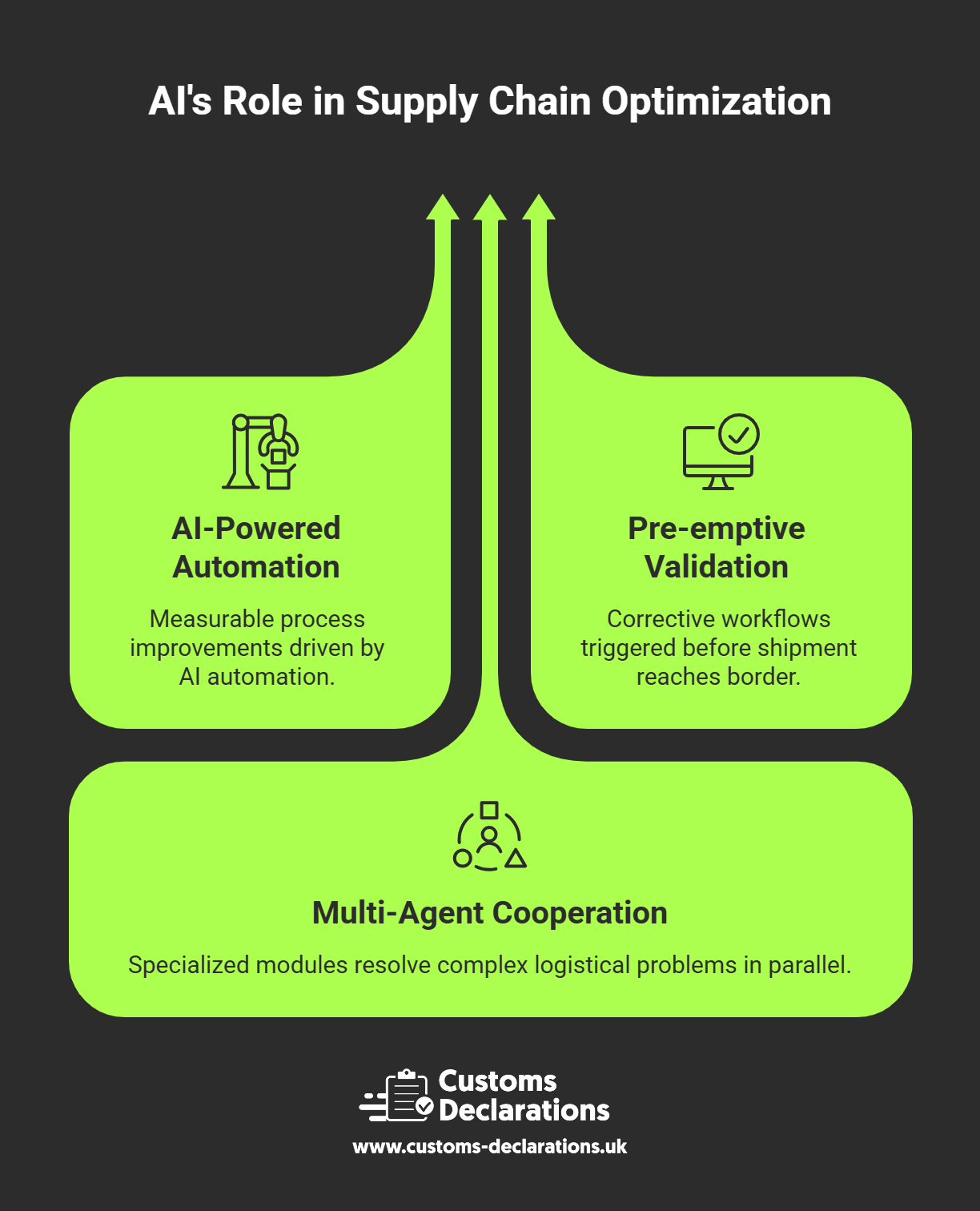
According to Gartner, over 50% of global supply chain leaders now attribute measurable process improvements directly to AI-powered automation. This is not incremental enhancement; it represents a fundamental restructuring of how operations are orchestrated. Multi-agent architectures allow specialised AI modules — one focused on procurement, another on transport, another on customs regulatory compliance — to cooperate, share data, and collectively resolve complex logistical problems faster than any human team could.
For customs and trade professionals, the practical implication is significant. Agentic systems can autonomously monitor regulatory changes, pre-validate declaration data against HMRC requirements, identify classification inconsistencies, and trigger corrective workflows — all before a shipment reaches the border.
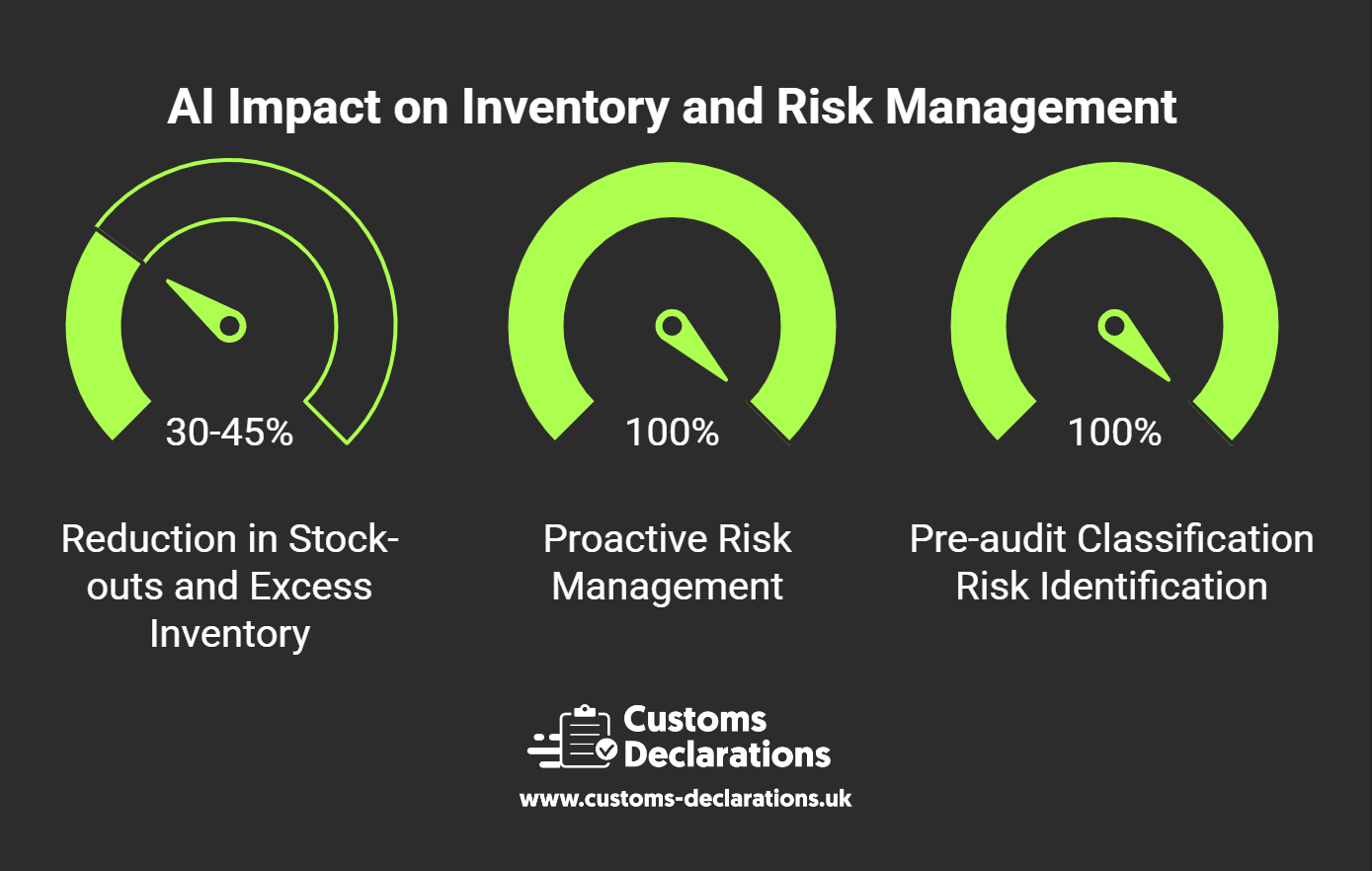
Turning massive, disparate datasets into strategic foresight — from stock management optimisation to geopolitical risk scenario modelling.
Predictive analytics has existed in supply chain management for years, but 2026 marks a step-change in both the volume of data processed and the sophistication of insights generated. Modern AI systems ingest data streams from shipping routes, supplier networks, consumer behaviour patterns, port congestion sensors, weather systems, and macroeconomic indicators — synthesising them into actionable operational guidance at speeds no human analyst could match.
The most commercially significant evolution is the shift from descriptive reporting (“here is what happened”) to prescriptive intelligence (“here is what you should do, and here are three alternatives if conditions change”). What-if scenario modelling now allows logistics teams to simulate the impact of geopolitical shifts, tariff changes, and route disruptions before they occur — transforming risk management from a reactive function into a genuine strategic advantage.
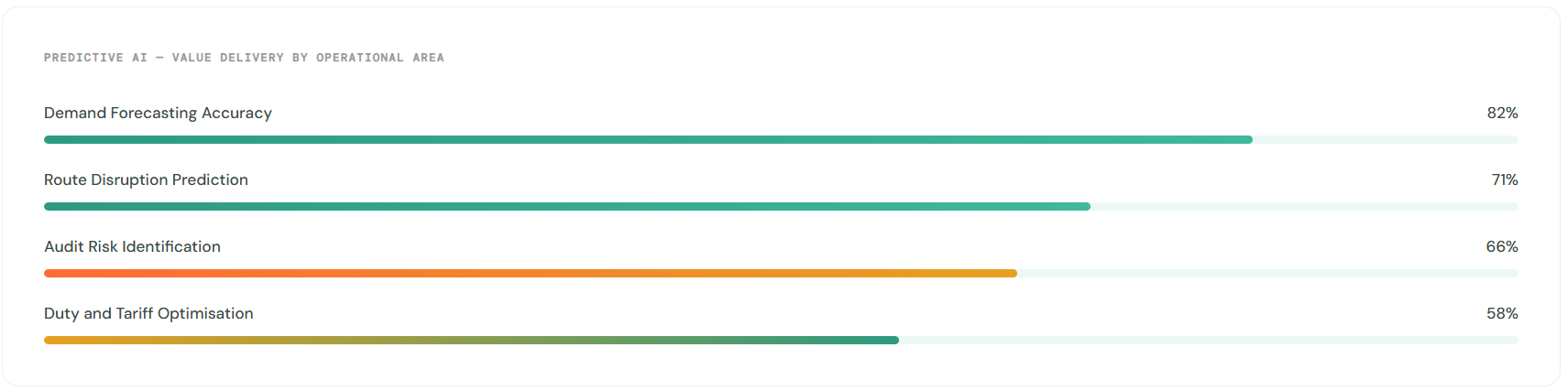
For customs and trade compliance teams, predictive analytics delivers particular value in classification accuracy, duty optimisation, and audit risk assessment. By analysing historical declaration patterns alongside current market data, AI can flag potential misclassification risks, identify preferential tariff opportunities, and anticipate HMRC audit triggers — allowing businesses to correct issues proactively rather than during a costly post-clearance review.
“The organisations winning on trade efficiency are not those with the fastest logistics — they are those with the most accurate foresight. Predictive AI closes the gap between what supply chains plan and what actually happens.” — Supply Chain Intelligence Review, 2026 |
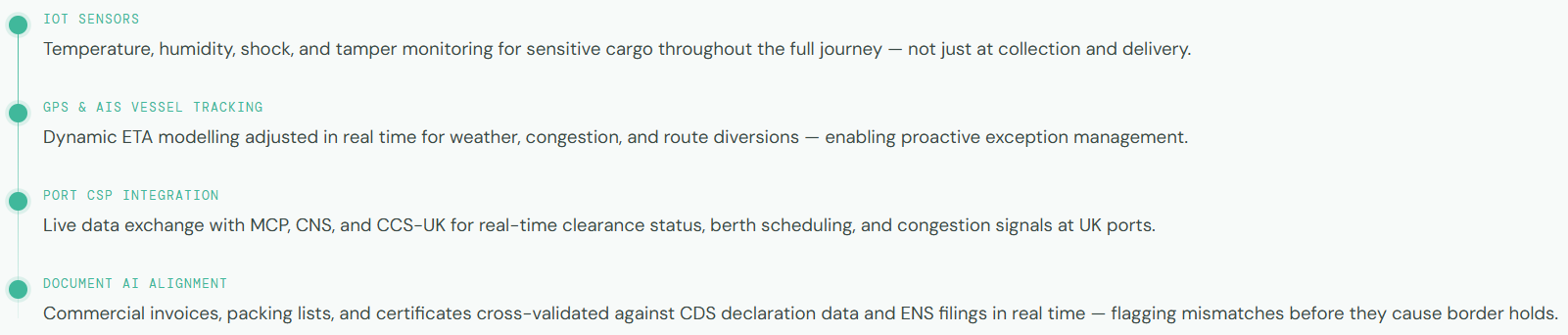
End-to-end shipment intelligence: AI continuously processing IoT sensors, GPS data, digital documentation, and port systems in a single unified picture.
The promise of full supply chain visibility has been discussed for over a decade. In 2026, it is finally being delivered — not through manual tracking updates or fragmented carrier portals, but through AI systems that continuously synthesise data from IoT sensors, GPS tracking, digital documentation, carrier systems, and port management platforms into a unified, real-time operational picture.
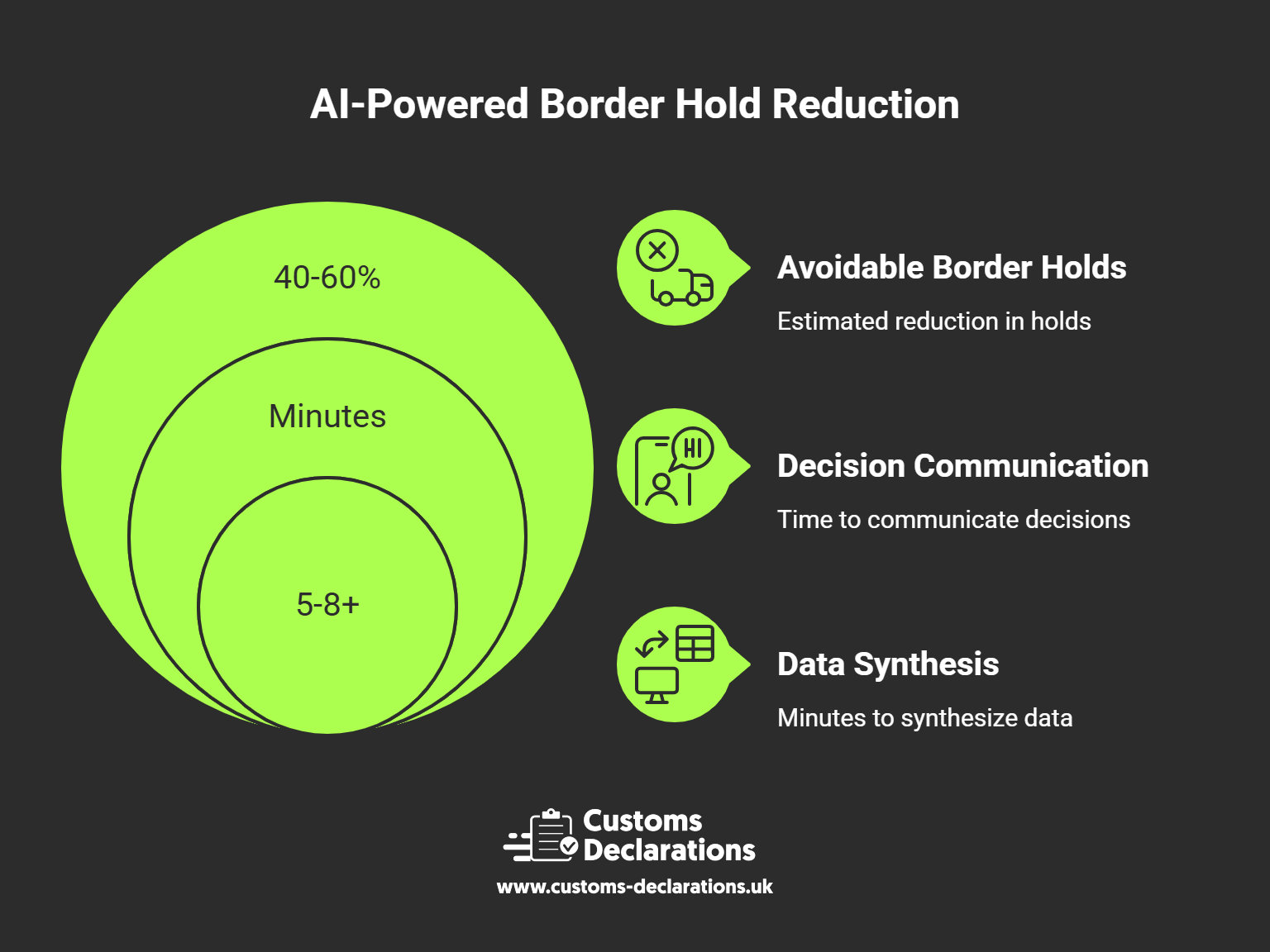
The practical impact is transformative. AI can now identify port bottlenecks and predict congestion delays hours or days in advance, automatically suggest alternative routes or rescheduled departures, and push proactive notifications to customs and logistics teams before a problem becomes a crisis. For importers managing time-sensitive shipments, this capability directly reduces demurrage costs, prevents clearance delays, and improves customer fulfilment performance.
From a customs compliance perspective, real-time visibility is equally significant. When declaration data, carrier safety and security filings (ENS), and physical shipment data are all aligned and monitored continuously, the risk of data mismatches — a common and costly cause of border holds — is dramatically reduced. AI systems can detect discrepancies between declared goods descriptions, weights, and consignee data against carrier manifest information, and flag corrections before submission to HMRC.
“Real-time visibility is not about knowing where your goods are — it is about knowing what is about to go wrong, and having the intelligence to act before it does.” — Logistics Technology Review, 2026 |
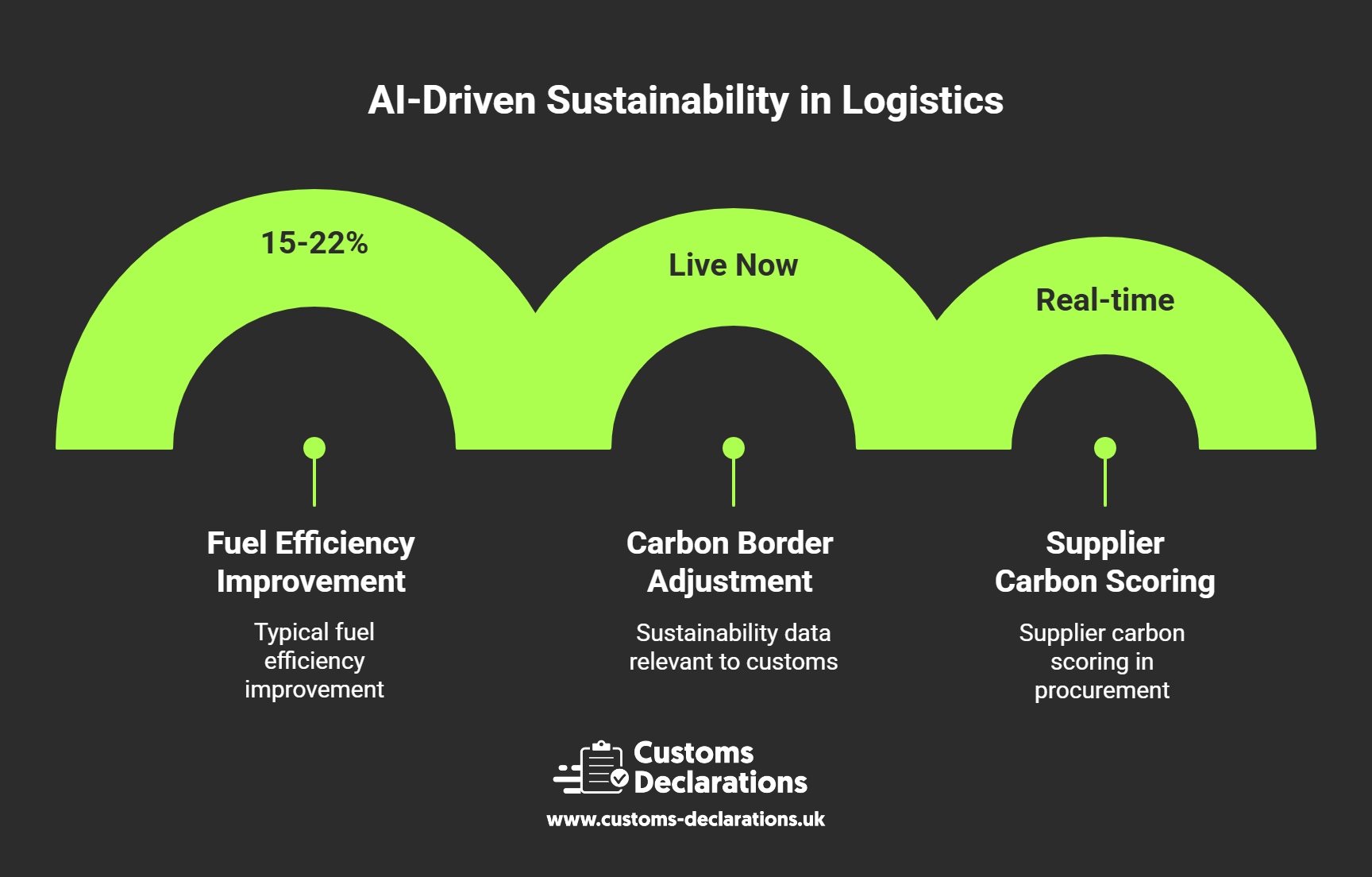
AI embedding environmental intelligence into every procurement, routing, and supplier evaluation decision — making sustainability a live operational input, not a quarterly report.
Sustainability is no longer a voluntary addition to supply chain strategy — it is rapidly becoming a regulatory and commercial imperative. In 2026, AI is the primary mechanism through which businesses are operationalising their environmental commitments at scale, moving from high-level carbon targets to granular, decision-by-decision sustainability intelligence.
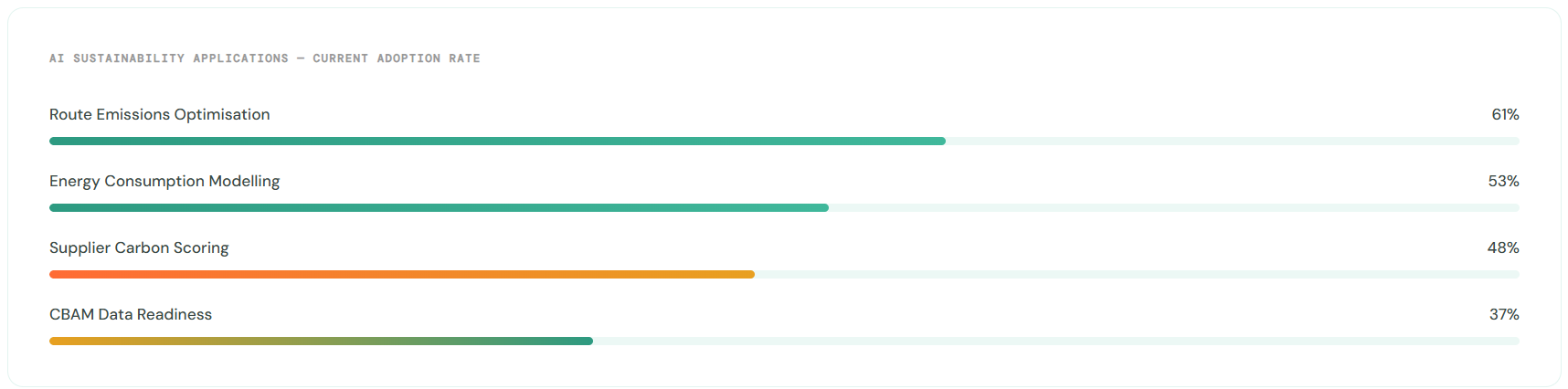
Modern AI platforms now analyse energy consumption across logistics networks, model the carbon footprint of competing shipping routes, evaluate suppliers on environmental performance metrics, and embed these factors directly into procurement scoring. Rather than reviewing sustainability as a quarterly reporting exercise, leading organisations are making it a live input into every logistics decision — choosing a shipping lane, selecting a carrier, or approving a supplier based on carbon impact alongside cost and lead time.
For customs and trade compliance teams, sustainability AI intersects with emerging carbon border adjustment mechanisms and product origin documentation requirements. As regulatory frameworks such as the EU’s Carbon Border Adjustment Mechanism (CBAM) mature, the data generated by sustainability AI systems — supplier environmental assessments, transport emissions records, energy consumption documentation — will become directly relevant to customs declarations and preferential trade eligibility.
Supply chain AI does not operate in isolation from customs compliance — the two are increasingly inseparable. As agentic systems take ownership of procurement, logistics, and routing, the data they generate must flow accurately and consistently into customs declarations filed with HMRC’s Customs Declaration Service (CDS).
Mismatches between AI-managed operational data and declarations submitted at the border remain one of the leading causes of avoidable holds and post-clearance HMRC enquiries. The solution is not more manual intervention — it is ensuring that the platform used to file declarations is as intelligently designed as the supply chain systems feeding it.
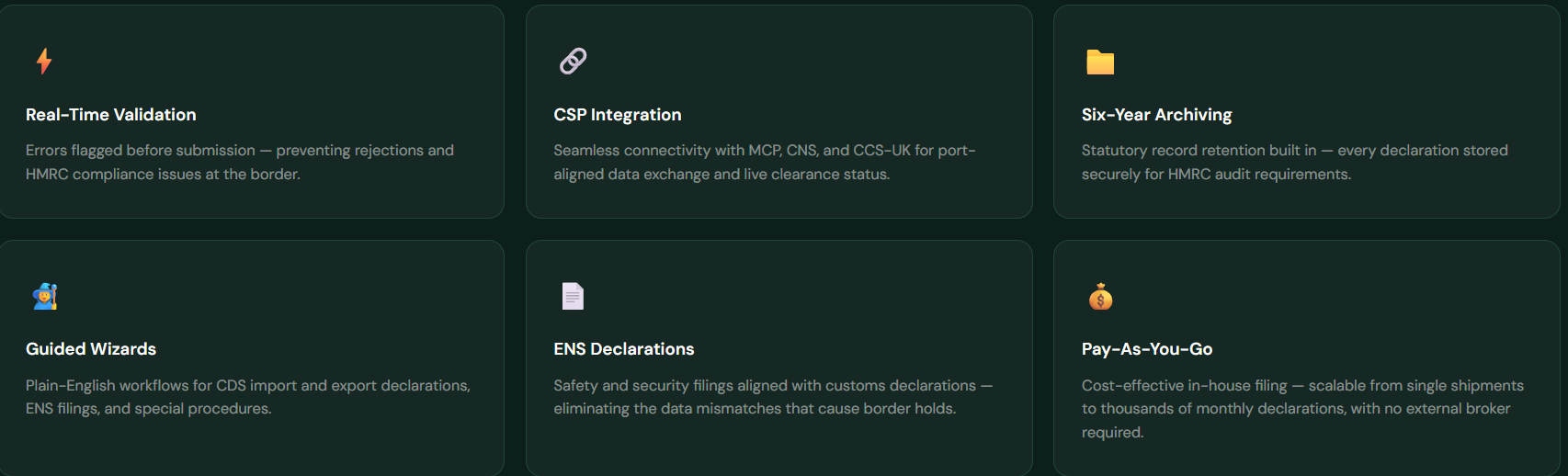
Customs Declarations UK (CDUK) is built for exactly this environment: a cloud-based platform that integrates with carrier Community System Providers, performs real-time compliance validation before submission, and maintains full declaration audit trails — ensuring that the intelligence your supply chain AI generates is matched by the precision of your customs filings.
The four trends examined in this analysis — agentic AI, predictive analytics, real-time visibility, and sustainability integration — are not independent phenomena. They are converging into a single, unified model of intelligence-centric supply chain management where data flows continuously between operational systems, decisions are made or recommended by AI in real time, and human teams focus on governance, exception management, and strategic direction.
For businesses moving goods across UK and EU borders, the practical implication is clear: the quality of your customs declarations will increasingly depend on the quality of data flowing from your supply chain systems. Agentic AI systems must be connected to declaration platforms that can match their precision — validating data in real time, flagging compliance risks before submission, and maintaining the audit trails that HMRC requires.
The businesses that will trade most effectively in 2026 and beyond are those that treat customs compliance as a natural extension of their AI-driven supply chain strategy — not a separate, manual process bolted on at the end. Customs Declarations UK provides the platform to make that integration seamless, accurate, and audit-ready.
We value your feedback, and if you have any comments, suggestions or anything else that you would like to highlight to us, we will be delighted to hear from you and incorporate your feedback into our content.
Note: While we have made every attempt to ensure that the information contained in this Site has been obtained from reliable sources, Customs Declarations UK is not responsible for any errors or omissions, or for the results obtained from the use of this information. All information in this Site is provided “as is”, with no guarantee of completeness, accuracy, timeliness or of the results obtained from the use of this information, and without warranty of any kind, express or implied, including, but not limited to warranties of performance, merchantability and fitness for a particular purpose. Nothing herein shall to any extent substitute for the independent investigations and the sound technical and business judgment of the reader. In no event will Customs Declarations UK, or its partners, employees or agents, be liable to you or anyone else for any decision made or action taken in reliance on the information in this Site or for any consequential, special or similar damages, even if advised of the possibility of such damages. Certain links in this Site connect to other Web Sites maintained by third parties over whom Customs Declarations UK has no control. Customs Declarations UK makes no representations as to the accuracy or any other aspect of information contained in other Web Sites.