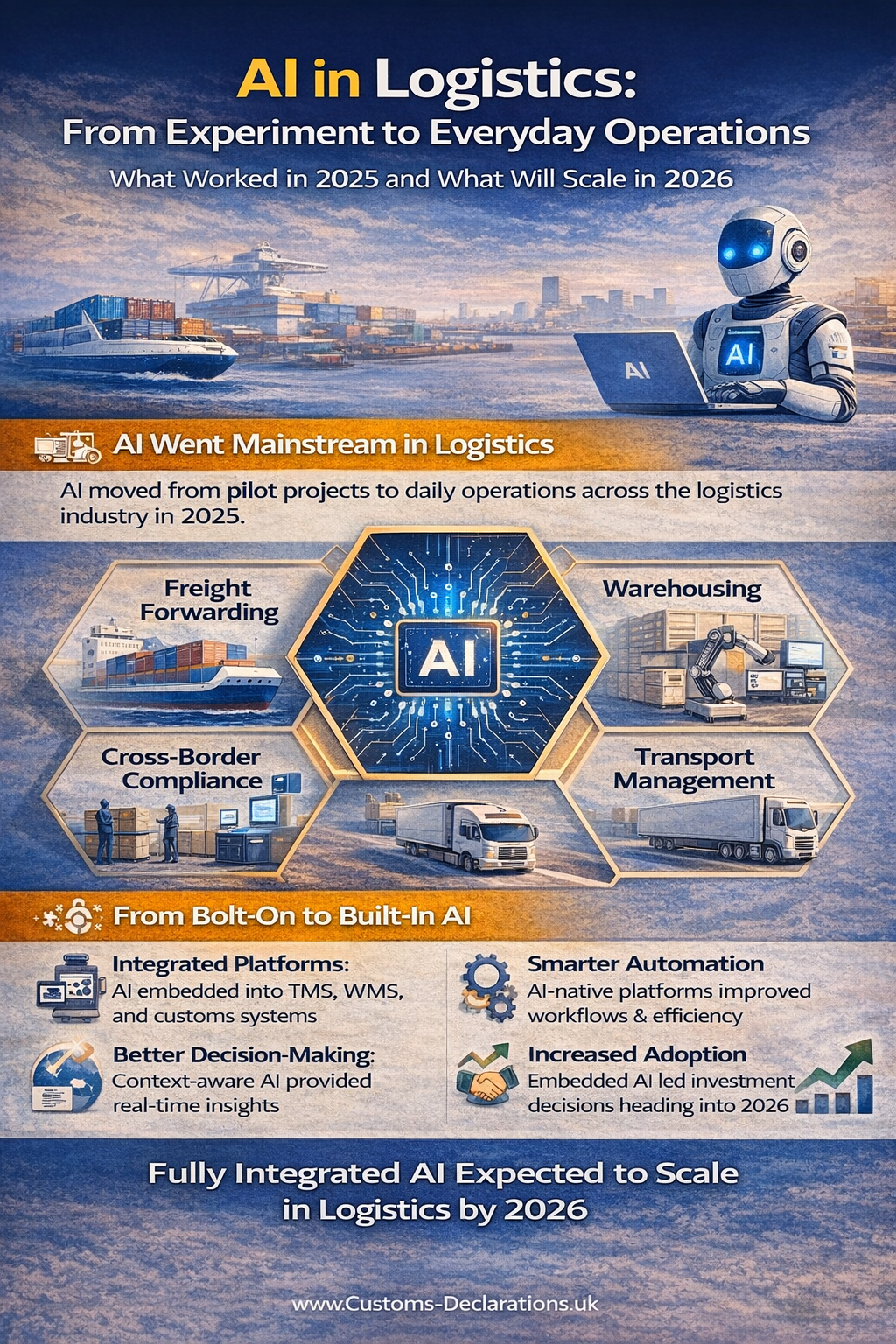
For most of the past decade, artificial intelligence in logistics occupied a familiar position: full of promise, short on proof. Pilot programmes generated impressive case studies, but genuine operational embedding remained elusive. That changed meaningfully in 2025. Across freight forwarding, warehousing, cross-border trade compliance, and transportation management, AI moved from the experimental fringe into the daily workflow. The shift carries real implications for logistics operators, customs professionals, and technology buyers heading into 2026.
The Transition from Bolt-On to Built-In
The most important development of 2025 was not any single AI capability but a structural one: the industry began retiring the model of attaching AI assistants on top of legacy systems in favour of embedding intelligence directly into core operational platforms. Transportation management systems, warehouse management systems, and customs filing platforms increasingly treat AI not as a feature to be added, but as a foundational layer of how data flows, decisions are made, and exceptions are flagged.
This matters because bolt-on AI creates friction. Users must toggle between their operational system and a separate assistant, and the models often lack the domain-specific context needed to be genuinely useful. When AI is native to the workflow — trained on the same data schemas, aware of the same regulatory requirements, and surfacing insights within the same interface a user already operates — adoption increases and outcomes improve. Vendors who understood this early built meaningful competitive distance in 2025, and the gap is expected to widen through 2026 as procurement decisions increasingly favour AI-native architecture over feature parity.
Demand Forecasting with External Signal Integration
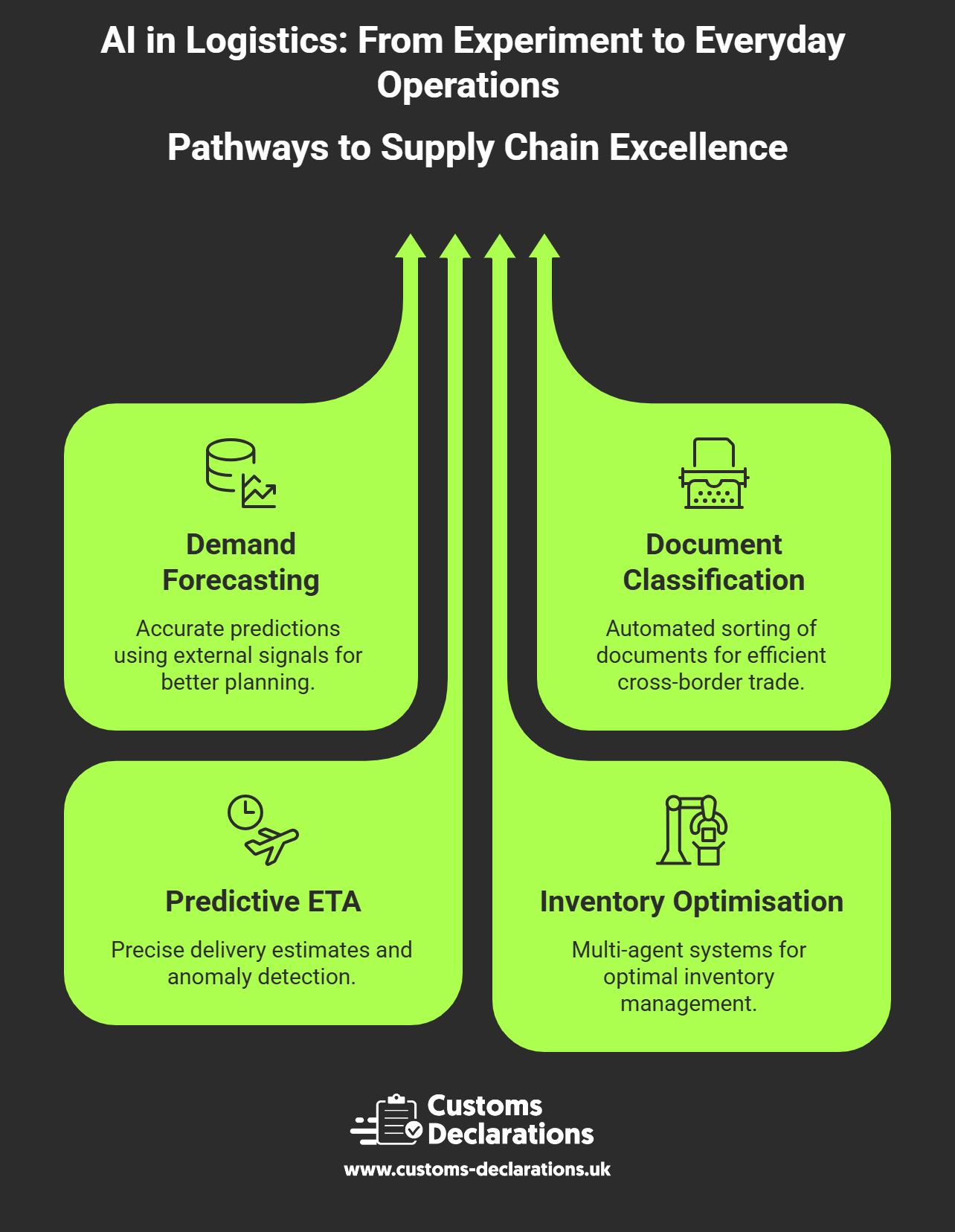
Among the practical applications that delivered measurable value in 2025, demand forecasting stood out for its maturation. Earlier generations of forecasting models relied predominantly on historical shipment data and seasonal patterns. The models that performed best last year integrated a broader class of external signals — weather event data, macroeconomic indicators, port congestion indices, and even social media sentiment tied to product categories — to build a more complete picture of near-term demand.
The results were particularly visible in inventory positioning across distribution networks. Operators who had integrated multi-signal forecasting reported reduced stockouts, lower safety stock requirements, and more efficient inbound freight planning.
Document Classification Automation in Cross-Border Trade
Cross-border trade generates a relentless volume of documentation: commercial invoices, packing lists, bills of lading, certificates of origin, declarations of conformity, and licences. Processing these documents manually is slow, error-prone, and expensive. In 2025, document classification automation using optical character recognition combined with natural language processing reached a level of reliability that justified operational deployment rather than continued piloting.
Customs compliance teams reported significant gains in first-time-right processing rates once document AI was embedded into their pre-declaration workflows. The technology reads incoming documentation, extracts relevant fields, validates them against declaration data, and flags discrepancies — all before a human reviewer touches the file. For organisations filing CDS import declarations at volume, this pre-validation step reduces the rate of customs holds caused by mismatched data between shipping documents and submitted declarations.
The practical ceiling for document AI in 2025 was not accuracy on clean, well-formatted documents — that problem is largely solved — but handling edge cases: non-standard invoice formats, handwritten certificates, multilingual documents, and supplier documents that bundle information in unconventional ways. Progress on these edge cases will continue into 2026, but the core workflow automation is production-ready today.
Predictive ETA Models and Cleaner Anomaly Detection
Logistics operations generate enormous volumes of status events, tracking updates, and exception alerts. The challenge for operations teams is not insufficient data but excessive noise — so many alerts that distinguishing genuine exceptions from routine variance becomes practically impossible at scale.
Predictive estimated-time-of-arrival models that account for carrier behaviour, weather routing, port dwell patterns, and historical lane performance reduced alert volumes by filtering out events that fell within expected variation while escalating those that represented genuine risk to delivery commitments. Operators who deployed these models reported a measurable reduction in the manual review burden on operations teams, enabling those teams to focus on the exceptions that actually required intervention.
Anomaly detection models layered on top of shipment data served a parallel function in customs risk environments, flagging consignments where declared values, routing patterns, or document characteristics deviated from established norms — enabling compliance teams to focus review effort where it was most needed rather than sampling broadly. HMRC and EU customs authorities including those administering ENS safety and security declarations are building similar logic into their own risk-profiling systems, which means that submitting accurate, consistent data at the point of declaration is more important than ever.
Multi-Agent Inventory Optimisation Across Distribution Networks
Single-location inventory optimisation is a mature discipline. The more complex and previously unsolved challenge is coordinating inventory decisions across multiple distribution centres simultaneously — where moving stock to optimise one location creates constraints or costs at others. Multi-agent AI systems, where individual models representing each distribution node negotiate with one another under shared network constraints, showed genuine commercial-scale results in 2025.
The practical benefit is a reduction in both total inventory held and the frequency of costly inter-facility transfers. For supply chains sourcing goods internationally — where lead times are long and declaration processes add transit time — improved network-level inventory positioning reduces the pressure on expedited air freight and the associated customs complexity that comes with urgent shipments.
AI-Native Platforms
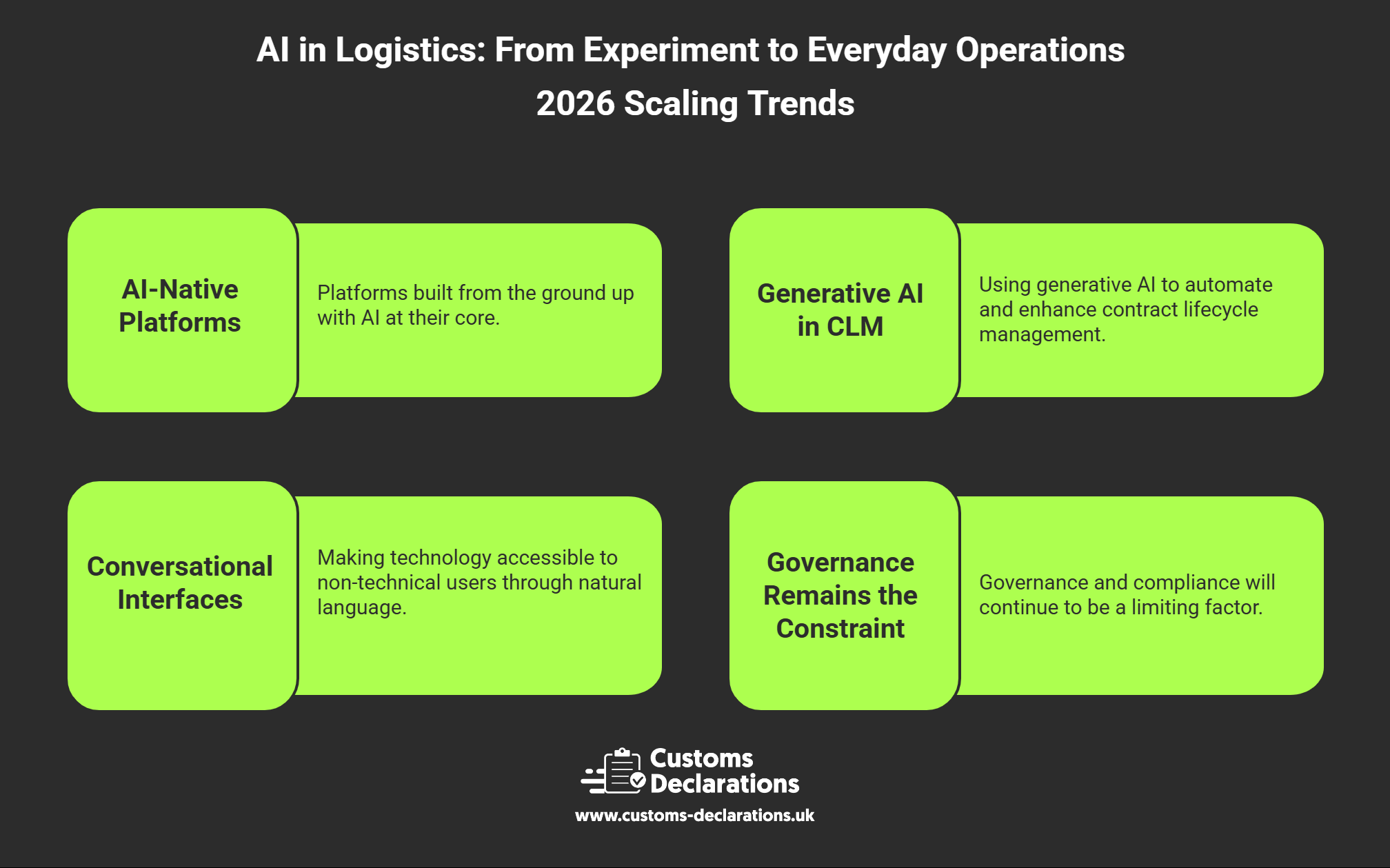
The central theme for 2026 is consolidation around AI-native platforms and the retirement of parallel tooling. Logistics technology buyers have grown sceptical of point solutions that require separate logins, separate data pipelines, and separate vendor relationships. The competitive advantage in 2026 will belong to platforms that deliver AI capabilities — classification assistance, document validation, anomaly detection, conversational data query — within the same environment where operational work happens.
For customs filing specifically, this means that platforms like Customs Declarations UK — which already provide guided, wizard-based workflows with real-time validation directly integrated into HMRC’s Customs Declaration Service — are well-positioned as AI capabilities are layered into the declaration preparation process. Automated plausibility checks, classification suggestions, and document cross-validation become natural extensions of an existing compliant workflow rather than separate tools that operators must learn to use alongside their core system.
Generative AI in Contract Lifecycle Management
One of the more commercially significant applications expected to scale in 2026 is the use of generative AI to automate contract lifecycle management in freight and logistics. The administrative burden of drafting, reviewing, negotiating, and monitoring logistics contracts — carrier agreements, freight forwarder terms, customs agent mandates, warehousing contracts — is substantial and largely unautomated today.
Generative AI systems trained on contract corpora and regulatory requirements can accelerate drafting, identify non-standard clauses, flag compliance risks, and maintain audit trails across contract versions. For trade compliance teams managing the legal documentation associated with customs special procedures, authorisations, and third-party representation, this represents a meaningful reduction in administrative overhead.
Conversational Interfaces for Non-Technical Users
Perhaps the most democratising development anticipated for 2026 is the mainstreaming of AI-based conversational interfaces that allow non-technical users to interrogate complex logistics and trade data in plain language. Rather than requiring analysts to write queries or navigate dashboard filters, operations and compliance staff will increasingly be able to ask direct questions — “What is our average clearance time for Chapter 84 goods through Felixstowe this quarter?” or “Which of our suppliers has the weakest conformity documentation?” — and receive structured, cited answers drawn from live operational data.
For customs compliance specifically, conversational interfaces have the potential to surface regulatory guidance, flag procedure requirements, and explain declaration fields in a way that reduces dependence on specialist knowledge for routine queries. This lowers the barrier to in-house customs management for businesses that might otherwise rely entirely on brokers — a shift that platforms designed for direct filing, such as Customs Declarations UK, are structurally positioned to support.
Governance Remains the Constraint
Across all these applications, the limiting factor in 2026 will not be technical capability but governance. Logistics and customs are regulated environments where errors carry real financial and legal consequences. AI systems that assist with classification, valuation, or compliance must operate within frameworks that preserve human accountability, provide explainability for decisions that affect clearance outcomes, and maintain audit trails that satisfy both HMRC and EU customs authorities.
Operators deploying AI in customs workflows should map each use case against emerging requirements under the EU AI Act, ensure that human review steps are preserved for high-consequence decisions, and maintain clear documentation of how AI outputs are incorporated into declaration data. The organisations that build these governance frameworks now will be better placed to adopt new AI capabilities quickly and confidently as they emerge, rather than retrofitting controls after deployment.
Conclusion
2025 established that AI in logistics is operational, not aspirational. Demand forecasting with external signals, document classification automation, predictive ETA modelling, and multi-agent inventory optimisation all moved from proof of concept to production. 2026 will be defined by consolidation — AI-native platforms replacing bolt-on tooling, generative AI taking on contract and document lifecycle work, and conversational interfaces extending analytical capability to non-specialist users.
For customs and trade compliance professionals, the practical priority is ensuring that the platforms they use today are built to absorb these capabilities natively rather than alongside them. Filing accurate, validated declarations through an integrated platform like Customs Declarations UK means your operational data is already structured in a way that future AI capabilities — classification assistance, anomaly detection, document cross-validation — can act on directly, without additional integration work. The groundwork laid now determines how quickly your operation captures the value of what comes next.