Pre-loader

Understanding the ICS2 Process Lifecycle: A Complete Stage-by-Stage Guide for EU Import Compliance

Introduction: The Foundation of EU Customs Security

The Import Control System 2 (ICS2) represents a fundamental transformation in how safety and security information is collected, analysed, and acted upon at European Union borders. For businesses moving goods into the EU customs territory—whether from the United Kingdom, Asia, the Americas, or any non-EU origin—understanding the complete ICS2 process lifecycle is essential for maintaining compliance, avoiding delays, and ensuring smooth customs clearance. The system operates through a carefully orchestrated sequence of seven distinct stages, each serving a specific purpose in the broader framework of border security and trade facilitation.

Unlike the previous ICS1 system, ICS2 introduces enhanced data requirements, earlier filing obligations, and more sophisticated risk analysis capabilities powered by advanced algorithms. The process begins well before goods physically arrive at EU borders and continues through to final customs clearance within the EU. Each stage builds upon the previous one, creating a comprehensive audit trail that EU customs authorities use to make informed decisions about which consignments require additional scrutiny and which can be fast-tracked through clearance.

This article provides a detailed examination of each stage in the ICS2 process lifecycle, explaining the responsibilities, timelines, and practical considerations that traders, freight forwarders, and customs agents must navigate. For UK businesses exporting to the EU, understanding ICS2 is crucial for ensuring customers receive goods without border delays. For EU importers and logistics providers, mastering this workflow ensures compliance with EU customs regulations and maintains efficient supply chain operations in the post-Brexit trading environment.

Stage 1: ENS Filing (Pre-loading/Pre-arrival) – Establishing the Security Foundation

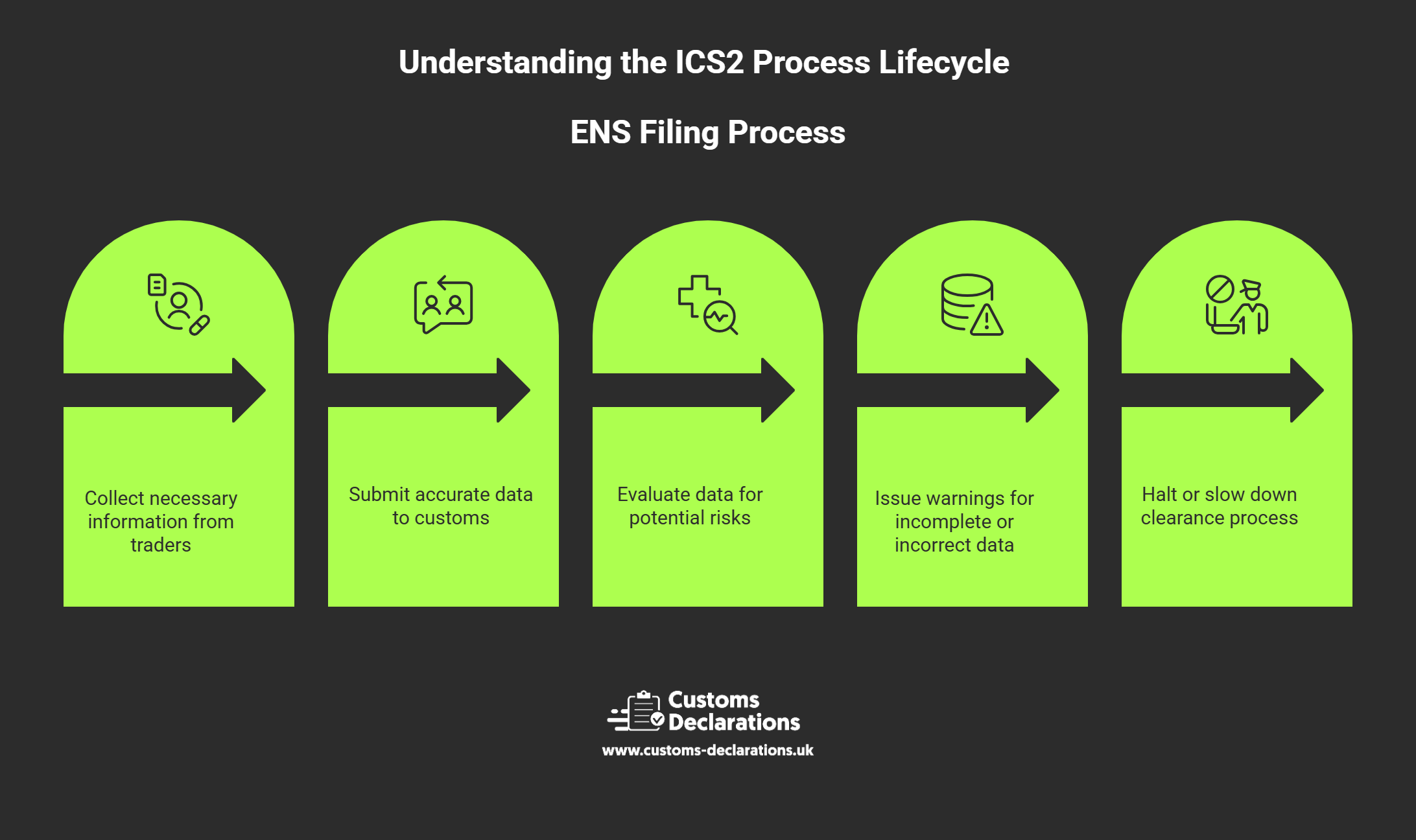
The Entry Summary Declaration forms the cornerstone of the ICS2 process and must be submitted before goods are loaded onto the means of transport destined for the European Union. This pre-arrival filing requirement represents a significant departure from traditional customs procedures, where declarations were often submitted upon or after arrival. The ENS provides EU customs authorities with advance notice of incoming consignments, enabling risk assessment to occur while goods are still in transit rather than creating bottlenecks at ports and airports throughout the EU.

The filing deadlines vary depending on the mode of transport and the specific circumstances of the shipment. For maritime containerised cargo, the ENS must be lodged before loading at the port of departure outside the EU. Air freight typically requires filing at least four hours before arrival for long-haul flights, though shorter timeframes may apply for intra-European movements from non-EU locations. Road and rail transport follow similar pre-arrival principles, with filings required before the goods cross into EU customs territory. These deadlines are strictly enforced across all EU member states, and late submissions can result in rejected entries, physical inspections, or even penalties.

The ENS itself requires comprehensive data across multiple categories. Traders must provide accurate information about the consignor and consignee, detailed commodity descriptions including Harmonised System codes at the six-digit level, precise weight and quantity measurements, container and seal numbers where applicable, complete transport routing information showing the journey from origin to the EU Customs Office of First Entry, and identification of the carrier and other parties involved in the movement. The quality and accuracy of this data directly impact the risk assessment that follows. Incomplete, inconsistent, or obviously incorrect information triggers alerts that can slow or halt clearance entirely at any EU border point.

Different filing methods exist depending on the trader’s operational profile and relationship with EU customs systems. Many businesses operating from the UK or other non-EU locations use the services of carriers or freight forwarders who submit ENS declarations on their behalf through connections to EU member state customs systems. However, increasingly sophisticated traders are bringing this function in-house using platforms such as Customs Declarations UK, which provides guided ENS filing workflows specifically designed for ICS2 compliance. The platform validates data in real time against EU requirements and enables direct submission, offering UK exporters and EU importers greater control, visibility, and the ability to correct errors before they reach customs authorities.

The importance of data consistency cannot be overstated at this stage. The information provided in the ENS must align with commercial invoices, packing lists, bills of lading, and any subsequent customs declarations that will be submitted for release to free circulation within the EU. Discrepancies between documents are a primary trigger for customs intervention at EU borders. Traders should establish robust internal processes to ensure that commodity descriptions, values, quantities, and party identities are captured accurately at source and flow consistently through all documentation throughout the import process into the EU.

For UK exporters, ICS2 compliance represents an additional layer of responsibility in serving EU customers. While UK businesses may not be the legal importer of record in the EU, they often play a crucial role in ensuring accurate ENS data is available to carriers or EU consignees who file on behalf of the shipment. Providing comprehensive, accurate shipping information to logistics partners has become essential for maintaining smooth trade flows between the UK and EU markets.

Stage 2: Risk Analysis and Assessment Complete – The Automated Decision Point

Once the Entry Summary Declaration is successfully lodged and accepted by the ICS2 system, an automated risk analysis process begins immediately. This stage represents the technological heart of ICS2, where sophisticated algorithms deployed across the EU customs union evaluate the submitted data against extensive risk profiles, historical patterns, intelligence databases, and current threat assessments. The system processes multiple data points simultaneously, looking for anomalies, inconsistencies, and indicators that might suggest security concerns, revenue risk, or compliance issues.

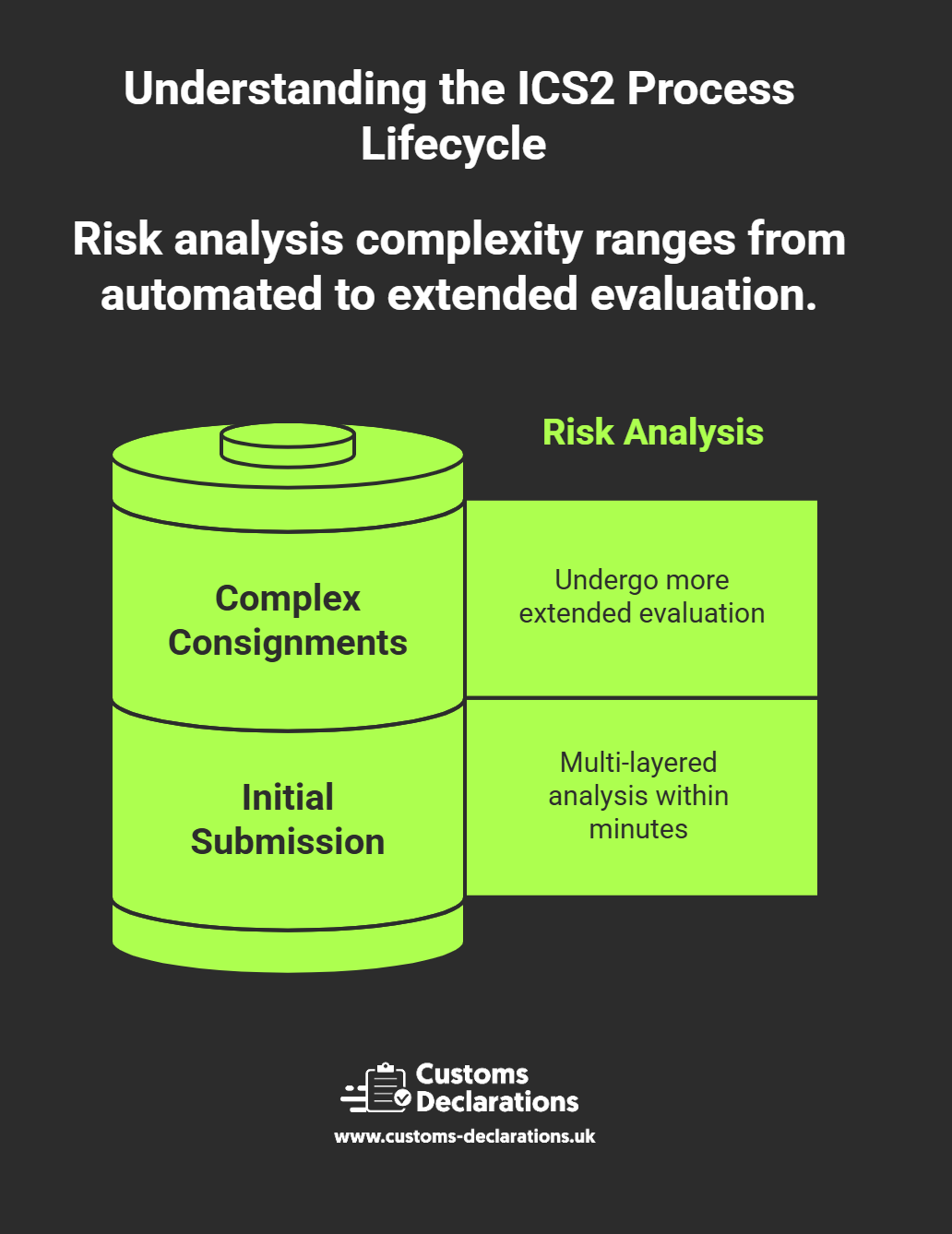
The risk analysis considers numerous factors in its evaluation. These include the nature of the goods being imported into the EU, their origin and routing through multiple jurisdictions before reaching EU territory, the identities and compliance histories of the parties involved both within and outside the EU, unusual pricing or valuation patterns that might indicate undervaluation or misclassification, packaging and transport arrangements that deviate from normal commercial practice, and any red flags in the commodity codes or descriptions. The system also cross-references data against EU sanctions lists, restricted goods registers, and previous enforcement outcomes across all member states. This multi-layered analysis happens within minutes of submission, though complex or high-risk consignments may undergo more extended evaluation.

When the risk assessment concludes, the system generates an IE3N03 Assessment Complete notification. This message communicates the outcome of the risk analysis back to the filer, though it does not necessarily provide detailed reasoning behind the decision. Consignments deemed low-risk receive clearance to proceed toward the EU border, while those flagged for potential concern may be marked for intervention at later stages. Importantly, this assessment is provisional rather than final; circumstances can change, and additional information received at subsequent stages may trigger reassessment by EU customs authorities.

For traders operating in both UK-to-EU and other non-EU-to-EU supply chains, the key objective at this stage is to ensure the ENS data supports a positive risk assessment by EU authorities. This means providing complete, accurate, and professionally presented information that demonstrates transparency and facilitates automated processing. Vague commodity descriptions, missing or incomplete data elements, inconsistent party identities, or obvious errors in weights, values, or codes all increase the likelihood of adverse risk scoring when the shipment reaches EU borders. Conversely, detailed and precise information, backed by appropriate supporting documentation and submitted by operators with strong compliance histories in EU trade, tends to pass through risk analysis with minimal friction.

The Assessment Complete notification should be retained as evidence that the ENS was properly processed and that risk analysis occurred before goods arrived at EU territory. This documentation becomes crucial if questions arise during subsequent stages at EU borders or if customs authorities conduct post-clearance audits. Traders using the Customs Declarations UK platform benefit from automatic archiving of these notifications alongside the original ENS submission, creating a complete audit trail that satisfies both EU customs requirements and UK record-keeping obligations for businesses involved in cross-border trade.

Stage 3: Arrival Notification – Confirming Physical Presence at EU Borders

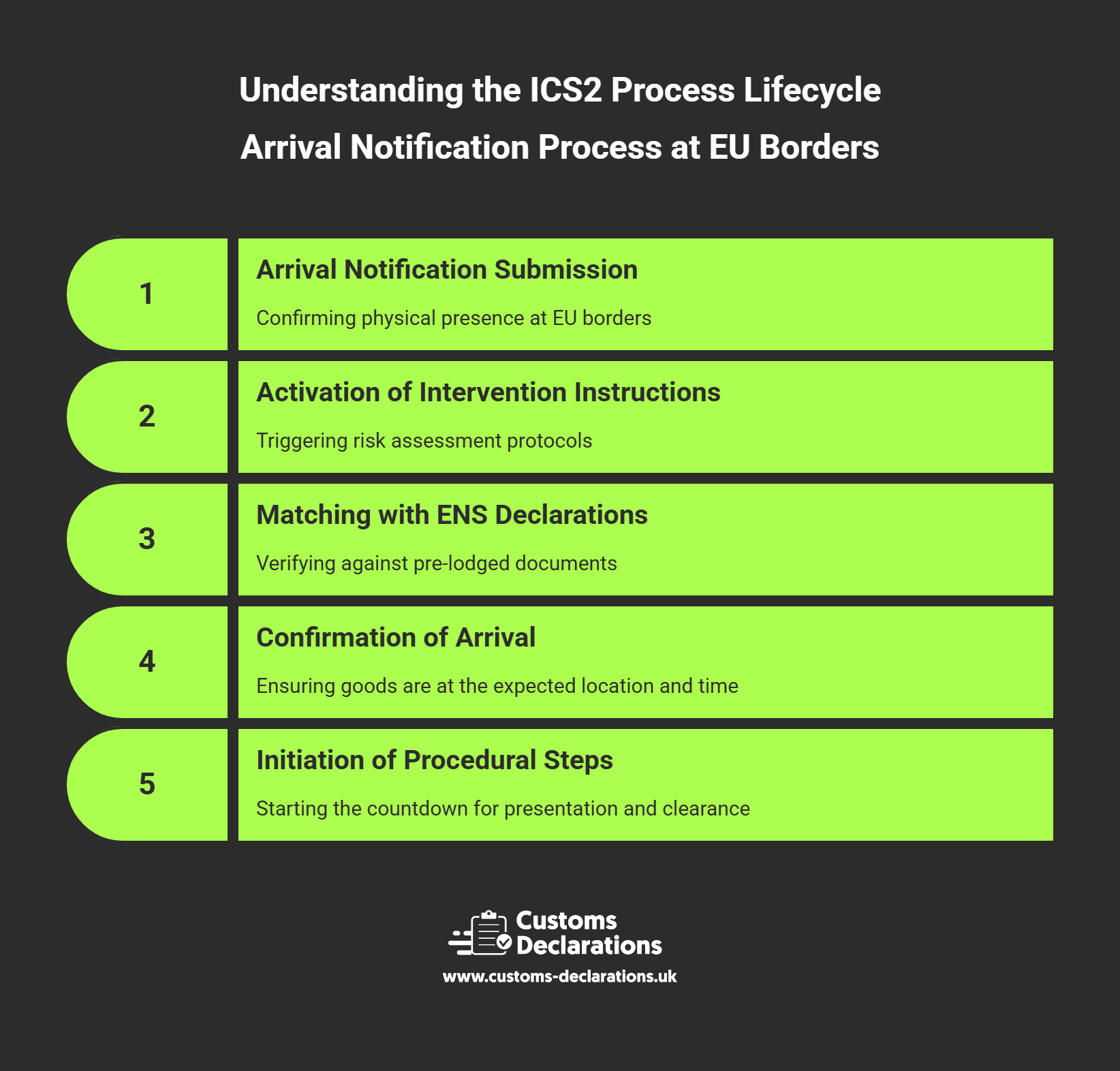
The Arrival Notification marks the transition from pre-arrival planning to active border management at EU entry points. This stage occurs when the means of transport carrying the goods physically reaches the Customs Office of First Entry within the European Union, which may be a seaport in Rotterdam, Hamburg, or Antwerp, an airport such as Schiphol or Charles de Gaulle, a rail terminal receiving freight from the UK or other non-EU countries, or a road crossing point at the EU external border. The carrier or their representative submits a formal notification to the relevant EU member state customs authorities confirming that the transport has arrived and that the goods are now within EU customs territory and subject to EU customs control.

This notification serves multiple purposes within the ICS2 framework across the EU. It triggers the activation of any intervention instructions generated during the risk assessment stage, allows EU customs officers to match physical arrivals against pre-lodged ENS declarations, confirms that goods have arrived at the expected location and time within the EU, and initiates the countdown for subsequent procedural steps such as presentation and clearance under EU customs law. Without a valid arrival notification, goods remain in legal limbo, unable to proceed through EU customs formalities even if all other documentation is in order.

The accuracy of arrival notifications is critical for maintaining supply chain integrity in EU trade. The notification must reference the correct ENS declaration through its Movement Reference Number, specify the actual Customs Office of First Entry within the EU where arrival occurred, provide accurate arrival date and time information, and include transport identification details such as vessel name, flight number, or vehicle registration. Discrepancies between the notified arrival and the original ENS declaration can trigger investigations, delays, or requirements for corrected submissions by EU customs authorities.

For businesses engaged in UK-EU trade or other international movements into the EU, the arrival notification stage requires close coordination between various parties in the supply chain spanning multiple jurisdictions. Carriers are typically responsible for submitting the notification to the relevant EU member state authorities, but traders should verify that this has occurred correctly and within required timeframes. Delays in notification can cascade through subsequent stages, creating pressure on presentation deadlines and clearance windows at EU borders. Companies with strong relationships with their carriers and forwarders usually establish automated notification processes where arrival at EU territory triggers immediate system updates accessible to all parties involved in the transaction.

The notification also represents the point at which theoretical customs obligations under EU law become practical realities. Once arrival is confirmed at an EU port or border point, the clock starts ticking on time-bound requirements for presentation, control, and clearance under EU customs regulations. Goods cannot remain indefinitely in an arrived-but-not-cleared state; EU customs regulations impose strict timelines for moving consignments through the remaining stages of the process. Traders must be prepared to act quickly after arrival notification at EU borders to ensure compliance and avoid storage charges, demurrage, or enforcement action by member state authorities.

Stage 4: Diversion (If Applicable) – Managing Route Changes Within EU Operations

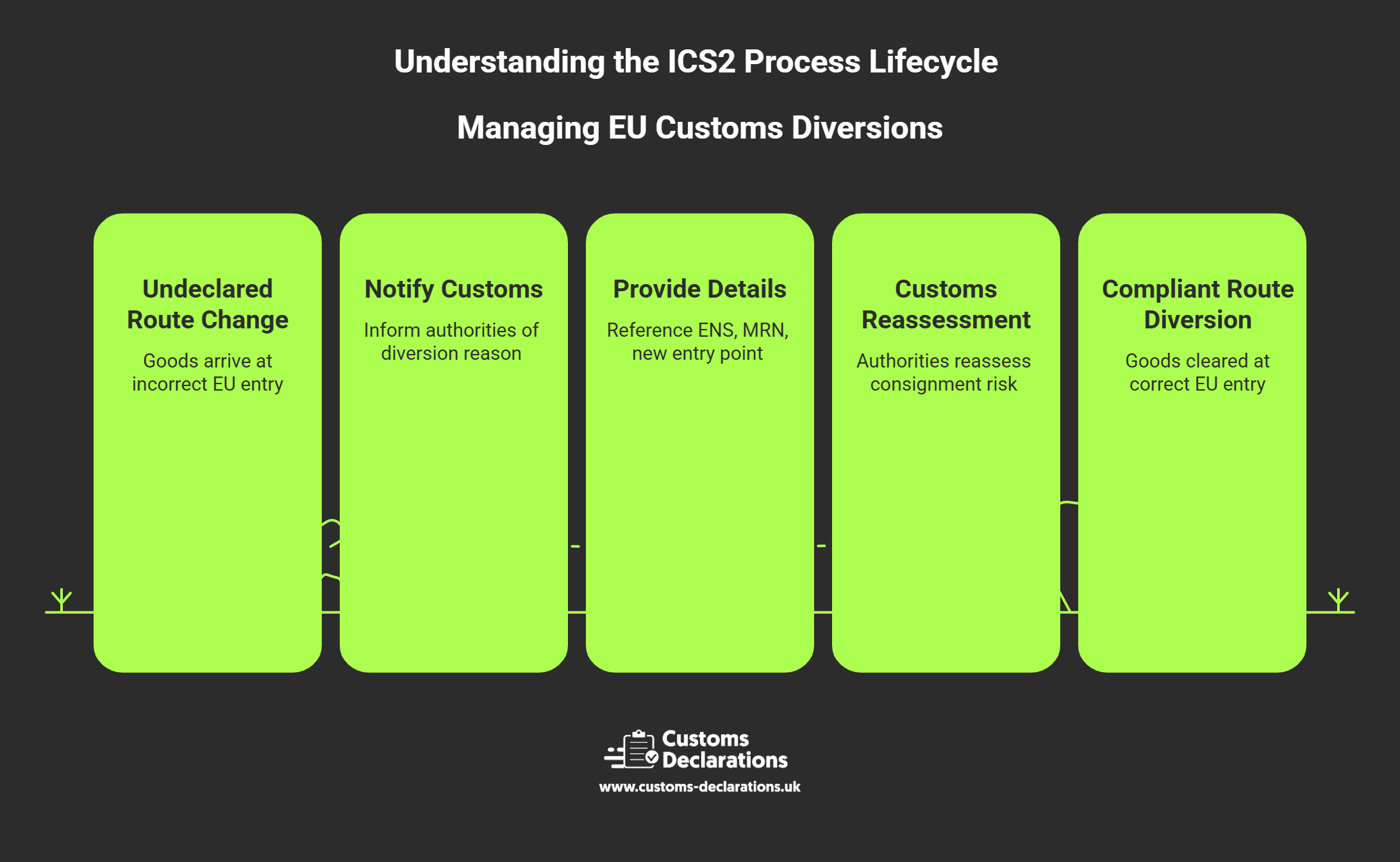
Diversion represents an exceptional circumstance within the ICS2 process lifecycle, occurring when goods arrive at a Customs Office of First Entry within the EU different from the one declared in the original Entry Summary Declaration. This situation can arise for numerous operational reasons including weather-related port closures or route changes affecting EU destinations, transport scheduling adjustments or equipment failures requiring alternative EU entry points, commercial decisions to redirect cargo to different EU member states or ports, or emergency rerouting due to congestion or capacity constraints at planned EU entry locations. While not a routine occurrence, diversions require careful handling to maintain customs compliance with EU regulations and avoid penalties.

When a diversion occurs affecting the EU entry point, the carrier or trader must notify the relevant EU member state customs authorities promptly, typically before or immediately upon arrival at the alternative EU location. The notification must explain the reason for the diversion, reference the original ENS and its Movement Reference Number, specify the new Customs Office of First Entry within the EU, and confirm that all other details regarding the goods remain unchanged. EU customs authorities will reassess the consignment in light of the diversion, as the change in arrival location may have implications for control capacity, risk profile, or administrative arrangements within the receiving member state.

The diversion process creates additional administrative burden and potential delay when entering the EU. Customs officers at the alternative EU location may not have been expecting the consignment and may require additional time to review documentation and assign resources for any necessary inspections. The original risk assessment conducted through ICS2 remains valid in most cases, but EU authorities retain discretion to conduct fresh evaluation if the diversion raises concerns about cargo integrity or route security. Traders should therefore maintain comprehensive documentation explaining the legitimate operational reasons for any diversion affecting EU entry points.

From a practical perspective, diversions highlight the importance of flexibility and communication in customs operations involving EU borders. Businesses should ensure their customs agents, carriers, and internal teams can respond quickly when transport plans change affecting EU destinations. Having access to systems that allow rapid amendment or resubmission of customs data is essential. The Customs Declarations UK platform enables users to update ENS information and submit notifications for diverted consignments bound for the EU without requiring complete re-filing, streamlining what could otherwise be a complex and time-consuming correction process when dealing with EU customs authorities.

The best approach to diversion is prevention through robust transport planning and contingency arrangements for EU shipments. However, when diversions are unavoidable, treating them as serious compliance events requiring immediate attention and proper documentation protects businesses from allegations of improper importation or attempts to evade controls at EU borders. EU customs authorities distinguish between legitimate operational diversions handled transparently and suspicious route changes that might indicate smuggling or fraud attempts.

Stage 5: Presentation Notification – Making Goods Available for EU Customs Control

Presentation Notification represents the formal declaration to EU customs authorities that goods have arrived at their designated location within EU territory and are available for inspection, examination, or other control measures under EU customs law. This stage follows arrival notification but involves a distinct legal obligation under EU regulations: the trader or their representative must affirmatively present the goods to customs rather than simply notifying that they have arrived. Presentation confirms that goods are in a secure, accessible location where EU customs officers can exercise their statutory powers if required.

The timing of presentation is governed by strict regulatory requirements established by EU customs law. Generally, goods must be presented to EU customs authorities immediately upon arrival or within a very short window thereafter. Failure to present goods promptly can result in penalties, seizure, or prosecution for smuggling under member state legislation, regardless of whether any intent to evade EU customs controls existed. The presentation must occur at an approved customs facility or designated location within the EU, which might be a port warehouse, temporary storage facility, customs examination area, or other authorised premises within the member state where goods first entered EU territory.

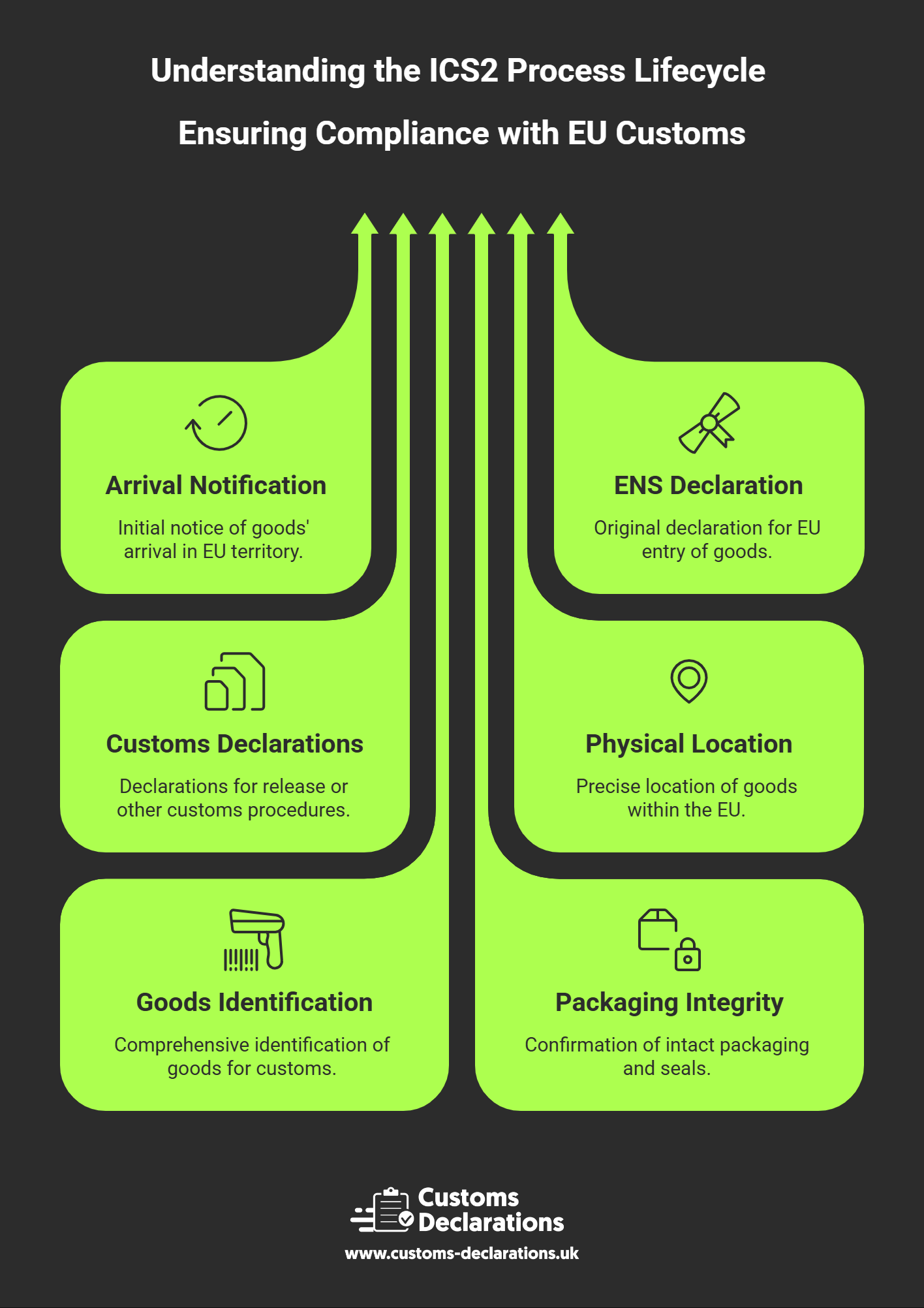
The presentation notification must include comprehensive identification of the goods, linking them back to the original ENS declaration submitted for EU entry, any applicable customs declarations for release to free circulation or other procedures under EU customs regulations, and the precise physical location within the EU where goods can be accessed. The notification should also confirm that goods match the descriptions provided in earlier submissions to ICS2, that packaging and seals remain intact, and that no unauthorised interference with the consignment has occurred during transport or after arrival at EU borders.

For traders operating in UK-EU supply chains or other international movements into the EU, presentation represents a critical compliance checkpoint under EU law. The goods must be made available in the condition and quantity described in all previous declarations submitted to EU authorities. Any shortfalls, damages, or discrepancies discovered at this stage must be reported immediately and explained satisfactorily to the relevant member state customs authority. EU customs authorities take a dim view of presentation notifications that prove inaccurate when officers attend to conduct physical inspections. Repeated inaccuracies can damage a trader’s compliance record across EU member states and result in increased scrutiny for future shipments into EU territory.

Presentation also triggers the final decision point regarding physical controls by EU customs authorities. Although risk assessment occurred earlier through the ICS2 system, customs authorities within individual EU member states retain the right to select consignments for inspection even after an initial green light. Presentation is the stage where such intervention decisions are executed by EU officers. Goods selected for control must remain in the presented location until customs officers complete their examination and issue release instructions under EU procedures. This can introduce uncertainty into supply chain planning for EU-destined shipments, as inspection timelines are not always predictable, particularly when complex technical assessments or laboratory testing are required by EU authorities.

Stage 6: Controls (If Applicable) – Physical and Documentary Examination by EU Authorities

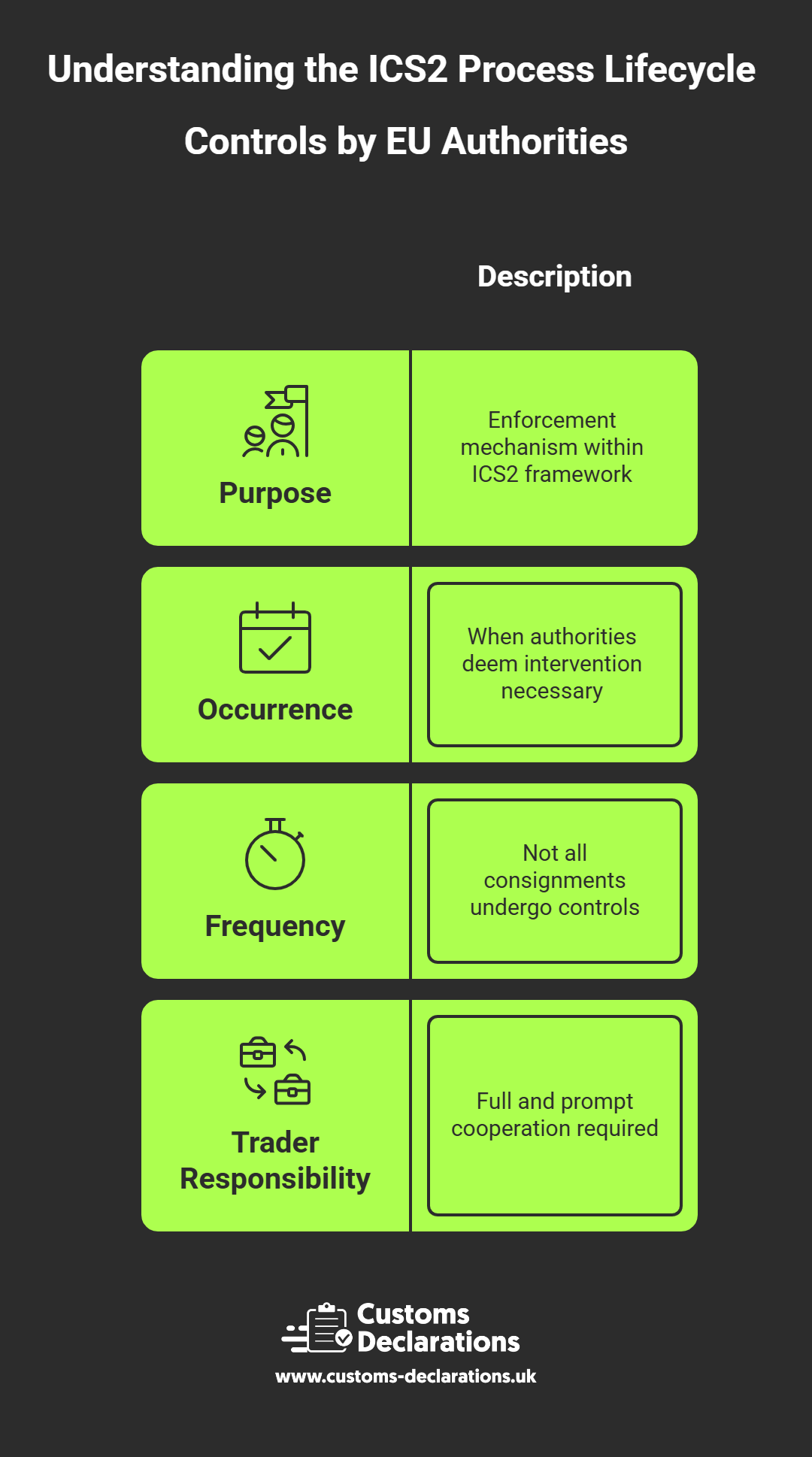
Controls represent the enforcement mechanism within the ICS2 framework and EU customs operations, occurring when customs authorities within EU member states determine that physical inspection, documentary verification, or other intervention is necessary before goods can be released into EU free circulation or other customs procedures. Not all consignments entering the EU proceed through this stage; indeed, the majority of imports are cleared without physical controls, reflecting both the effectiveness of risk-based targeting through ICS2 and the economic necessity of maintaining trade flow into the EU. However, when controls are imposed by EU customs authorities, traders must cooperate fully and promptly to avoid extended delays and additional costs.

Physical controls at EU borders typically involve customs officers from the relevant member state attending the location where goods are presented and conducting hands-on inspection of the cargo. This may range from simple visual verification that goods match their description to detailed examination of individual items, laboratory analysis of samples by EU-approved facilities, or complete unpacking and repacking of containers. The intensity of control depends on the specific concerns that triggered the intervention in the EU context, which might relate to commodity classification under EU tariff nomenclature, valuation accuracy for EU import duty purposes, product safety and conformity with EU regulations, prohibited or restricted goods under EU law, intellectual property concerns under EU enforcement programmes, or general verification of declaration accuracy for EU customs purposes.

Documentary controls focus on paperwork rather than physical goods, requiring traders to produce and explain supporting evidence for their declarations to EU customs authorities. EU customs officers may request commercial invoices, contracts of sale, packing lists, certificates of origin establishing preferential treatment under EU trade agreements, product specifications and technical documentation demonstrating EU conformity, licences or permits for restricted goods under EU regulations, transport documents, or correspondence with suppliers. The examination seeks to verify that declarations accurately reflect the commercial reality of the transaction and that all EU regulatory requirements have been satisfied.

From a practical standpoint, controls introduce delay and cost into the import process at EU borders. Goods remain under EU customs control until examination is complete and officers are satisfied with the results, which can take hours, days, or even weeks depending on complexity and the specific requirements of the member state authority conducting the control. Storage charges accumulate at EU facilities, delivery schedules to EU customers are missed, and additional staff time is required to respond to customs requests from EU authorities. For perishable or time-sensitive cargo entering the EU, controls can result in significant commercial losses. Businesses should factor this possibility into their supply chain planning for EU shipments and maintain relationships with customs brokers who can respond quickly when controls are imposed at EU entry points.

The key to minimising the impact of controls by EU customs authorities is cooperation and responsiveness. When EU customs officers request additional information or access to goods, providing it promptly and professionally usually results in faster resolution. Defensive or obstructive responses, on the other hand, tend to extend examinations and may trigger more intensive scrutiny by EU authorities. Traders should also learn from control experiences at EU borders; if particular product lines or suppliers consistently attract intervention when entering the EU, this may indicate underlying problems with declarations, product compliance with EU standards, or supplier reliability that need addressing.

Stage 7: Subsequent Customs Procedure – Final Clearance and Release Within the EU

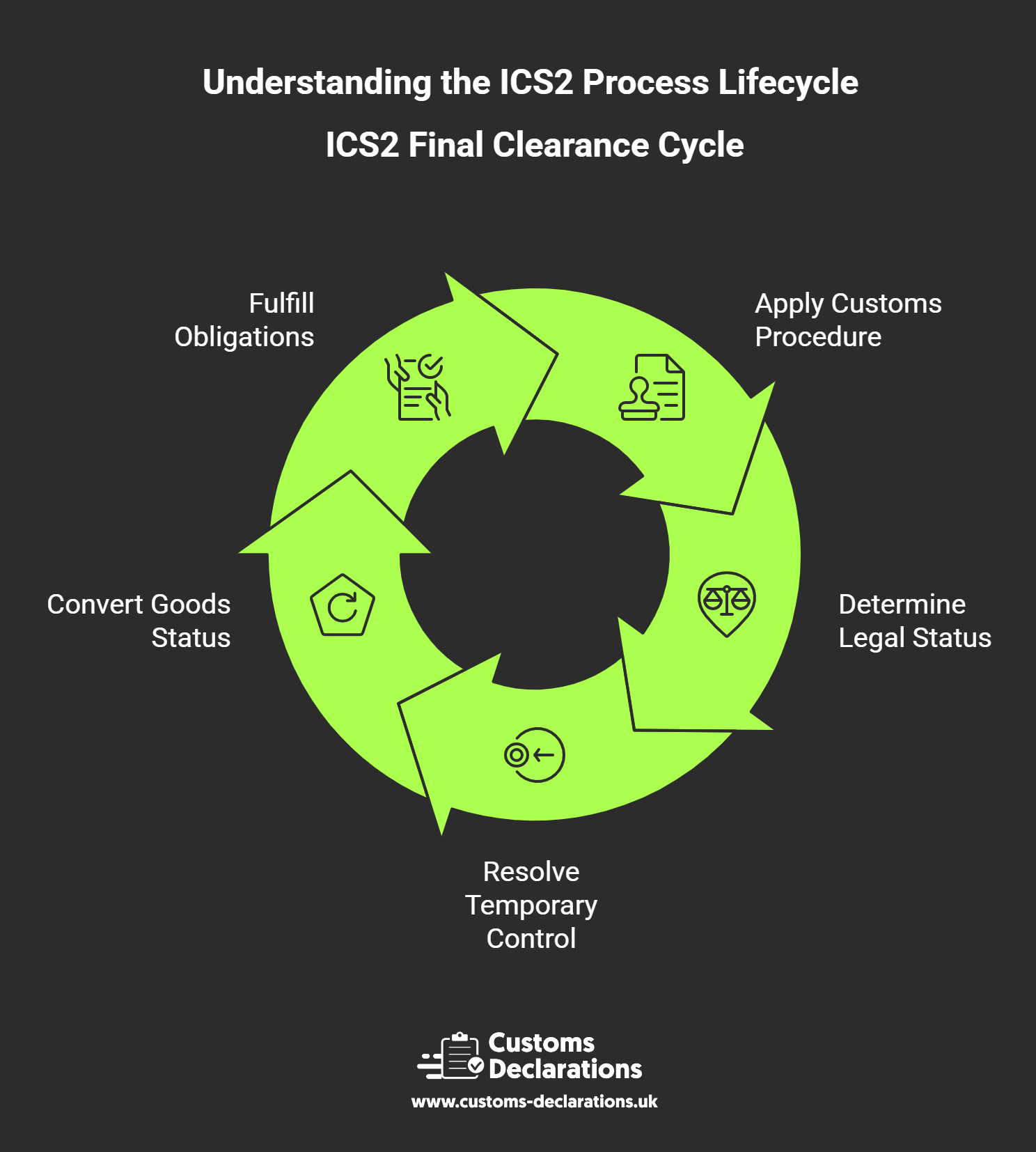
The final stage of the ICS2 process lifecycle involves the application of a subsequent customs procedure that determines the legal status and permitted uses of the imported goods within the European Union. This stage resolves the temporary state of customs control established at arrival and presentation, converting goods from “arrived and presented” status to their final destination within EU customs territory. Several distinct procedures are available under EU customs law, each serving different business purposes and carrying different obligations.

Release to free circulation is the most common subsequent procedure for goods intended for consumption, sale, or use within the EU. This procedure clears goods for home use within the EU, making them equivalent to EU-origin goods without restrictions on movement between member states. EU import duty and VAT become payable at this stage unless relief or suspension arrangements apply under EU law. Traders must submit a full import declaration through the customs systems of the relevant EU member state, providing comprehensive commercial and classification information in accordance with Union Customs Code requirements. For UK exporters working with EU customers, ensuring that complete and accurate information is available for this declaration stage is essential for smooth clearance.

Temporary storage represents an interim procedure used when goods have arrived at EU borders but the final customs procedure has not yet been determined or declared. Under EU regulations, goods can remain in temporary storage for up to ninety days while traders arrange onward movement within the EU, complete documentation, or resolve commercial issues. Temporary storage facilities within EU member states must be approved by national customs authorities and maintain strict security and record-keeping standards. No EU duty or VAT is payable during temporary storage, but the goods cannot be used, processed, or consumed while under this procedure.

Transit procedures apply when goods are moving through EU territory to another destination without being released for consumption within the EU. Union Transit arrangements allow goods to traverse EU member states under seal, subject to guarantees and strict route and timeline controls established by EU law. This procedure is particularly relevant for goods arriving at EU ports but destined for non-EU countries or for goods transiting through the EU on their way to final destinations. The transit declaration effectively suspends EU customs formalities until goods reach their final destination, where normal import procedures apply under the relevant jurisdiction’s regulations.

Special procedures under EU customs law provide alternatives for specific business scenarios including customs warehousing where goods are stored under EU customs control with duty and VAT suspended until released for consumption within the EU, inward processing that allows temporary import for manufacturing or repair within the EU with re-export relief, authorised use permitting temporary import for specific purposes such as testing or exhibition within EU territory, and outward processing for EU goods exported temporarily for processing outside the EU. Each special procedure requires prior authorisation from the relevant EU member state customs authority and compliance with specific conditions regarding use, location, record-keeping, and discharge established by EU regulations.

Regardless of which subsequent procedure applies under EU law, this final stage represents the point where customs obligations crystallise and become enforceable within the EU customs union. Traders assume responsibility for paying applicable EU duties and taxes, maintaining required records in accordance with EU retention requirements, complying with product safety and conformity requirements under EU law, and ensuring goods are used only for permitted purposes within or in relation to EU territory. The Movement Reference Number from the ENS declaration and any subsequent customs declarations should be retained alongside commercial documentation for the retention period required by EU law, creating an audit trail that links safety and security data with fiscal and commercial information.

Practical Integration: How the Customs Declarations UK Platform Supports EU-Bound Trade

Understanding the ICS2 process lifecycle theoretically is valuable, but practical implementation requires systems and processes that translate EU regulatory requirements into operational reality for businesses engaged in trade with the European Union. The Customs Declarations UK platform is designed to support traders through ICS2 compliance requirements for EU-bound shipments, from initial ENS filing through documentation management and record-keeping. The platform’s architecture accommodates the ICS2 workflow for EU imports, providing stage-appropriate functionality that keeps UK exporters and EU importers compliant while minimising administrative burden.

At the ENS filing stage for EU-bound shipments, CDUK offers intuitive wizards that guide users through data capture specifically designed for ICS2 requirements, automatically validating entries against EU customs specifications and flagging errors before submission. The platform maintains libraries of frequently used commodity codes, party identities, and transport details that can be reused across multiple declarations to EU destinations, dramatically reducing data entry time for repeat EU trade lanes. For businesses handling high volumes of ENS filings for EU markets, bulk upload capabilities allow simultaneous submission of multiple declarations from structured data files, with automated formatting and validation ensuring consistency with EU requirements.

Throughout the risk analysis and arrival notification stages, CDUK provides real-time status tracking and notifications for EU-bound consignments. Users can monitor the progress of their ENS declarations submitted for EU customs, receive automatic alerts when Assessment Complete notifications are issued by EU authorities, and track arrival confirmations as they occur at EU entry points. This visibility is crucial for coordinating with carriers, freight forwarders operating in EU markets, and warehouse operators within EU territory, ensuring that all parties are working from current information and can respond quickly if issues arise at EU borders.

When diversion or controls occur affecting shipments entering the EU, CDUK enables rapid response through its amendment and documentation capabilities. Users can update ENS information for EU-bound shipments, submit explanatory notes to address concerns raised by EU customs authorities, and attach supporting documents directly through the platform. For consignments selected for physical inspection by EU customs officers, the platform’s secure document storage allows traders to quickly assemble and share the technical files, compliance certificates demonstrating conformity with EU regulations, and commercial evidence that EU customs officers typically request during examinations.

The platform also archives all related documents, from the original ENS submission for EU entry through risk notifications, arrival confirmations at EU borders, and communications with EU customs authorities, creating a comprehensive audit file that satisfies both EU retention requirements and UK record-keeping obligations for businesses engaged in cross-border trade. This integrated approach ensures that traders involved in UK-EU supply chains maintain the documentation necessary to demonstrate compliance with both UK export procedures and EU import requirements.

Conclusion: Mastering the ICS2 Lifecycle for Efficient EU Trade

The ICS2 process lifecycle represents a sophisticated, multi-stage framework designed to balance legitimate trade facilitation with robust security controls at European Union borders. For businesses moving goods into EU customs territory—whether UK exporters serving EU customers or EU importers receiving goods from global suppliers—understanding each stage in depth is essential for maintaining compliance, managing risk, and achieving predictable clearance outcomes at EU entry points. The seven stages work as an integrated system where accuracy and timeliness at each step influence success at subsequent stages. Errors or delays introduced early in the lifecycle tend to compound, creating problems that become progressively more difficult and expensive to resolve when dealing with EU customs authorities.

Successful navigation of the ICS2 lifecycle for EU-bound trade requires three key elements. First, traders must invest in understanding EU regulatory requirements, filing deadlines established by EU law, and data standards that govern each stage of entry into the EU. This knowledge forms the foundation for designing compliant processes and training staff appropriately for EU trade operations. Second, businesses need robust operational procedures that capture accurate information at source, maintain consistency across documents destined for EU customs authorities, coordinate effectively with carriers and agents operating in EU markets, and respond quickly when exceptions arise at EU borders. Third, traders benefit significantly from technology platforms that embed compliance controls for EU requirements, automate routine tasks, and provide visibility across the entire customs process for EU-destined shipments.

As ICS2 continues to evolve and additional data requirements are phased in through future releases by EU authorities, the importance of systematic, technology-enabled compliance will only increase for businesses engaged in EU trade. Companies that master the ICS2 process lifecycle today position themselves for competitive advantage through faster clearance times at EU borders, lower control rates by EU customs authorities, stronger relationships with EU customers and logistics partners, and reduced exposure to delays and penalties. Understanding and implementing best practices across all seven stages is an investment that delivers returns through improved supply chain reliability and long-term customs compliance for trade with the European Union.

We value your feedback, and if you have any comments, suggestions or anything else that you would like to highlight to us, we will be delighted to hear from you and incorporate your feedback into our content.

Note: While we have made every attempt to ensure that the information contained in this Site has been obtained from reliable sources, Customs Declarations UK is not responsible for any errors or omissions, or for the results obtained from the use of this information. All information in this Site is provided “as is”, with no guarantee of completeness, accuracy, timeliness or of the results obtained from the use of this information, and without warranty of any kind, express or implied, including, but not limited to warranties of performance, merchantability and fitness for a particular purpose. Nothing herein shall to any extent substitute for the independent investigations and the sound technical and business judgment of the reader. In no event will Customs Declarations UK, or its partners, employees or agents, be liable to you or anyone else for any decision made or action taken in reliance on the information in this Site or for any consequential, special or similar damages, even if advised of the possibility of such damages. Certain links in this Site connect to other Web Sites maintained by third parties over whom Customs Declarations UK has no control. Customs Declarations UK makes no representations as to the accuracy or any other aspect of information contained in other Web Sites.