Pre-loader

UK Trade Deficit Widens to £6.1 Billion: What the Latest ONS Data Means for Importers, Exporters, and Customs Compliance

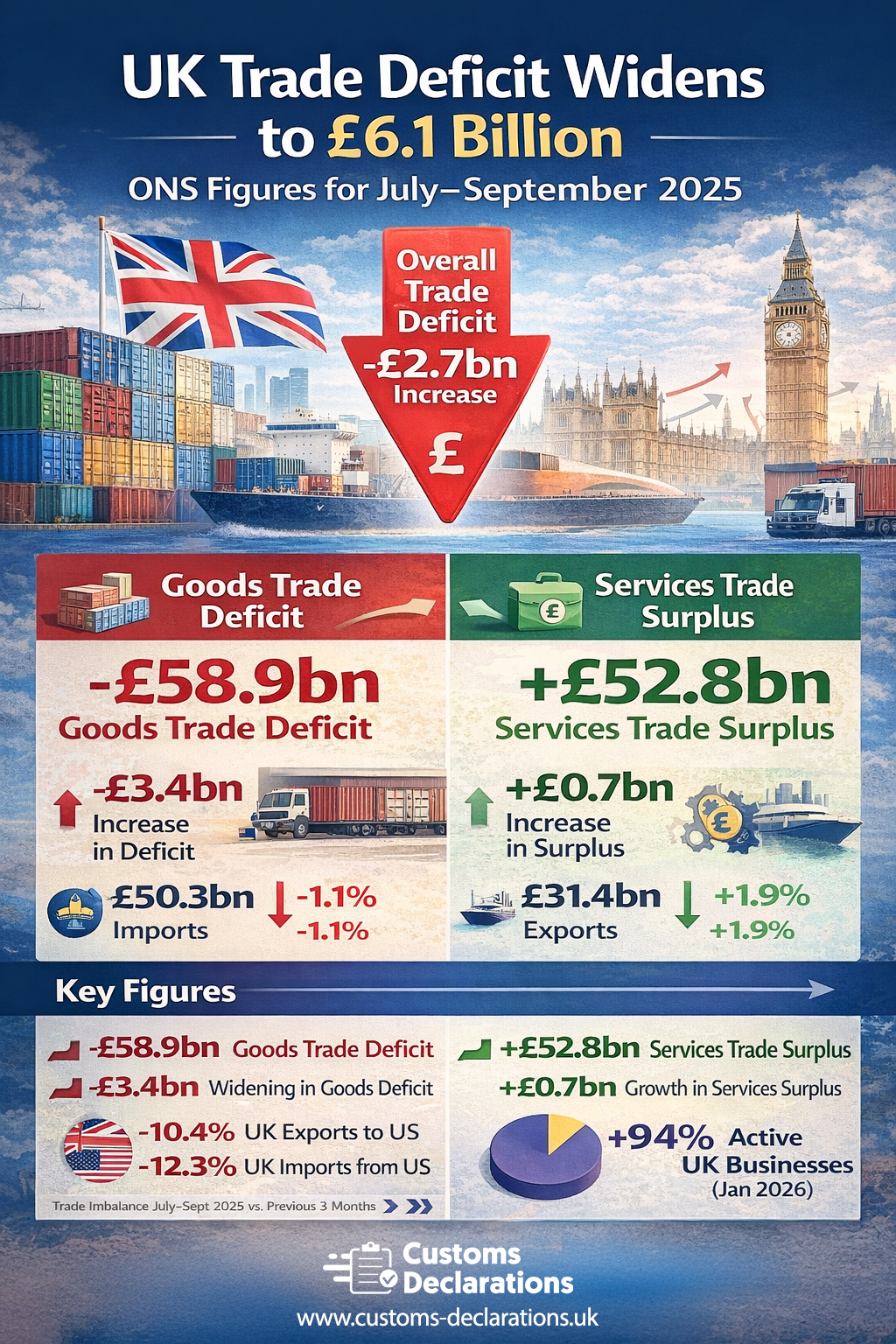
The Office for National Statistics released comprehensive UK trade data on January 23, 2026, covering the July to September 2025 quarter, with supplementary monthly figures extending through November 2025. The statistics paint a picture of persistent trade imbalances and evolving international commerce patterns that carry direct implications for businesses engaged in cross-border trade. The most striking headline figure shows that the United Kingdom’s total trade deficit widened to £6.1 billion for the three months ending November 2025, representing a £2.7 billion increase compared to the August baseline. This deterioration in the trade balance reflects deeper structural shifts in both goods and services trade flows, and it arrives at a moment when economic uncertainty ranks as the primary challenge affecting business turnover across the UK economy.

The granular breakdown of the November 2025 data reveals that the trade in goods deficit stood at £58.9 billion, having widened by £3.4 billion over the reference period. This was partially offset by an improving services surplus of £52.8 billion, which grew by £0.7 billion. Within the goods category, November figures showed imports valued at £50.3 billion, down 1.1 percent from the previous period, while goods exports reached £31.4 billion, marking a 1.9 percent increase. These movements suggest that while export performance showed modest resilience, the structural import dependency of the UK economy continues to exert pressure on the overall trade position. Particularly notable within these figures is the sharp contraction in UK-US trade, with exports to the United States falling 10.4 percent and imports declining 12.3 percent. The Office for National Statistics has scheduled a dedicated analytical article for January 30, 2026, examining the impact of tariffs on UK-US trade in goods, underscoring the policy sensitivity of transatlantic commerce in the current environment.

These trade statistics arrive alongside complementary business sentiment data from the Business Insights and Conditions Survey, released on January 22, 2026. The survey found that 94 percent of UK businesses were actively trading in early January 2026, demonstrating operational continuity despite macroeconomic headwinds. However, the same survey identified concerning trends in business performance, with 32 percent of respondents reporting decreased turnover in December 2025, an increase of four percentage points over prior readings. Economic uncertainty emerged as the dominant challenge affecting turnover, cited by 31 percent of trading businesses. For firms engaged in international trade, this uncertainty is compounded by the administrative and compliance demands of managing import declarations and export declarations in a complex regulatory landscape shaped by Brexit, evolving trade agreements, and heightened customs enforcement.

Understanding the customs implications of shifting trade volumes

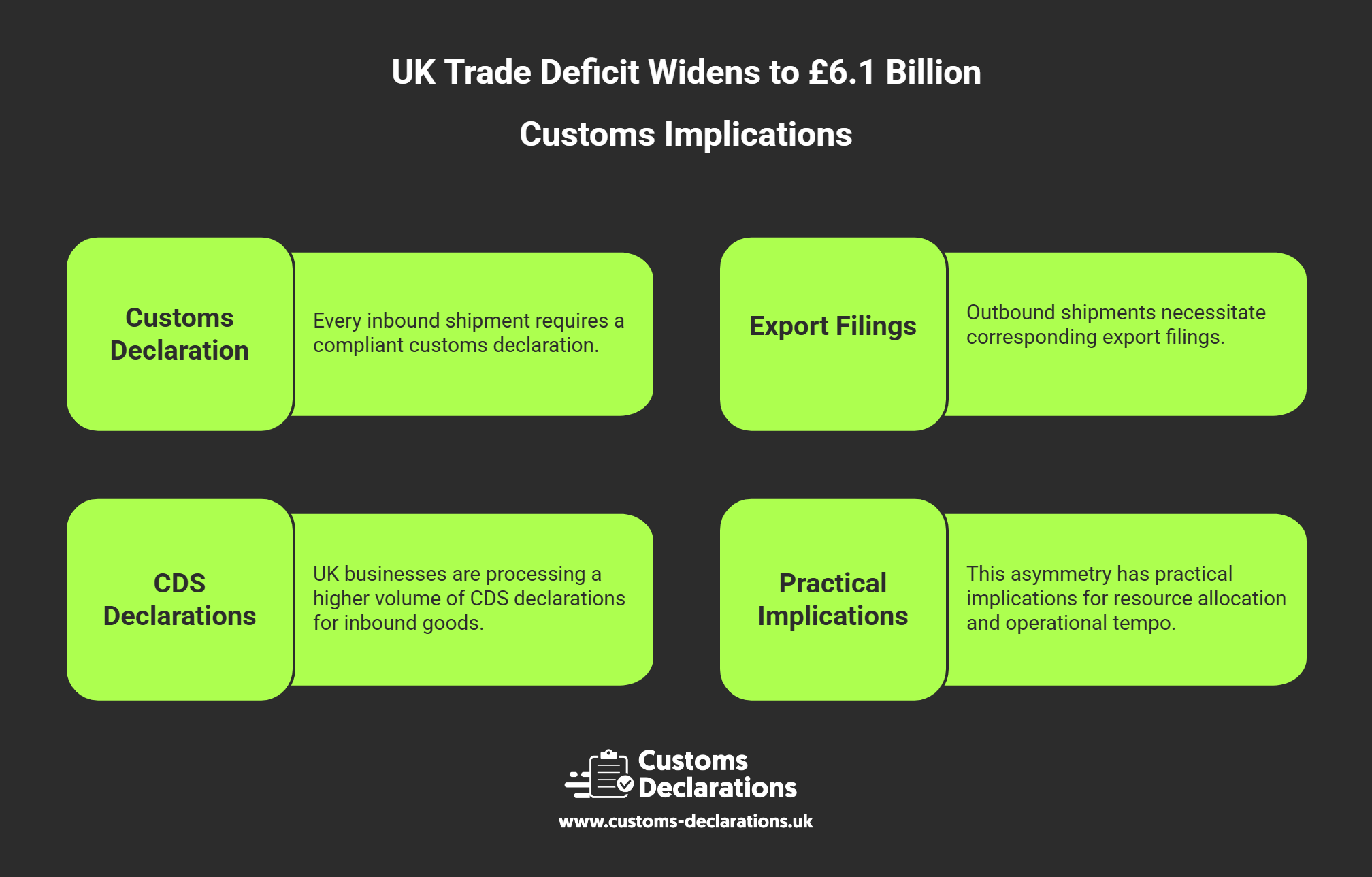
Trade deficits of the magnitude reported by the ONS translate directly into customs administration workloads and compliance obligations for importers and exporters. Every inbound shipment contributing to the £50.3 billion in November goods imports required a compliant customs declaration lodged with HMRC’s Customs Declaration Service. Similarly, outbound shipments forming part of the £31.4 billion export figure necessitated corresponding export filings. The widening goods deficit indicates that import volumes continue to outpace exports significantly, which in turn means that UK businesses, freight forwarders, hauliers, and customs intermediaries are processing a higher cumulative volume of CDS declarations for inbound goods than for outbound movements. This asymmetry has practical implications for resource allocation, systems capacity, and the operational tempo of customs clearance processes at UK ports and inland clearance sites.

For businesses operating in this environment, maintaining accuracy and timeliness in import declarations is not merely a regulatory formality but a critical determinant of supply chain reliability. Delays or errors in customs filings can cascade into inventory shortages, contract penalties, and reputational damage, particularly in sectors dependent on just-in-time logistics models. The formal requirements for an import declaration encompass commodity classification, customs valuation, origin determination, applicable duty and VAT calculations, and the provision of supporting documentation such as commercial invoices, transport documents, and certificates of conformity. Each of these elements must align precisely with the physical goods and the commercial terms of the transaction. Misalignment between declared values and actual transaction prices, for instance, can trigger post-clearance audits, duty reassessments, and financial penalties.

The trade data also highlights the continuing importance of export declarations as a compliance obligation and a strategic business consideration. While export volumes remain lower than imports in aggregate terms, the 1.9 percent increase in November exports suggests that some UK businesses are successfully navigating international markets despite economic uncertainty. Exporters must ensure that their CDS declarations accurately reflect the goods being shipped, including correct commodity codes, destination countries, and any preferential tariff claims under free trade agreements. The UK’s network of trade agreements, including the Trade and Cooperation Agreement with the EU and bilateral agreements with countries such as Japan, Australia, and Canada, offers tariff relief for qualifying goods, but only when origin can be substantiated through compliant documentation and accurate declaration data.

The role of safety and security declarations in international trade flows

Beyond the core customs declarations required for goods clearance, businesses must also contend with safety and security filing obligations. ENS declarations, or Entry Summary Declarations, are required for goods being imported into the UK to provide advance cargo information to customs and border authorities. These filings are designed to enable risk assessment and targeting before goods physically arrive at the border, thereby enhancing border security without unduly impeding legitimate trade. The ENS regime applies to shipments arriving by sea, air, road, and rail, and the timing and content requirements vary depending on the mode of transport and the routing of the goods.

For importers managing the volumes reflected in the ONS data, ensuring that ENS declarations are lodged accurately and on time is essential to avoid border holds and associated costs. Missing or incomplete ENS filings can result in goods being refused entry or held for inspection, disrupting supply chains and incurring demurrage and storage charges. The complexity of ENS compliance is compounded when shipments involve multiple legs, consolidations, or transhipment through third countries, all of which require careful coordination between shippers, carriers, freight forwarders, and customs agents. Businesses that operate in high-volume import lanes benefit significantly from automated systems that integrate ENS filing with core customs declaration processes, allowing data to be captured once and reused across multiple submission types.

Customs Declarations UK: supporting compliant trade in a high-volume environment

Navigating the compliance requirements associated with the trade volumes reported by the ONS demands robust systems, clear processes, and access to timely guidance. The Customs Declarations UK platform provides businesses with a structured, user-friendly pathway to prepare and submit import declarations, export declarations, and ENS declarations to HMRC and relevant border systems. By offering guided workflows, real-time validation, and secure data archiving, the platform reduces the risk of errors, accelerates clearance times, and ensures that businesses maintain audit-ready records for the statutory retention period.

One of the key advantages of using a dedicated customs declaration platform is the ability to standardize and automate repetitive elements of the filing process. Businesses that handle regular shipments of similar goods can create reusable templates that capture commodity descriptions, tariff codes, origin information, and valuation methodologies, thereby reducing manual data entry and minimizing the potential for inconsistencies. Real-time validation checks embedded within the platform flag missing or illogical data elements before submission to HMRC, preventing rejections and the need for corrective resubmissions. This proactive approach to data quality is particularly valuable in high-pressure operational environments where rapid turnaround times are critical to maintaining supply chain continuity.

The platform also supports the lodging of safety and security declarations, enabling importers to fulfill their ENS obligations through the same interface used for customs declarations. This integration eliminates the need to maintain separate systems or re-enter data across multiple platforms, improving efficiency and reducing the likelihood of discrepancies between customs and security filings. For businesses managing the scale and complexity of trade flows reflected in the ONS statistics, such integration is not merely a convenience but a strategic capability that enhances operational resilience and regulatory compliance.

Looking ahead: trade policy developments and compliance readiness

The scheduled release of the ONS analytical article on UK-US trade and the impact of tariffs on January 30, 2026, will provide further insight into one of the most significant bilateral trade relationships for the United Kingdom. The marked decline in UK-US trade volumes evident in the November 2025 data suggests that tariff measures and broader economic factors are reshaping transatlantic commerce. For businesses engaged in UK-US trade, understanding these dynamics and their implications for customs compliance will be critical. This may include reassessing supply chain configurations, exploring alternative sourcing strategies, or evaluating the feasibility of tariff mitigation measures such as duty drawback or inward processing relief.

More broadly, the trade statistics released by the ONS serve as a reminder of the ongoing evolution of the UK’s position in global trade. As the UK continues to negotiate and implement trade agreements, businesses must remain vigilant in monitoring regulatory changes and adapting their customs compliance practices accordingly. This includes staying informed about updates to tariff schedules, rules of origin, product standards, and customs procedures. Platforms such as Customs Declarations UK play a vital role in this adaptive process by incorporating regulatory updates into their systems and providing users with timely guidance on new requirements.

We value your feedback, and if you have any comments, suggestions or anything else that you would like to highlight to us, we will be delighted to hear from you and incorporate your feedback into our content.

Note: While we have made every attempt to ensure that the information contained in this Site has been obtained from reliable sources, Customs Declarations UK is not responsible for any errors or omissions, or for the results obtained from the use of this information. All information in this Site is provided “as is”, with no guarantee of completeness, accuracy, timeliness or of the results obtained from the use of this information, and without warranty of any kind, express or implied, including, but not limited to warranties of performance, merchantability and fitness for a particular purpose. Nothing herein shall to any extent substitute for the independent investigations and the sound technical and business judgment of the reader. In no event will Customs Declarations UK, or its partners, employees or agents, be liable to you or anyone else for any decision made or action taken in reliance on the information in this Site or for any consequential, special or similar damages, even if advised of the possibility of such damages. Certain links in this Site connect to other Web Sites maintained by third parties over whom Customs Declarations UK has no control. Customs Declarations UK makes no representations as to the accuracy or any other aspect of information contained in other Web Sites.