Pre-loader

Reforming Low Value Imports: The UK’s Comprehensive Customs Modernisation Initiative

Introduction: A Transformative Shift in UK Customs Policy

The United Kingdom is embarking on one of the most significant reforms to its customs framework since Brexit, with far-reaching implications for cross-border e-commerce, parcel operators, online marketplaces, and millions of consumers. In November 2025, HM Treasury and HM Revenue & Customs jointly launched a comprehensive consultation on reforming the customs treatment of low value imports into the United Kingdom. This initiative represents a fundamental recalibration of how goods valued at £135 or less are processed, declared, and taxed when entering Great Britain.

It is critical to emphasise that the proposals outlined in this consultation remain subject to stakeholder feedback and policy refinement. The government has explicitly stated that the final design of the new Low Value Import arrangements will be informed by responses from businesses of all sizes, consumers, parcel operators, customs intermediaries, and technology providers. Implementation is scheduled for March 2029 at the latest, providing a substantial window for co-design, system development, and industry preparation. The consultation period, which runs until 6 March 2026, represents a genuine opportunity for the trade community to shape the future architecture of this critical customs pathway.

The Current Landscape: Understanding BIRDS Volume and Low Value Import Relief

To appreciate the scale and urgency of this reform, one must first understand the explosive growth in low value import trade over recent years. The use of Low Value Import customs arrangements in the UK has fundamentally transformed since their inception, driven by the rapid expansion of cross-border e-commerce, evolving business models, and changing consumer behaviour. The government’s consultation document provides striking evidence of this transformation through detailed volume analysis and trade value assessment.

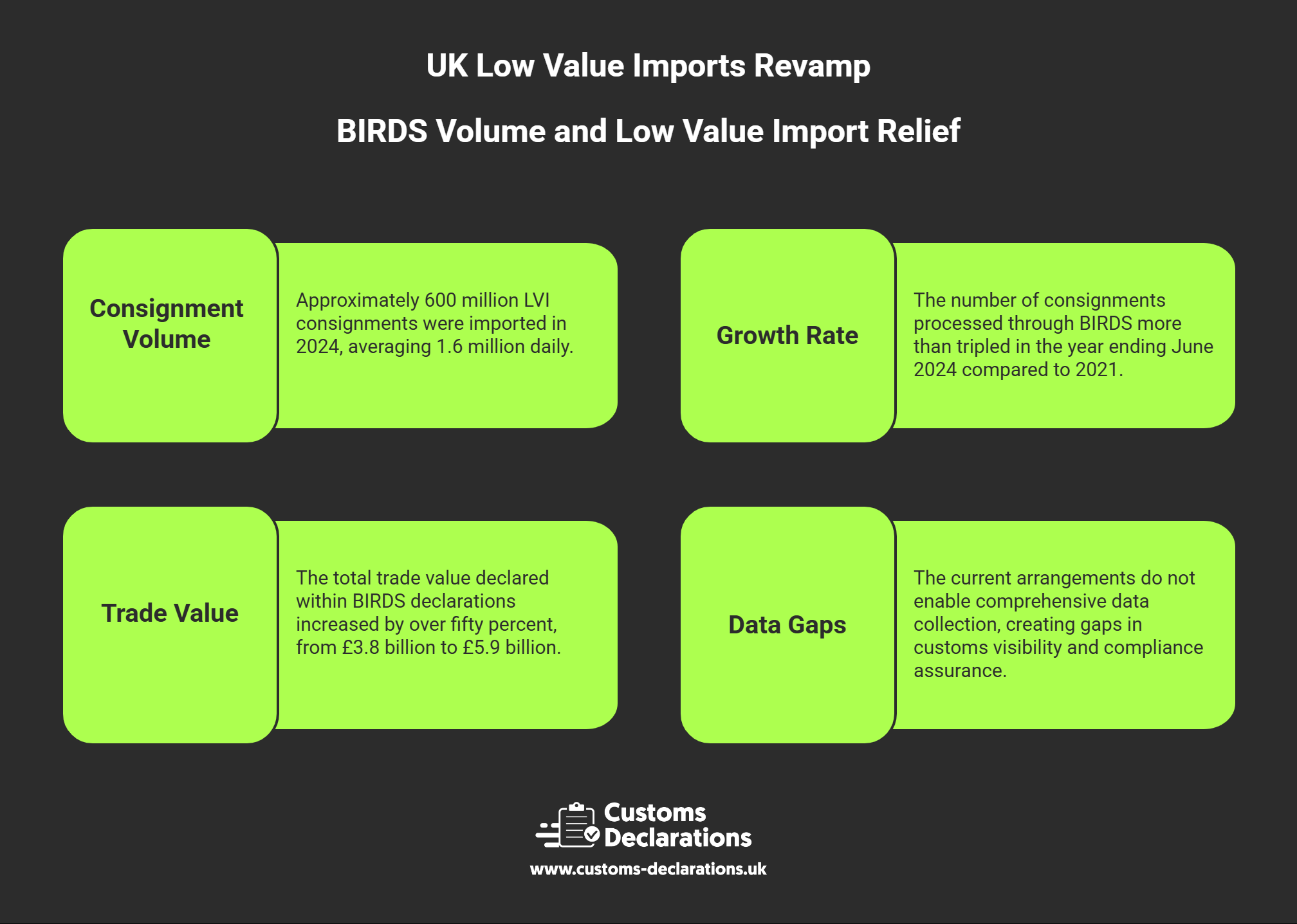
HMRC analysis, based on sample data, estimates that approximately 600 million LVI consignments were imported using the Bulk Import Reduced Data Set declaration process in 2024 alone. This staggering figure translates to roughly 1.6 million individual consignments crossing the UK border every single day. The number of consignments processed through BIRDS is estimated to have more than tripled in the annual period ending June 2024 when compared to calendar year 2021. This represents an unprecedented acceleration in low value trade flows, far exceeding the modest, ad hoc volumes that the original relief framework was designed to accommodate.

The financial magnitude of this trade is equally remarkable. The total trade value declared within BIRDS declarations increased by over fifty percent, rising from £3.8 billion in the 2023-24 financial year to £5.9 billion in 2024-25. However, HMRC has indicated that the actual BIRDS trade value is likely higher than currently captured, and the department is taking steps to quantify the full extent of this discrepancy. This uncertainty itself highlights one of the core challenges driving reform: the current arrangements do not enable comprehensive data collection at the individual consignment level, creating significant gaps in customs visibility and compliance assurance.

Under existing arrangements, individual consignments sent from countries outside the UK to recipients in Great Britain with a declared value of £135 or less benefit from full relief from customs duty. This Low Value Import relief, as codified in the United Kingdom Customs Tariff: Reliefs from Import Duty document, was originally designed for infrequent, non-commercial movements where the administrative cost of collecting duty would exceed the revenue generated. Parcel operators and customs intermediaries authorised by HMRC can use the Bulk Import Reduced Data Set—a simplified declaration mechanism that allows a single customs declaration to cover many individual LVI consignments simultaneously, substantially reducing administrative burden and facilitating rapid clearance.

The Case for Reform: Fairness, Compliance, and Border Integrity

The decision to remove the Low Value Import relief and replace the existing customs arrangements stems from multiple interconnected policy drivers. First and foremost is the principle of fair competition between high street retailers and online platforms. Traditional retailers importing goods in bulk through standard import customs arrangements must pay applicable customs duties on their inventory, classify goods accurately to ten-digit commodity codes, and comply with comprehensive data requirements. In contrast, businesses selling individual low value consignments have enjoyed duty relief and reduced data obligations simply by virtue of their import method rather than the nature of their goods. This structural asymmetry has created an uneven playing field, with online-only sellers benefitting from a cost advantage unrelated to operational efficiency or product quality.

The government’s commitment to supporting UK retailers and high streets, coupled with the objective of ensuring that tax reliefs meet their intended aims, has made reform inevitable. The Autumn Budget 2025 reinforced this direction, emphasising the need to address unfairness within the tax system and ensure that all retailers—regardless of their distribution model—pay customs duty on goods sold to UK consumers. This alignment principle extends beyond domestic fairness considerations; the UK’s approach now mirrors reforms being implemented or considered by major trading partners including the United States and the European Union, reflecting a global recognition that legacy low value import frameworks are no longer fit for purpose in the modern e-commerce environment.

Beyond competitive equity, there are critical compliance and border security imperatives driving change. The current BIRDS mechanism, while efficient for facilitating trade flow, does not enable HMRC to collect item-level data on individual consignments. Customs officers and border enforcement agencies have limited visibility into the specific contents, origins, and values of the hundreds of millions of parcels entering annually through this pathway. This data gap creates vulnerabilities: it becomes more difficult to detect under-valuation, misclassification, or the importation of prohibited and restricted goods including counterfeit products, unsafe consumer items, and substances subject to licensing requirements.

As part of the UK’s G7 commitments, the government pledged to explore mechanisms to address the risks and challenges posed by high-volume, low-value trade. The consultation explicitly acknowledges that the nature and volume of low value trade has shifted profoundly since the existing arrangements were first introduced, and that the current framework was never designed to handle the scale, complexity, and commercial sophistication of today’s cross-border e-commerce ecosystem. Developing a new set of arrangements that better reflect contemporary trade patterns, collect richer data, and exercise appropriate controls while ensuring continued goods flow has therefore become a strategic priority.

The Proposed New LVI Customs Arrangements: Structure and Responsibilities

The cornerstone of the reform is the removal of the Low Value Import relief, making consignments valued at £135 or less subject to the tariffs set out in the UK Global Tariff schedule. This fundamental policy shift will be accompanied by the introduction of entirely new customs arrangements tailored specifically for low value imports, distinct from both the legacy BIRDS process and the standard import customs arrangements used for higher-value consignments. The government intends for these new arrangements to take effect by March 2029 at the latest, providing a multi-year transition window for system development and stakeholder preparation.

Under the proposed model, responsibility for the payment of customs duty on low value imports will rest with sellers and, where applicable, operators of online marketplaces that facilitate sales. This allocation of liability represents a deliberate alignment with the existing VAT collection model introduced in 2021, which already places VAT accountability on these actors for business-to-consumer transactions. By consolidating both customs duty and VAT obligations on the same party, the government seeks to create administrative coherence, improve price transparency for consumers, and leverage the compliance infrastructure of large, well-regulated marketplace platforms.

The rationale for this approach is multi-dimensional. Sellers and marketplace operators typically possess the most accurate and comprehensive data on the goods being sold, including detailed product specifications, transaction values, and inventory characteristics. They are also the actors best positioned to integrate duty costs into the point-of-sale price, ensuring consumers see a fully inclusive price upfront rather than encountering unexpected charges at delivery. Furthermore, concentrating liability on entities that already have VAT registration, quarterly reporting cycles, and established payment mechanisms reduces duplication and creates opportunities for unified compliance processes.

To operationalise duty collection, the government proposes that sellers and marketplace operators pay customs duty to HMRC on a quarterly basis, mirroring the typical VAT return cycle. This periodic payment model departs from the consignment-by-consignment payment approach used in standard import customs arrangements, recognising both the impracticality of real-time per-parcel payments for millions of daily movements and the desirability of aligning customs duty remittance with existing VAT obligations. The government anticipates that third-party software providers and customs intermediaries will play a critical enabling role, developing and offering services that allow sellers and marketplace operators to calculate, consolidate, and transmit duty payments efficiently. The consultation actively solicits views from software providers on their willingness and capacity to support these new payment flows.

A significant and potentially contentious element of the proposed framework is the concept of a fiscal representative requirement for non-UK-established businesses. The government is minded to mandate that sellers and marketplace operators without a physical presence in the United Kingdom must appoint a UK-based fiscal representative that assumes joint and several liability for the overseas entity’s customs debts, and potentially VAT debts as well. This requirement reflects a core principle of the UK customs regime: that importers, directly or indirectly, maintain a UK presence to ensure HMRC’s ability to take compliance action where necessary. Customs intermediaries operating under the indirect liability model represent one potential category of fiscal representatives, though the consultation seeks broader input on how businesses might access such services and what the associated costs and operational impacts might be.

The Four-Stage Operational Flow: From Order to Clearance

The government has outlined a detailed four-stage operational model that illustrates how the new LVI customs arrangements would function in practice, spanning from the moment a UK consumer places an order through to the final clearance of goods at the border. This multi-stage framework reflects the complexity of modern cross-border e-commerce supply chains while establishing clear responsibilities and data transmission points for each actor involved. Understanding these stages is essential for businesses preparing to adapt their systems, processes, and commercial relationships ahead of the 2029 implementation date.

Stage 1: Pre-Movement – Overseas Business Submits Item-Level Dataset

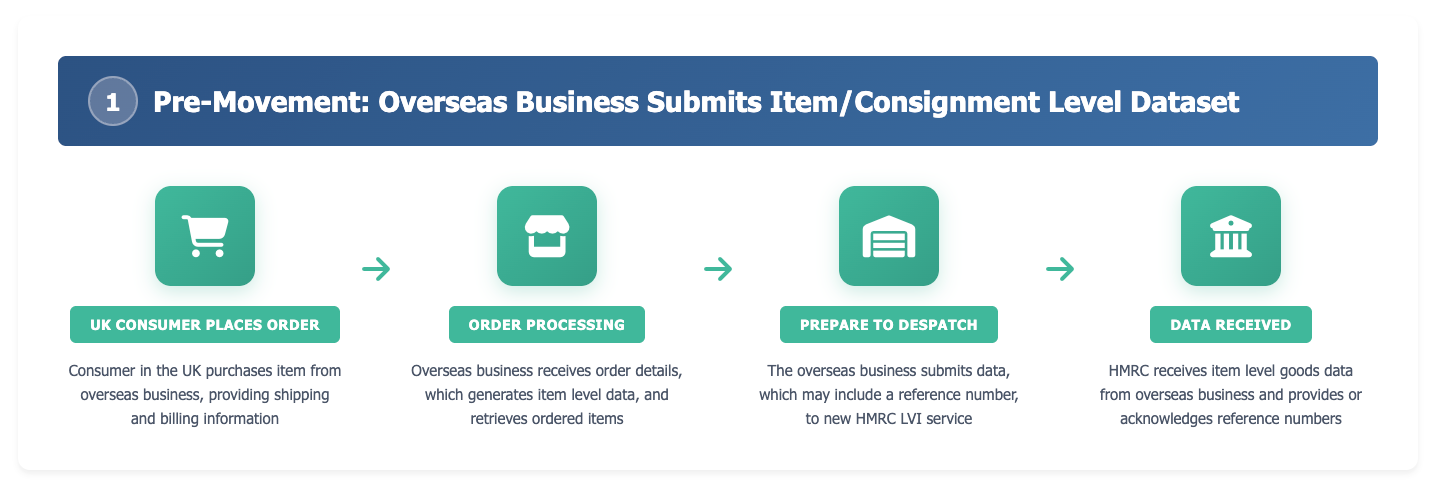
The first stage of the proposed LVI process begins at the point of sale, when a consumer in the United Kingdom places an order valued at £135 or less with an overseas business. This initial transaction triggers a series of data generation and transmission activities that form the foundation of the new customs arrangements. Upon receiving the order, the overseas business processes the customer’s shipping and billing information, retrieves the ordered items from inventory, and generates detailed item-level data for each product in the consignment.

This item-level data would include critical elements such as the product description, declared value, weight, country of origin, and potentially the commodity classification depending on whether the business is using the full UK Global Tariff schedule or an optional simplified tariff bucket system. The overseas business would then prepare the goods for dispatch, packaging them appropriately and readying them for handover to the carrier or parcel operator who will move them into the UK.

stage-01-pre-movements-overseas-business-submit-item-LVI

At this pre-movement stage, the overseas business would submit the item-level dataset to HMRC’s new LVI service—a dedicated digital platform separate from the existing Customs Declaration Service. This submission may include a reference number generated by the seller’s own systems, or the business may request a new reference number directly from HMRC upon data submission. The timing of this data transmission is critical: it must occur in advance of the goods being dispatched from the overseas location to enable HMRC to conduct pre-arrival risk assessment and provide the necessary reference numbers that will facilitate clearance at the UK border.

Upon receiving and validating the item-level data, HMRC would acknowledge receipt and provide or confirm reference numbers for the consignment. These reference numbers serve as unique identifiers that link the product and transaction data submitted by the seller to the subsequent movement and clearance activities managed by carriers and border authorities. This decoupling of product data submission (by the seller who knows the goods best) from logistics data submission (by the carrier who manages the physical movement) represents a fundamental architectural shift from the current BIRDS model, where carriers typically submit all data in a single consolidated declaration.

The stage one process establishes the seller or marketplace operator as the primary data source and ensures that customs authorities receive rich, accurate information about what is being imported before the goods enter transit. This early visibility is essential for effective risk targeting, enabling HMRC and Border Force to identify high-risk consignments for examination while allowing the vast majority of compliant shipments to proceed with minimal intervention.

Stage 2: Pre-Movement – Carrier Submits Shipment-Level Dataset

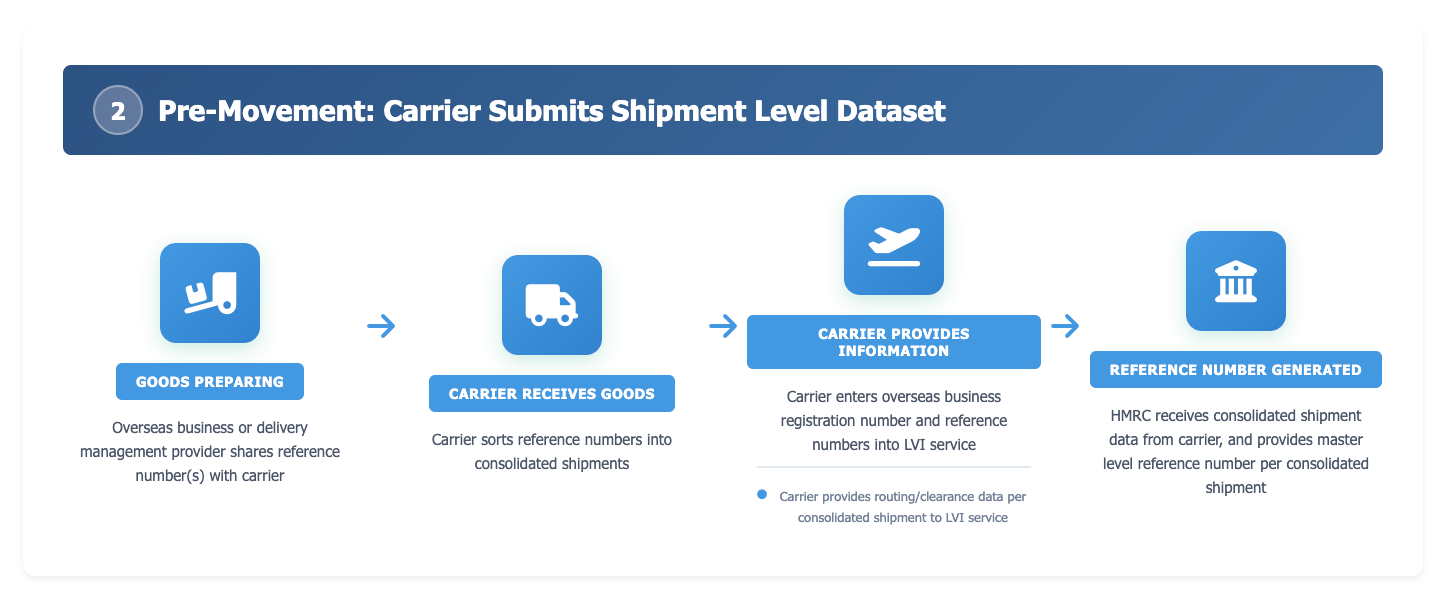
The second stage of the operational flow commences once the overseas business or a delivery management provider shares the HMRC-issued reference numbers with the carrier or parcel operator responsible for transporting the goods to the United Kingdom. At this point, the carrier takes physical possession of the packages and begins the process of preparing them for shipment. In the high-volume, multi-client environment typical of express parcel operations, the carrier would receive numerous individual consignments from many different sellers, each accompanied by its own unique reference number or set of reference numbers.

The carrier’s first operational task under the new arrangements would be to sort these individual reference numbers into consolidated shipments—groupings of multiple consignments that will travel together on the same flight, vessel, or vehicle into the UK. This consolidation is a standard feature of modern logistics operations, allowing carriers to achieve economies of scale and optimise routing efficiency. However, under the proposed LVI system, this physical consolidation must be mirrored digitally: the carrier would need to register each consolidated shipment with HMRC’s LVI service by entering the overseas business registration numbers and associated item-level reference numbers that correspond to all the individual consignments included in that consolidated load.

stage-02-pre-movements-carrier-submit-shipment-LVI

In addition to registering the consolidated shipment and linking it to the underlying item-level data, the carrier would provide shipment-level information that complements the product data already submitted by sellers. This shipment-level dataset would typically include routing and clearance data such as the countries through which the goods will transit, the mode of transport being used at the UK border (air, sea, road, rail), the expected date and time of arrival at the UK port or airport, and potentially security-related information about the handling and movement of the goods. Much of this data is already collected and transmitted by carriers under existing safety and security declaration requirements, and the government has indicated its intention to minimise duplication by aligning the new LVI data requirements with established processes wherever possible.

Upon receiving the consolidated shipment data from the carrier, HMRC would validate the submission, confirm that all referenced item-level records exist and are in good order, and issue a master-level reference number for the consolidated shipment as a whole. This master reference number effectively creates a digital container that groups together all the individual item references, providing a single identifier that can be used to track and manage the entire consolidated load as it moves through the clearance process. The issuance of this master reference number represents HMRC’s acknowledgment that the shipment is registered, appropriately documented, and ready to proceed to the border.

Stage two is critical for maintaining the flow of goods through the supply chain while ensuring that customs authorities have comprehensive visibility over both the granular details of individual items and the aggregated characteristics of consolidated loads. By requiring carriers to link item-level references to shipment-level movements, the system creates a complete digital thread from the point of sale through to border presentation, enabling risk assessment at multiple levels and facilitating targeted intervention where concerns arise.

Stage 3a: Goods Clearance at Inventory-Linked Ports

The third stage of the operational flow encompasses the actual clearance of goods upon arrival in the United Kingdom, with different processes applying depending on the type of port facility and the border infrastructure in use. Stage 3a specifically addresses clearance at Inventory-Linked Ports, which include major airports and container terminals where goods are managed through Community System Provider inventory systems. These facilities handle the majority of air freight and a significant proportion of maritime containerised cargo, making them a primary entry channel for low value imports.

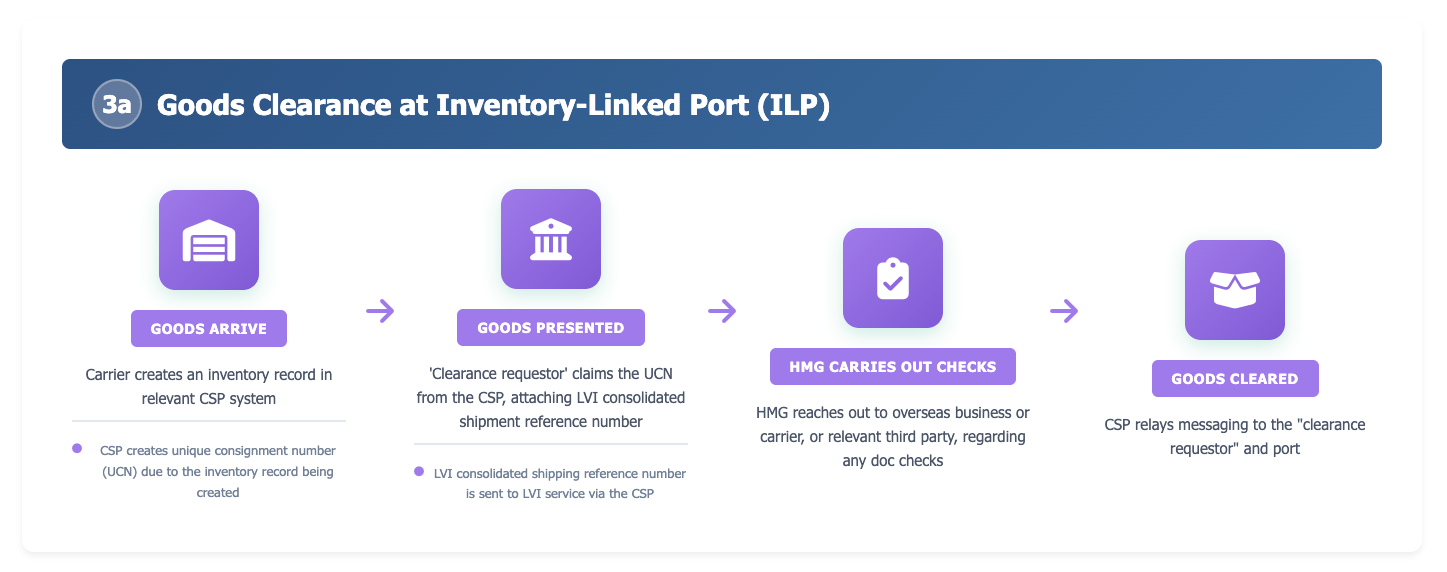
When a consolidated shipment of low value goods arrives at an Inventory-Linked Port, the carrier creates an inventory record in the relevant Community System Provider platform—commercial software systems operated by companies such as Destin8, Sequoia, and others that interface with HMRC’s border systems and manage the flow of goods through port facilities. The act of creating this inventory record generates a Unique Consignment Number, a system-generated identifier that represents the physical arrival and storage of the goods at the temporary storage location within the port.

At this point, a “clearance requestor”—typically the carrier, a customs intermediary acting on behalf of the seller, or another authorised party—claims the Unique Consignment Number from the Community System Provider and attaches the LVI consolidated shipment reference number that was issued by HMRC during stage two. This critical linkage connects the physical goods now sitting in the port’s inventory system to the digital customs record containing all the item-level and shipment-level data previously submitted by the seller and carrier. The Community System Provider then transmits this linked information to HMRC’s LVI service, effectively presenting the goods to customs for clearance consideration.

stage-03a-goods-clearance-at-inventory-linked-port-LVI

HMRC and Border Force, having already received and risk-assessed the item-level data at stage one and the shipment-level data at stage two, can now conduct their checks in near real-time. The risk assessment may have been partially or fully completed pre-arrival, meaning that for low-risk consignments the clearance decision can be communicated almost instantaneously. For consignments flagged for documentary or physical examination, HMRC would reach out to the overseas business, carrier, or other relevant third party to request additional information, supporting documents, or to schedule a physical inspection of the goods. Throughout this process, the Community System Provider acts as a messaging hub, relaying clearance status updates and instructions between HMRC, the clearance requestor, and the port terminal operators.

Once HMRC is satisfied that the goods comply with all applicable requirements—or has completed any necessary examinations—the clearance decision is communicated back through the Community System Provider, which in turn notifies the clearance requestor and authorises the port to release the goods from temporary storage. The goods can then proceed to the next stage of their journey, typically onward domestic delivery to the UK consumer. The entire stage 3a process is designed to leverage existing port infrastructure and Community System Provider platforms while integrating the new LVI reference number system to enable granular visibility and control without creating bottlenecks or delays.

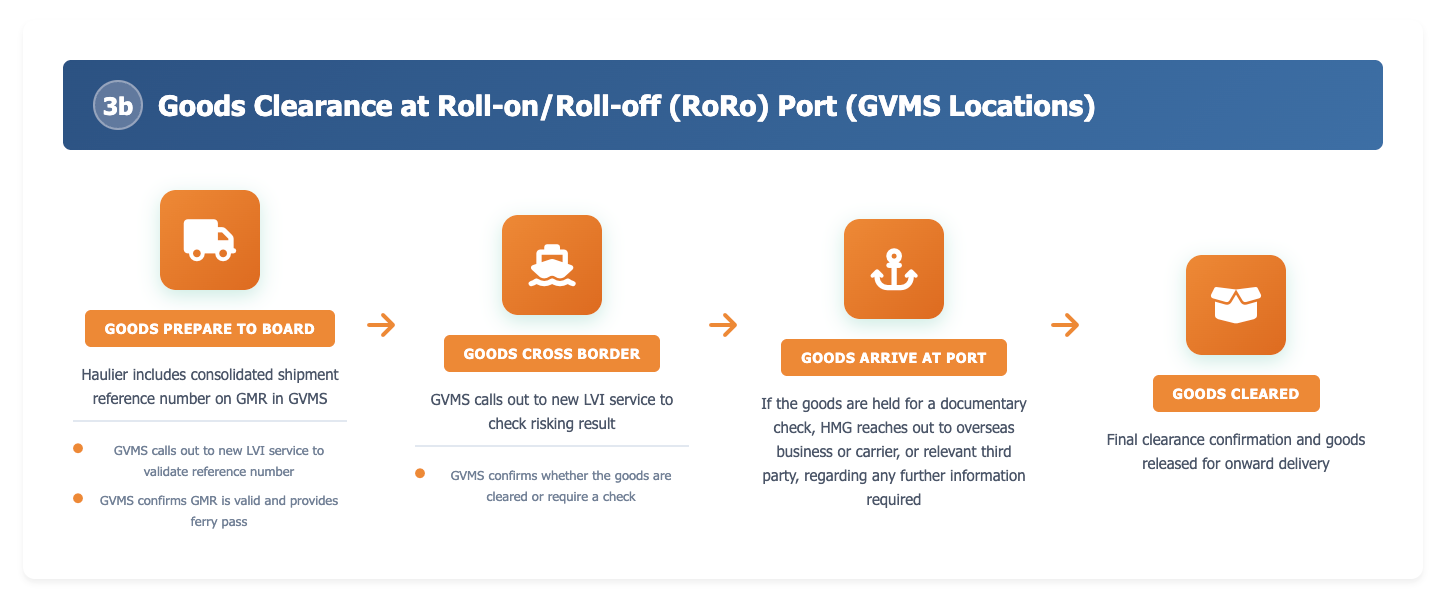
Stage 3b: Goods Clearance at Roll-on/Roll-off Ports Using GVMS

Stage 3b addresses a distinct clearance pathway used at Roll-on/Roll-off ports, where goods are transported by road vehicles that drive directly on and off ferries or through the Channel Tunnel. These RoRo movements are predominantly managed through the Goods Vehicle Movement Service, a digital platform that enables drivers and hauliers to obtain pre-arrival clearance and receive a Goods Movement Reference that serves as a “passport” for the vehicle to cross the border. GVMS locations include major short-sea crossings such as Dover, Holyhead, and other ferry ports that handle significant volumes of accompanied road freight.

The stage 3b process begins as goods are being prepared to board the ferry or enter the tunnel. At this point, the haulier or driver includes the consolidated shipment reference number issued by HMRC during stage two as part of their GVMS declaration. This reference number is entered into the GVMS platform alongside other standard information about the vehicle, driver, and cargo. Upon receiving this data, GVMS immediately calls out to the new LVI service to validate the reference number, confirming that it exists, is associated with properly submitted item-level and shipment-level data, and is eligible for clearance consideration.

stage-03b-goods-clearance-roro-LVI

If the reference number validates successfully, GVMS conducts or retrieves the risk assessment outcome from HMRC’s systems. This assessment determines whether the goods can proceed directly to clearance or require additional checks. For low-risk consignments that have been pre-cleared based on the data submitted in stages one and two, GVMS confirms that the Goods Movement Reference is valid and provides the driver with a “ferry pass”—a digital authorisation to board the vessel and proceed to the UK. This streamlined process enables rapid, frictionless movement of compliant goods through the RoRo corridor, which is essential given the high throughput and time-sensitive nature of these crossings.

Upon arrival at the UK port after crossing the border, GVMS makes a final call to the LVI service to check the risking result and confirm the clearance status. If the goods have been cleared, GVMS provides the final release notification and the vehicle can proceed directly from the port without further intervention. If, however, the goods have been held for a documentary or physical check—perhaps because the risk assessment identified concerns requiring further investigation—HMRC reaches out to the overseas business, carrier, or relevant third party to request additional information or arrange for the necessary examination. Once any required checks are completed and HMRC is satisfied, the goods are released and can continue their journey to the final destination.

The stage 3b RoRo clearance process is specifically designed to maintain the speed and efficiency that is critical for time-sensitive ferry and tunnel crossings, where delays can cascade rapidly and cause significant operational and commercial disruption. By integrating the LVI reference numbers directly into the GVMS workflow and enabling pre-arrival risk assessment based on data submitted well before the vehicle reaches the border, the new arrangements aim to replicate the “green channel” experience that currently applies to BIRDS consignments while simultaneously collecting the richer, item-level data necessary for robust customs control and compliance assurance.

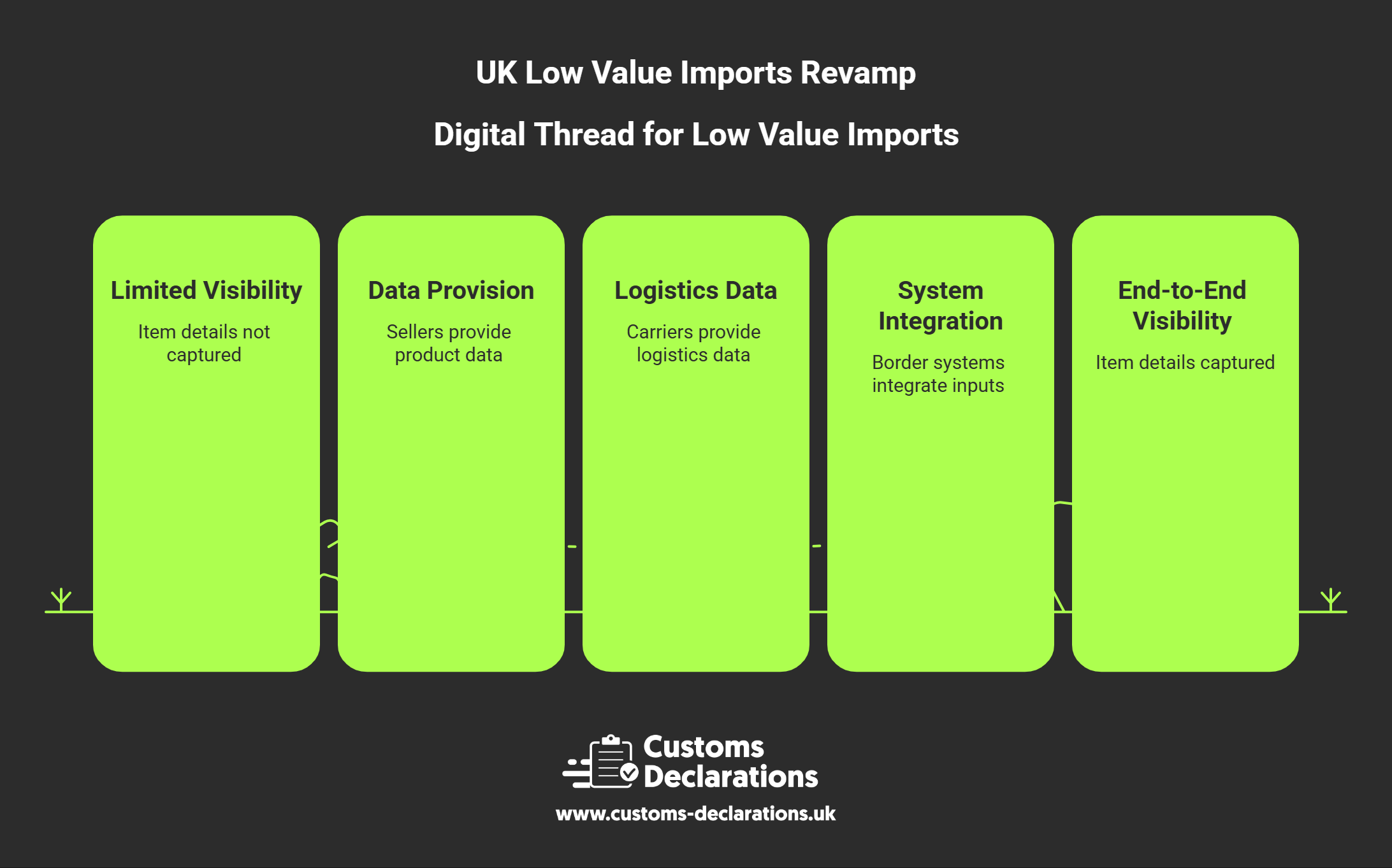
Coordination Across All Stages: The Digital Thread

Taken together, these four stages create a comprehensive digital thread that traces each low value import from the moment of purchase through to final customs clearance and release. This end-to-end visibility represents a step change from the current BIRDS arrangements, where item-level details are not captured and customs authorities have limited insight into the specific contents of individual parcels within bulk declarations. The staged approach allocates clear responsibilities to each supply chain actor—sellers provide product data, carriers provide logistics data, and border systems integrate these inputs to enable risk-based decision-making—while creating multiple validation and control points that strengthen compliance without impeding the flow of legitimate trade.

However, the operational success of this multi-stage model will depend critically on seamless data exchange, robust system integrations, and effective coordination among sellers, marketplace operators, carriers, customs intermediaries, software providers, Community System Providers, GVMS, and HMRC’s new LVI service. The consultation actively seeks stakeholder feedback on the feasibility of each stage, the potential challenges in implementing the required data flows, the costs and technical requirements for businesses to develop the necessary capabilities, and whether alternative approaches should be considered. The government has emphasised its commitment to co-designing these processes with industry to ensure that the final operational model is both effective from a compliance perspective and workable from a commercial and logistical perspective.

Data Requirements and Border Clearance: Moving to Item-Level Visibility

One of the most technically complex and operationally significant aspects of the reform concerns data collection and border presentation mechanisms. The existing BIRDS framework, by design, does not capture item-level information on individual consignments. A single BIRDS declaration can cover thousands of parcels, providing aggregate data but not the granular detail necessary for robust risk assessment, compliance verification, or post-clearance audit. Once the relief is removed and duties become chargeable, this data deficit becomes untenable. The government has therefore determined that item-level data collection will be a foundational requirement of the new LVI customs arrangements.

The consultation outlines a vision in which sellers and marketplace operators submit detailed information on each individual item to HMRC in advance of goods being dispatched from overseas. Examples of the data elements under consideration include goods descriptions, values, weights, consignor and consignee details, and country of origin information. This data would be transmitted into a new, LVI-specific system—separate from the existing Customs Declaration Service used for standard import declarations and ENS declarations. The government explicitly recognises that sellers and marketplace operators, as the source of the transaction and product data, are best positioned to provide accurate item-level information directly, reducing the risk of data degradation as consignments move through complex logistics networks.

Upon receiving and validating the item-level data submission, HMRC would issue a unique reference number back to the seller or marketplace operator. This reference number would then be shared with the parcel operator, customs intermediary, or carrier responsible for moving the goods into the UK. These logistics actors would, in turn, use the reference numbers to submit shipment-level data covering aspects such as routing information, mode of transport at the border, expected arrival times, and consolidation details. This layered data model—combining rich product and transaction data from the seller with movement and logistics data from the carrier—aims to give HMRC and Border Force a comprehensive view of each consignment without imposing duplicative reporting obligations on different supply chain participants.

The consultation presents a potential operational flow spanning several stages. In the pre-movement stage, the overseas business submits item or consignment-level datasets to HMRC, which acknowledges receipt and provides reference numbers. Before or during shipment, the carrier submits shipment-level data, potentially consolidating multiple reference numbers for goods moving together. At the border, the mechanism for customs clearance diverges based on the type of port facility. At Inventory-Linked Ports such as major airports and container terminals, the reference numbers would be submitted into Community System Provider inventory systems, with the CSP calling out to the new LVI system to validate the references and confirm clearance eligibility. At Roll-on/Roll-off ports using the Goods Vehicle Movement Service, the reference numbers would be incorporated into the Goods Movement Reference to facilitate presentation and clearance.

This approach aims to maintain the speed and efficiency essential for high-volume parcel flows while dramatically improving data quality and customs visibility. However, the consultation acknowledges that achieving this vision will require significant coordination, system development, and potentially new integrations between government platforms, commercial software providers, and logistics operators. The government is explicitly seeking stakeholder input on the feasibility, costs, and operational implications of these data requirements, particularly for smaller sellers who may have limited technical capacity or resources to implement new data transmission processes.

VAT Alignment and Integration

Although the primary focus of the consultation is customs duty reform, Value Added Tax treatment of low value imports is intimately connected and must be considered holistically. Since January 2021, the UK has operated a point-of-sale VAT model for business-to-consumer LVI transactions, with sellers—or marketplace operators where they facilitate the sale—collecting VAT from consumers at the time of purchase and remitting it to HMRC through quarterly VAT returns. This model was designed to improve consumer price transparency, reduce border delays, and concentrate compliance responsibility on identifiable, regulatable entities rather than individual consumers or overwhelmed parcel operators.

The removal of customs duty relief and the shift to quarterly duty payments by sellers and marketplace operators creates an opportunity to more closely align VAT and customs duty collection mechanisms. The consultation explores the concept of a fully integrated system in which sellers and marketplace operators register once for the new LVI arrangements rather than maintaining separate customs and VAT registrations, and remit both taxes together through a unified quarterly payment process. Such integration could reduce administrative duplication, simplify compliance workflows, and enhance the coherence of the overall import tax regime. However, it also raises practical questions: many businesses will need to maintain separate UK VAT registrations to account for other taxable activities beyond low value imports, meaning they would still interact with two distinct systems even if LVI customs duty and VAT are merged. The consultation seeks views on whether integrated collection would deliver material benefits or introduce new complexities.

A technical consideration relates to the calculation of VAT once customs duties become chargeable. Under UK VAT law, import VAT is calculated on a duty-inclusive base: the value of the goods plus any customs duty and other includable charges. Currently, because low value imports benefit from duty relief, VAT is simply calculated on the sale price (potentially adjusted for transport costs and other elements). Once duties apply, the VAT calculation becomes more complex, as it must incorporate the duty amount. If both taxes are collected at the point of sale by the same entity—the seller or marketplace operator—that entity will need systems capable of calculating the applicable duty, adding it to the goods value, and then calculating VAT on the resulting figure. The feasibility of this integrated point-of-sale calculation is a key question posed by the consultation, particularly given the diversity of seller sophistication and the potential use of simplified tariff buckets that may not precisely match actual UKGT rates.

The consultation also considers scenarios in which certain low value goods are cleared through standard import customs arrangements rather than the new LVI pathway—for example, goods subject to licencing, non-ad valorem rates, or preference claims. In such cases, customs duty would be collected at the point of importation as it is for higher-value goods, raising the question of whether VAT should similarly be collected at the border rather than at the point of sale. Closer alignment between VAT and customs duty collection points could simplify administration and reduce the risk of VAT calculation errors when duty is added to the base. However, it would also represent a departure from the current point-of-sale model and could affect consumer experience and seller cash flow. The government is seeking views on the trade-offs between maintaining the existing VAT approach for all low value imports versus introducing differentiated VAT treatment based on the customs pathway used.

Implications for the Customs Declarations UK Platform

Customs Declarations UK has established itself as a comprehensive, cloud-based solution for businesses navigating the complexities of UK customs compliance. The platform currently supports the full spectrum of import declarations and export declarations, enabling users to prepare and submit filings directly to HMRC’s Customs Declaration Service with guided, plain-English workflows. For clients handling CDS declarations, the platform offers real-time validation, audit-grade record retention, and seamless integrations with Community System Providers to expedite clearance at major UK ports.

Critically, Customs Declarations UK already supports BIRDS declarations under the existing Low Value Import arrangements, providing parcel operators, customs intermediaries, and authorised traders with a streamlined interface to manage bulk submissions efficiently. As volumes have grown exponentially—from hundreds of millions to over 600 million consignments annually—the platform’s capacity to handle high-throughput, simplified declaration pathways has proven essential for maintaining border fluidity while meeting HMRC’s data and compliance requirements.

Looking ahead, Customs Declarations UK is committed to supporting businesses through the transition to the new LVI customs arrangements. As the government finalises the design of item-level data requirements, reference number systems, and integration protocols with the forthcoming LVI-specific clearance system, the platform will evolve to incorporate these new functionalities. Sellers, marketplace operators, and logistics providers will be able to leverage the platform’s intuitive workflows to submit item-level product data, receive HMRC-issued reference numbers, and coordinate with carriers to ensure seamless presentation and clearance at the border. By maintaining continuity of service across both legacy and reformed LVI frameworks, Customs Declarations UK aims to minimise disruption, reduce implementation costs, and help the trade community adapt confidently to the new compliance landscape.

Moreover, the platform’s existing support for ENS declarations—the safety and security data submissions required for goods entering the UK—will remain a critical component of the end-to-end compliance offering. As the consultation emphasises the importance of aligning customs declaration data with ENS filings to prevent holds and discrepancies at the border, Customs Declarations UK’s ability to coordinate these datasets within a single interface will become increasingly valuable. Whether businesses are filing standard customs declarations for higher-value goods, managing LVI compliance under the reformed arrangements, or fulfilling security obligations through ENS submissions, the platform provides a unified, audit-ready solution designed to meet both current and future regulatory requirements.

For businesses concerned about navigating the complexity of tariff classification under the new LVI regime—whether applying full UKGT rates or utilising a simplified tariff bucket system—Customs Declarations UK will integrate classification guidance, rate lookup tools, and validation checks to help users select appropriate codes and calculate duties accurately. As the consultation period progresses and policy details crystallise, the platform will remain responsive to stakeholder feedback and government guidance, ensuring that when the new LVI customs arrangements go live in 2029, users have a reliable, tested, and fully compliant pathway to continue their UK trade operations without interruption.

Conclusion: A Defining Moment for UK Customs Modernisation

The consultation on reforming the customs treatment of low value imports represents a defining moment in the evolution of the UK’s post-Brexit customs framework. With 600 million annual consignments, billions of pounds in trade value, and profound implications for consumer experience, retail competition, and border integrity, the stakes are exceptionally high. The government’s decision to remove the Low Value Import relief and introduce new, data-rich customs arrangements signals a clear recognition that incremental adjustments to the existing system are insufficient—fundamental reform is necessary to meet the demands of modern cross-border commerce.

The proposals outlined in the consultation are ambitious and far-reaching: shifting duty liability to sellers and marketplace operators, mandating item-level data submission, potentially requiring fiscal representatives for overseas businesses, introducing optional simplified tariff schedules, considering additional fees for cost recovery, and integrating VAT collection more closely with customs processes. Each of these elements involves significant technical, operational, and commercial complexities that will require careful refinement through co-design with industry.

What is abundantly clear is that the government is approaching this reform with genuine openness to stakeholder input and a recognition of the need for sufficient implementation time. The four-year runway to March 2029 is intended to provide businesses of all sizes—from small independent sellers to major marketplace platforms and global logistics operators—with the opportunity to prepare, invest, and adapt. For those currently utilising BIRDS declarations for low value trade, the message is unambiguous: the era of duty relief and minimal data requirements is coming to an end, and the future will demand greater compliance rigour, more sophisticated systems, and closer integration with HMRC’s data and risk frameworks.

At the same time, the government’s commitment to developing streamlined, proportionate compliance pathways—such as the simplified tariff bucket option and quarterly payment cycles—demonstrates a pragmatic understanding that the new system must remain accessible and workable for the diverse ecosystem of sellers, platforms, and service providers that collectively drive low value trade. Success will ultimately be measured not only by revenue collection and data quality, but by whether the reformed arrangements support a thriving, competitive, and secure cross-border marketplace that benefits UK consumers and businesses alike.

For those seeking to navigate this transition effectively, early engagement with the consultation, investment in understanding the proposed requirements, and proactive planning for system changes and process adaptation will be essential. Platforms like Customs Declarations UK, which already support BIRDS declarations, import declarations, CDS declarations, and ENS declarations, will play a critical enabling role in helping businesses maintain compliance continuity as the LVI landscape transforms. The next four years will require collaboration, innovation, and resilience from all participants in the UK customs ecosystem—but the destination, if achieved, will be a fairer, more transparent, and more secure framework for low value imports into the United Kingdom.

We value your feedback, and if you have any comments, suggestions or anything else that you would like to highlight to us, we will be delighted to hear from you and incorporate your feedback into our content.

Note: While we have made every attempt to ensure that the information contained in this Site has been obtained from reliable sources, Customs Declarations UK is not responsible for any errors or omissions, or for the results obtained from the use of this information. All information in this Site is provided “as is”, with no guarantee of completeness, accuracy, timeliness or of the results obtained from the use of this information, and without warranty of any kind, express or implied, including, but not limited to warranties of performance, merchantability and fitness for a particular purpose. Nothing herein shall to any extent substitute for the independent investigations and the sound technical and business judgment of the reader. In no event will Customs Declarations UK, or its partners, employees or agents, be liable to you or anyone else for any decision made or action taken in reliance on the information in this Site or for any consequential, special or similar damages, even if advised of the possibility of such damages. Certain links in this Site connect to other Web Sites maintained by third parties over whom Customs Declarations UK has no control. Customs Declarations UK makes no representations as to the accuracy or any other aspect of information contained in other Web Sites.