Pre-loader

Major UK Customs Tariff Updates: March 2026

HMRC published Statutory Instrument 2026/253 on 3 March 2026, introducing five significant changes to the UK’s customs tariff regime. From Ukraine trade liberalisation to offshore wind duty relief, these updates affect importers, exporters, customs agents, and logistics operators across multiple sectors — and take effect immediately.

What Has Changed and Why It Matters

The March 2026 tariff update is one of the most substantively varied statutory instruments published this year. It spans five distinct changes — extending a trade liberalisation arrangement supporting Ukraine, updating annual tariff rates under the UK–Japan CEPA, introducing new duty relief for the offshore wind energy sector, and correcting technical errors affecting Iceland–Norway and North Macedonia trade references. Together, these changes affect a broad cross-section of UK trade activity.

Understanding which changes apply to your business — and acting on them correctly — is essential to claiming the right preferential rates, avoiding unnecessary duty costs, and maintaining compliant customs declarations from 3 March 2026 onwards.

UK–Ukraine Preferential Tariffs Extended to March 2028

Zero or reduced tariffs on Ukrainian egg and poultry products extended by two years, providing planning certainty for importers in this sector.

UK–Japan CEPA: 2026 Tariff Rates in Effect

Annual reduction schedule updated with lower duties now applicable across automotive, machinery, food, and textiles sectors under the Comprehensive Economic Partnership Agreement.

New Authorised Use Duty Relief

New measures reduce import duty on equipment used in manufacturing offshore wind turbines — a significant cost saving for the UK's renewable energy supply chain.

Iceland–Norway & North Macedonia: Technical Corrections

Error corrections to the Iceland–Norway preferential tariff document and origin reference updates for North Macedonia under the UK–North Macedonia PTCA.

UK–Ukraine Trade Liberalisation Extended to 2028

The preferential tariff reference document for Ukraine has been updated to give effect to the temporary liberalisation of tariffs on imports of Ukrainian egg and poultry products. This extension runs until 31 March 2028, building on the agreement between the UK and Ukraine to support Ukrainian agricultural exports during the ongoing conflict.

The measure provides zero or reduced tariffs on specified egg and poultry product lines, and represents a continuation of the UK’s post-Brexit trade support arrangements with Ukraine. The two-year extension — beyond the previous temporary measures — provides a meaningful forward planning horizon for importers operating in these categories.

  • Products:Specified Ukrainian egg and poultry products
  • Rate:Zero or reduced tariff (product-specific)
  • Duration:Extended to 31 March 2028
  • Document:Preferential Tariff reference — Ukraine
  • Rules of origin must be satisfied to claim preference
  • Statement on Originor equivalent origin evidence required
  • Evidence must be retained for HMRC audit purposes
  • Commodity codes must match specified product lines
 
📋Planning Note

The extension to 2028 gives UK importers of Ukrainian eggs and poultry products confirmed preferential access for over two years. Businesses should update their trade terms, supplier documentation requirements, and declaration templates to reflect the extended arrangement.

UK–Japan CEPA: 2026 Annual Tariff Rates Now in Effect

The preferential tariff reference document for Japan has been updated for structural clarity and to reflect the 2026 tariff rates under the UK–Japan Comprehensive Economic Partnership Agreement. The annual tariff reduction schedule under CEPA continues as planned, meaning some goods now face lower duties in 2026 than they did in 2025. The document has also been reorganised for easier navigation.

Action Required: If you are importing from Japan and claiming CEPA preference, you should check whether your specific commodity codes now attract lower duty rates under the updated 2026 schedule. Rates change annually and must be verified against the current tariff document — declarations filed with 2025 rates are not compliant from 3 March 2026.
  • Automotive components and parts
  • Machinery and electrical equipment
  • Food and agricultural products
  • Textiles and apparel
  • Annual tariff reduction schedule updated for 2026
  • Some goods now face lower duties than 2025
  • Document reorganised for clearer navigation
  • Product-specific rules of origin clarified

Offshore Wind Energy: New Authorised Use Duty Relief

This is the most strategically significant of the five changes in SI 2026/253. New authorised use measures have been introduced to reduce import duty on goods used in the manufacture of offshore wind turbines. The measure is implemented through amendments to the Customs (Special Procedures and Outward Processing) (EU Exit) Regulations 2018 and a new version of the “Authorised Use: Eligible Goods and Rates” document (version 1.23, dated 3 March 2026).

The policy reflects the UK’s broader commitment to offshore wind expansion and Net Zero objectives, reducing the import cost burden on businesses supplying components into the renewable energy supply chain.

🔌Cables linking wind farms to mainland substations
 
⚙️Auxiliary systems for incorporation in onshore substations
 
🔋Low-voltage systems for offshore substations
 
🌊Other components used in offshore wind energy production
 
⚡ Implementation Detail

To benefit from this relief, importers must use the Authorised Use special procedure. This requires prior authorisation from HMRC and the goods must be used for the specified eligible purpose. The updated Authorised Use document (v1.23) specifies the eligible goods and their reduced duty rates. The update also aligns commodity codes with recent EU code changes.

Iceland–Norway and North Macedonia: Technical Corrections

The preferential tariff reference document for Iceland and Norway has been updated to correct technical errors identified in the previous version. Operators importing from these countries should ensure they are working from the updated document to avoid applying incorrect rates or conditions.

Separately, the origin reference document for North Macedonia has been updated to give effect to the latest decisions under the UK–North Macedonia Partnership, Trade and Cooperation Agreement. Importers and exporters trading under this agreement should verify their origin documentation and declaration data against the updated reference.

 
📌 Practical Note

Technical corrections of this kind are easy to overlook, but applying outdated or erroneous tariff data — even where the source of error is HMRC’s original document — can result in incorrect duty calculations and post-clearance queries. Always work from the current version of the relevant reference document, as published in the UK Integrated Tariff.

What These Changes Mean for Your Business

The practical implications of SI 2026/253 vary significantly depending on your role in the supply chain. Select your category below to see the actions most relevant to you.

Importers

  • Ukraine eggs & poultry: Confirm your commodity codes fall within the specified lines for the extended liberalisation. Update your declaration templates to reflect the new validity period (to 31 March 2028) and ensure Statement on Origin documentation is in place from your Ukrainian suppliers.
  • Japan CEPA goods: Check the 2026 tariff rates for each commodity code you import from Japan. If rates have reduced under the annual schedule, update your landed cost calculations, declaration data, and any duty deferment forecasts accordingly. Do not continue using 2025 rates.
  • Offshore wind components: If you import cables, substation equipment, or other eligible wind turbine components, assess whether the new Authorised Use procedure would reduce your import duty liability. This requires HMRC authorisation in advance — begin the authorisation process promptly if relevant.
  • Iceland–Norway goods: Cross-check your current declarations against the corrected preferential tariff document. If previous entries applied rates from the erroneous version, consider whether a voluntary disclosure is appropriate.
  • All preferential imports: Origin evidence — Statements on Origin, supplier declarations, or equivalent — must be held at the time of making the preference claim and retained for the HMRC audit period. Review your documentation processes against each relevant agreement.

Exporters

  • Japan CEPA exports: The 2026 tariff rate update and document restructuring may affect how your Japanese buyers calculate landed cost and declare your goods on arrival in Japan. Ensure your trade documentation — commercial invoices, packing lists, Statements on Origin — reflects current product classifications and is consistent with the updated CEPA document structure.
  • North Macedonia: If your goods move under the UK–North Macedonia PTCA, review whether the origin reference update affects the origin-conferring requirements for your product categories. Update supplier declaration templates and ensure your export evidence pack is current.
  • Origin documentation generally: Where you issue Statements on Origin or Supplier Declarations to support your customers’ preference claims, you carry responsibility for the accuracy of those statements. Review your origin evidence files against the updated rules of origin where applicable.

Custom Agents and Brokers

  • Update tariff working documents immediately: SI 2026/253 is effective from 3 March 2026. Declarations filed after this date must reflect UK Integrated Tariff v1.31, Tariff Suspension Document v3.4, and Authorised Use Document v1.23. Flag this update across your team.
  • Japan CEPA rate verification: For every Japan import declaration using CEPA preference codes, verify the applicable 2026 rate against the updated tariff document. Do not carry forward 2025 rates without checking whether they have changed.
  • Ukraine preference claims: Confirm with clients that they hold current origin evidence (Statement on Origin or equivalent). The extension to March 2028 does not remove the obligation to hold valid origin documentation at time of import.
  • Offshore wind Authorised Use: For clients importing eligible wind turbine components, advise on the new duty relief and assist with HMRC authorisation applications where appropriate. Authorised Use requires specific CDS procedure codes and must be applied correctly to avoid misuse liability.
 
  • Iceland–Norway corrections: Review recent declarations filed under the Iceland–Norway preferential arrangement. If rates were applied from the now-corrected document, assess whether any corrections or voluntary disclosures are required for your clients.

Freight Forwarders, Hauliers & Transport Companies

  • Communicate tariff changes to shipper clients: Importers of Japanese goods and Ukrainian poultry/egg products should be notified of the updated preferential rates and documentation requirements. Proactive communication prevents declaration errors and port delays.
  • Offshore wind supply chain: If you coordinate movements of cables, substation equipment, or other wind turbine components, ensure your shipper clients are aware of the new Authorised Use duty relief. Incorrect procedure codes on customs entries will negate the benefit and may create compliance exposure.
  • Document consistency: The commercial invoice, packing list, and customs declaration must all reflect consistent descriptions, values, and origin details. Tariff document updates can change the expected values — ensure the paperwork presented at the frontier aligns with what has been declared.
  • Review routing and procedure codes: Where you handle transit and special procedure movements for goods affected by these changes, verify that the procedure codes used in CDS entries remain appropriate under the updated tariff rules.

Offshore Wind Developers & Renewable Energy Supply Chain

  • Assess eligibility immediately: Review your import schedules for cables, auxiliary systems, low-voltage equipment, and other offshore wind components against the eligible goods list in Authorised Use Document v1.23. Significant duty savings are available — but only if the correct procedure is followed.
  • Apply for HMRC Authorised Use authorisation: The duty relief operates as a special procedure and requires prior authorisation from HMRC. This is not applied retrospectively. Begin the authorisation process as soon as possible to benefit from the reduced rates on upcoming shipments.
  • Engage your customs agent: The Authorised Use procedure requires specific CDS procedure codes and careful record-keeping to demonstrate that imported goods were used for the eligible purpose. Work with your customs agent to set up the process correctly from the outset.
  • Update landed cost models: The duty relief will reduce your total import cost on eligible components. Update your project procurement models and cost forecasts to reflect the lower duty burden — and ensure the savings are passed through correctly to project cost accounting.

Filing Compliant Declarations Across Every Affected Trade Lane

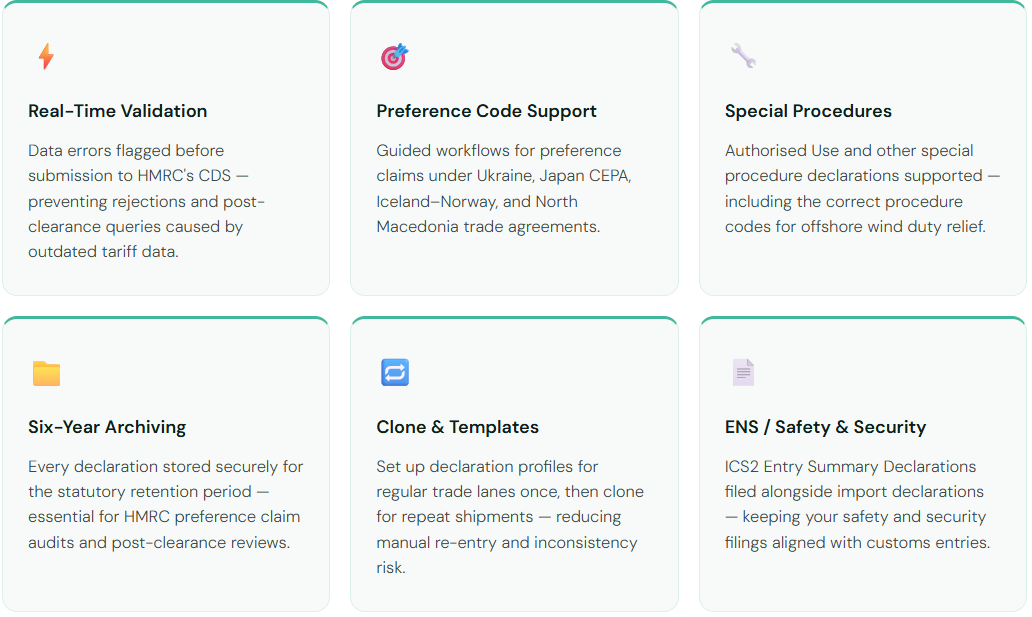
The changes introduced by SI 2026/253 — new preferential rates, extended trade liberalisation, and a new special procedure for offshore wind — all require accurate, up-to-date customs declarations filed through HMRC’s Customs Declaration Service. Customs Declarations UK (CDUK) provides the platform, guidance, and validation tools to ensure your declarations reflect the latest tariff rules from day one.

Whether you are an importer claiming CEPA preference on Japanese goods, a customs agent managing Ukraine preference claims, or an offshore wind developer setting up an Authorised Use procedure, CDUK’s guided workflows and real-time compliance checks reduce the risk of errors and ensure every declaration is audit-ready.


We value your feedback, and if you have any comments, suggestions or anything else that you would like to highlight to us, we will be delighted to hear from you and incorporate your feedback into our content.

Note: While we have made every attempt to ensure that the information contained in this Site has been obtained from reliable sources, Customs Declarations UK is not responsible for any errors or omissions, or for the results obtained from the use of this information. All information in this Site is provided “as is”, with no guarantee of completeness, accuracy, timeliness or of the results obtained from the use of this information, and without warranty of any kind, express or implied, including, but not limited to warranties of performance, merchantability and fitness for a particular purpose. Nothing herein shall to any extent substitute for the independent investigations and the sound technical and business judgment of the reader. In no event will Customs Declarations UK, or its partners, employees or agents, be liable to you or anyone else for any decision made or action taken in reliance on the information in this Site or for any consequential, special or similar damages, even if advised of the possibility of such damages. Certain links in this Site connect to other Web Sites maintained by third parties over whom Customs Declarations UK has no control. Customs Declarations UK makes no representations as to the accuracy or any other aspect of information contained in other Web Sites.