Fresh produce is one of the most time-sensitive categories in international trade. For UK importers sourcing vegetables and fruit from the Netherlands—one of Europe’s premier horticultural exporters—getting the customs, phytosanitary, and logistics framework right is not optional; it is the difference between goods that reach the shelf in prime condition and consignments that face costly delays at the border. This guide walks through every stage of the process, from supplier engagement and product classification to phytosanitary compliance, customs valuation, and filing your import declarations through the Customs Declarations UK platform.
The Post-Brexit Context: Why Netherlands-to-UK Trade Changed
Before Brexit, vegetables and fruit moved freely between the Netherlands and the United Kingdom under EU single market rules, with no customs formalities and no phytosanitary checks at the border. That world no longer exists. Since January 2021, goods arriving from the Netherlands into Great Britain (England, Scotland, and Wales) are treated as imports in the full legal sense. Every commercial consignment requires a customs declaration submitted to HMRC via the Customs Declaration Service (CDS), and regulated plant products must satisfy UK plant health import requirements administered by the Animal and Plant Health Agency (APHA).
This does not make trade impossible—the Netherlands remains one of the UK’s most significant fresh produce partners, and the UK-EU Trade and Cooperation Agreement (TCA) preserves zero tariffs for goods of EU origin. However, the administrative and compliance obligations are real and consequential. Preparation is everything.
Establishing Your Import Readiness
Before the first consignment crosses the North Sea, your business must be correctly constituted to interact with HMRC and port health authorities.
You will need a GB EORI number (Economic Operators Registration and Identification), which is your unique identifier for all import and export activity. If your business is VAT-registered, you should activate Postponed VAT Accounting (PVA). Under PVA, you account for import VAT on your periodic VAT return rather than paying it at the point of entry. For high-volume fresh produce importers dealing with frequent, time-critical shipments, PVA delivers both cash flow benefits and administrative simplicity.
Finally, identify your logistics chain carefully. Most Netherlands-to-UK fresh produce moves by road freight via the short-sea route (Dover or Eurotunnel), where transit times can be as little as a few hours. Selecting a freight forwarder with experience in perishable goods and an established relationship with port health and customs teams at your entry point is essential. Every hour of avoidable delay at the border has direct consequences for shelf life.
Phytosanitary Requirements: Plant Health at the Border
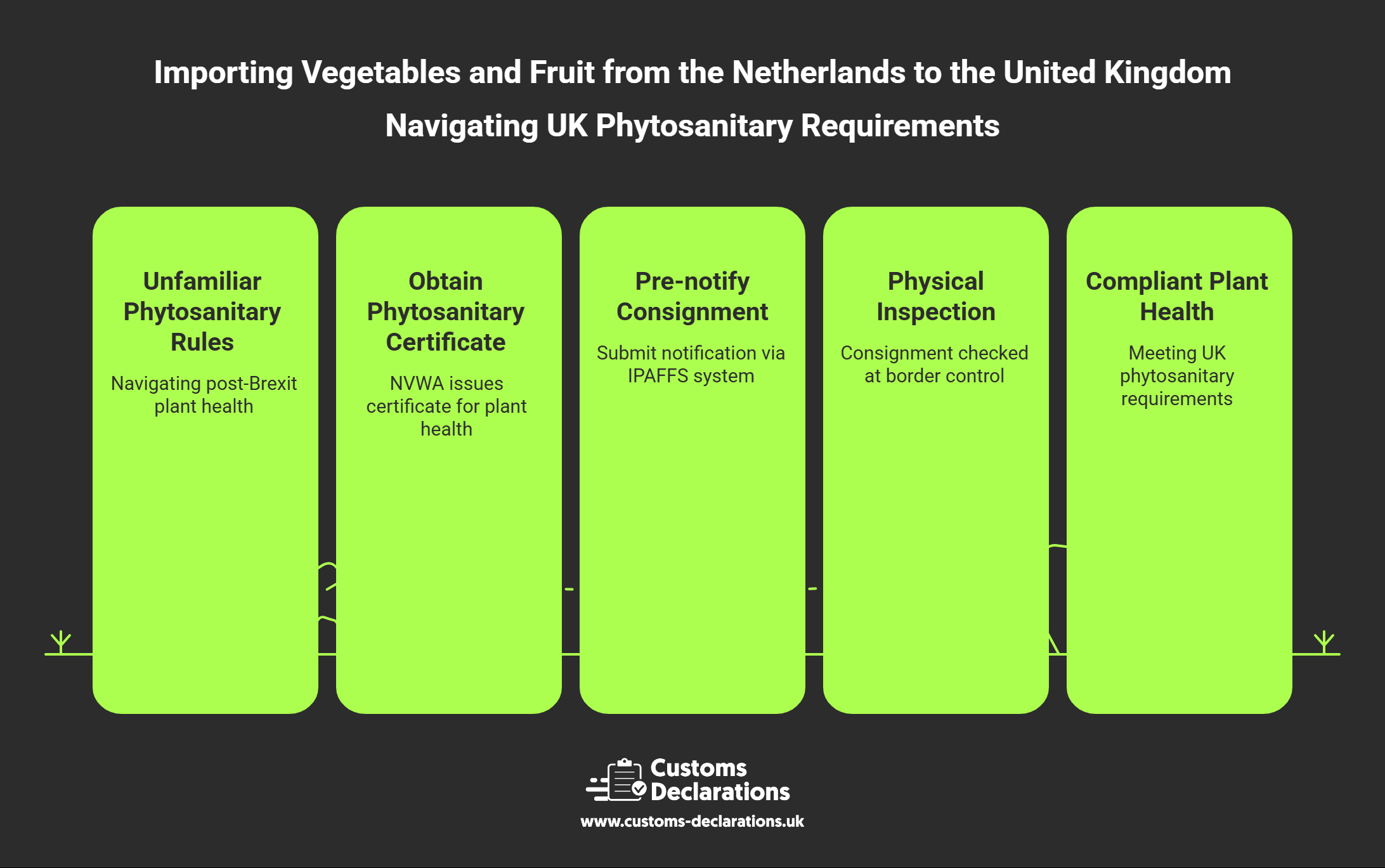
For importers accustomed to sourcing domestically or from within the EU pre-Brexit, the plant health regime is often the most unfamiliar element of the compliance framework. The United Kingdom enforces its own phytosanitary rules through APHA, and these rules apply in full to fresh vegetables and fruit arriving from EU member states including the Netherlands.
Phytosanitary Certificates are required for a significant range of regulated plants and plant products. These certificates are issued by the Netherlands Food and Consumer Product Safety Authority (NVWA) and accompany the consignment as evidence that the goods have been inspected and found free from specified pests and diseases. Without a valid phytosanitary certificate where one is required, your goods will be held at the port of entry.
Importers must give pre-notification of regulated plant consignments through APHA’s Import of Products, Animals, Food and Feed System (IPAFFS) before the goods arrive. The timing requirements vary depending on the commodity and mode of transport, but for road freight arriving at a land border inspection post such as Dover, notification must generally be submitted at least four hours before the estimated arrival time.
Once in the UK, consignments may be subject to physical and identity checks at a designated border control post. Not all ports can handle plant health inspections; confirm that your chosen entry point has the necessary facilities before booking freight.
The UK Plant Health Risk Register and APHA’s commodity-specific guidance are the authoritative sources for checking which products require phytosanitary certification. It is equally important to note that requirements can change at relatively short notice in response to new pest or disease threats, so maintaining an up-to-date compliance calendar is advisable.
Customs Classification and Tariff Codes
Accurate classification is the foundation of a compliant customs entry. Every commodity entering the UK must be assigned the correct ten-digit tariff code from the UK Integrated Tariff, and the consequences of misclassification range from incorrect duty rates to post-clearance assessments and penalties.
Fresh vegetables are generally classified within Chapter 7 of the UK Integrated Tariff, while fresh fruit falls under Chapter 8. Within these chapters, headings and subheadings distinguish between specific product types, varieties, and sometimes the season or intended use. For example, tomatoes (heading 0702), cucumbers (heading 0707), sweet peppers (heading 0709), onions and shallots (heading 0703), and apples (heading 0808) each have their own classification structure with further subheadings reflecting variety, size, or specification.
Where a shipment contains multiple product types—which is common in mixed produce loads—each commodity line must be declared separately with its own code, weight, value, and origin. Importers handling high volumes of diverse fresh produce should build and maintain a product classification library to ensure consistency across declarations.
You can verify codes using the UK Trade Tariff tool on GOV.UK. For particularly complex classification questions, HMRC offers Binding Tariff Information (BTI), a formal ruling that provides legal certainty for the assigned code.
Rules of Origin and Claiming Zero Tariff Under the TCA
One of the most commercially valuable aspects of the UK-EU Trade and Cooperation Agreement is the zero-tariff provision for goods that qualify as originating in the EU. For fresh vegetables and fruit grown in the Netherlands, this is typically straightforward—wholly grown produce is generally considered to be of EU origin—but origin must still be demonstrated with documentary evidence.
The standard evidence for fresh produce is a statement on origin on the commercial invoice or another commercial document. The Dutch exporter makes this declaration, and it confirms that the goods meet the applicable product-specific rules of origin under the TCA. As the UK importer, you are entitled to rely on this statement, but you remain responsible for the accuracy of any preference claim you make. If the statement is subsequently found to be incorrect, HMRC can recover the duty that would otherwise have been due, plus interest.
Retain all origin documentation—including supplier statements, invoices, and any supporting correspondence—for a minimum of four years following the declaration date, as HMRC may request verification under the TCA’s origin verification procedures.
Customs Valuation
HMRC applies the transaction value method as the default basis for customs valuation—that is, the price actually paid or payable for the goods when sold for export to the UK. For fresh produce, several practical valuation considerations arise.
The customs value must reflect the costs to the UK frontier, meaning it should include the price of the goods, international freight, and insurance. Domestic inland delivery costs incurred after the border are excluded. Packaging costs and any selling commissions paid by the buyer should be included where they form part of the transaction value.
For fresh produce traded on short-term contracts or spot market terms, where prices can fluctuate daily, it is important that the commercial invoice reflects the actual price agreed for each specific consignment. HMRC takes a dim view of invoices that appear to understate market value, particularly for commodities where published wholesale price data is readily available. Accurate, consistent valuation records also protect you in the event of a post-clearance audit.
Filing Customs Declarations Using Customs Declarations UK
Submitting your CDS declarations to HMRC correctly and on time is the central act of the import process. The Customs Declarations UK (CDUK) platform is designed specifically to make this process manageable, accurate, and auditable, whether you are an experienced customs professional or a business filing declarations in-house for the first time.
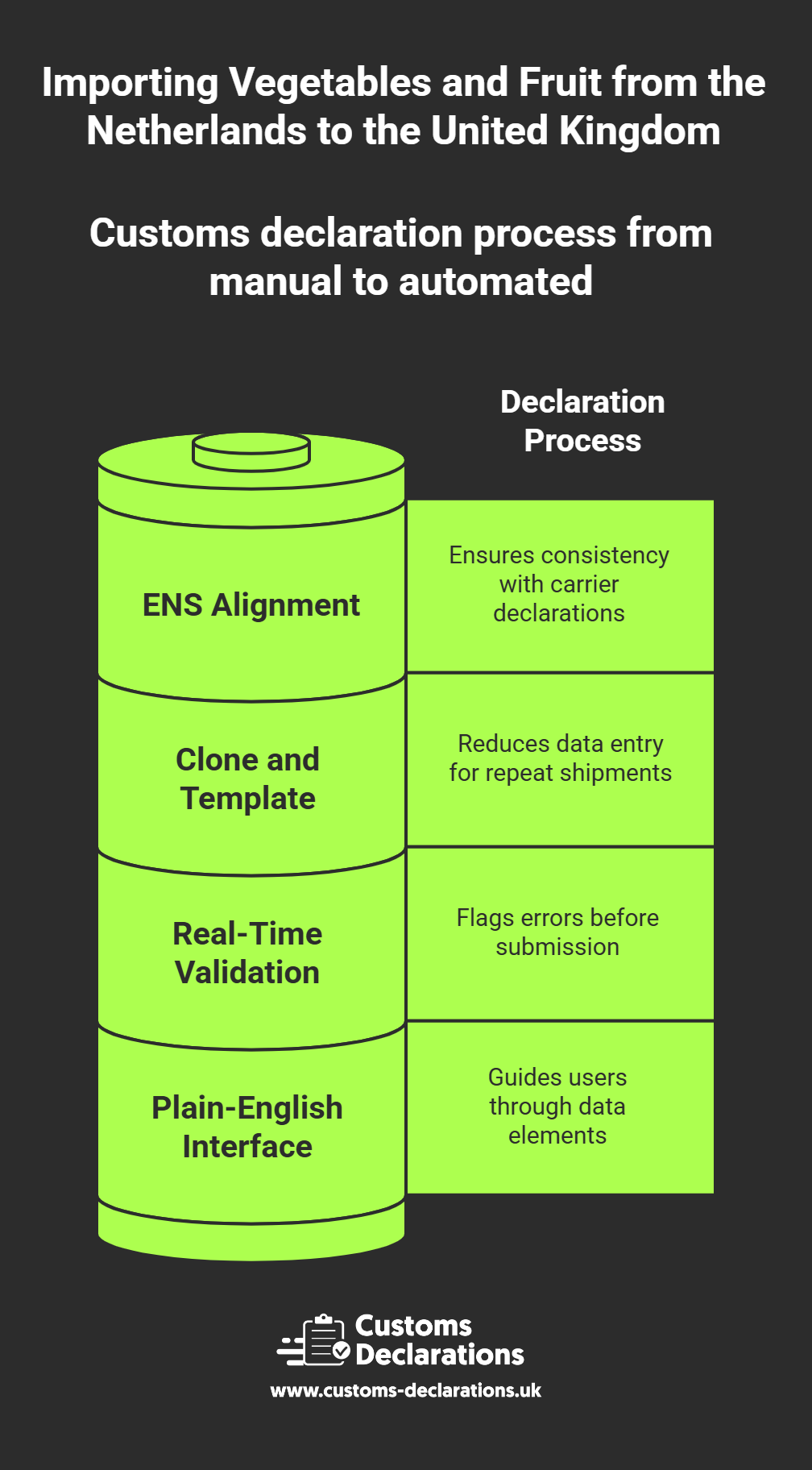
Within the CDUK platform, importers can create and manage the full lifecycle of their customs declarations through a guided, plain-English interface. The system walks you through each data element—importer and exporter identification, commodity classification, customs value, Incoterms, country of origin, and any preference claims—ensuring that nothing is omitted and that the data is internally consistent before submission.
One of the most important features for fresh produce importers is real-time validation. Because fresh produce consignments are time-sensitive, a declaration that is rejected by HMRC due to a data error can have immediate consequences for the condition of the goods. CDUK performs pre-submission validation checks that flag missing or inconsistent data before the entry is transmitted, dramatically reducing the likelihood of rejections.
Once HMRC accepts your entry, CDUK generates and displays the Movement Reference Number (MRN)—the official acknowledgement that your declaration has been received and accepted.
For importers managing multiple consignments, the clone and template functionality within CDUK is particularly valuable. You can clone an existing fresh produce declaration and amend only the consignment-specific details (date, weight, value, transport reference), which substantially reduces data entry time for repeat shipments of the same commodity lines.
CDUK also supports alignment between your customs declarations and your carrier’s ENS declarations (Entry Summary Declarations for safety and security purposes). Mismatches between the commodity descriptions, weights, and consignee details in the ENS filing and those in the import declaration are a common cause of avoidable border holds. By keeping these datasets aligned within the platform, you minimise the risk of your time-sensitive produce being held pending a data reconciliation check.
VAT, Duty, and Financial Planning for Fresh Produce Imports
Under the TCA, qualifying fresh vegetables and fruit of Dutch origin attract a zero percent customs duty rate. This is a significant advantage compared to sourcing from countries without a preferential trade agreement with the UK, where duty rates on fresh produce can be meaningful.
Import VAT at the standard rate of 20% applies to most fresh produce imports. However, many basic foodstuffs—including most fresh vegetables and fruit—are zero-rated for VAT in the UK. This means that while import VAT is technically applied at the border, the effective rate for qualifying produce is zero percent, which removes one of the principal financial barriers of the post-Brexit import framework. You should verify the VAT liability of your specific products against HMRC’s food VAT guidance, as the zero-rating does not apply universally to all food products.
For importers dealing in higher-value consignments or operating with significant import volumes, a Duty Deferment Account enables monthly settlement of any applicable charges rather than payment at each entry.
Practical Compliance Checklist for Fresh Produce Importers
Before each consignment, confirm that you hold a valid GB EORI and that PVA is activated. Verify whether a phytosanitary certificate is required for the specific commodity and ensure the Dutch exporter has arranged NVWA inspection and certification. Submit your IPAFFS pre-notification within the required timeframe. Obtain the Statement on Origin from the exporter for TCA preference. Prepare your commercial invoice and packing list with accurate values, weights, and descriptions. File your import declaration through the Customs Declarations UK platform, run the real-time validation check, and confirm the MRN on HMRC acceptance. Share final consignment data with your carrier so that ENS filings are aligned. Retain the full documentation pack for six years.
Conclusion: Building a Reliable and Compliant Import Lane
Importing fresh vegetables and fruit from the Netherlands into the United Kingdom is a commercially attractive and entirely achievable proposition when approached with the right compliance infrastructure. The combination of zero TCA tariffs, well-established Dutch horticultural supply chains, and relatively short transit times makes the Netherlands a natural sourcing partner for UK fresh produce businesses.
The keys to success are preparation and precision: securing phytosanitary certification before goods leave the Netherlands, submitting IPAFFS pre-notifications on time, classifying produce correctly, evidencing TCA origin claims with documentary rigour, and filing accurate customs declarations through the Customs Declarations UK platform with pre-submission validation to avoid costly rejections. With these disciplines embedded into your operations, Netherlands-to-UK fresh produce imports can become a reliable, scalable, and audit-ready process that delivers consistent results throughout the year.