Pre-loader

Importing Fruits and Vegetables from Spain to the United Kingdom: A Step-by-Step Guide for UK Importers

Importing fresh fruits and vegetables from Spain to the United Kingdom represents a significant commercial opportunity for UK businesses, combining proximity, consistent quality, and preferential tariff treatment under the UK-EU Trade and Cooperation Agreement. However, successful imports require precise navigation of plant health regulations, marketing standards, customs procedures, and documentary requirements that have evolved considerably since Brexit. This guide provides UK importers with a structured pathway through compliance, from supplier selection and phytosanitary certificates to customs declarations and border inspection procedures, ensuring your Spanish produce arrives on time, meets UK standards, and clears efficiently through Great Britain ports.

Understanding the Post-Brexit Framework for Spanish Produce

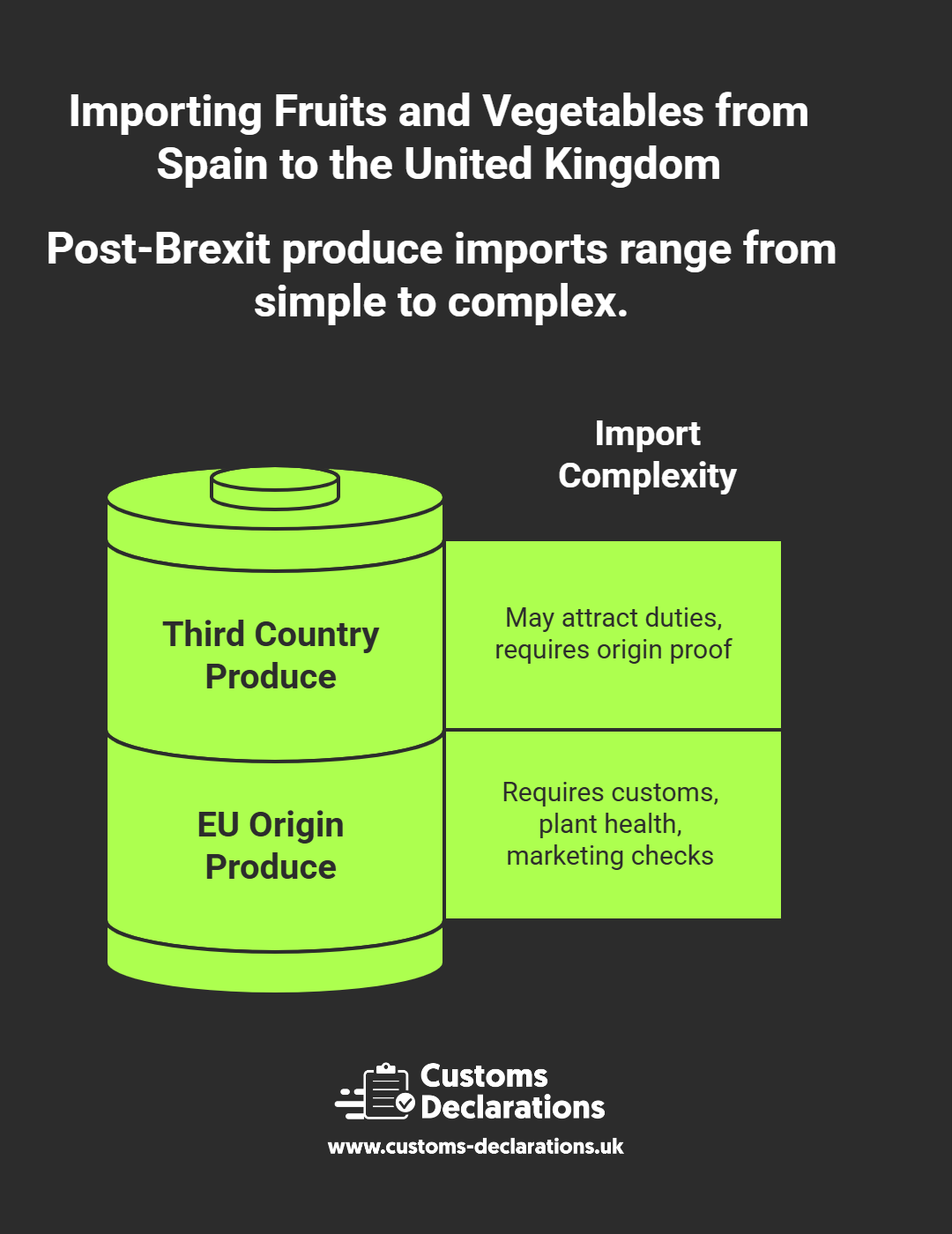
Since the United Kingdom’s departure from the European Union, all goods arriving from Spain into Great Britain are classified as imports and require full customs treatment, even though no tariff duties apply for goods of EU origin under the UK-EU Trade and Cooperation Agreement. This means that while Spanish tomatoes, peppers, citrus fruits, and leafy greens can enter the UK duty-free, they must still undergo rigorous plant health checks, meet marketing standards requirements, and be accompanied by complete customs declarations submitted to HMRC’s Customs Declaration Service. The duty-free status is conditional upon origin, meaning that produce grown and harvested in Spain qualifies for preferential treatment, whereas products merely transshipped through Spain from third countries do not automatically receive this benefit and may attract Most-Favoured-Nation duty rates unless separate preference arrangements apply.

The framework operates on three parallel tracks that must be managed simultaneously. The first is plant health and biosecurity, administered by the Animal and Plant Health Agency (APHA) and enforced at Border Control Posts, which aims to prevent the introduction of pests and diseases into Great Britain’s agricultural ecosystem. The second is marketing standards compliance, overseen by the Horticultural Marketing Inspectorate (HMI) in England and Wales and Science and Advice for Scottish Agriculture (SASA) in Scotland, which ensures that imported fruits and vegetables meet defined quality, sizing, labelling, and presentation requirements. The third is customs clearance, managed through HMRC’s Customs Declaration Service, which captures commercial data, applies tariff treatment, and calculates import VAT even when duty itself is zero-rated.

Plant Health Requirements and Phytosanitary Controls

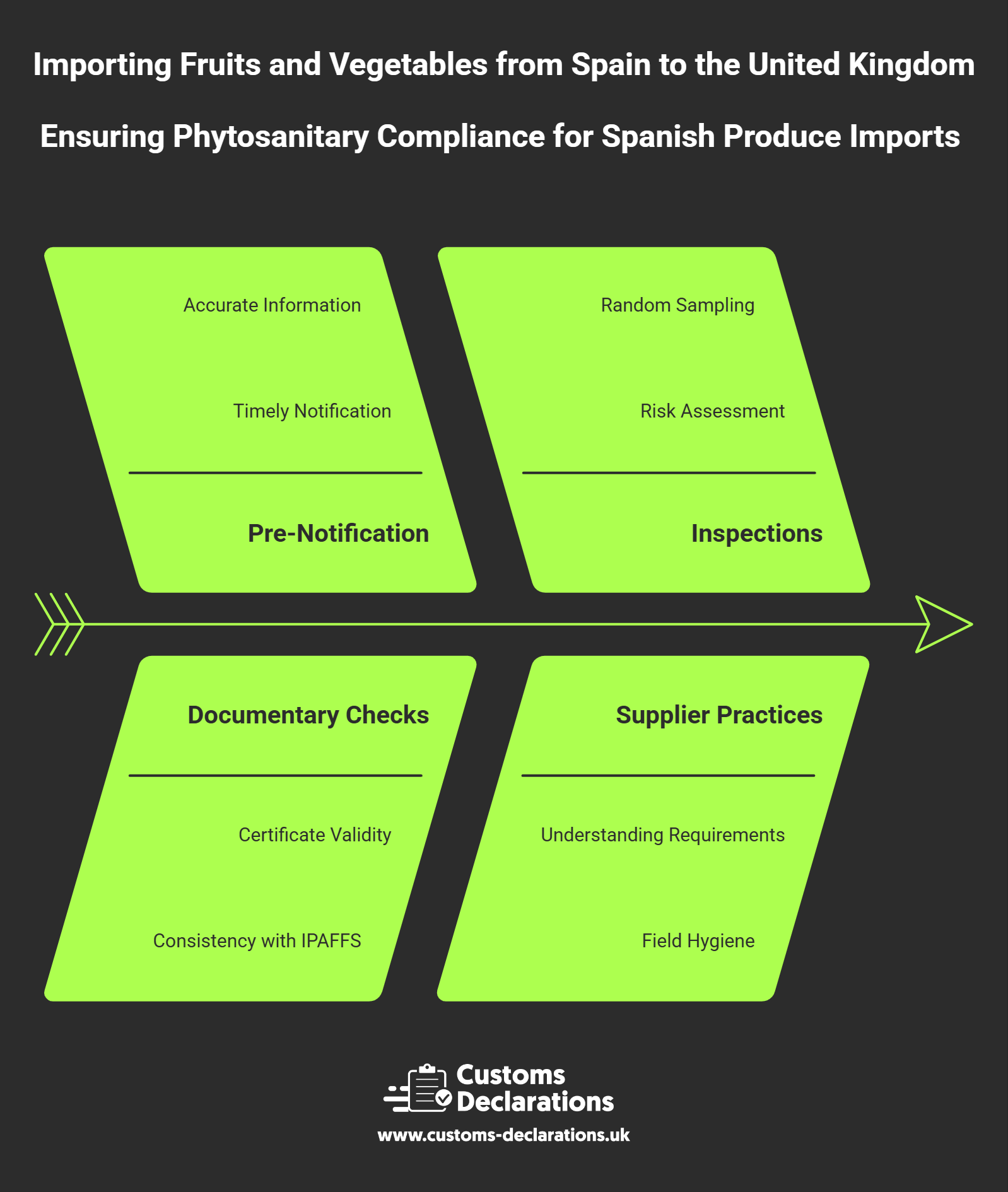
Fresh fruits and vegetables from Spain are subject to stringent plant health requirements designed to protect UK agriculture from quarantine pests, plant diseases, and invasive species. Many categories of Spanish produce are classified as medium-risk or high-risk plants and plant products, triggering mandatory pre-notification through the Import of Products, Animals, Food and Feed System (IPAFFS), documentary checks at the point of entry, and potential identity or physical inspections at designated Border Control Posts. High-risk produce typically includes items such as citrus fruits, stone fruits, certain leafy vegetables, and solanaceous crops like tomatoes and peppers, which are susceptible to pests such as Xylella fastidiosa, citrus black spot, or tomato brown rugose fruit virus.

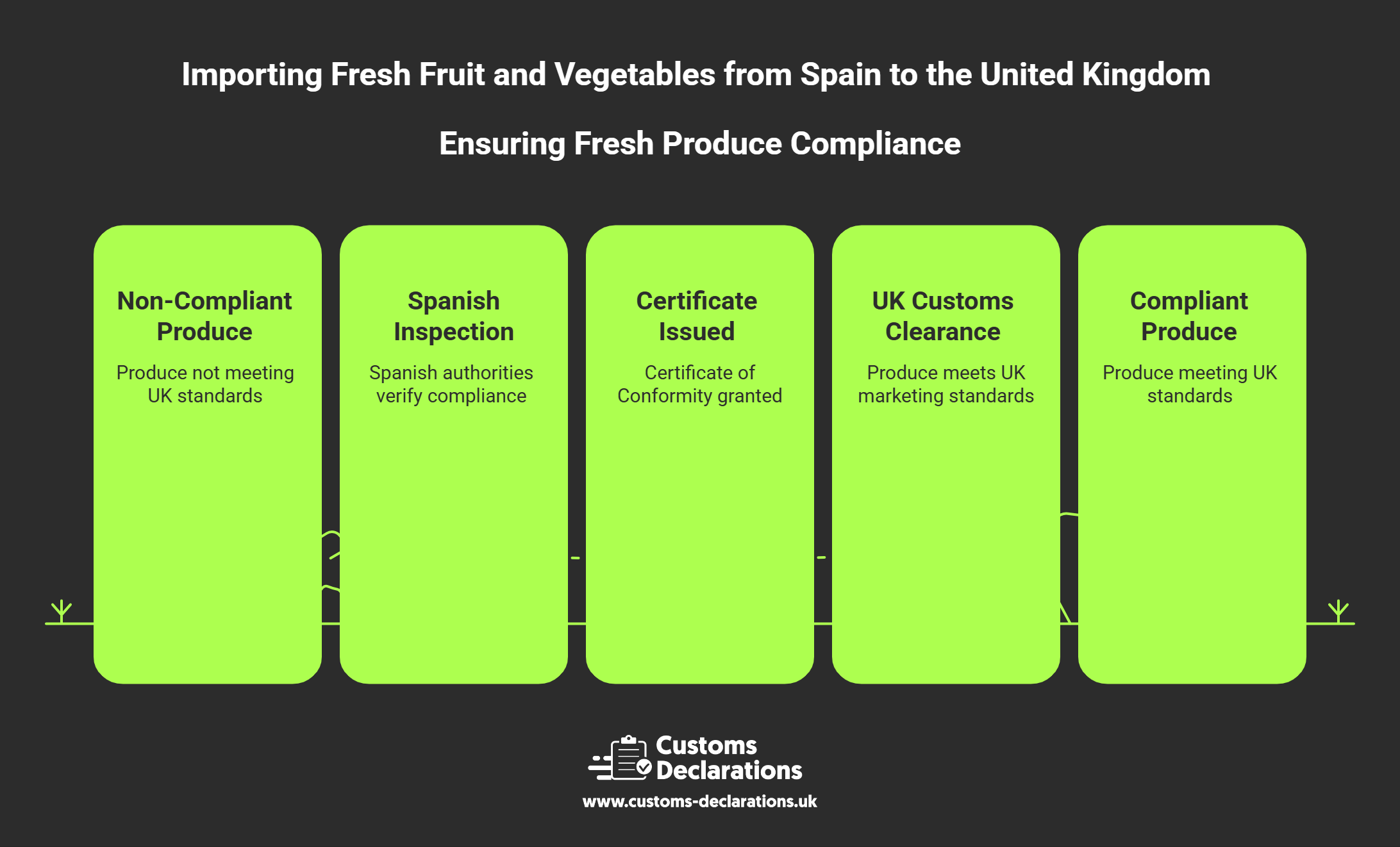
To import high-risk or medium-risk produce, UK importers must pre-notify APHA through IPAFFS at least one working day before the consignment arrives at the UK border. This notification requires detailed information including the commodity description, quantity, packaging type, point of entry, estimated arrival time, and the identity of the Spanish grower or exporter. Upon arrival, consignments undergo documentary checks to verify that accompanying phytosanitary certificates are valid, complete, and consistent with the IPAFFS notification. A phytosanitary certificate is a formal attestation from the Spanish plant health authorities confirming that the produce has been inspected, found free from quarantine pests, and complies with UK import requirements. This certificate must be issued by the competent Spanish authority and must reference the specific UK phytosanitary import requirements for the commodity in question.

Identity checks and physical inspections may be conducted based on risk assessments, previous compliance history, and random sampling protocols. During these inspections, APHA officers verify that the produce matches the description on the phytosanitary certificate, check for visible signs of pests or disease, and may take samples for laboratory testing if suspicious symptoms are observed. Consignments that fail inspection may be refused entry, destroyed, or subjected to official treatment such as cold storage or fumigation depending on the nature of the non-compliance. For importers, this underscores the importance of selecting Spanish suppliers who understand UK phytosanitary requirements, maintain rigorous field hygiene, and work closely with Spanish plant health authorities to secure accurate and complete certificates.

Marketing Standards and Certificates of Conformity

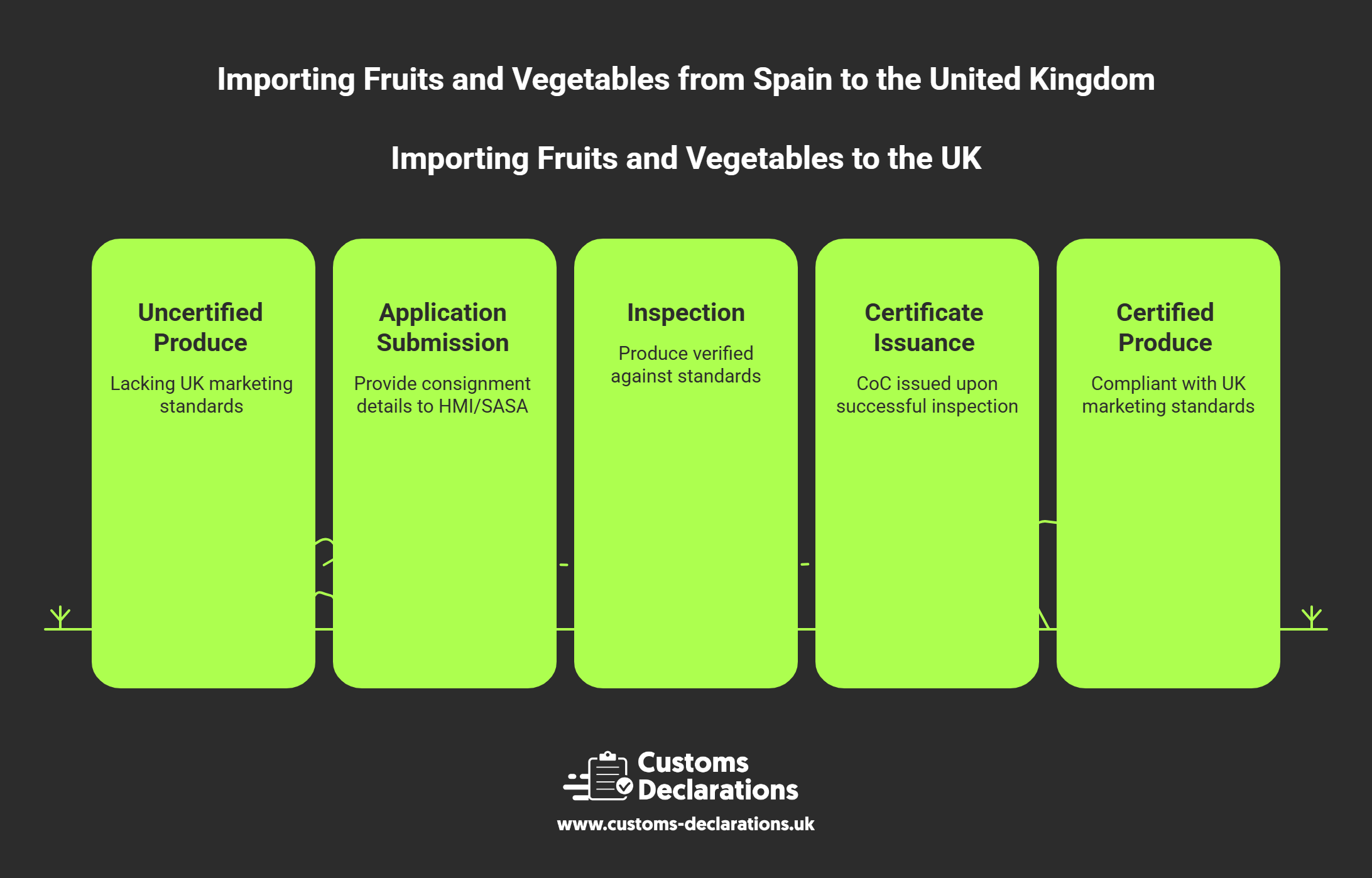
In addition to plant health controls, imported fruits and vegetables must comply with UK marketing standards that govern quality, sizing, labelling, and presentation. These standards are divided into two categories: Specific Marketing Standards (SMS), which apply to ten defined product groups including apples, citrus fruits, kiwifruit, lettuces, peaches, pears, strawberries, sweet peppers, table grapes, and tomatoes, and the General Marketing Standard (GMS), which applies to all other fresh produce not covered by SMS. Products subject to SMS must be graded into quality classes—Extra Class, Class I, or Class II—based on criteria such as shape, colour, absence of defects, and degree of ripeness, and must be accompanied by a Certificate of Conformity (CoC) issued by Great Britain authorities before they can be released for free circulation.

The Certificate of Conformity is obtained by submitting an application to HMI (for England and Wales) or SASA (for Scotland) through IPAFFS, providing details of the consignment, the Spanish supplier, and the intended quality class designation. HMI or SASA may conduct inspections at the border or at approved inland facilities to verify that the produce meets the declared standard before issuing the certificate. Spain does not currently hold Great Britain Approved Inspection Service (GB AIS) status for fruits and vegetables, which means that Spanish-issued certificates cannot be used to clear customs in Great Britain. Instead, all SMS produce must undergo Great Britain inspection and certification, adding an administrative step and potential delay if documentation is incomplete or if quality deficiencies are detected during inspection.

Customs Classification and Tariff Treatment

Accurate classification of fresh fruits and vegetables under the UK Integrated Tariff is fundamental to compliant customs declarations. Fresh produce is generally classified within Chapters 7 and 8 of the Harmonized System, with Chapter 7 covering edible vegetables, roots, and tubers, and Chapter 8 covering edible fruit and nuts, citrus fruit peel, and melons. The precise ten-digit commodity code assigned to each product determines applicable measures, licensing requirements, and statistical reporting obligations, even though duty rates for Spanish produce are zero under the UK-EU Trade and Cooperation Agreement.

Even though customs duty is zero-rated for Spanish produce under preference, this treatment is contingent upon demonstrating EU origin. Origin for fresh produce is determined by the place of harvest, meaning that fruits and vegetables grown in Spain qualify as originating goods. However, if Spain acts merely as a transit point for produce grown in Morocco, Turkey, or other third countries, the goods do not benefit from UK-EU preferential treatment and may be subject to standard tariff rates unless covered by a separate UK trade agreement with the country of harvest. Importers must retain origin evidence, typically in the form of supplier declarations or statements on commercial invoices confirming that the produce was “harvested in Spain” or “of Spanish origin,” and be prepared to present this evidence to HMRC upon request.

Filing Customs Declarations with Customs Declarations UK

The Customs Declarations UK (CDUK) platform provides a streamlined, user-friendly pathway for UK importers to prepare and submit import declarations to HMRC’s Customs Declaration Service (CDS). Unlike generic customs software or intermediary services that may require technical expertise or incur brokerage fees, CDUK is designed for direct use by importers, freight forwarders, and logistics operators who prefer to manage their customs compliance in-house. The platform offers guided wizards that walk users through each stage of declaration preparation, prompting for essential data elements such as importer and exporter details, commodity codes, quantities, customs values, origin information, and supporting document references.

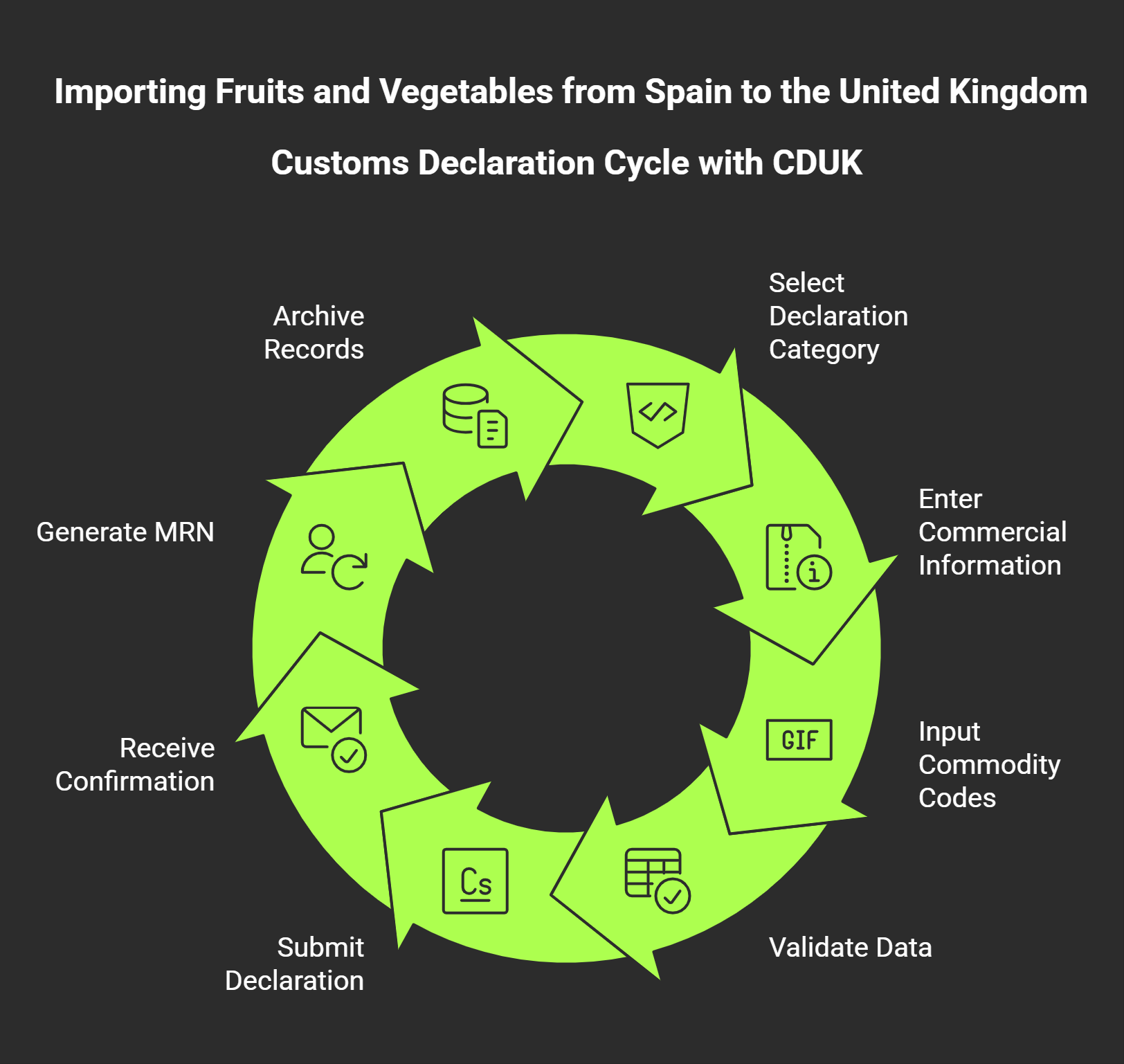
For Spanish fruit and vegetable imports, the declaration process begins by selecting the appropriate declaration category—typically a standard H1 import declaration for release to free circulation—and entering core commercial information including the Spanish supplier’s details, the UK importer’s EORI number, and a description of the goods. Users then input the commodity classification codes, ensuring that each line item corresponds to the correct ten-digit tariff heading and that all product-specific measures are addressed. CDUK performs real-time validation checks as data is entered, flagging missing fields, inconsistent values, or logical errors before submission, which significantly reduces the risk of rejection by CDS and avoids the delays and rework associated with incomplete or incorrect declarations.

Once the declaration data is complete and validated, CDUK submits the entry electronically to CDS and receives immediate confirmation of acceptance or rejection. Upon acceptance, the system generates and displays the Movement Reference Number (MRN), which serves as the unique identifier for the import transaction and is used by border authorities, carriers, and warehouse operators to track the consignment’s clearance status. CDUK automatically archives the full declaration record, including all supporting documents and status messages, for the statutory retention period of six years, ensuring that importers can respond promptly to HMRC audits, respond to post-clearance queries, and maintain compliance with record-keeping obligations. For businesses importing multiple consignments of Spanish produce on a regular basis, CDUK’s template and cloning features enable rapid declaration creation by reusing standard data fields and adjusting only variable elements such as shipment dates, quantities, and invoice values.

In addition to import declarations, CDUK supports the filing of Entry Summary Declarations (ENS) for safety and security purposes. ENS filings provide advance cargo information to UK authorities before goods physically arrive at the border, enabling risk assessment and security screening. For maritime and air shipments of fresh produce, carriers typically lodge ENS declarations on behalf of importers, but in cases where the importer holds the transport contract or where the carrier does not have a direct ENS filing arrangement, CDUK allows importers to submit their own ENS entries, ensuring that safety and security data aligns seamlessly with the subsequent customs declaration and avoiding discrepancies that could trigger holds or inspections.

Conclusion: Building a Compliant and Efficient Spanish Import Operation

Importing fruits and vegetables from Spain to the United Kingdom demands a disciplined, evidence-led approach that integrates plant health compliance, marketing standards adherence, and accurate customs procedures into a seamless operational framework. By selecting qualified Spanish suppliers who understand UK requirements, maintaining rigorous documentation practices, pre-notifying imports through IPAFFS, securing Certificates of Conformity for SMS produce, and filing validated CDS declarations through the Customs Declarations UK platform, importers can achieve predictable clearance times, minimize border disruptions, and maintain full audit readiness.

The zero-tariff environment under the UK-EU Trade and Cooperation Agreement provides a competitive foundation for Spanish produce imports, but this advantage is only realized when origin is properly evidenced and when all regulatory requirements are satisfied. As UK authorities continue to refine border controls, enhance digital systems such as IPAFFS, and strengthen enforcement of plant health and marketing standards, importers who invest in robust compliance infrastructure today will be best positioned to scale their Spanish supply chains, respond to market opportunities, and build long-term commercial relationships grounded in quality, reliability, and regulatory integrity.

We value your feedback, and if you have any comments, suggestions or anything else that you would like to highlight to us, we will be delighted to hear from you and incorporate your feedback into our content.

Note: While we have made every attempt to ensure that the information contained in this Site has been obtained from reliable sources, Customs Declarations UK is not responsible for any errors or omissions, or for the results obtained from the use of this information. All information in this Site is provided “as is”, with no guarantee of completeness, accuracy, timeliness or of the results obtained from the use of this information, and without warranty of any kind, express or implied, including, but not limited to warranties of performance, merchantability and fitness for a particular purpose. Nothing herein shall to any extent substitute for the independent investigations and the sound technical and business judgment of the reader. In no event will Customs Declarations UK, or its partners, employees or agents, be liable to you or anyone else for any decision made or action taken in reliance on the information in this Site or for any consequential, special or similar damages, even if advised of the possibility of such damages. Certain links in this Site connect to other Web Sites maintained by third parties over whom Customs Declarations UK has no control. Customs Declarations UK makes no representations as to the accuracy or any other aspect of information contained in other Web Sites.