Pre-loader

Importing Clothing from Vietnam to the United Kingdom: A Complete Compliance and Customs Guide

Importing clothing and textiles from Vietnam to the United Kingdom represents a significant opportunity for UK retailers, fashion brands, and distributors seeking competitive sourcing options in Southeast Asia. Vietnam has emerged as one of the world’s leading apparel manufacturing hubs, offering high-quality garments, competitive pricing, and increasingly sophisticated production capabilities across categories ranging from basic t-shirts to technical sportswear and luxury fashion items. However, realizing the commercial benefits of Vietnamese textile imports requires meticulous attention to customs procedures, product compliance, preferential tariff claims under the UK-Vietnam Free Trade Agreement, and accurate valuation. This guide provides a structured, end-to-end framework for importing clothing from Vietnam into Great Britain, helping businesses navigate the regulatory landscape while maintaining efficient supply chains and audit-ready documentation.

Understanding the UK-Vietnam Trade Relationship and Preferential Access

The United Kingdom and Vietnam maintain a bilateral free trade agreement that continues the preferential terms previously available under the EU-Vietnam FTA. This agreement, known as the UK-Vietnam Free Trade Agreement (UKVFTA), provides UK importers with duty-free or significantly reduced tariff rates on qualifying Vietnamese-origin garments and textiles, delivering substantial cost savings compared to standard Most-Favoured-Nation (MFN) duty rates that can range from 8% to 12% for many clothing categories. To benefit from these preferential rates, importers must demonstrate that the clothing meets the agreement’s rules of origin, which typically require that garments undergo sufficient manufacturing or processing in Vietnam to qualify as originating goods. This often means that fabric production, cutting, and assembly must occur in Vietnam or in approved cumulation partners, and that the value of non-originating materials used remains within specified thresholds.

Crucially, preferential duty is not automatic simply because goods are shipped from Vietnam. Importers must possess valid proof of origin at the time of importation, either through a statement on origin provided by the Vietnamese exporter on a commercial invoice or other commercial document, or through importer’s knowledge where the UK business holds sufficient production and sourcing evidence to substantiate origin independently. The statement on origin must be based on information demonstrating that the product is originating, including details of the production process and the origin of materials used. Without this evidence, customs authorities will apply the standard MFN duty rate, eliminating the competitive advantage that makes Vietnamese sourcing attractive in the first place.

Product Compliance for Textile and Clothing Imports

Beyond customs duties and tariffs, clothing imports into the UK market must comply with a comprehensive set of product safety, labelling, and consumer protection regulations. These requirements exist to protect UK consumers from unsafe products, ensure accurate product information, and maintain fair trading standards. UK importers assume full legal responsibility as the entity placing goods on the Great Britain market, making compliance verification an essential early step in the sourcing process.

Textile products sold in the UK must meet textile labelling requirements under the Textile Products (Labelling and Fibre Composition) Regulations. These rules mandate that garments carry permanent, legible labels indicating fibre content by percentage weight, using standardized fibre names in English. Multi-component garments must show the composition of each distinct textile part that comprises at least 80% of the garment’s weight, and decorative or functional components below certain thresholds may be excluded. Labels must be securely affixed and remain legible throughout the product’s normal lifespan, typically requiring woven or printed care labels sewn into seams or collars. Generic terms like “mixed fibres” are not sufficient; precise fibre names and percentages are mandatory.

General product safety obligations apply under the Product Safety and Metrology etc. (Amendment etc.) (UK(NI) Indication) (EU Exit) Regulations 2020 and the General Product Safety Regulations 2005. Clothing items, particularly children’s garments and nightwear, must not present unreasonable risks. This includes ensuring that drawstrings, cords, and fastenings meet safety standards to prevent strangulation or entanglement hazards, that flammability characteristics comply with relevant standards, and that small detachable parts on children’s clothing do not pose choking risks. Importers should request test reports and certificates from Vietnamese suppliers confirming compliance with applicable EN or BS standards, and maintain these as part of the technical file for each product line.

The UK Conformity Assessed (UKCA) marking and CE marking framework applies selectively to textiles. While most basic garments do not require UKCA marking, certain specialized textile products with embedded electronics, heated elements, or other regulated features may fall under electrical safety or electromagnetic compatibility regulations, requiring appropriate conformity assessment and marking. The UK government continues to recognize CE marking for most product categories placed on the Great Britain market, providing importers with flexibility. Importers must ensure that their UK importer details—including business name, registered trade name or trademark, and contact address—are clearly indicated on the product, packaging, or accompanying documentation in English. This information allows market surveillance authorities and consumers to identify the responsible party for compliance queries or safety incidents.

Restricted substances in textiles are controlled under REACH (Registration, Evaluation, Authorisation and Restriction of Chemicals) as retained in UK law. Certain azo dyes, formaldehyde, and heavy metals are restricted or banned in textile products placed on the UK market. UK importers should specify acceptable chemical limits in purchase contracts with Vietnamese manufacturers and request test certificates from accredited laboratories confirming compliance with UK REACH Annex XVII restrictions. Additionally, products subject to Extended Producer Responsibility (EPR) for packaging must be considered. If garments arrive in retail packaging that will remain with the product through final sale, importers may need to register with an EPR packaging compliance scheme and report packaging data annually.

Customs Classification and Accurate Tariff Determination

Proper classification of clothing imports under the UK Integrated Tariff is the foundation of a compliant customs declaration. Garments are classified primarily in Chapter 61 (knitted or crocheted articles) and Chapter 62 (woven articles) of the tariff, with specific headings and subheadings determined by factors including garment type, gender, fibre composition, construction method, and sometimes the presence of specific features like hoods or linings. Classification directly determines the applicable duty rate, statistical reporting requirements, and any product-specific measures or controls. Misclassification can lead to underpayment or overpayment of duty, post-clearance adjustments, penalties, and delayed clearance.

For example, women’s woven cotton blouses typically fall under heading 6206, while knitted cotton t-shirts are classified under heading 6109. The distinction between “woven” and “knitted” fabrics, and between categories like “women’s or girls'” versus “men’s or boys'” garments, must be determined objectively based on the physical characteristics and intended use of the product. Importers should maintain detailed product specifications, technical drawings, fabric composition details, and photographs to substantiate classification decisions. Where classification is uncertain or products are novel, consider requesting a Binding Tariff Information (BTI) ruling from HMRC, which provides legal certainty and protection from reclassification for three years.

Once the correct commodity code is established, importers can determine whether preferential duty under UKVFTA applies or whether the standard MFN rate is payable. The UK Trade Tariff tool provides up-to-date duty rates, import controls, and preferential agreement details for every commodity code. Importers should verify rates immediately before each shipment, as tariff schedules and preferential agreements can change with policy updates or new trade negotiations.

Customs Valuation and Building the Fiscal Base

Accurate customs valuation is essential for calculating both import duty and VAT. HMRC uses the transaction value method as the primary basis for valuation, defined as the price actually paid or payable for the goods when sold for export to the UK, adjusted to include certain costs and exclude others. The transaction value must include the cost of the garments themselves, international freight charges to the UK border, insurance costs, packing expenses, and any assists or royalties that are conditions of sale. Importers must exclude costs incurred after importation, such as UK inland transport from the port to the final warehouse, installation services, and UK duties or taxes themselves.

For Vietnamese clothing imports, the customs value declaration should be supported by a detailed commercial invoice from the supplier showing a clear breakdown of unit prices, total product cost, and separately identified transport and insurance charges if these are arranged by the seller. Where pricing involves related-party transactions, transfer pricing documentation may be necessary to demonstrate that the declared value reflects arm’s length commercial terms. Undervaluation is a serious compliance risk that can trigger HMRC investigations, duty reassessments, and financial penalties. Conversely, overvaluation results in unnecessary duty and VAT payments. Maintaining a transparent, well-documented valuation methodology with clear records of Incoterms, freight contracts, and invoices protects importers during audits.

Import VAT is calculated on a base that includes the customs value plus any import duty payable, at the standard UK rate of 20% for most clothing items. VAT-registered UK businesses can use Postponed VAT Accounting (PVA), which allows import VAT to be accounted for on the VAT return rather than paid upfront at the border. This mechanism significantly improves cash flow for importers by deferring the VAT liability until the monthly or quarterly VAT return cycle, while still allowing immediate input VAT recovery where applicable. PVA is activated by indicating the appropriate method code on the customs declaration and ensuring that the import VAT amount is later reported correctly on the VAT return under the postponed VAT accounting box.

Rules of Origin and Claiming Preferential Duty Under UKVFTA

To claim preferential duty treatment under the UK-Vietnam Free Trade Agreement, importers must satisfy the agreement’s rules of origin and possess valid origin evidence at the time of declaration. The product-specific rules for textiles and clothing generally require that fabric production and garment manufacturing occur in Vietnam, or that the value of non-originating materials used in production does not exceed a specified percentage of the ex-works price of the finished garment. Some rules allow cumulation, meaning that inputs originating in other countries with which the UK has FTAs may count as originating for the purposes of the UKVFTA, provided specific cumulation provisions apply.

Origin can be claimed based on a statement on origin provided by the Vietnamese exporter, which may be included on a commercial invoice, delivery note, or any other commercial document that describes the originating product in sufficient detail to enable its identification. The statement must be made out by the exporter based on information demonstrating that the product qualifies as originating, and it can cover single or multiple shipments of identical products within a 12-month period. Alternatively, UK importers with sufficient knowledge of the production process, sourcing of materials, and compliance with the relevant origin rule can claim preferential treatment based on importer’s knowledge, provided they retain comprehensive documentation to substantiate the origin claim during HMRC audits or verification requests.

Importers should request origin evidence from Vietnamese suppliers before the first shipment and establish clear contractual terms requiring suppliers to provide statements on origin, maintain production records, and cooperate with any official verification procedures initiated by UK or Vietnamese customs authorities. Without robust origin evidence, the preferential rate cannot be claimed, and standard MFN duties will apply, eroding the cost advantage that makes Vietnamese sourcing competitive. Maintaining a dedicated origin compliance file for each product line, including supplier declarations, production process descriptions, bills of materials, and correspondence confirming origin criteria, ensures audit readiness and protects against challenges to preferential claims.

Filing Customs Declarations Using the Customs Declarations UK Platform

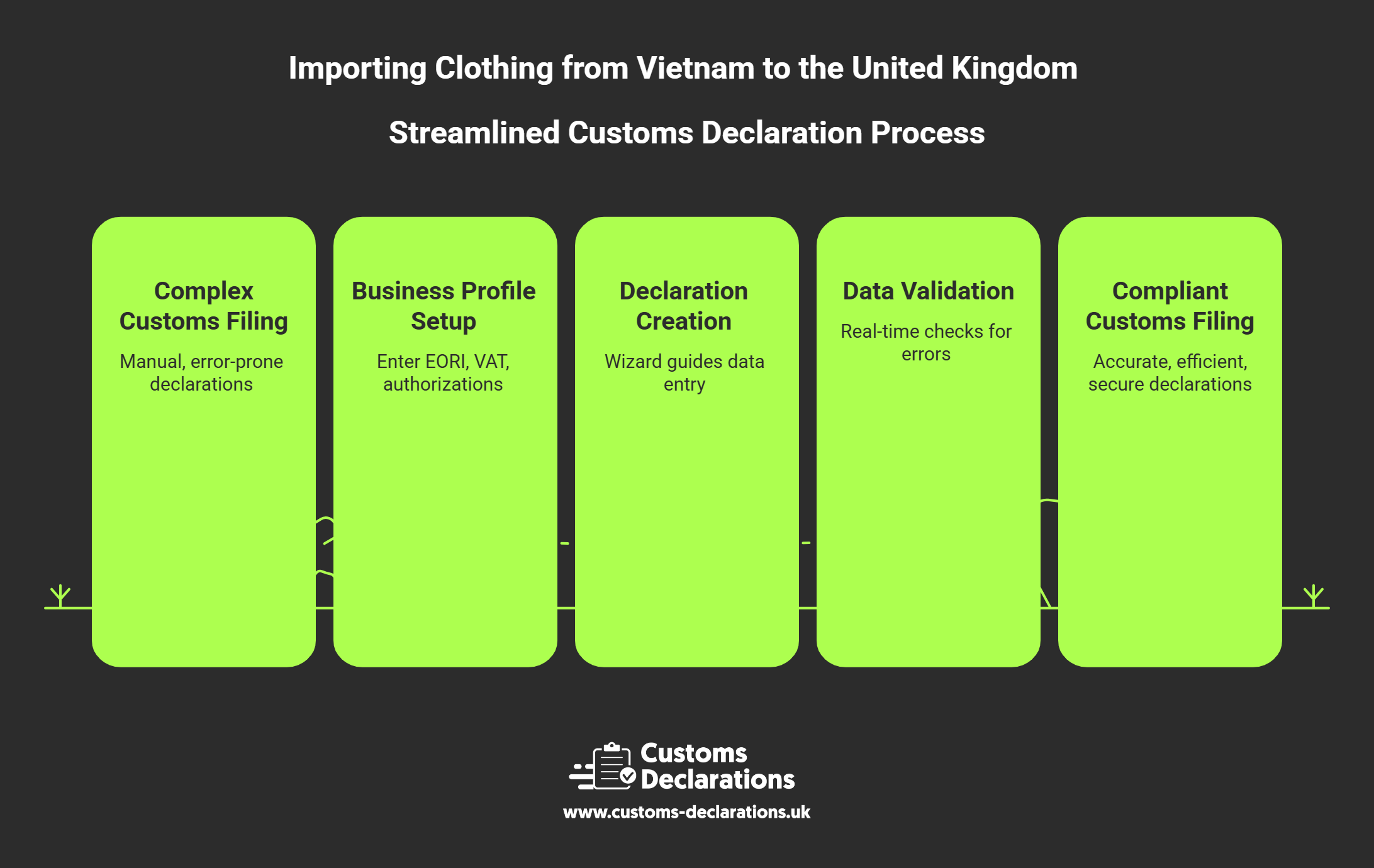
The Customs Declarations UK (CDUK) platform provides UK importers with a structured, user-friendly pathway to prepare and submit import declarations to HMRC’s Customs Declaration Service (CDS). Filing accurate, complete declarations is essential for lawful importation, timely clearance, and compliance with all customs and fiscal obligations. CDUK simplifies this process by offering guided workflows, real-time validation, and secure record-keeping that aligns with HMRC requirements.

Within the CDUK platform, importers begin by setting up their business profile, including the GB EORI number, VAT registration details, and any relevant customs authorizations or approvals. Once the profile is established, users can create new customs declarations for each shipment of Vietnamese clothing. The platform presents a wizard-based interface that walks users through each required data element in plain English, reducing the complexity of navigating CDS codes and technical jargon. Importers enter key information including the consignor and consignee details, the commodity classification code determined during the product research phase, the customs value and its components, the country of origin, and the preferential tariff treatment being claimed under UKVFTA.

For clothing imports claiming preferential duty, the declaration must include the correct procedure code indicating free circulation with preference, reference to the UKVFTA agreement, and the origin criterion code that corresponds to the type of origin evidence held. CDUK’s built-in validation engine checks data consistency and completeness before submission, flagging missing fields, illogical entries, or discrepancies that could result in declaration rejection or clearance delays. This real-time feedback allows importers to correct errors immediately, avoiding costly rework and reducing the risk of penalties for incorrect declarations.

Once all data is entered and validated, the declaration is submitted electronically to CDS. Upon acceptance by HMRC, the platform retrieves the Movement Reference Number (MRN), which serves as the unique identifier for the customs entry and is required for release of the goods by the port or carrier. CDUK securely archives the complete declaration dataset, including all supporting documents, invoices, packing lists, and origin statements, for the statutory six-year retention period mandated by HMRC. This comprehensive digital record provides importers with instant access to historical data for compliance audits, VAT reporting, and financial reconciliation.

The platform also supports the preparation and submission of ENS declarations (Entry Summary Declarations) for safety and security purposes. While ENS filings are typically submitted by carriers, importers can use CDUK to align their customs declaration data with the safety and security information provided to customs authorities, ensuring consistency across all datasets and reducing the risk of holds or inspections triggered by data mismatches. For businesses managing multiple shipments or complex supply chains, CDUK offers features such as bulk data upload via CSV files, reusable templates for common product lines, and integration capabilities with internal ERP or logistics systems, streamlining the declaration process and enabling scalable, efficient customs operations.

Logistics, Documentation, and Frontier Presentation

Efficient customs clearance depends not only on accurate declarations but also on well-organized logistics and complete supporting documentation. Vietnamese clothing shipments to the UK typically move via sea freight for cost efficiency on bulk orders, with transit times of approximately 25 to 35 days from major Vietnamese ports such as Ho Chi Minh City or Haiphong to UK ports including Felixstowe, Southampton, or London Gateway. Air freight is an option for urgent or high-value fashion items, reducing transit time to three to seven days but at significantly higher cost.

Importers must agree on clear Incoterms with their Vietnamese suppliers to define responsibility for freight, insurance, and customs formalities. FOB (Free on Board) is commonly used, placing responsibility for international transport and insurance on the UK importer and providing control over carrier selection and costs. CIF (Cost, Insurance, and Freight) transfers these responsibilities to the supplier up to the UK port, simplifying arrangements for the importer but potentially reducing visibility over logistics costs. Regardless of the Incoterm chosen, all costs relevant to customs valuation must be clearly documented and consistently reflected across the commercial invoice, transport documents, and customs declaration.

Essential shipping documents include the commercial invoice detailing product descriptions, quantities, unit prices, total value, and Incoterms; the packing list specifying the number and type of packages, contents of each carton, and gross and net weights; the bill of lading or air waybill serving as the contract of carriage and title document; and the certificate of origin or statement on origin if claiming UKVFTA preferential treatment. Additional documents may include product test certificates, conformity declarations, and licences if any import controls apply to specific textile categories.

Consistency across all documents is critical. Discrepancies between the invoice value, the declared customs value, the packing list quantities, and the transport document descriptions can trigger HMRC examinations, delay clearance, and undermine the credibility of the importer’s compliance systems. Importers should establish rigorous internal controls to ensure that data flows seamlessly from purchase orders through supplier invoices, freight bookings, and customs declarations, with reconciliation checks at each handoff point.

Common Pitfalls and Practical Controls

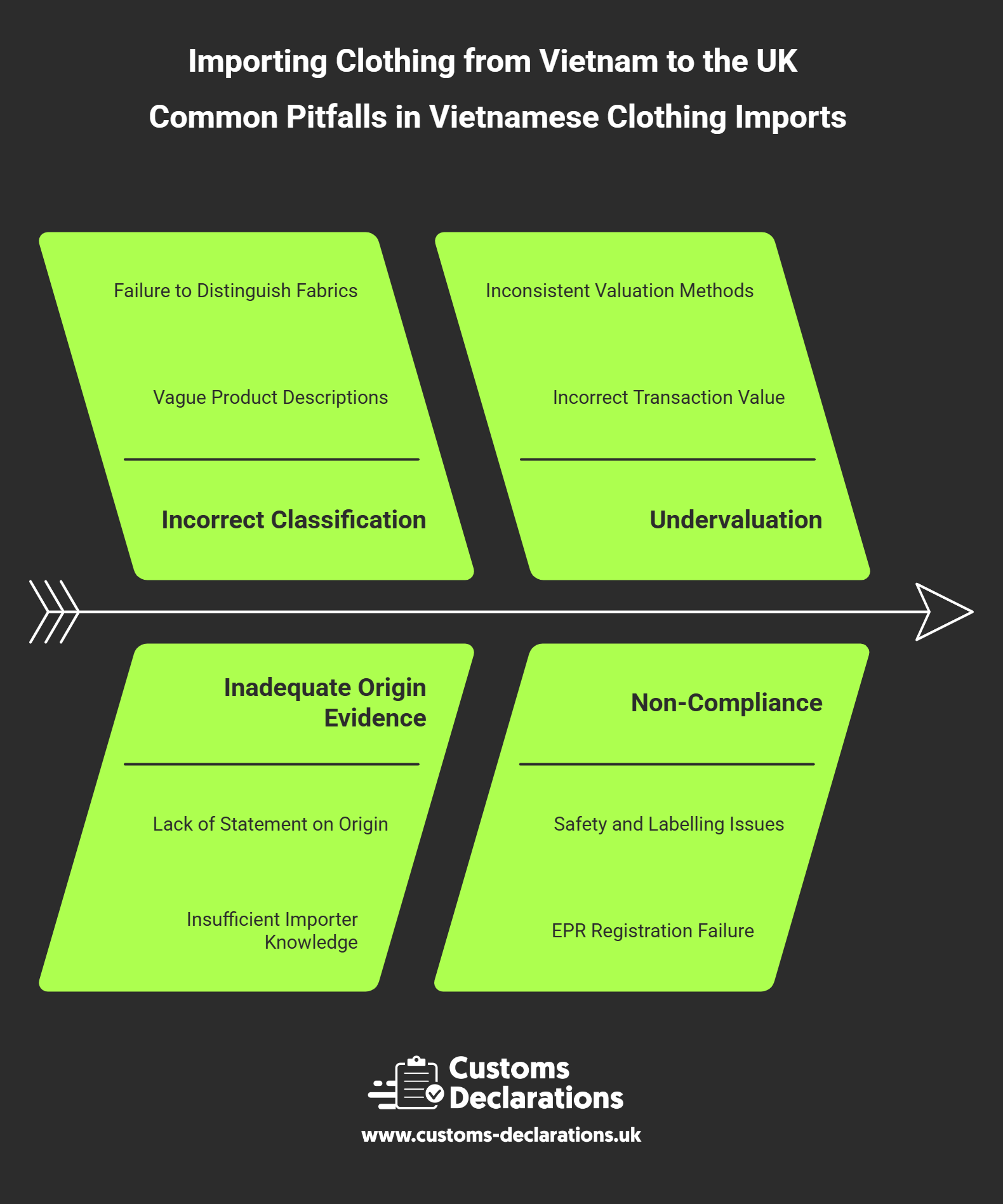
Several recurring errors can disrupt Vietnamese clothing imports and expose businesses to compliance risks. Incorrect classification is among the most frequent, often resulting from vague product descriptions or failure to distinguish between knitted and woven fabrics, or between different garment categories. Investing time in proper classification research, maintaining detailed product specifications, and seeking BTI rulings for ambiguous items significantly reduces this risk.

Inadequate origin evidence is another major pitfall. Importers who assume that goods shipped from Vietnam automatically qualify for preferential duty without obtaining a valid statement on origin or building importer’s knowledge files will face MFN duty charges and lose the commercial benefit of the UKVFTA. Establishing clear origin requirements in supplier contracts and conducting periodic audits of origin documentation mitigates this exposure.

Undervaluation or inconsistent valuation creates both immediate and long-term problems. HMRC’s post-clearance audit teams routinely examine declared values against commercial intelligence and peer benchmarks, and discrepancies can result in duty reassessments, interest charges, and penalties. Importers should ensure that all elements of the transaction value—including royalties, assists, and freight—are correctly captured and disclosed, and that valuation methodologies are consistently applied and well-documented.

Non-compliance with product safety and labelling requirements can lead to goods being detained at the border, refused entry to the market, or subject to enforcement action by trading standards authorities. Conducting pre-shipment inspections, requiring suppliers to provide test certificates for chemical restrictions and flammability, and verifying that fibre content labels and care instructions are correct and in English before goods leave Vietnam prevents costly rejections and rework.

Failure to register for Extended Producer Responsibility schemes where packaging obligations apply can result in regulatory penalties and reputational damage. Importers should assess whether their clothing shipments include packaging that falls within EPR scope and register with an approved compliance scheme if necessary, reporting packaging data annually to meet UK environmental obligations.

Conclusion: Building a Sustainable, Compliant Vietnamese Clothing Import Programme

Importing clothing and textiles from Vietnam into the United Kingdom offers compelling commercial opportunities when managed through a disciplined, compliance-focused framework. Success depends on understanding and leveraging the preferential duty access provided by the UK-Vietnam Free Trade Agreement, ensuring that products meet UK safety and labelling requirements, accurately classifying and valuing goods for customs purposes, and filing complete, validated declarations through platforms such as Customs Declarations UK. By establishing strong supplier relationships, verifying origin evidence, maintaining transparent valuation records, and implementing rigorous documentation and record-keeping practices, UK importers can build scalable, audit-ready import operations that deliver cost efficiency, regulatory compliance, and long-term competitive advantage in the dynamic UK fashion and retail market.

We value your feedback, and if you have any comments, suggestions or anything else that you would like to highlight to us, we will be delighted to hear from you and incorporate your feedback into our content.

Note: While we have made every attempt to ensure that the information contained in this Site has been obtained from reliable sources, Customs Declarations UK is not responsible for any errors or omissions, or for the results obtained from the use of this information. All information in this Site is provided “as is”, with no guarantee of completeness, accuracy, timeliness or of the results obtained from the use of this information, and without warranty of any kind, express or implied, including, but not limited to warranties of performance, merchantability and fitness for a particular purpose. Nothing herein shall to any extent substitute for the independent investigations and the sound technical and business judgment of the reader. In no event will Customs Declarations UK, or its partners, employees or agents, be liable to you or anyone else for any decision made or action taken in reliance on the information in this Site or for any consequential, special or similar damages, even if advised of the possibility of such damages. Certain links in this Site connect to other Web Sites maintained by third parties over whom Customs Declarations UK has no control. Customs Declarations UK makes no representations as to the accuracy or any other aspect of information contained in other Web Sites.