The most pressing compliance deadline for traders operating across European Union borders arrives on February 3, 2026, when Import Control System 2 (ICS2) version 3 messaging becomes mandatory and version 2 is permanently decommissioned. This transition affects all Entry Summary Declaration (ENS) submissions for goods entering or transiting the EU, representing a fundamental shift in how safety and security data must be structured and transmitted. Economic operators who fail to implement version 3 messaging in time face significant operational disruption, potential border delays, and financial penalties.
Understanding the Version 3 Transition and Its Immediate Implications
The European Commission has been unequivocal in its guidance: any ENS declarations lodged using ICS2 version 2 prior to February 3, 2026 cannot be amended after that date using the legacy message format. Instead, these declarations must be invalidated and re-lodged using version 3 messaging standards. This creates a hard cutover point that requires traders, carriers, freight forwarders, and customs software providers to complete their technical implementations well before the deadline. The Commission has strongly urged all economic operators to implement version 3 capabilities as early as possible to avoid last-minute technical failures and the cascading delays that inevitably follow when entire supply chains attempt simultaneous system changes.
For businesses managing regular EU-bound shipments, this deadline demands proactive planning rather than reactive scrambling. The transition is not merely a technical update; it reflects the EU’s broader strategy to enhance pre-arrival risk assessment capabilities, improve data quality at the point of entry, and create more granular visibility over goods movements across member states. Version 3 messaging introduces refined data fields, stricter validation rules, and enhanced interoperability requirements that align with the full rollout of ICS2 Release 3 functionality. Customs Declarations UK platform is already compatible with ICS2 Version 3, and can support all types of ICS2 declarations.
GVMS Users: Immediate Action Required for Post-January 1 Movements
For traders and carriers using the Goods Vehicle Movement Service (GVMS) to manage roll-on/roll-off (RoRo) movements between Great Britain and the EU, the transition to ICS2 messaging carries immediate operational consequences. All movements submitted after December 31, 2025 must use the updated “Start a Goods Movement” menu option, selecting either “RoRo Unaccompanied [ICS2]” or “RoRo Accompanied [ICS2]” depending on the nature of the shipment. The legacy “RoRo (Accompanied / Unaccompanied)” option remains temporarily visible in the GVMS interface for technical reasons, but it must not be used for any movements initiated in 2026 or later. Selecting the wrong option will result in declarations being rejected by border systems, leading to vehicle holds and potential missed sailing slots.
GVMS users should update their internal standard operating procedures, driver instructions, and dispatch checklists to reflect the new menu selection requirements. Where GVMS access is delegated to third-party logistics providers or hauliers, clear communication is essential to ensure all parties understand the change and adopt the correct workflow immediately. The risk of accidental legacy submissions is highest during the first weeks of January, when operational muscle memory and automated processes may default to the old menu path. Establishing clear verification steps—such as requiring supervisors to review the first five movements of each new month—can prevent costly errors during this transitional period.
How Customs Declarations UK Supports ICS2 Version 3 Compliance
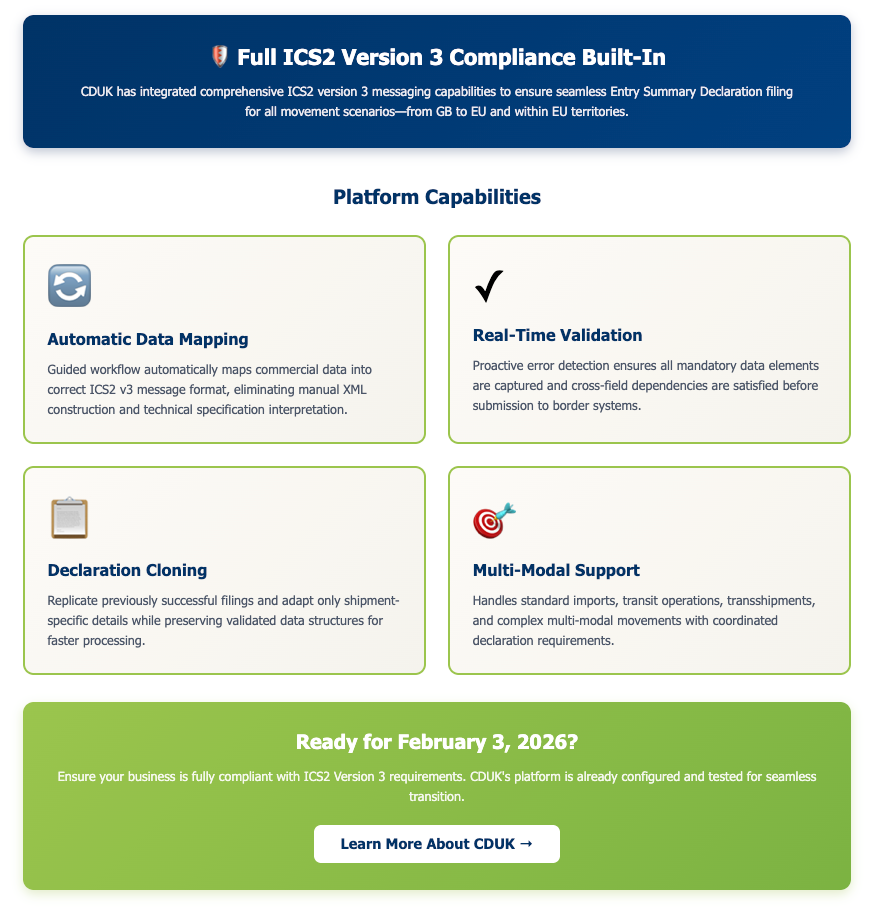
Customs Declarations UK has integrated full ICS2 version 3 messaging capabilities across its platform to ensure clients can file compliant Entry Summary Declarations for all movement types—whether goods are traveling from Great Britain to the European Union or moving between EU member states. The CDUK platform supports the complete spectrum of ENS filing scenarios.
The platform’s guided workflow automatically maps user-entered commercial data into the correct ICS2 version 3 message format, eliminating the need for declarants to manually interpret technical specifications or construct XML payloads. Real-time validation checks ensure that all mandatory data elements are captured, that value ranges conform to EU requirements, and that cross-field dependencies are satisfied before submission. This proactive error detection significantly reduces the risk of rejection at the point of transmission, allowing traders to resolve issues while goods are still in their control rather than discovering problems when vehicles are queued at the port.
Turning Compliance into Operational Advantage
The ICS2 version 3 mandate represents more than a regulatory obligation; it offers an opportunity to modernize customs filing workflows, eliminate inefficiencies, and establish a foundation for future EU trade requirements. Businesses that approach the transition strategically—by investing in capable platforms like Customs Declarations UK, training their teams thoroughly, and establishing robust data governance practices—will find themselves better positioned not only to meet the February 3 deadline but to handle subsequent regulatory changes with agility and confidence. Proactive compliance today reduces risk, protects cash flow, and ensures that cross-border supply chains continue to operate without disruption as European customs systems evolve.