The Import Control System 2 represents the most significant transformation of European customs border security in decades. For UK businesses exporting to the European Union, understanding this system is not merely helpful but essential for maintaining uninterrupted trade flows. As ICS2 Release 3 became fully operational on 1 September 2025 across all transport modes, the terminology and technical vocabulary surrounding this system has become the language of cross-border commerce. This comprehensive reference document provides UK traders, freight forwarders, hauliers, and customs professionals with an exhaustive guide to every abbreviation, acronym, and technical term they will encounter when navigating ICS2 compliance.
Understanding the ICS2 Framework
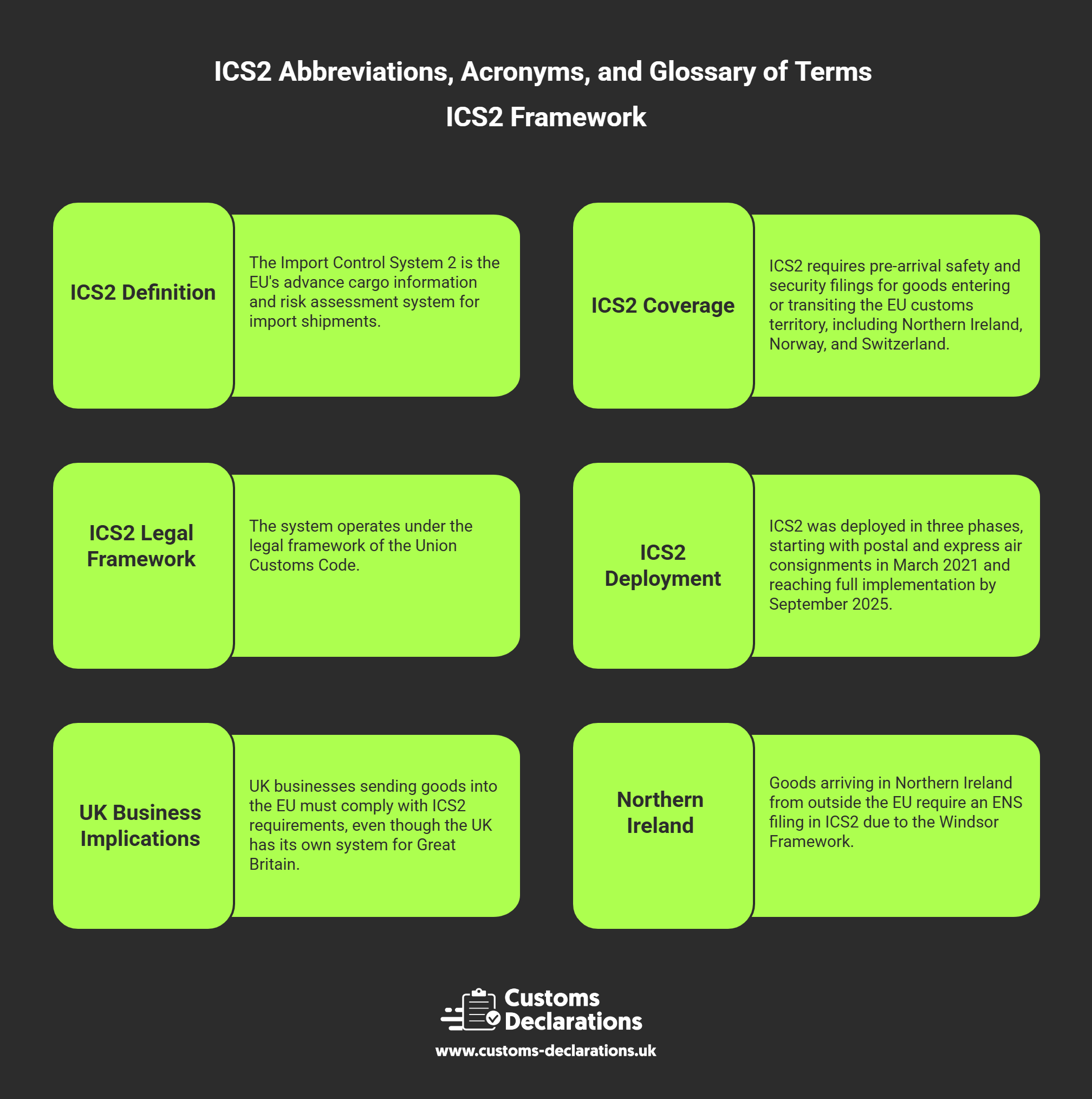
Before diving into specific terminology, it is important to understand what ICS2 represents in the broader context of EU-UK trade. The Import Control System 2 is the European Union’s advance cargo information and risk assessment system for import shipments. It replaces the older Import Control System (ICS1) and requires pre-arrival safety and security filings for all goods entering or transiting the EU customs territory, which includes Northern Ireland under the Windsor Framework arrangements, as well as Norway and Switzerland. The system operates under the legal framework of the Union Customs Code and was deployed in three phases: Release 1 for postal and express air consignments from March 2021, Release 2 for general aviation cargo from March 2023, and Release 3 for maritime, road, rail, and inland waterways from 2024 onwards with full implementation achieved by September 2025.
For UK businesses, this means that any goods sent into the European Union must comply with ICS2 requirements, even though the United Kingdom now operates its own separate Safety and Security system for Great Britain. The distinction is critical: ICS2 governs entry into the EU customs territory, while Safety and Security GB governs entry into Great Britain. Northern Ireland follows EU customs rules under the Windsor Framework, meaning goods arriving in Northern Ireland from outside the EU require an ENS filing in ICS2.
ICS2 Abbreviations and Acronyms
The following alphabetical listing provides comprehensive coverage of every significant abbreviation and acronym encountered in ICS2 documentation, technical specifications, and operational guidance.
AC (Assessment Complete) represents the positive outcome of ICS2 risk analysis. When customs authorities complete their security assessment and find no obstacles to the movement of goods, they issue an Assessment Complete notification. This effectively provides the green light for loading goods onto transport bound for the EU. However, it is essential to understand that Assessment Complete does not guarantee import clearance; it merely confirms that pre-loading or pre-arrival security screening has been satisfied. A second risk analysis occurs pre-arrival, which could still result in control recommendations upon arrival at the EU border.
AEO (Authorised Economic Operator) denotes a status granted by customs authorities to businesses that demonstrate high standards of security and compliance. AEO certification signals that a company’s supply chain is secure and compliant with customs requirements. While holding AEO status does not exempt operators from ICS2 filing requirements, AEO-certified traders may benefit from reduced risk scoring, meaning their shipments might face fewer interventions and inspections. The status comes in different categories, with AEO-S specifically relating to security and safety standards.
AMS (Addressed Member State) refers to the EU Member State declared in the Entry Summary Declaration as the expected point of entry for the goods. This is the country where the goods are anticipated to first enter EU customs territory. In situations where actual routing differs from planned routing due to operational changes, the AMS may differ from the actual country of entry, triggering specific ICS2 protocols for handling such diversions..
AN (Arrival Notification) is the notification submitted to customs authorities upon the physical arrival of goods at the EU border. This notification confirms that goods covered by an ENS have actually presented at the declared entry point, allowing customs to update the status of the consignment and proceed with any controls that may have been recommended during risk analysis.
BCP (Business Continuity Plan) relates to contingency arrangements that allow economic operators to continue submitting ENS declarations when their primary IT systems experience failures. The ICS2 framework includes provisions for business continuity, though it is important to note that activation of business continuity arrangements is not permitted simply because an operator is not ready to comply with ICS2 requirements.
BTI (Binding Tariff Information) while not exclusive to ICS2, this term refers to legally binding classification decisions issued by customs authorities. BTI rulings become relevant in ICS2 contexts because accurate commodity classification using Harmonised System codes is mandatory for ENS submissions. An incorrect HS code can trigger risk analysis flags or rejection of the declaration.
CFSS (Common Functional System Specifications) refers to the technical documentation produced by DG TAXUD that defines how the ICS2 system operates at a functional level. These specifications govern the business rules, data validation requirements, and processing logic applied to ENS submissions.
CIRCABC (Communication and Information Resource Centre for Administrations, Businesses and Citizens) is the EU platform where official ICS2 documentation, guidance, training materials, and the list of stop words are published. Economic operators seeking authoritative information about ICS2 requirements should consult the dedicated ICS2 group within CIRCABC.
COFE (Customs Office of First Entry) designates the customs office at the location where goods first enter EU customs territory. The COFE plays a central role in determining which Member State holds responsibility for risk analysis and any subsequent controls.
CR (Common Repository) is the central database and processing core of the ICS2 system. Once the Shared Trader Interface receives an ENS message, it is passed to the Common Repository for technical validation, storage, and distribution to Member State risk engines. The Common Repository manages the lifecycle state of every consignment, tracking declarations from received status through registration, risk analysis, control decisions, and arrival confirmation.
CRMF (Common Risk Management Framework) represents the EU-wide system for standardised risk assessment of consignments. This framework ensures that risk criteria are applied consistently across all Member States, preventing inconsistent treatment of similar risk indicators depending on the country of entry.
DA (Delegated Act) refers to secondary EU legislation that supplements the Union Customs Code. The UCC Delegated Act contains specific provisions relevant to ICS2, including detailed data requirements specified in Annex B.
DG TAXUD (Directorate-General for Taxation and Customs Union) is the department of the European Commission responsible for EU policies on taxation and customs. Within the ICS2 context, DG TAXUD acts as the system owner and architect of the Multi-Annual Strategic Plan for electronic customs. All authoritative technical specifications and guidance originate from this directorate.
DNL (Do Not Load) represents the most severe operational command in the ICS2 vocabulary. A Do Not Load message is a strict prohibition against loading goods onto the means of transport, issued when customs authorities identify a serious security threat. This directive typically applies during pre-loading screening for air cargo and indicates that intelligence suggests a severe risk such as explosives or prohibited items. Loading goods subject to a DNL notification constitutes a major violation of EU security law.
DUCR (Declaration Unique Consignment Reference) is a unique reference number assigned to customs declarations that allows tracking and cross-referencing of related filings. While primarily associated with import declarations, DUCRs may be referenced in ICS2 submissions when coordinating between ENS filings and subsequent customs clearance.
ELO (Enveloppe Logistique Obligatoire) is a French system that groups multiple customs declarations under a single barcode to improve border security and reduce waiting times at the Brexit Smart Border. While separate from ICS2, ELO interacts with ICS2 compliance for UK-France corridor movements and is expected to become mandatory from January 2026.
ENS (Entry Summary Declaration) is the electronic safety and security declaration that must be lodged for all goods entering or transiting the EU customs territory before arrival. The ENS is the fundamental data unit of ICS2, containing advance cargo information including consignor and consignee details, goods descriptions with HS codes, quantities, weights, and routing information. This declaration enables customs authorities to perform risk analysis and identify high-risk consignments prior to border crossing. The ENS is strictly a security declaration, distinct from the customs import declaration used for fiscal clearance.
EO (Economic Operator) refers to any business or individual engaging in activities covered by customs legislation, including importers, exporters, carriers, freight forwarders, and logistics providers. Economic operators must be registered and identified by an EORI number to interact with ICS2 and other customs systems.
EORI (Economic Operators Registration and Identification) is the unique registration identifier assigned to businesses for customs interactions. An EORI number is mandatory for filing ENS declarations in ICS2. Following Brexit, UK companies require an EU-issued EORI number to lodge filings in ICS2, which is distinct from the GB EORI number used for dealings with UK customs. For Northern Ireland, the XI prefix is used for EORI numbers.
EUCTP (EU Customs Trader Portal) is the online portal through which traders can interact with customs systems like ICS2. Also referred to as the Shared Trader Portal, this web interface allows users to manually submit ENS filings, check declaration statuses, and manage their ICS2 accounts.
GVMS (Goods Vehicle Movement Service) is the UK’s IT platform for managing the movement of goods through ports using the common transit procedure. While separate from ICS2, GVMS interactions become relevant for UK traders because movements through UK ports may require coordination between UK systems and EU ICS2 requirements.
GMR (Goods Movement Reference) is the reference number generated within GVMS that links together declarations associated with a vehicle movement. For UK-EU trade, operators must manage both GMR references for UK systems and MRN references for ICS2 compliance.
HBL (House Bill of Lading) is the transport document issued by freight forwarders for consolidated shipments. In ICS2 Multiple Filing scenarios, house-level data linked to house bills is filed separately from master-level data, with the HBL number serving as a key linking reference.
HRCM (High Risk Cargo and Mail) is a status applied to goods that fit a high-risk profile during ICS2 risk analysis. Consignments flagged as HRCM require physical security screening using high-standard methods before loading can proceed.
HS (Harmonised System) refers to the international nomenclature for classifying traded goods. ICS2 requires a minimum six-digit HS code for each item declared in an ENS, enabling consistent risk assessment based on the nature of goods being transported.
HTI (Harmonised Trader Interface) refers to the technical specifications defining the structure and content of messages exchanged between economic operators and the Shared Trader Interface. HTI documentation includes XML Schema Definitions and service specifications that software systems must comply with to successfully connect to ICS2.
IA (Implementing Act) refers to secondary EU legislation that implements the Union Customs Code. The UCC Implementing Act contains procedural details and technical requirements relevant to ICS2 operations.
ICS1 (Import Control System 1) was the EU’s original import security filing system, now being phased out and replaced by ICS2. Under ICS1, entry summary declarations were handled by individual Member States’ systems with less stringent data requirements. From September 2025, ICS1 is being fully replaced by ICS2.
ICS2 (Import Control System 2) is the EU’s modern, unified system for pre-arrival customs safety and security declarations. Implemented across the EU, Switzerland, Norway, and Northern Ireland, ICS2 mandates submission of Entry Summary Declarations for all goods destined for or transiting the EU customs territory before loading or arrival. The system operates via a centralised platform and was deployed in three releases covering all transport modes.
IED (Improvised Explosive Device) and IID (Improvised Incendiary Device) are threat categories specifically targeted by pre-loading screening under ICS2 air cargo provisions. PLACI filings are designed to enable early detection of these immediate aviation security threats.
IMS (Involved Member State) refers to any Member State with an interest in a consignment, typically because it is the destination country or a transit country. The ICS2 architecture allows involved Member States to view declaration data and input their own risk markers into the common analysis.
ITSP (IT Service Provider) refers to third-party software providers or customs brokers offering ICS2 filing services on behalf of traders. Many companies choose to use an ITSP to submit ENS filings rather than developing their own technical interface.
LRN (Local Reference Number) is the internal reference code generated by the trader’s software for each ENS submission. The LRN must be unique within the trader’s system and is used to track the filing before customs authority acceptance. Customs refer to the ENS by its LRN in any queries or responses until an official Movement Reference Number is issued.
MASP (Multi-Annual Strategic Plan) refers to the EU’s strategic planning framework for electronic customs systems, under which ICS2 has been developed and deployed.
MBL (Master Bill of Lading) is the transport document issued by carriers for overall consignments. In ICS2 Multiple Filing scenarios, master-level data linked to master bills is filed by carriers, while house-level data is filed separately by forwarders.
MRN (Movement Reference Number) is the official receipt number generated by ICS2 upon successful validation of an ENS filing. The MRN serves as proof of filing and is required for goods to proceed through border controls. In road transport, drivers must present the MRN, often linked to vehicle registration plates, to cross the border.
MS (Member State) refers to the 27 countries of the European Union. In ICS2, Member States serve as the operational enforcement arm, making decisions about inspections and controls based on centralised risk analysis.
NCTS (New Computerised Transit System) is the EU’s system for managing transit movements of goods. NCTS Phase 6 introduced integration capabilities with ICS2, allowing some Member States to accept ENS data within transit declarations rather than requiring separate ICS2 filings.
NSD (National Service Desk) refers to the customs authority contact point in each EU Member State where economic operators can request deployment windows or obtain support for ICS2 onboarding.
PLACI (Pre-Loading Advance Cargo Information) is the minimal dataset required prior to loading for air cargo and mail shipments. Under ICS2 air freight rules, certain minimum information must be filed as PLACI to enable initial risk screening before aircraft loading. This filing enables early detection of immediate aviation security threats such as explosives.
RA (Risk Analysis) refers to the automated and manual process where ENS data is screened against Common Risk Criteria. Electronic risk analysis provides the initial automated assessment, with manual intervention occurring when potential matches are flagged for human analyst review.
RFI (Request for Information) is a referral asking for additional data when risk analysts identify ambiguities in ENS submissions. Traders must respond digitally with requested documentation such as commercial invoices or material safety data sheets.
RFS (Request for Screening) is a command to perform physical security screening on consignments. When issued, the carrier must screen goods using high-standard methods and confirm screening results to customs before Assessment Complete status can be granted.
RMS (Responsible Member State) is the EU Member State holding legal responsibility for performing security risk assessment on a consignment. Typically, the RMS is the country where the Customs Office of First Entry is located. The RMS coordinates risk results and issues official notifications to traders.
S&S GB (Safety and Security Great Britain) is the UK’s safety and security declaration system for imports into Great Britain. This system is distinct from ICS2 and covers goods arriving in England, Scotland, and Wales. Northern Ireland follows EU ICS2 requirements rather than S&S GB.
STI (Shared Trader Interface) is the EU’s system-to-system gateway for ICS2, providing the centralised electronic filing interface that all Member States share. Traders or their IT providers can lodge ENS data via API or messaging integration through the STI using the AS4 secure messaging protocol.
STP (Shared Trader Portal) is the online web portal component of ICS2 where traders can log in and manually submit or view ENS filings. The portal provides a user-friendly graphical interface for those without automated system connections.
TAPAS (TAXUD AS4 Access Point) is the specific software implementation of the AS4 access point used by DG TAXUD. When configuring system-to-system connections, traders effectively configure their systems to communicate with TAPAS.
TSS (Trader Support Service) is a free UK Government-supported service helping traders with customs formalities for moving goods between Great Britain and Northern Ireland. The TSS can handle ENS filings into Northern Ireland via ICS2 on behalf of registered traders.
UCC (Union Customs Code) is the overarching EU customs law framework that came into force in 2016, modernising customs processes across Member States. ICS2 is the technological implementation of UCC Article 127, which mandates entry summary declarations for goods entering EU customs territory.
UUM&DS (Uniform User Management and Digital Signatures) is the EU’s centralised authentication system for customs systems access. Traders connecting to ICS2 must authenticate through UUM&DS to obtain credentials and certificates for the EU Customs Trader Portal and Interface.
ICS2 Glossary of Terms
Beyond abbreviations, ICS2 introduces numerous technical terms and operational concepts that require clear definition for effective compliance.
Advance Cargo Information refers to the electronic data submitted before goods arrival for security risk assessment. This information forms the core of ICS2 via the Entry Summary Declaration and enables customs authorities to identify potential threats before goods reach the border.
Assessment Complete is the positive outcome notification indicating that ICS2 risk analysis has finished without identifying obstacles to loading or entry. While this allows goods to proceed, it does not guarantee subsequent import clearance.
Conformance Testing is the mandatory preparatory step for economic operators or IT providers planning to interface directly with ICS2 systems. Before sending live ENS filings via the Shared Trader Interface, users must successfully complete a series of tests in a sandbox environment demonstrating that their messages meet ICS2 specifications.
Consignee is the party receiving goods, whose full address, postal code, and EORI number are typically required in ENS submissions, particularly for EU-established entities.
Consignor is the party sending goods, whose details are required in ENS submissions for traceability purposes.
Declarant is the party responsible for lodging the ENS, who must use their EORI number for identification. The declarant may be a carrier, forwarder, or other economic operator depending on the filing arrangement.
Deployment Window is the transitional period granted by national customs authorities for economic operators to connect to ICS2. Operators who were not ready by mandatory implementation dates were required to request deployment windows from their National Service Desk.
Diversion Notification is the ICS2 protocol for handling situations where goods enter EU customs territory through a different location than declared in the original ENS. This notification hands over responsibility from the addressed Member State to the actual Member State of arrival.
Do Not Load Message is the customs instruction preventing high-risk goods from being loaded onto transport bound for the EU. This represents the most severe outcome of pre-loading risk analysis.
Goods Description refers to the detailed commercial description required in ENS submissions. Descriptions must be specific and accurate, avoiding vague terms that would prevent meaningful risk assessment.
House-Level Filing is the partial ENS submitted by freight forwarders or logistics providers containing detailed information on individual consignments consolidated under a master bill. House-level filings include the actual buyer and seller details, specific goods descriptions, and consignment-specific data.
Master-Level Filing is the partial ENS submitted by carriers containing overall transport details for a vessel, aircraft, or vehicle movement. Master-level filings include transport information, master bill references, and identification of house filers responsible for consignment-level data.
Minimum Dataset refers to the reduced data elements required for PLACI submissions in air cargo contexts, enabling early risk screening based on essential information before full ENS data is available.
Multiple Filing is the mechanism allowing different parties in the supply chain to file their specific data subsets separately, which the system then links together into a complete ENS. This approach recognises that carriers often do not possess detailed commercial information about consolidated consignments, which is held by freight forwarders. Multiple filing preserves commercial confidentiality while distributing filing responsibility appropriately.
Partial ENS refers to an incomplete declaration focusing on specific levels, either master or house. Multiple partial filings combine in the Common Repository to form a complete ENS satisfying all regulatory requirements.
Pre-Arrival is the phase before goods reach EU customs territory when comprehensive risk analysis occurs on full ENS data. Pre-arrival filings must be submitted within specified timeframes depending on transport mode.
Pre-Loading is the phase before loading onto outbound transport, critical for air and express shipments. Pre-loading screening enables early detection of immediate security threats before goods are loaded onto aircraft.
Referral is a customs request for additional information or action on a consignment due to identified risks during ENS analysis.
Risk Analysis is the automated and manual assessment process using ENS data to identify security threats, prohibited goods, or other risks requiring intervention.
Single Filing is the traditional approach where one party submits a complete ENS containing all required data elements, as opposed to multiple filing where data is distributed across several partial submissions.
Stop Words are vague or generic terms prohibited in ENS goods descriptions that would prevent meaningful risk assessment. Terms such as “unknown,” “various,” “miscellaneous,” “parts,” “samples,” and “consolidated cargo” trigger validation errors. The ICS2 system maintains a library of stop words that declarants must avoid to ensure data quality.
Structured Address is the preferred address format in ICS2 submissions, requiring separate fields for street name, building number, city, postal code, and country code. Unstructured addresses are being deprecated in favour of this more precise format.
Technical Rejection occurs when an ENS submission fails schema validation due to incorrect data formatting, missing mandatory fields, or invalid values. Technical rejections require correction and resubmission with a new Local Reference Number.
ICS2 Message Types
The ICS2 system communicates through a standardised catalogue of messages in the IE3 series. Understanding these message types is essential for IT teams and compliance managers implementing ICS2 solutions.
Filing messages convey ENS data from traders to the system. The IE3F10 message is used for maritime full ENS submissions when one party holds all required data. The IE3F12 message is the standard carrier filing for maritime master-level data. The IE3F14 message is the standard forwarder filing for maritime house-level data. The IE3F20 through IE3F22 messages handle air cargo PLACI submissions. The IE3F40 message is the standard filing for road transport. The IE3F50 message provides simplified single filing for accompanied road transport, critical for Roll-on/Roll-off operations. The IE3F51 message handles rail transport filings.
Notification messages convey feedback from the system to traders. The IE3N01 message indicates validation errors requiring correction and resubmission. The IE3N02 message indicates ENS not complete status, typically when expected house filings have not been received. The IE3N03 message confirms Assessment Complete status. The IE3N04 message conveys Request for Information from customs. The IE3N05 message conveys screening requests for high-risk cargo. The IE3N08 message indicates control notification for inspection upon arrival.
Amendment messages allow traders to correct previously submitted data. In ICS2, amendments require submission of the complete dataset again with corrected values rather than differential changes. Amendments are restricted after goods have arrived or after control notifications have been issued.
Transport Mode Requirements
ICS2 requirements vary by transport mode, with specific filing timelines and data elements applicable to each.
For air transport, PLACI minimum data must be submitted before loading at the airport of departure, with full ENS data submitted prior to arrival. Filing deadlines typically require submission at least four hours before arrival. Air cargo requirements were fully implemented under Release 2 from March 2023.
For maritime and inland waterway transport, ENS must be submitted 24 hours before loading for containerised cargo. Multiple filing arrangements typically involve carriers filing master-level data while forwarders file house-level data. Maritime requirements were deployed under Release 3 from 2024.
For road transport, full ENS must be submitted before arrival, with shorter timelines applicable for cross-Channel movements. Release 3 requirements became mandatory from September 2025, though some Member States obtained derogations extending transition periods.
For rail transport, full ENS requirements mirror those for road, with Release 3 implementation completing in 2025. Integration with NCTS Phase 6 provides some Member States with the option of combined transit and ENS filings.
Northern Ireland Considerations
Northern Ireland occupies a unique position under the Windsor Framework, following EU customs rules while remaining part of the UK. Goods arriving in Northern Ireland from outside the EU require ENS filing in ICS2. Goods moving from Great Britain to Northern Ireland often require ENS filings, though facilitations exist for certain movements under the Green Lane scheme. The Trader Support Service provides assistance for businesses managing these requirements, submitting ICS2 ENS declarations on behalf of registered traders.
Filing ICS2 Declarations with Customs Declarations UK
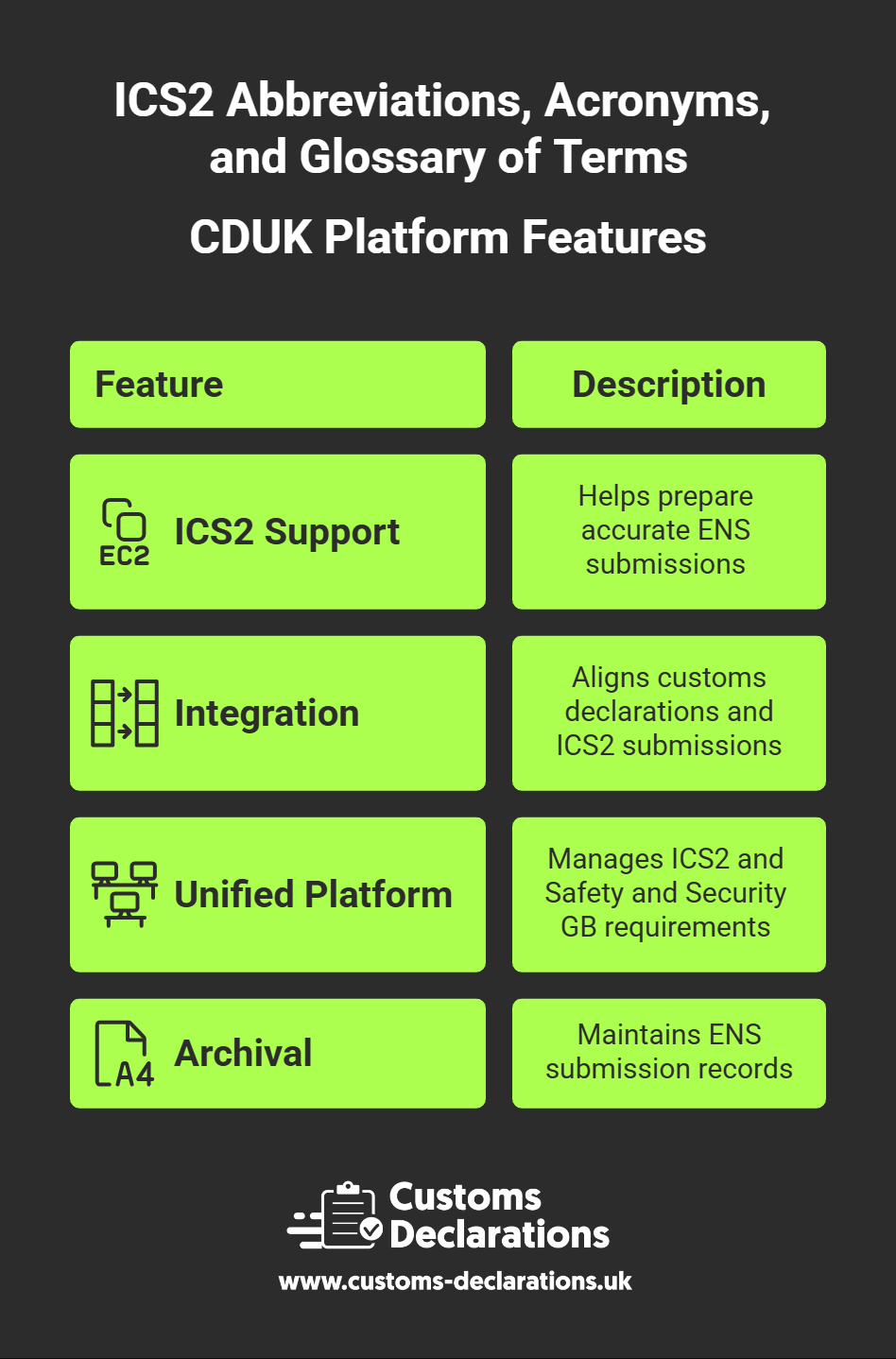
The Customs Declarations UK platform provides comprehensive support for businesses navigating ICS2 requirements alongside their broader customs compliance obligations. Through wizard-based workflows and real-time validation, CDUK helps traders prepare accurate ENS submissions that meet ICS2 data quality standards. The platform’s integration with carrier safety and security filings ensures alignment between customs declarations and ICS2 submissions, preventing the mismatches that commonly cause border delays.
For businesses managing goods movements into both the EU and Great Britain, CDUK provides a unified platform for both ICS2 and Safety and Security GB requirements, streamlining compliance across multiple regulatory regimes. The platform’s archival capabilities ensure that ENS submission records are maintained for the statutory retention period, supporting audit readiness and regulatory inquiries.
Conclusion
The vocabulary of ICS2 represents more than technical jargon; it is the operational language of EU-bound trade. Mastery of these abbreviations, acronyms, and terms enables UK traders and customs professionals to navigate compliance requirements confidently, communicate effectively with customs authorities and supply chain partners, and implement systems and processes that satisfy regulatory expectations.
As ICS2 continues to evolve, with multiple filing capabilities extending across all transport modes and ongoing technical updates to message specifications, staying current with ICS2 terminology and requirements is essential for maintaining competitive cross-border operations. The investment in understanding this system pays dividends through smoother border crossings, fewer delays, and reduced compliance risks.