What UK–EU RoRo operators must do now. From 20 April 2026, every truck crossing the French Smart Border with the United Kingdom — whether loaded or empty, in either direction — must present a single barcode known as the Obligatory Logistics Envelope (ELO). Operators who arrive without a valid, closed ELO risk being directed to the orange lane for physical customs checks.
What the ELO Is and Why France Has Introduced It
The Obligatory Logistics Envelope is a digital aggregation tool developed by the French Directorate General of Customs and Indirect Taxes (DGDDI) as part of the French Smart Border regime governing UK–EU freight movements. Its purpose is straightforward: to consolidate under a single reference all of the declarative formalities that apply to a given transport unit crossing the border between France and the United Kingdom. Rather than relying on individual document checks at multiple points, French Customs can scan one barcode and verify in real time that every required declaration is in place, correctly filed, and in good standing.
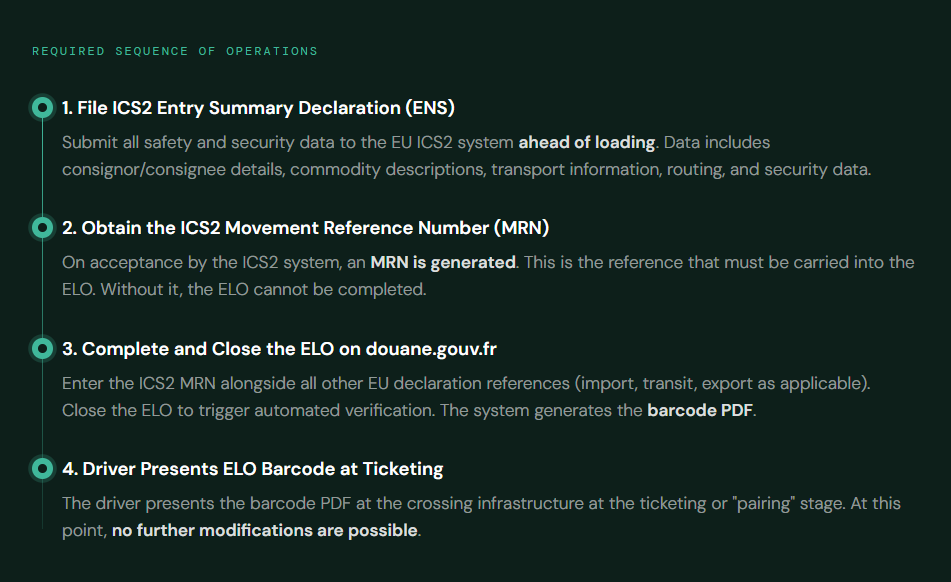
The ELO is accessed and created through a nominative account on douane.gouv.fr, the French Customs portal. It is available free of charge. Once created, the ELO is closed by the operator after all relevant declaration references have been entered; this triggers automated verification of the status of each declaration. The system then generates a PDF document bearing the ELO barcode, which the driver presents at the crossing infrastructure at the ticketing or “pairing” stage.
The Declarations That Must Go Into an ELO
When a truck is loaded, the ELO must group all the EU-side formalities necessary for crossing the Smart Border. For goods moving in the UK-to-EU direction, this includes EU import declarations, transit declarations, export declarations, and — of central importance to those operating in the UK customs space — the ENS filed via ICS2 along with its Movement Reference Number.
UK formalities — specifically the Goods Movement Reference (GMR) generated under the UK’s GVMS system — are not included in the ELO. Those remain a separate UK obligation. The ELO is purely an EU-side instrument.
Who Needs to Act and What Roles Are Involved
The question of who creates the ELO is deliberately flexible. French Customs specifies that any actor within the logistics chain with the capacity to centralise all the necessary information for the border crossing may create an ELO. This can change from crossing to crossing. In practice, the responsibility will typically fall to one of the following parties:
The ICS2 ENS: The Filing That Unlocks the ELO
For many UK-based and EU-based operators moving goods by road through French Channel ports, the ICS2 ENS MRN is the filing that connects the entire chain. The ENS must be submitted to the EU’s ICS2 system ahead of the goods being loaded, generating an MRN that confirms the safety and security data has been received and accepted by EU customs. That MRN is then entered into the ELO alongside the other relevant EU customs declaration references.
Practical Steps Before 20 April 2026
Operators approaching this deadline should work through a structured preparation checklist. The priority actions are as follows:
- Establish ICS2 ENS filing capability immediately if declarations are not already being submitted for UK-to-EU truck movements. This is the single most urgent action for non-compliant operators.
- Review your current ENS process — if it is manual or inconsistent, confirm whether it can reliably generate MRNs in time for ELOs to be completed before vehicles depart for port.
- Clarify responsibility across your logistics chain — hauliers, freight forwarders, exporters, and customs agents must each understand who is responsible for creating the ELO for each crossing.
- Establish a clear MRN communication protocol — declaration references must reach the ELO creator before the scheduled vehicle departure, not at the port.
- Register on douane.gouv.fr if accounts do not yet exist. The ELO application is free. Operators with SIRET or SIREN numbers may associate those with their account.
The ICS2 ENS Filing Capability That Unlocks ELO Compliance
The Customs Declarations UK platform provides a dedicated ICS2 ENS service that enables freight forwarders, hauliers, transport companies, customs agents, and exporters to prepare and submit ENS declarations to the EU’s ICS2 system through an intuitive, guided filing workflow. The platform generates the MRN on acceptance, providing the exact reference that must be carried into the ELO.
Through CDUK’s plain-English, wizard-based workflow, operators can enter all required data elements — consignor and consignee details, commodity descriptions, transport information, routing, and safety and security data — and submit directly to the ICS2 system. Real-time validation checks identify any missing or inconsistent data before submission, reducing the risk of rejections and the delays that follow. CDUK also archives all submission data for the statutory retention period, providing an audit-ready record for any subsequent compliance review.
Conclusion: A Convergence of EU Compliance Requirements
The ELO’s mandatory enforcement from 20 April 2026 represents the convergence of several EU compliance developments that have been developing across the post-Brexit period. ICS2 has been progressively rolling out across transport modes; the French Smart Border has been operating since Brexit; and the ELO itself has been available in voluntary form for nearly a year. What changes on 20 April is that all of these elements become simultaneously required and simultaneously verified at the point of crossing.
For operators who are already filing ICS2 ENS declarations accurately and in good time, and whose EU customs declaration obligations are being managed compliantly, the ELO adds a co-ordination step rather than a substantive new burden. For those who have not yet established compliant ICS2 ENS filing, the deadline is the prompt to act without further delay.