What the DTA covers—and why it matters for customs operations
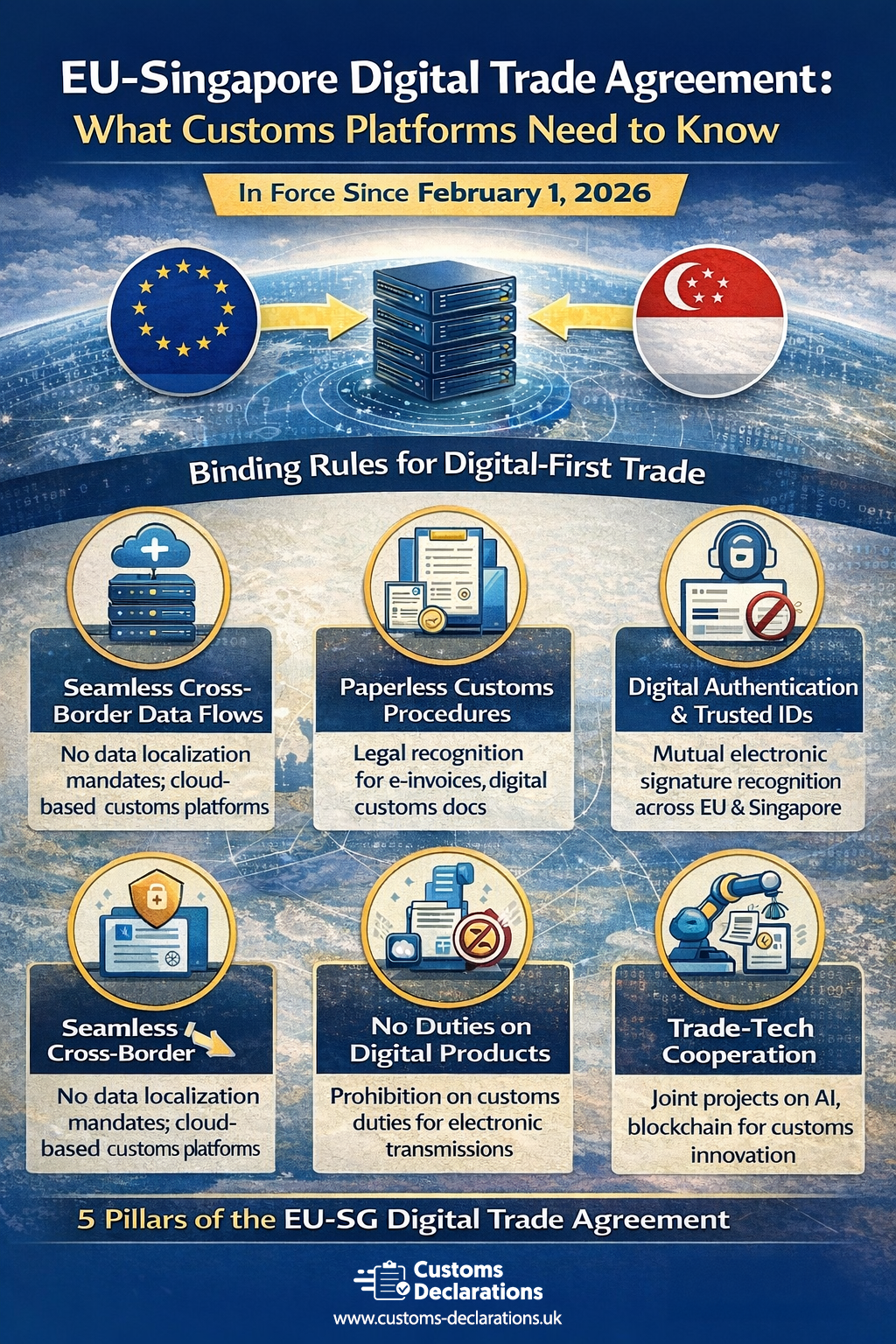
The agreement addresses five core pillars that intersect directly with customs and border management:
Cross-border data flows and localization restrictions. The DTA prohibits mandatory data localization requirements, allowing companies to transfer commercial data across borders without being forced to maintain servers or processing infrastructure in-country. For customs platforms and trade-tech providers, this means declaration data, shipment records, compliance documentation, and audit trails can be stored and processed in centralized cloud environments spanning EU and Singaporean jurisdictions—reducing infrastructure duplication and enabling unified data governance models.
Electronic invoicing and customs documentation. Both parties commit to recognizing electronic invoices, bills of lading, certificates of origin, and customs declarations as legally equivalent to paper originals. This accelerates the shift toward fully digital customs workflows where commercial documents are generated, transmitted, validated, and archived without any paper fallback. Customs authorities in EU member states and Singapore are expected to align their acceptance criteria for digital documents, reducing friction when traders present electronic evidence during clearance or post-clearance audits.
Digital authentication and trusted identities. The DTA encourages mutual recognition of electronic authentication mechanisms, including digital signatures, electronic seals, and trusted third-party identity verification. In practical terms, this means a company authenticated through Singapore’s national digital identity framework could use that credential to interact with EU customs portals, reducing the need for duplicate registrations or separate authentication layers across jurisdictions.
Prohibition on customs duties on electronic transmissions. The agreement formalizes the commitment not to impose customs duties on digital products delivered electronically—software downloads, streaming services, cloud-based applications, and data transfers. While this provision primarily affects digital goods rather than physical shipments, it reinforces the principle that digital services supporting trade (such as customs platform subscriptions, API access, or electronic document services) should remain duty-free, lowering compliance costs for tech-enabled logistics providers.
Cooperation on emerging trade-tech standards. The DTA establishes a framework for regulatory dialogue on artificial intelligence in trade, blockchain-based supply chain tracking, automated risk assessment, and standards for digital trade documents. As customs authorities and private platforms experiment with AI-assisted classification, automated origin verification, and smart-contract-driven transit procedures, the agreement provides a structured channel for aligning approaches and piloting cross-border interoperability projects.