HMRC has updated its guidance on amending and cancelling Customs Declaration Service (CDS) import declarations. The headline shift is procedural rather than substantive: businesses requesting “other amendments” to a cleared declaration must now use an online notification form rather than emailing HMRC directly. A second, smaller clarification confirms exactly what businesses must submit when asking HMRC to withdraw a declaration that has already cleared. Neither change alters the underlying time limits or eligibility rules for amendments, but both affect the practical steps a declarant or their agent needs to follow — and getting the wrong route wrong can add unnecessary delay to what should be a routine correction.
The Two Amendment Regimes: Before and After Clearance
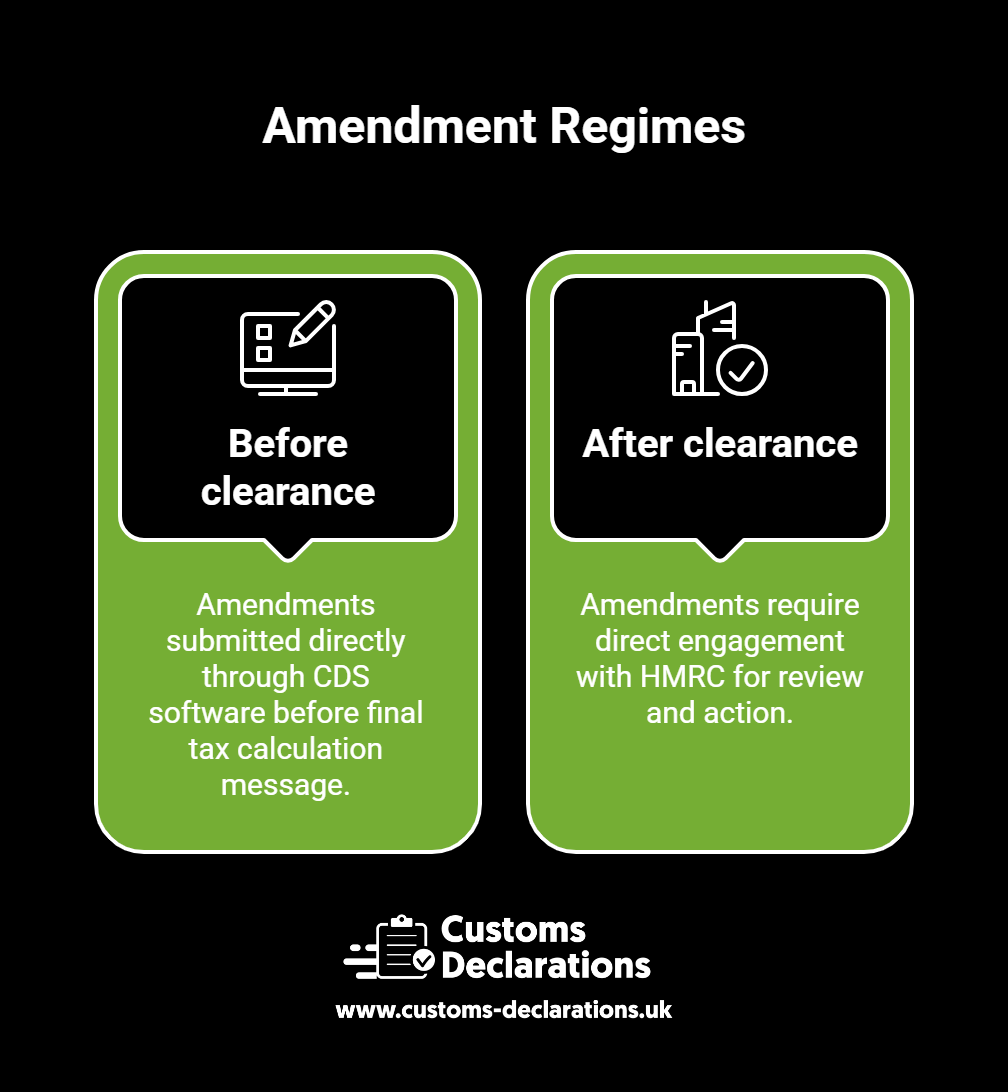
CDS treats amendments differently depending on whether a declaration has already cleared, and this distinction remains the foundation of the whole process.
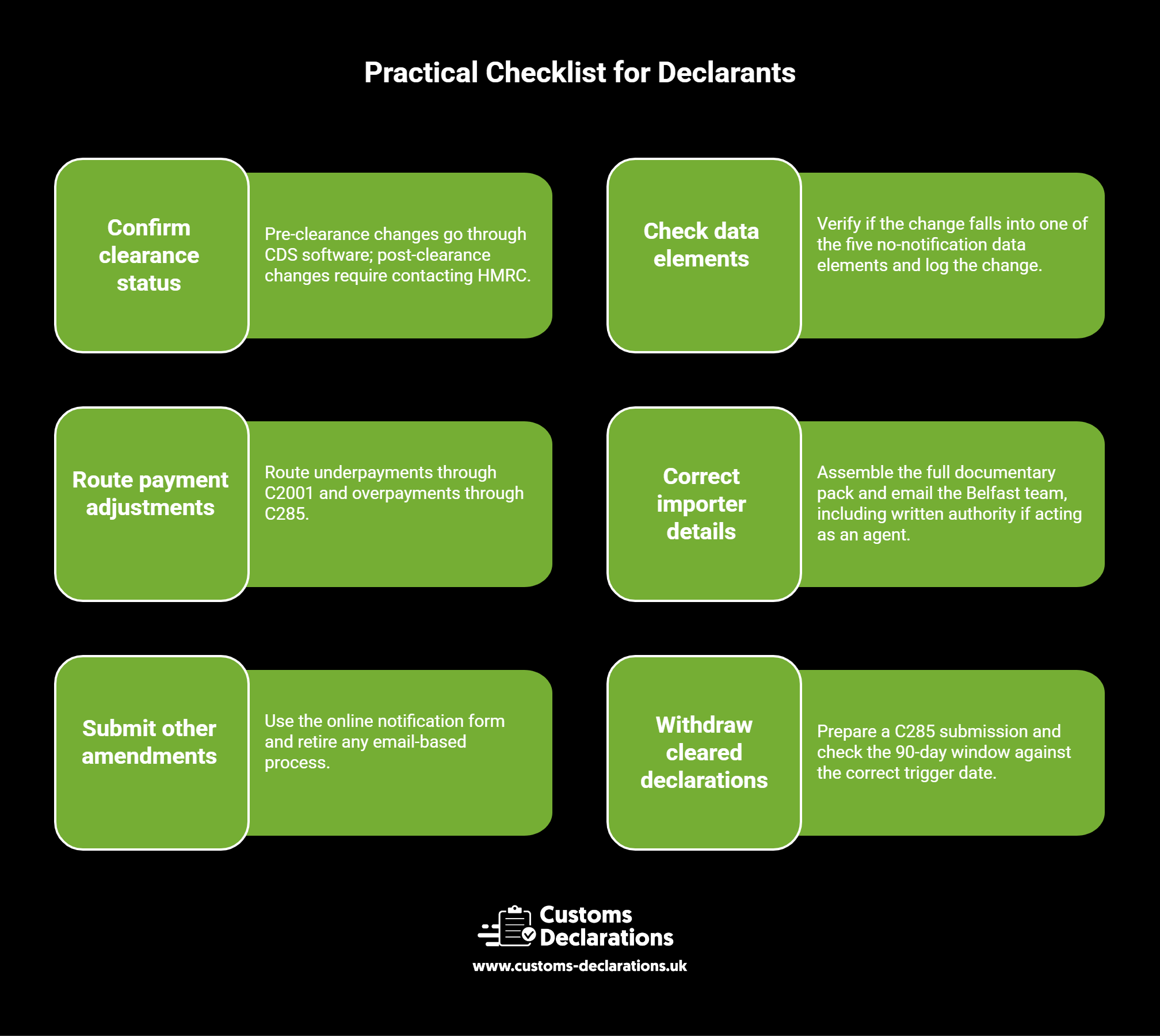
Before clearance — specifically, before the final tax calculation message has been issued — amendments can be submitted directly through CDS software without contacting HMRC at all. This window can extend beyond the point of arrival in certain circumstances: where a tariff quota claim is involved, the tax calculation remains provisional until the quota’s dwell time ends, and where a cash account balance is insufficient to cover the customs debt, an alert is issued to allow the discrepancy to be resolved. If an amendment submission returns an error, the declarant has two options — submit a corrected amendment, or submit a “nil changes” amendment that pauses the declaration until the underlying error is fixed. If an amendment genuinely cannot be made through software, the declaration can instead be cancelled and resubmitted, but only while it remains unclear.
Once a declaration has cleared, the position changes fundamentally. It can still be viewed in CDS software, but it can no longer be amended or cancelled there — any change requires direct engagement with HMRC, and HMRC will review the request before acting on it. The time limits here are firm: businesses have up to three years to request an amendment from whichever is earliest of the declaration’s acceptance or the application of a control to the goods, and up to 90 days to request a cancellation measured from the same reference point.
Amendments You Don’t Need to Tell HMRC About
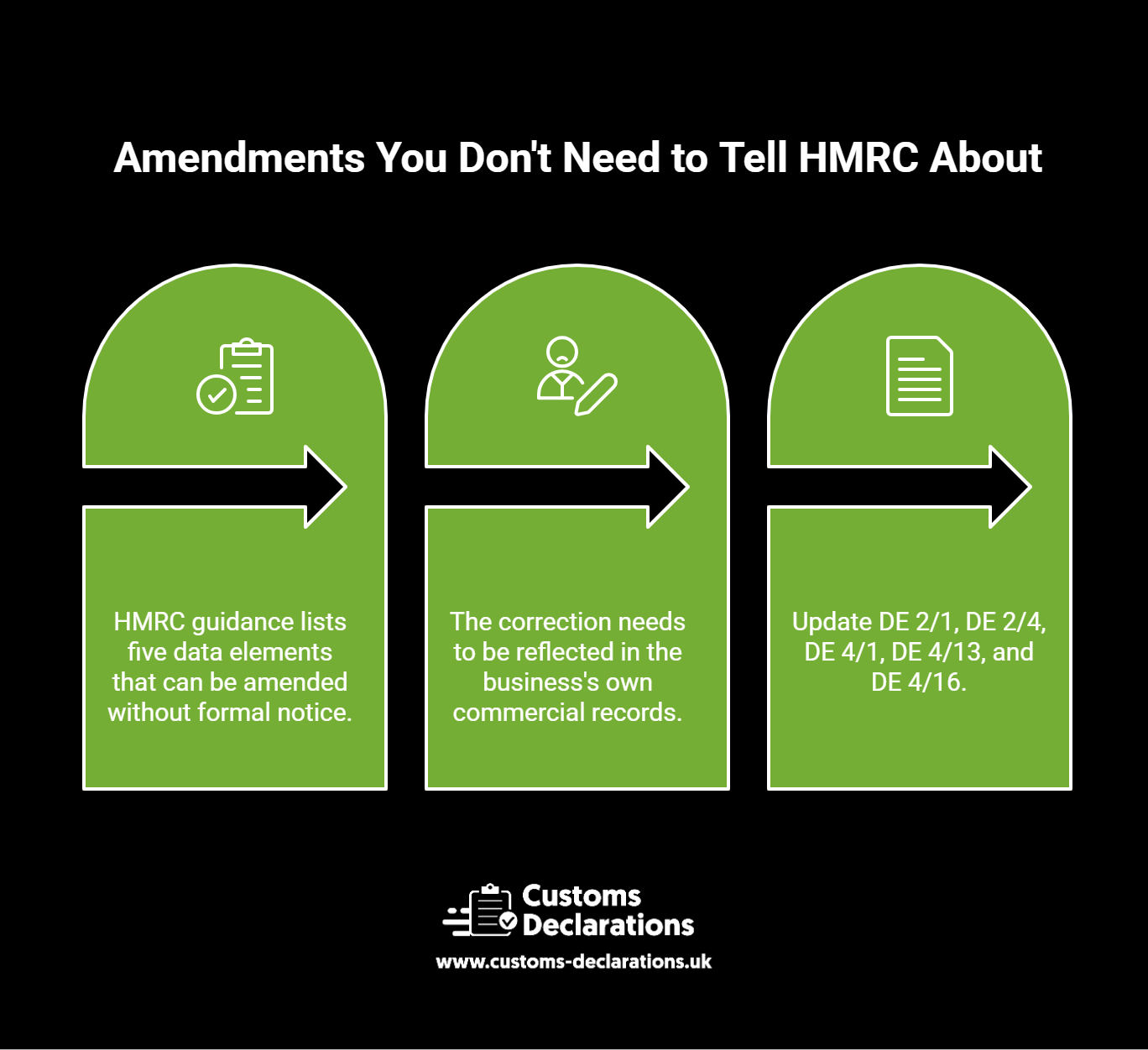
Not every post-clearance change requires notification. HMRC’s guidance lists five data elements that can be amended without formal notice, on the basis that the correction simply needs to be reflected in the business’s own commercial records: DE 2/1 (simplified declaration — previous documents), DE 2/4 (reference number), DE 4/1 (delivery terms), DE 4/13 (valuation indicator), and DE 4/16 (valuation method). This is a narrow list, and it’s worth building into internal checklists so that teams aren’t routing low-stakes corrections through a formal HMRC process unnecessarily — while making sure the record of the change is properly retained in case of a later audit.
Choosing the Right Notification Route
For everything else, the correct channel depends on what kind of amendment is being made, and this is where the recent changes bite.
Where an amendment results in an underpayment, the business must apply for a voluntary clearance amendment using form C2001. Where it results in an overpayment, the route is a repayment claim under form C285. Neither of these routes has changed.
Amendments to importer details follow a distinct, more document-heavy process. Because importer details in data elements 3/15 and 3/16 cannot normally be changed post-clearance unless they were genuinely incorrect, any such correction must be emailed to HMRC’s Belfast post-clearance team at [email protected], and the email must include the movement reference number or entry number, the new importer’s name and address, the new importer’s EORI number (or “GBPR” if the new importer is a private individual, or “No GBEORI held” if the business holds no GB-prefixed EORI), evidence of empowerment for the creation of the original declaration, an explanation of the error and why it occurred, and the commercial invoice. Where someone other than the original declarant — a tax agent, for instance — submits the request, written authority from the person who lodged the original declaration must also be provided.
Bulk amendments, where a high volume of declarations need to move from one importer’s EORI number to another, also go through the same Belfast mailbox: the business emails with “Bulk amendment enquiry” in the subject line and receives a reply setting out what further detail is required.
That leaves everything HMRC categorises as an “other amendment” — the general catch-all for post-clearance changes that don’t fall into the underpayment, overpayment, importer-detail, or bulk categories. This is precisely the route that changed on 16 June 2026. Previously handled by email, these notifications must now be submitted through an online notification form on GOV.UK, where the business must provide the name of the business making the amendment, the requester’s name, the date the original declaration was submitted on CDS, and a description of the amendment being requested. Businesses and agents who have built internal procedures — or automated correspondence templates — around emailing HMRC for these amendments will need to update them; email submissions for this category are no longer the correct channel.
Cancelling a Declaration Before Clearance
Cancellation requests can be submitted directly through CDS software provided the declaration has not yet cleared and has not yet arrived. Once goods have arrived and are under customs control, the decision to accept a cancellation request passes to the relevant customs authority — HMRC, Border Force, or Trading Standards, depending on which is exercising control. When that control is finalised and the declarant receives a final provisional tax notification or an insufficient balance message, the cancellation request is accepted automatically. As with amendments, if a declaration is showing an error following a prior amendment submission, that error must be resolved before a cancellation can proceed.
Requesting a Withdrawal After Clearance
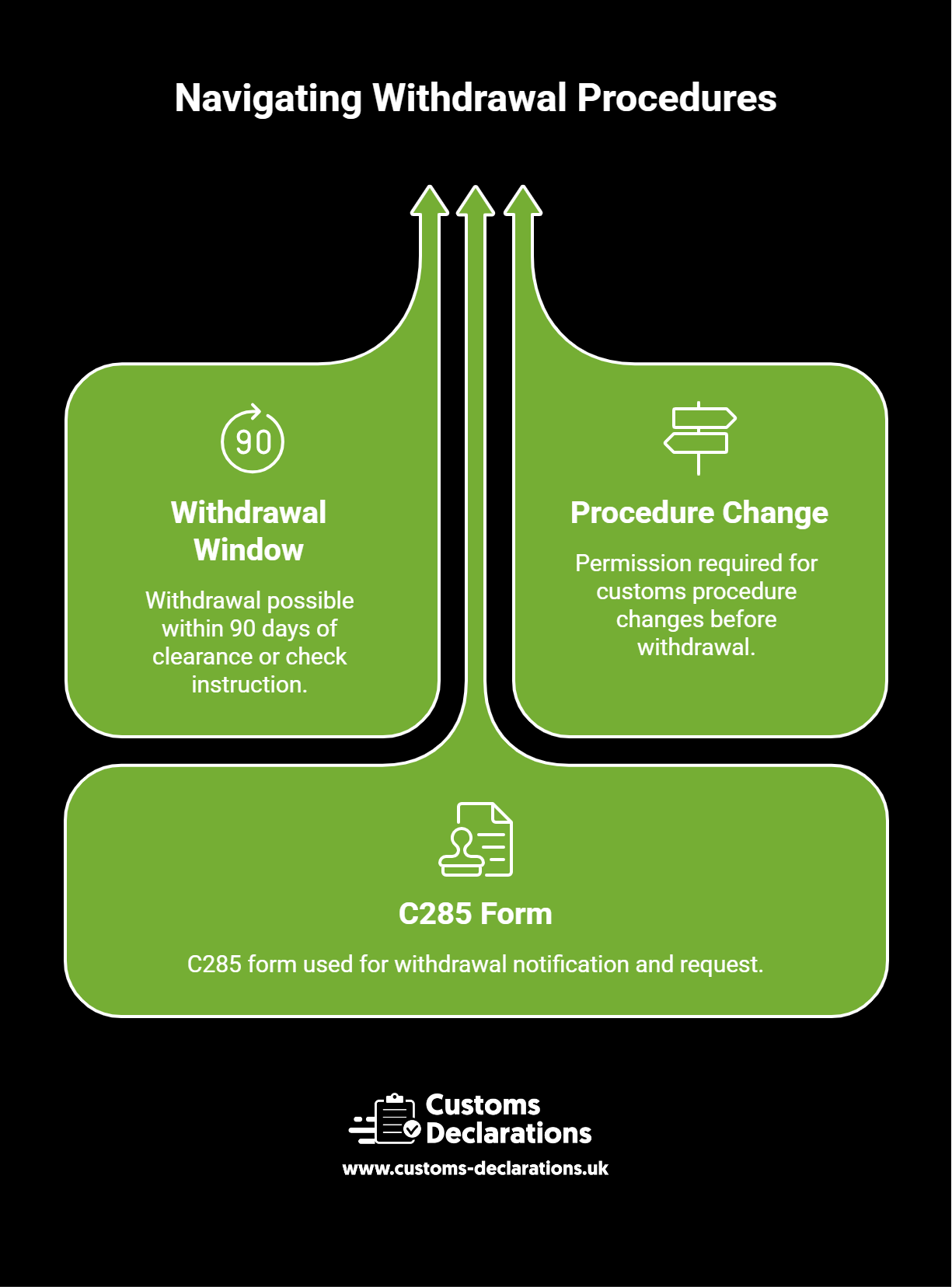
A declaration that has already cleared cannot be cancelled — the correct mechanism is a withdrawal request, and this is the second area the June update clarified. Businesses can notify HMRC of a withdrawal request up to 90 days after the earlier of the declaration’s clearance or an instruction from a Border Force or HMRC officer to attend a physical or documentary check on the movement. Where the withdrawal is being requested because the business wants to change the customs procedure applied to the goods, permission from the supervising office must be obtained first. The guidance now confirms explicitly that the notification and withdrawal request itself must be made by submitting a C285 form — the same form used for import duty and VAT repayment claims — rather than through any separate withdrawal-specific channel.
How Customs Declarations UK Supports This
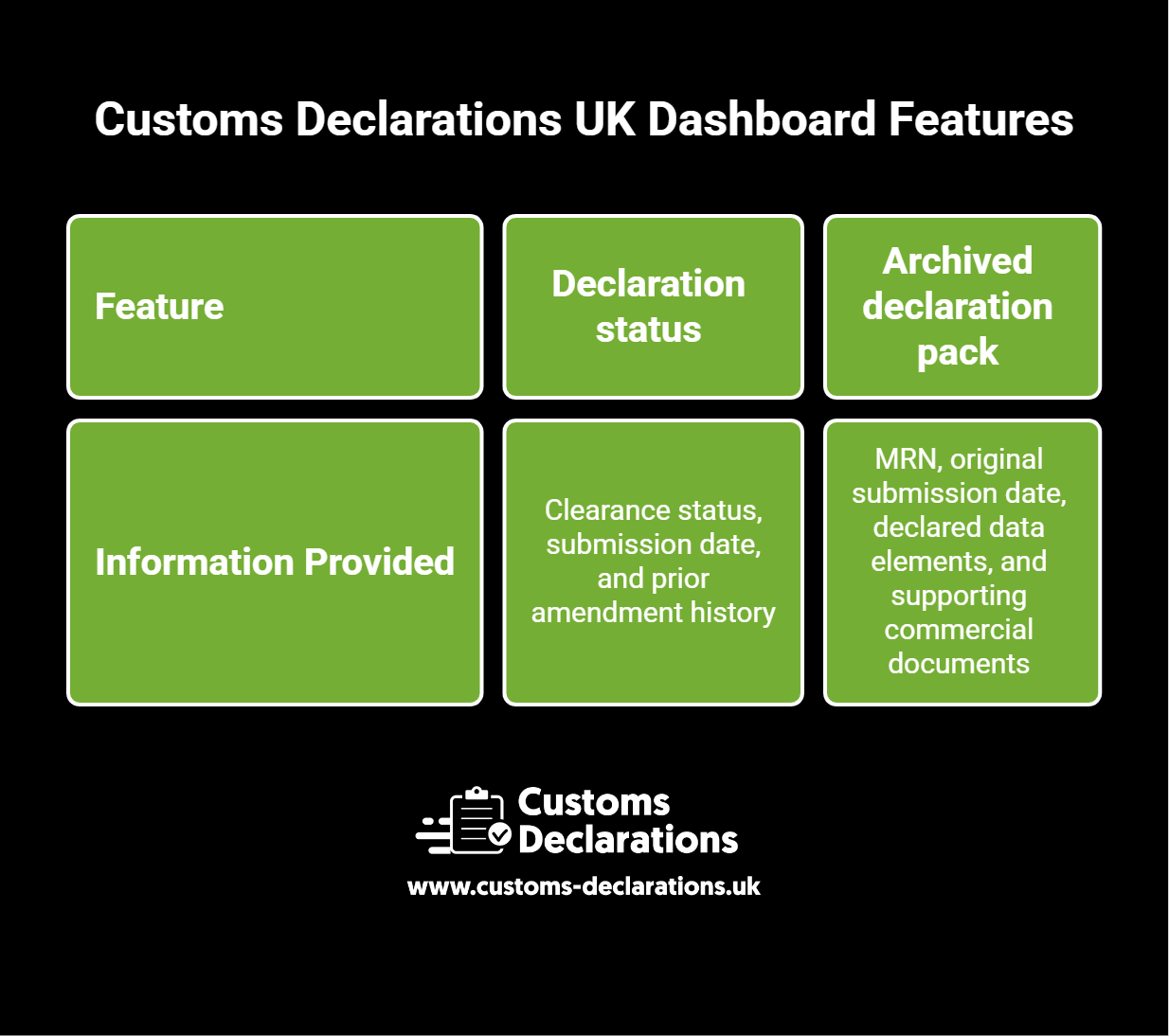
Getting the routing right — and getting it right quickly — matters more than it might first appear, given how tightly some of these windows run. Customs Declarations UK keeps a full, timestamped record of every declaration’s clearance status, submission date, and prior amendment history within its dashboard, so declarants can see at a glance which time-limit clock is running and which notification route applies before they act. Where an amendment or withdrawal needs to be initiated outside the platform — such as HMRC’s online notification form or a C285 submission — CDUK’s archived declaration pack gives you everything needed to complete that form correctly the first time: the MRN, the original submission date, the declared data elements, and the supporting commercial documents, all held together for the statutory retention period. That reduces the back-and-forth that often follows an incomplete amendment request and keeps your compliance trail intact for future audits.
Conclusion
The 16 June 2026 update to HMRC’s amendment guidance is a modest but practically important change: the “other amendments” category has moved from email to an online form, and the withdrawal process has been clarified to confirm the C285 route. Neither change affects the substantive time limits — three years for amendments, 90 days for cancellations and withdrawals — but both affect the mechanics declarants rely on every time a cleared declaration needs correcting. Reviewing internal procedures against the current GOV.UK guidance now will save time later, particularly for teams that had built email-based workflows around the previous process.