Pre-loader

UK–India FTA Goes Live: Customs, Tariffs and Rules of Origin for Importers and Exporters

The UK–India Comprehensive Economic and Trade Agreement (CETA) — the UK–India Free Trade Agreement — entered into force on 15 July 2026, four years after negotiations began and just over a year after signature in 2025. It is the UK’s most significant bilateral trade agreement since leaving the EU, and for customs professionals it marks the point where headline politics turns into everyday declaration data: new preference codes, new proof-of-origin documents, and a registration step that UK exporters cannot afford to overlook.

What Changed on 15 July

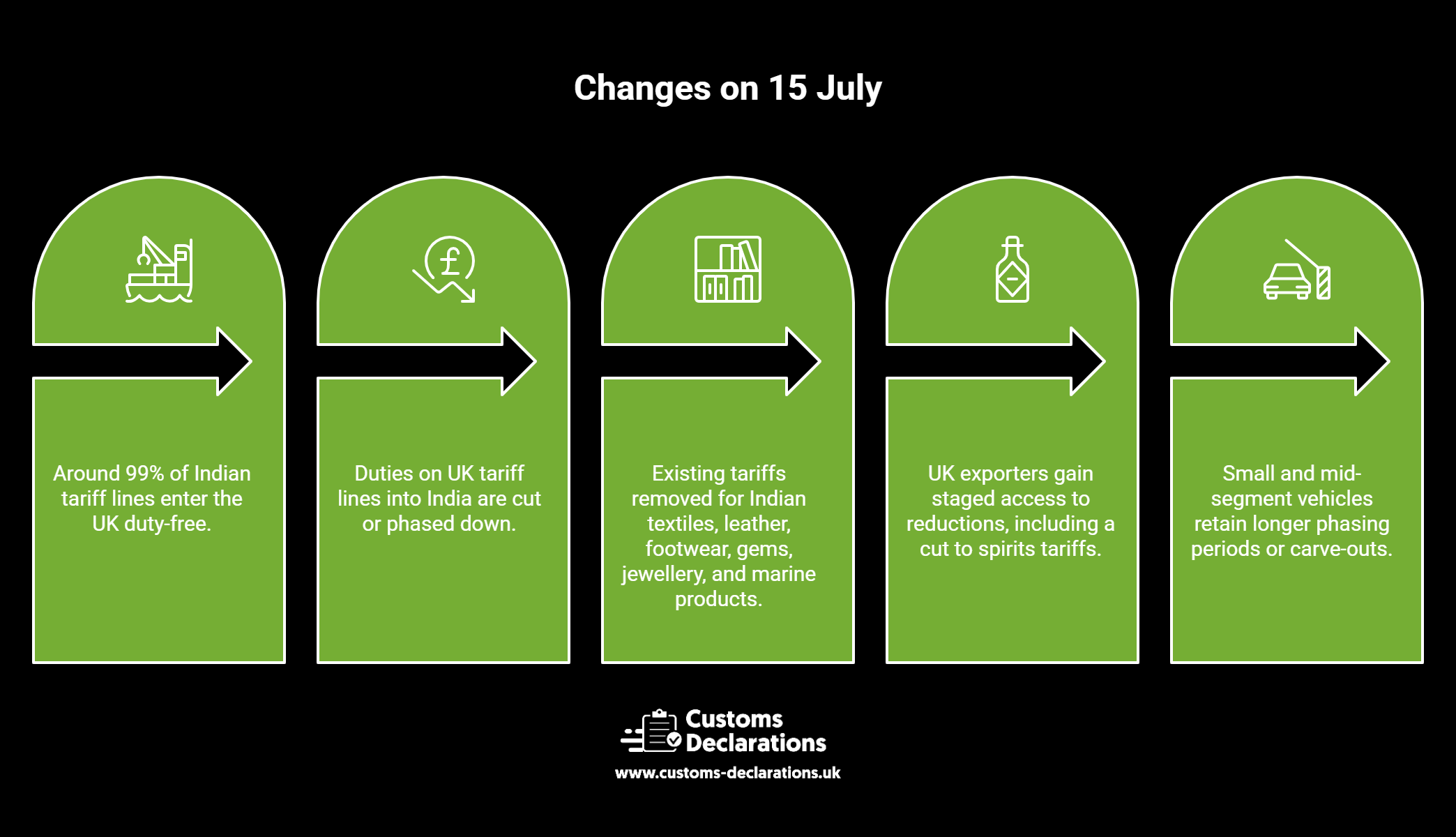
From entry into force, around 99% of Indian tariff lines can enter the UK duty-free, while the substantial majority of UK tariff lines into India see their duties cut or phased down over time. On the UK side, this removes existing tariffs across labour-intensive Indian export categories such as textiles and garments, leather and footwear, gems and jewellery, and marine products — sectors that had faced Most-Favoured-Nation duty on entry to the UK market. Moving in the other direction, UK exporters gain staged access to reductions that had previously kept British goods less competitive in India, including a significant cut to India’s tariff on spirits, which some industry estimates suggest could meaningfully lift UK beverage exports over time. Sensitive categories on both sides — including small and mid-segment vehicles — retain longer phasing periods or carve-outs rather than immediate liberalisation.

Alongside CETA, the UK and India brought a reciprocal Double Contributions Convention into force on the same date. This affects payroll and mobility rather than customs declarations directly, but it is worth flagging to clients with intra-group staff movements between the two countries, since it sits in the same commercial conversation as the trade deal itself.

None of this is automatic at the border. Preferential tariff treatment under CETA depends entirely on whether a consignment can demonstrate origin under the agreement’s rules — and that is where the real compliance work sits.

The Three Routes to Originating Status

Chapter 3 of the agreement sets out rules of origin that determine whether a good is treated as produced in the UK or India for preference purposes. A good can qualify in one of three ways.

The first and simplest is wholly obtained or produced goods — items entirely sourced or produced within one party’s territory, such as fish caught in UK waters, grapes harvested in India, or iron ore extracted in either country. The second is goods made entirely from originating materials, where every input used in production already qualifies as UK- or India-originating; a blended whisky made in the UK from wholly UK-produced component whiskies is the agreement’s own example. The third, and the one that will apply to most manufactured goods, covers products made using non-originating materials that nonetheless satisfy a Product-Specific Rule (PSR) set out in Annex 3A. PSRs are built around the Harmonised System and typically require either a change in tariff classification, a minimum qualifying value content (QVC), or a defined production process — and some rules combine a tariff-classification change with a value threshold.

Where a QVC threshold applies, businesses can calculate qualifying content using either the build-down method (subtracting the value of non-originating materials from the total value of the good) or the build-up method (based on the value of originating materials), with ex-works or FOB pricing bases available depending on which suits the transaction. Freight, insurance and certain taxes can be added to or deducted from these calculations under Article 3.5 of the agreement.

Cumulation is also available: originating materials from India can be used in UK production and treated as UK-originating, and vice versa. A UK-made engine used in a vehicle assembled in India can be treated as an originating input for that vehicle’s own origin assessment — a useful mechanism for integrated supply chains that already move components between the two countries.

Claiming Preference: A New Process for UK Exporters

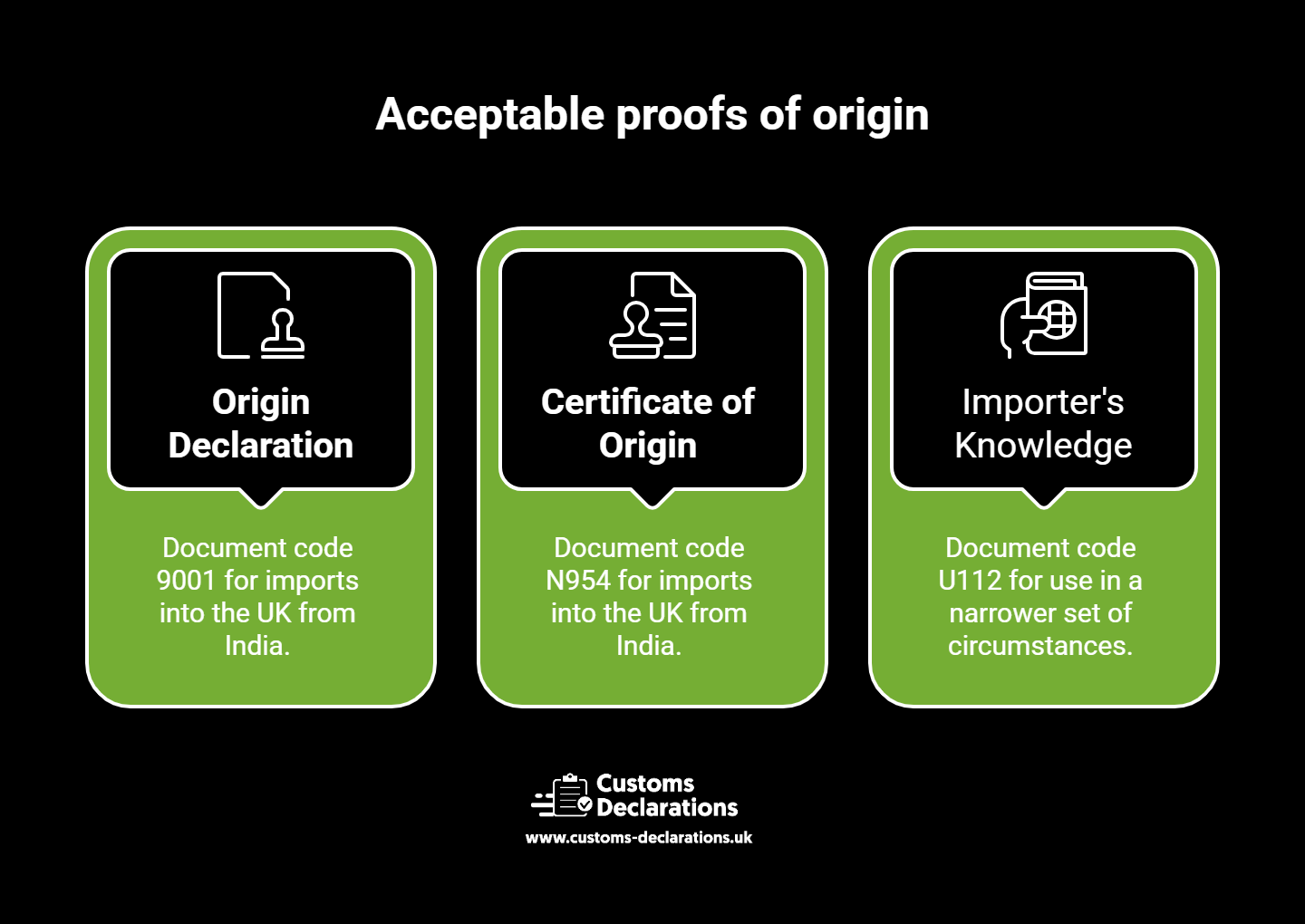
For imports into the UK from India, HMRC’s Trade Tariff has confirmed three acceptable proofs of origin: an Origin Declaration (document code 9001), a Certificate of Origin (document code N954), or, in a narrower set of circumstances, Importer’s Knowledge (document code U112). These reference codes slot into the existing CDS documentary evidence framework — the equivalent of Data Element 2/1 and its Appendix 5A codes that declarants already use for other preferential origin claims.

The more consequential change sits on the export side. UK producers and exporters who want to self-certify origin for goods moving to India must register with HMRC before completing any origin declarations under the agreement — this is a precondition, not a formality, and unregistered declarations will be rejected outright. Registration requires the business’s EORI number, trading name, and up to eleven email addresses (a primary address plus up to ten additional ones), and critically, each registered email address can only be linked to one EORI number; reusing an address across multiple EORI registrations will cause India’s authentication system to treat the submission as a duplicate and reject it, leaving the Indian importer unable to claim preference.

Once registered, the process for each shipment follows a defined sequence. The exporter completes an origin declaration using the specific UK-India CETA template — its layout differs from templates used under other UK FTAs — converts it to PDF, and emails it to the Indian importer with India’s customs authority copied in, using a registered email address. The subject line must follow a fixed format (EORI number and declaration date), and the email must contain the origin declaration as the sole attachment; including invoices or other documents in the same email. A successful submission generates an automatic confirmation from Indian customs, including a unique reference number the importer will cite when claiming preference. The origin declaration itself is valid for 12 months from completion and may cover multiple goods within a single shipment.

Two further provisions are worth flagging to clients. Goods already in transit or held in bonded storage in India before 15 July can still benefit from preference, provided the origin declaration is dated on or after entry into force — declarations dated earlier will be rejected as referring to an agreement not yet in effect at the time. And where preference isn’t claimed at the point of import, UK exporters’ Indian customers can make a retrospective claim up to a year after importation, provided the goods would have qualified at the time and a copy of the origin declaration can be produced.

Record-keeping runs for a minimum of five years from the date of the origin declaration, covering the declaration itself, invoices, supplier statements, production records, QVC costing workpapers, and transport documentation evidencing the non-alteration rule where goods have transited a third country.

Practical Checklist for Importers and Exporters

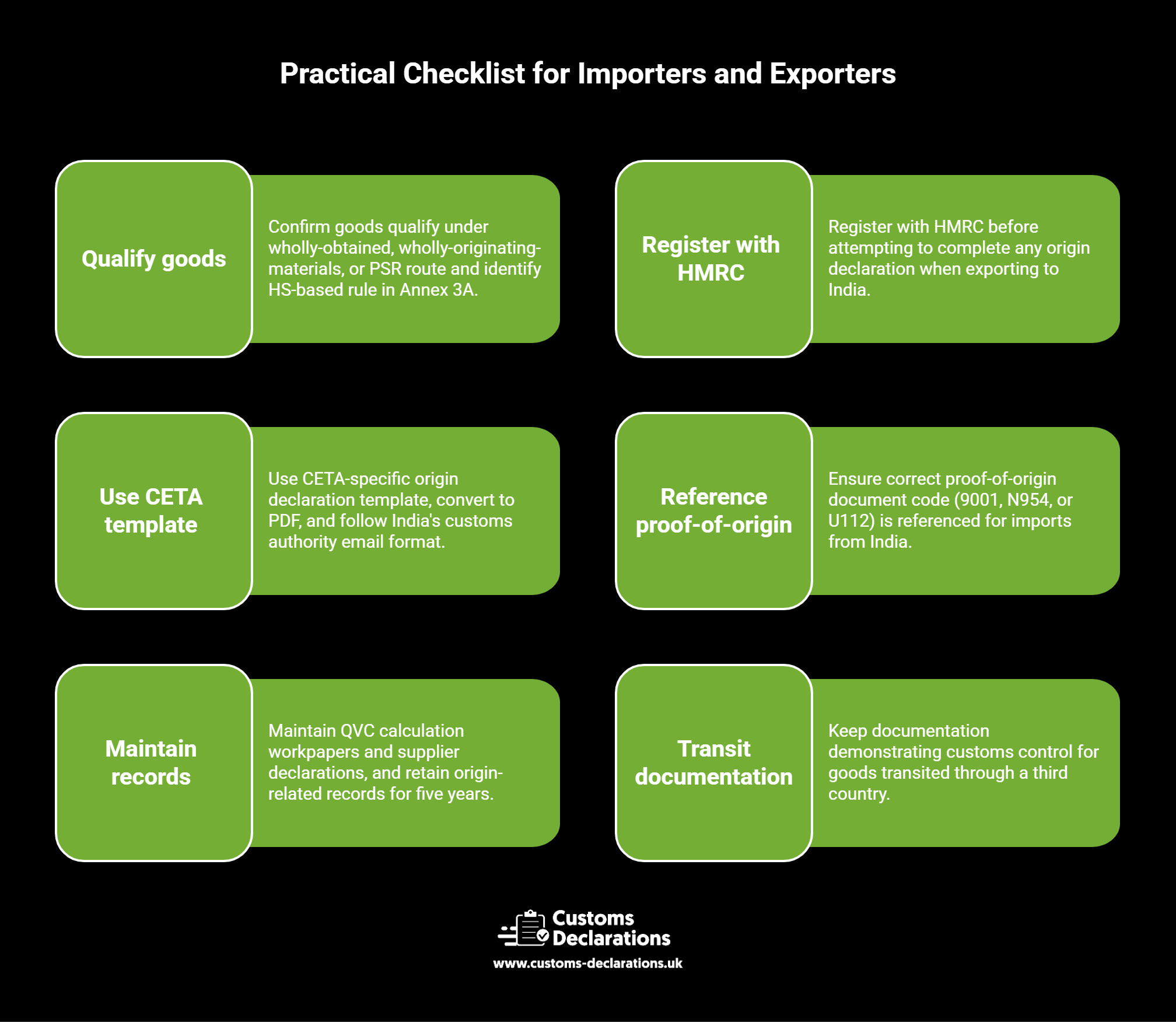
  • Confirm whether your goods qualify under the wholly-obtained, wholly-originating-materials, or PSR route, and identify the applicable HS-based rule in Annex 3A before assuming preference applies.
  • If exporting to India, register with HMRC before attempting to complete any origin declaration — do this now rather than at the point of first shipment.
  • Use only the CETA-specific origin declaration template, convert to PDF, and follow the exact email format required by India’s customs authority.
  • On imports from India, ensure the correct proof-of-origin document code (9001, N954, or U112) is referenced and available to support any preference claim on the CDS entry.
  • Maintain QVC calculation workpapers and supplier declarations for cumulation claims, and retain all origin-related records for at least five years.
  • Where goods transited a third country, keep documentation demonstrating customs control throughout and no processing beyond what Article 3.14 permits.

Where Customs Declarations UK Fits

For declarants filing CDS entries against India-origin goods, the practical requirement is straightforward: the correct preference code, the country of preferential origin, and a linked reference to the supporting proof-of-origin document need to be entered consistently and validated before submission. Customs Declarations UK’s guided workflows carry this data through the relevant fields, flag missing or inconsistent origin references before they reach HMRC, and let brokers clone and reuse import templates for recurring UK-India trade lanes rather than rebuilding entries from scratch each time. As the registration and authentication requirements on the export side settle into routine, that same template-and-validation approach extends naturally to keeping origin declaration references aligned with what’s been filed on the customs side.

Conclusion

CETA’s entry into force gives UK and Indian traders a genuine tariff opportunity, but the preference is not self-executing — it depends on getting the origin analysis right, registering correctly, and following an authentication process that is considerably more prescriptive than under many other UK free trade agreements. Businesses that get the registration and documentation habits right now, while volumes are still building, will be the ones capturing the savings from day one rather than chasing retrospective claims twelve months later.

We value your feedback, and if you have any comments, suggestions or anything else that you would like to highlight to us, we will be delighted to hear from you and incorporate your feedback into our content.

Note: While we have made every attempt to ensure that the information contained in this Site has been obtained from reliable sources, Customs Declarations UK is not responsible for any errors or omissions, or for the results obtained from the use of this information. All information in this Site is provided “as is”, with no guarantee of completeness, accuracy, timeliness or of the results obtained from the use of this information, and without warranty of any kind, express or implied, including, but not limited to warranties of performance, merchantability and fitness for a particular purpose. Nothing herein shall to any extent substitute for the independent investigations and the sound technical and business judgment of the reader. In no event will Customs Declarations UK, or its partners, employees or agents, be liable to you or anyone else for any decision made or action taken in reliance on the information in this Site or for any consequential, special or similar damages, even if advised of the possibility of such damages. Certain links in this Site connect to other Web Sites maintained by third parties over whom Customs Declarations UK has no control. Customs Declarations UK makes no representations as to the accuracy or any other aspect of information contained in other Web Sites.