Pre-loader

UK Trade Statistics March 2026: What the Latest ONS Data Means for Importers, Exporters, and Customs Professionals

The Office for National Statistics released its UK Trade: March 2026 bulletin on 14 May 2026, providing a detailed picture of goods and services flows into and out of the United Kingdom for both the month of March and the first quarter of the year. The data reveal sustained import growth, a widening trade deficit, and a notable shift in the composition of EU trade flows—all against a backdrop of rising fuel prices and a significant correction to previously published export figures. For businesses involved in import declarations, export declarations, and customs compliance, the release contains signals worth understanding carefully.

This article unpacks the headline numbers, explores the commodity and partner-country trends driving them, addresses the HMRC data correction included in this release, and considers what the figures mean in practice for traders filing customs declarations with HMRC’s Customs Declaration Service.

March 2026: The Monthly Picture

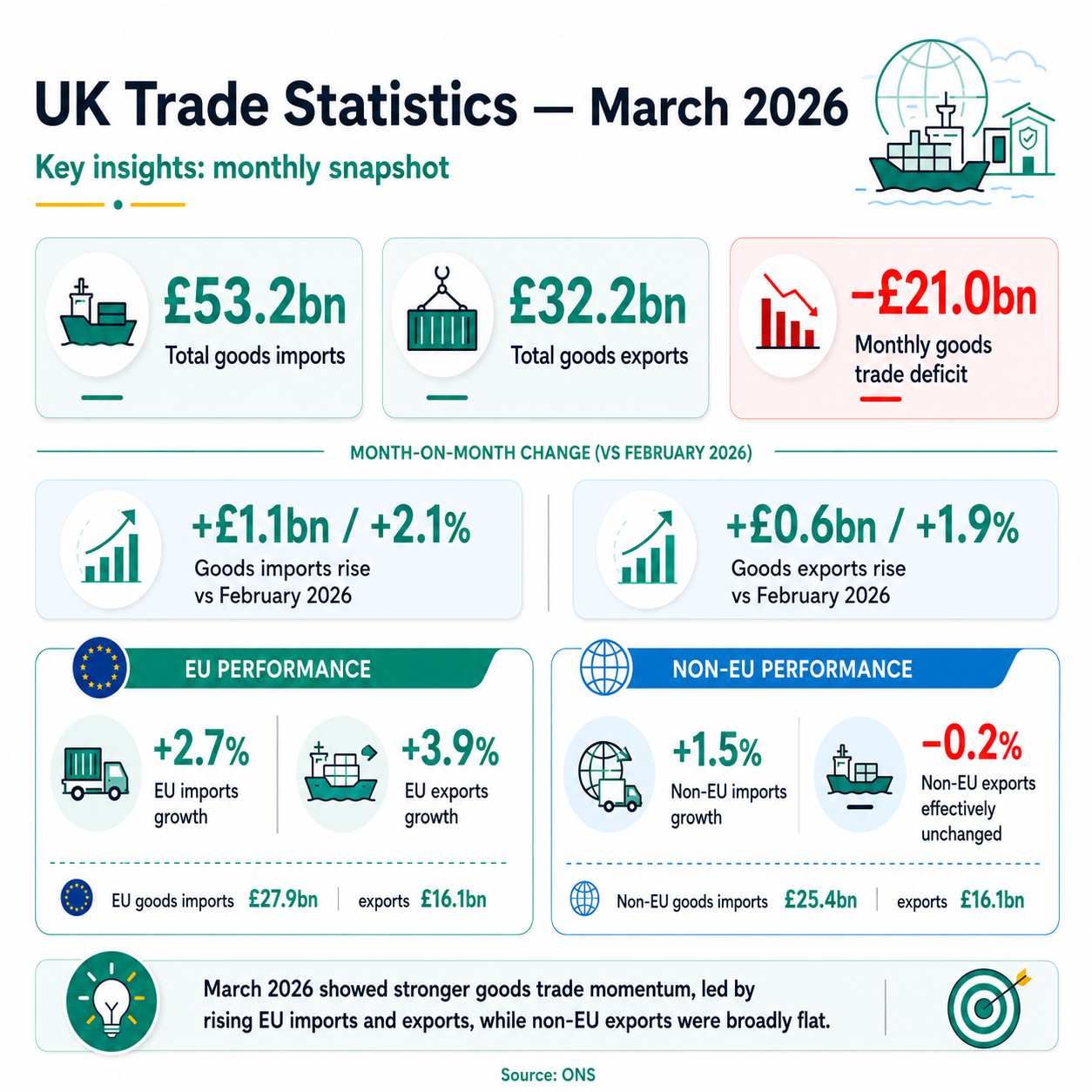
Total imports of goods increased by £1.1 billion (2.1%) in March 2026 compared with February 2026, driven by a rise in imports from both EU and non-EU countries. Total goods exports increased by £0.6 billion (1.9%) in the same period, with the improvement concentrated in exports to the EU.

Imports from the EU rose by £0.7 billion (2.7%), while imports from non-EU countries increased by £0.4 billion (1.5%). On the export side, EU-bound goods rose by £0.6 billion (3.9%), while exports to non-EU countries remained effectively flat, recording a marginal decline of 0.2%.

The monthly goods trade balance stood at a deficit of £21.0 billion. Imports from the EU were £2.5 billion higher than imports from non-EU countries in March 2026, while exports to the EU were similar in value to non-EU countries.

An important technical note accompanies the current price headline figures. After removing the effect of inflation through chained volume measures, total goods imports remained broadly similar in March 2026 when compared with February 2026, as a rise in EU imports was offset by a fall in non-EU imports. Total goods exports decreased by £0.3 billion after adjusting for inflation. The gap between headline value growth and inflation-adjusted volume reflects rising fuel prices rather than an underlying uplift in physical trade volumes.

KEY INSIGHTS: Q1 2026 Quarterly Snapshot

Quarter 1 2026: The Bigger Picture

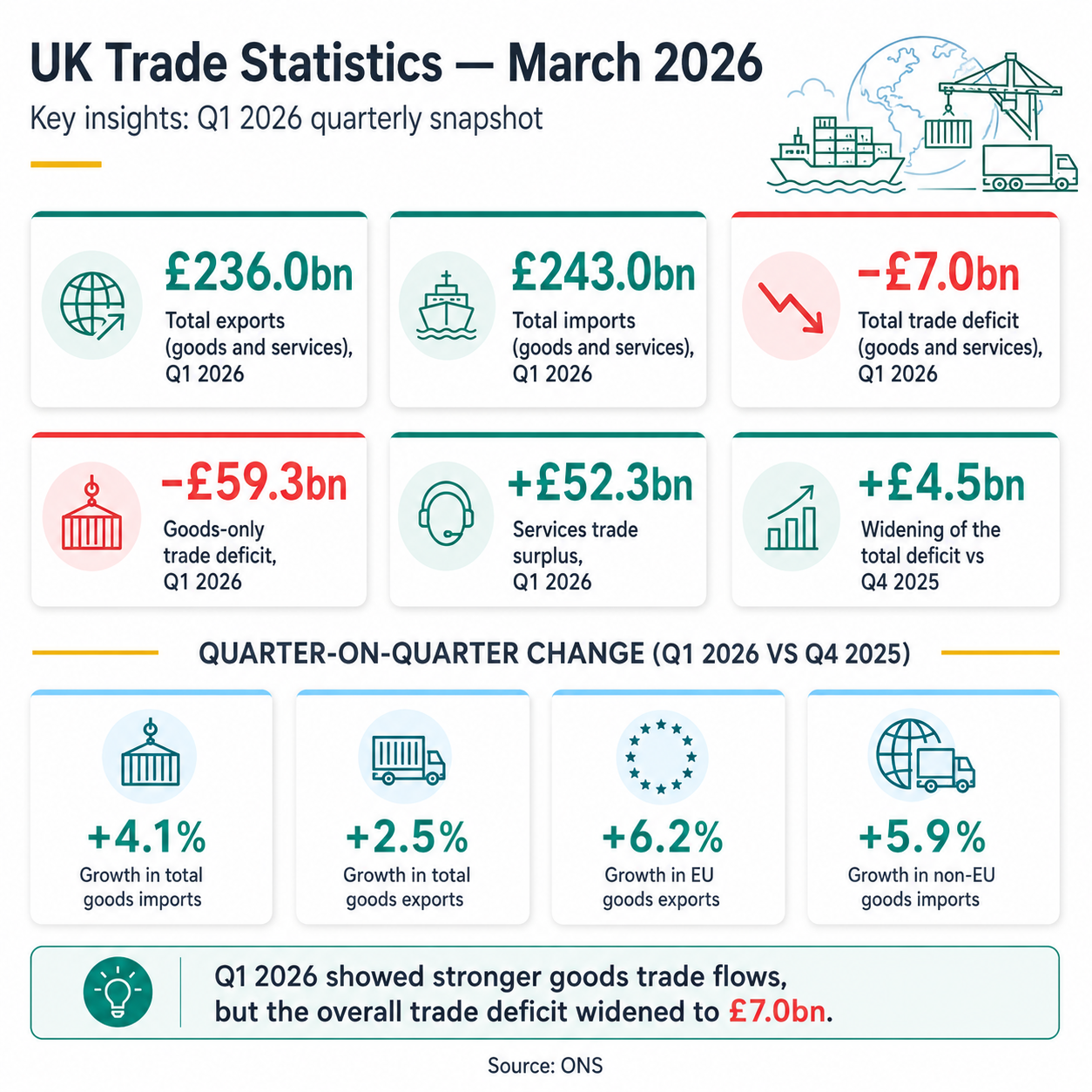
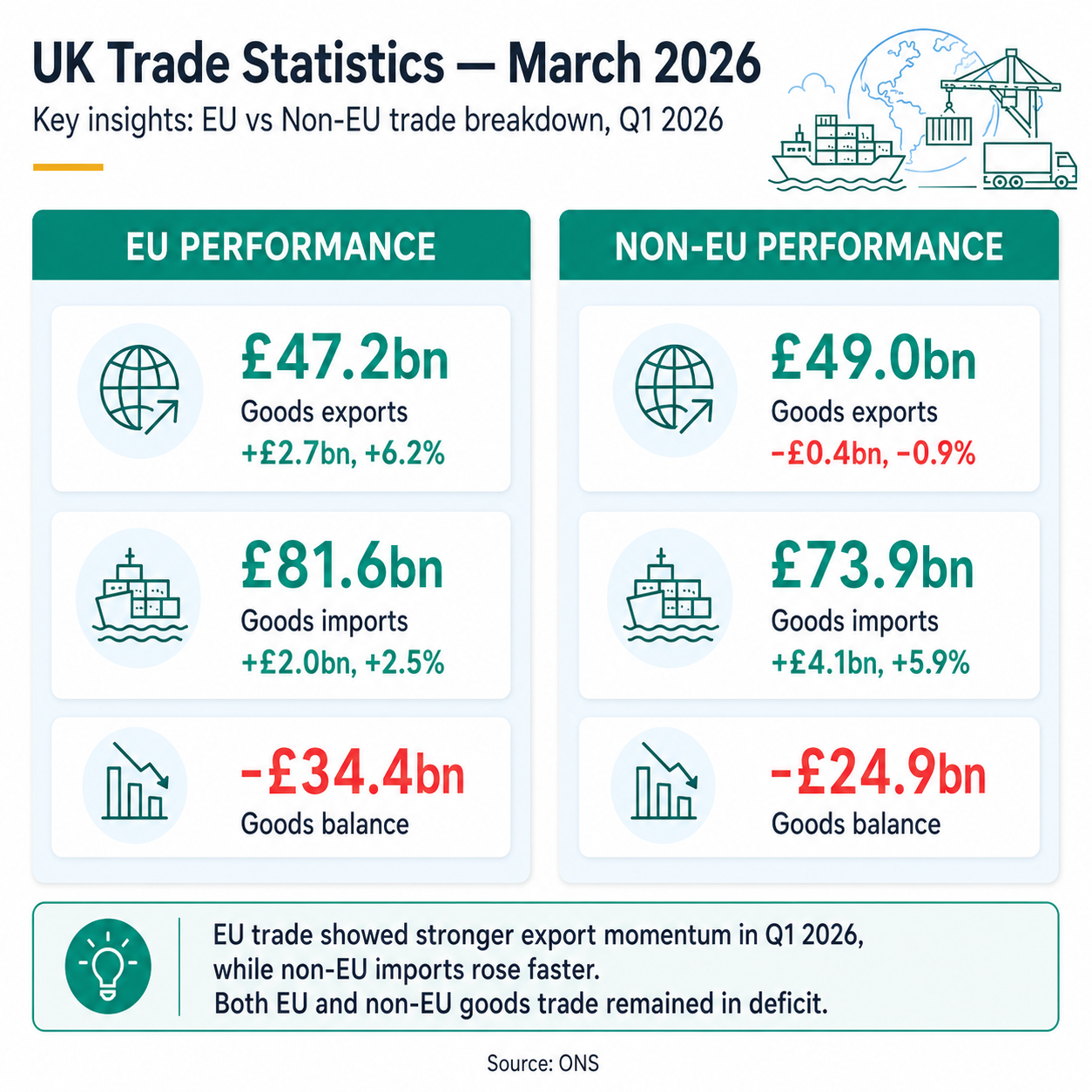
The quarterly data present a fuller and more stable view of underlying trade trends. Total imports of goods increased by £6.1 billion (4.1%) in Quarter 1 (January to March) 2026 compared with Quarter 4 (October to December) 2025. The increase was driven by a £4.1 billion (5.9%) rise in goods imports from non-EU countries, alongside a £2.0 billion (2.5%) rise from EU countries.

Total exports of goods increased by £2.3 billion (2.5%) in Quarter 1 2026. This rise was because goods exports to the EU increased by £2.7 billion (6.2%), partially offset by a £0.4 billion (0.9%) fall in goods exports to non-EU countries.

The total goods and services trade deficit, excluding precious metals, widened by £4.5 billion to £7.0 billion in Quarter 1 2026, compared with the previous quarter. The trade in goods deficit widened by £3.8 billion to £59.3 billion in Quarter 1 2026, while the trade in services surplus narrowed by an estimated £0.7 billion to £52.3 billion.

The overall picture for Q1 2026 is one of import demand growing faster than export capacity, a pattern with direct implications for the volume of import declarations being filed with HMRC and the compliance burden on businesses engaged in cross-border trade.

EU Trade: Growth in Both Directions

Despite the continuing post-Brexit customs overhead, the UK’s goods relationship with the European Union remained active and growing in Q1 2026. Exports to the EU increased at a notably stronger pace than non-EU exports, reflecting the EU’s continued importance as the United Kingdom’s primary goods trading partner.

Exports to the EU increased by £2.8 billion (6.2%) in Quarter 1 2026, because of a £1.4 billion rise in exports of machinery and transport equipment, and a £0.9 billion increase in fuel exports. The increase in exports of machinery and transport equipment was because of increased exports of office machinery to the Netherlands, while the increase in fuels was linked to a rise in exports of crude oil to Poland.

On the import side, imports of goods from the EU increased by £2.0 billion (2.5%) in Quarter 1 2026, driven by a £2.0 billion increase in imports of machinery and transport equipment, with the rise driven by increased imports of office machinery from Ireland.

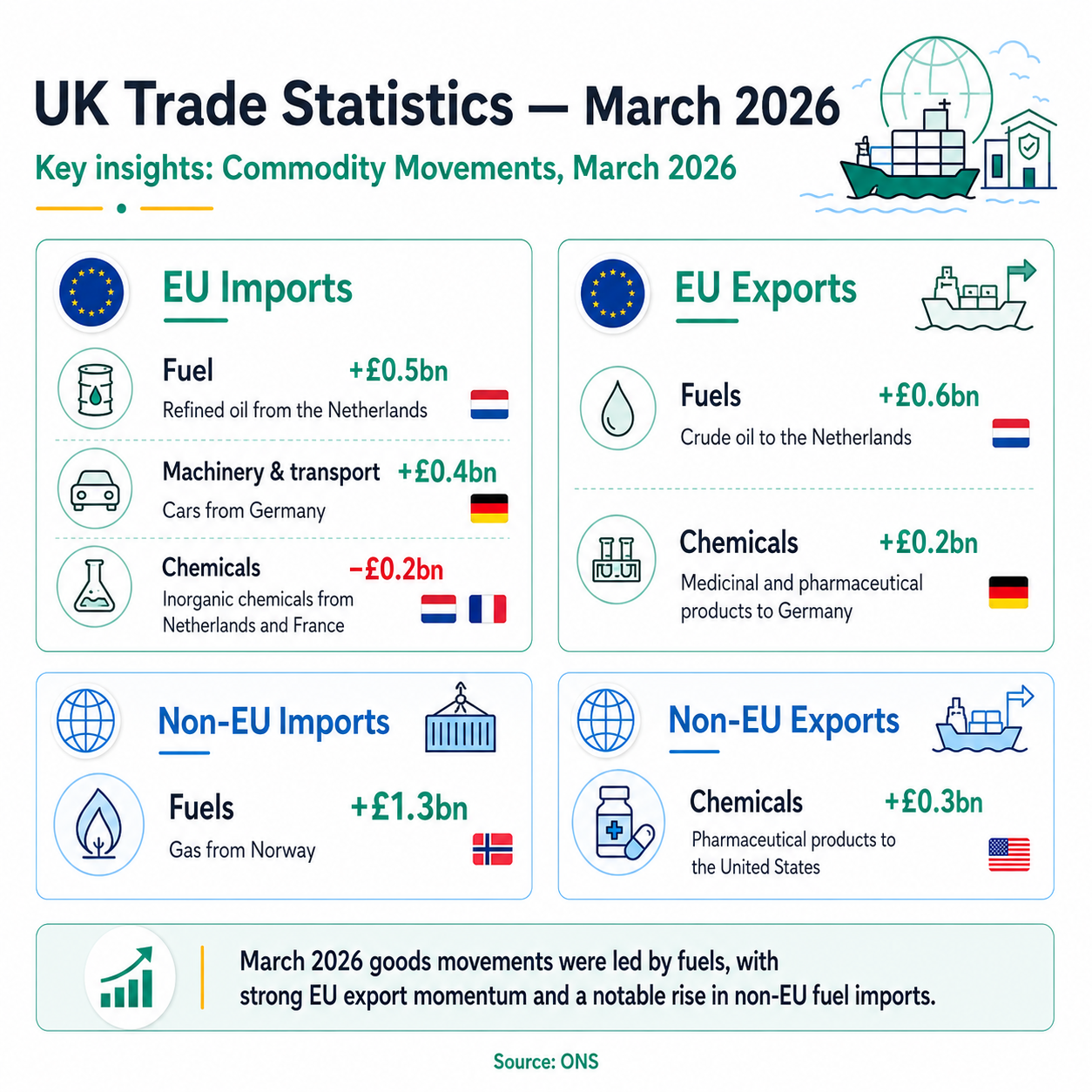
For the month of March specifically, imports from the EU increased because of a £0.5 billion rise in fuel imports linked to higher imports of refined oil from the Netherlands, and a £0.4 billion increase in imports of machinery and transport equipment, mainly because of higher imports of cars from Germany. These increases were partially offset by a £0.2 billion fall in chemical imports because of reduced imports of inorganic chemicals from the Netherlands and France.

The Ireland-Netherlands-Germany corridor emerges as particularly significant from these figures. For customs professionals, this underscores the continued importance of accurate classification and valuation for intra-EU origin goods arriving into Great Britain under the UK–EU Trade and Cooperation Agreement, where origin proof is required to access zero-tariff treatment.

Non-EU Trade: Import Surge, Flat Exports

The non-EU picture in Q1 2026 was shaped primarily by energy imports. Imports from non-EU countries increased by £4.1 billion (5.9%) in Quarter 1 2026, because of a £1.5 billion rise in imports of fuels, a £1.3 billion increase in machinery and transport equipment imports, and a £0.7 billion rise in imports of material manufactures. The rise in imports of fuels was linked to increased gas imports from Norway and the United States. The rise in imports of machinery and transport equipment was linked to increased imports of cars from China and aircraft from the United States.

Exports to non-EU countries decreased by £0.4 billion (0.9%) in Quarter 1 2026 because of a £0.7 billion fall in exports of miscellaneous manufactures and a £0.4 billion fall in exports of fuels, partially offset by a £0.4 billion rise in machinery and transport equipment exports.

For the month of March, the rise in non-EU imports was primarily because of a £1.3 billion increase in fuel imports, partially offset by £0.3 billion falls in imports of both machinery and transport equipment, and chemicals, and a £0.2 billion fall in imports of miscellaneous manufactures. The fall in imports of machinery and transport equipment was linked to reduced imports of telecoms and sound equipment from Vietnam and cars from China.

The continued volume of goods arriving from Norway, the United States, China, and Japan reinforces the breadth and complexity of non-EU supply chains that UK businesses must manage with compliant customs declarations, accurate commodity classification, and validated valuation data.

Trade in Services: A Surplus Under Pressure

Early estimates indicate that exports of services fell by an estimated £0.7 billion (0.5%) in Quarter 1 2026, compared with Quarter 4 2025, because of a £0.7 billion fall in exports of travel services alongside small falls in other service types.

Imports of services remained similar in Quarter 1 2026 compared with the previous quarter, with the largest fall being a £0.7 billion decrease in travel services, offset by a £0.6 billion rise in other business services.

The services surplus of £52.3 billion continues to partially offset the substantial goods deficit of £59.3 billion, resulting in the combined goods and services deficit of £7.0 billion. However, the narrowing services surplus—combined with growing goods imports—represents a structural pressure on the UK’s overall trade position.

For the month of March, exports of services increased by £0.1 billion (0.2%), while imports of services remained similar in value terms. A separate note in the release highlights that the war in Iran affected exports, with new business falling at its fastest rate in nearly a year, and business confidence declining sharply during March.

The HMRC Data Feed Correction: Why It Matters

A significant element of this release is a retrospective correction to previously published export data. During routine quality assurance checks, the ONS identified an error in trade in goods export data supplied by HMRC. The error occurred because of the new processing systems, resulting in incorrect data being delivered to the ONS. HMRC Overseas Trade Statistics are not affected.

This error affects data from July 2025 to December 2025 and has been corrected in this release. The corrected data reduce Quarter 3 exports by £0.6 billion and reduce Quarter 4 exports by £0.6 billion, representing 0.6% of total trade in goods exports and 0.3% of total trade exports. This correction mainly impacts EU exports of fuels.

This episode serves as a reminder that trade data pipelines—even at the level of national statistics—can be affected by systemic processing errors. Businesses relying on HMRC’s Customs Declaration Service for their own compliance records should maintain their own six-year archives of accepted declarations independently of any national-level data aggregation. The statutory retention requirement exists precisely to ensure that individual business records remain verifiable and accurate regardless of downstream data processing changes.

The Fuels Effect: Value vs Volume

A recurring theme in the March 2026 data is the divergence between current price figures and inflation-adjusted chained volume measures, driven by fuel price movements.

In March 2026, there was a notable difference between current price estimates and chained volume measures for non-EU imports and EU exports. This can be attributed to rising fuel prices for both exports and imports. Non-EU imports and EU exports of fuels increased in current prices in March 2026. However, when the effect of inflation is removed, non-EU imports and EU exports of fuels decreased in the same period.

This distinction is relevant for customs professionals. Customs valuation is based on transaction value expressed in current prices—the price actually paid or payable for goods—rather than inflation-adjusted measures. Rising fuel costs therefore increase declared customs values, affect the basis for import VAT calculation, and may affect the absolute thresholds relevant to duty deferment account limits and Postponed VAT Accounting statements. Importers of fuels and energy products in particular should ensure that their valuation methodology correctly captures all includable charges to the UK frontier.

What These Statistics Mean for Customs

The March 2026 ONS release has several practical implications for businesses managing their customs obligations under HMRC’s Customs Declaration Service.

The continued growth in goods imports—particularly from the EU and from major non-EU partners including Norway, the United States, and China—means the volume of import declarations being filed with HMRC is increasing. Each of those declarations must carry accurate commodity classifications, correct customs valuations, valid origin evidence, and compliant documentation. The cost of errors—in the form of post-clearance assessments, duty underpayments, and inspection delays—rises in proportion to import volumes.

The prominence of office machinery in both EU import and export flows during Q1 2026 is directly relevant to importers in the technology, logistics, and business services sectors. The rise in EU imports was driven by increased imports of office machinery from Ireland, while the rise in EU exports of machinery and transport equipment was because of increased exports of office machinery to the Netherlands. Importers of office machinery from EU member states must apply correct tariff classifications under Chapters 84 and 85 of the UK Integrated Tariff, confirm CE or UKCA conformity marking, and address software valuation questions where goods arrive with bundled operating systems or firmware.

The growing volume of non-EU goods from China—particularly cars and telecoms equipment—highlights the continued absence of a UK-China free trade agreement, meaning Most-Favoured-Nation duty rates apply and all goods require full customs declaration with accurate country of origin declarations.

The services trade picture, with declining travel exports and geopolitical headwinds affecting new business activity, reinforces the importance of the goods trade channel and the customs compliance infrastructure supporting it.

How Customs Declarations UK Supports Compliant Trade

Against the backdrop of rising trade volumes, widening goods deficits, and the commodity complexity evident in the March 2026 data, the ability to file accurate, validated customs declarations efficiently is more important than ever.

The Customs Declarations UK platform provides importers, exporters, freight forwarders, and customs agents with a structured, compliant pathway into HMRC’s Customs Declaration Service. Through guided, plain-English workflows, users can prepare and submit import declarations and export declarations covering the full range of commodity types represented in the ONS trade statistics—from office machinery and fuel products to vehicles, chemicals, and pharmaceutical goods.

For import declarations, the platform supports accurate commodity code entry across Chapters 84 and 85 for machinery, Chapter 87 for vehicles, and energy products across Chapter 27, with real-time validation to detect missing or inconsistent data before submission to CDS. Origin declarations—critical for claiming duty-free treatment on EU goods under the UK-EU Trade and Cooperation Agreement—are captured within the declaration workflow alongside Incoterms, customs value components, and supporting document references.

For ENS safety and security declarations, the platform aligns submission data with carrier filings to prevent the mismatches that are a common cause of avoidable border delays. All accepted declarations and Movement Reference Numbers are archived securely for the statutory six-year retention period, providing the individual business-level audit trail that the HMRC data correction episode highlights as indispensable.

Businesses processing high volumes of declarations—particularly those responding to the import growth patterns evident in Q1 2026—can take advantage of bulk upload functionality via CSV and Excel, reusable templates, and clone functionality for repeat lanes, reducing manual entry burden and improving throughput without sacrificing compliance accuracy.

To learn more about the platform’s capabilities, visit the Customs Declarations UK solutions page or explore the pricing information.

Conclusion: Reading the Data, Managing the Compliance Burden

The UK Trade: March 2026 release paints a picture of a trading economy in which goods imports are growing faster than exports, the EU remains the dominant bilateral trading partner, and energy prices are materially inflating declared trade values. The widening goods deficit, the prominence of machinery and fuel flows in both directions, and the retrospective correction to export data all have practical implications for customs professionals and the businesses they support.

For importers and exporters, the response to growing trade volumes is not simply operational—it is fundamentally a compliance challenge. Every additional shipment from the Netherlands, Germany, Ireland, China, or Norway represents an additional customs declaration, an additional valuation calculation, an additional origin determination, and an additional entry that must be accurate, complete, and retained for six years. The Customs Declarations UK platform exists to make that process efficient, validated, and audit-ready—whether you are filing a single declaration for an office machinery import or processing thousands of monthly declarations across multiple commodity categories and trade corridors.

We value your feedback, and if you have any comments, suggestions or anything else that you would like to highlight to us, we will be delighted to hear from you and incorporate your feedback into our content.

Note: While we have made every attempt to ensure that the information contained in this Site has been obtained from reliable sources, Customs Declarations UK is not responsible for any errors or omissions, or for the results obtained from the use of this information. All information in this Site is provided “as is”, with no guarantee of completeness, accuracy, timeliness or of the results obtained from the use of this information, and without warranty of any kind, express or implied, including, but not limited to warranties of performance, merchantability and fitness for a particular purpose. Nothing herein shall to any extent substitute for the independent investigations and the sound technical and business judgment of the reader. In no event will Customs Declarations UK, or its partners, employees or agents, be liable to you or anyone else for any decision made or action taken in reliance on the information in this Site or for any consequential, special or similar damages, even if advised of the possibility of such damages. Certain links in this Site connect to other Web Sites maintained by third parties over whom Customs Declarations UK has no control. Customs Declarations UK makes no representations as to the accuracy or any other aspect of information contained in other Web Sites.