
The French customs authority (Direction générale des douanes et droits indirects) has issued an updated operational notice addressing how Entry Summary Declarations (ENS) must be completed and submitted through ICS2 for goods crossing the Brexit Smart Border between the United Kingdom and France. This notice, dated 16 February 2026, applies to all operators crossing the Smart Border — regardless of which EU Member State they connect through — and carries significant practical implications for carriers, hauliers, freight forwarders, and logistics operators handling Ro-Ro and ferry movements.
The guidance arrives at a pivotal moment. ICS2 has been fully operational in France since 1 January 2026, marking the end of the French transition period. With the Obligatory Logistics Envelope (ELO) set to become mandatory in spring 2026, operators who have not yet aligned their ENS filing workflows with these updated requirements need to act without delay.
This guide translates the official French notice into a clear and practical reference, covering ENS completion rules, transport data fields, ELO integration, and how to use the Customs Declarations UK platform for compliant ICS2 submissions.
ICS2 (Import Control System 2) is the EU’s advance cargo information and risk analysis platform, mandatory for non-Union goods entering the EU customs territory (EUCT). Since 1 April 2025, ICS2 has been operational for goods entering the EUCT by truck, train, or as unaccompanied trailers on ships. France completed its ICS2 transition on 1 January 2026, at which point the system became fully effective for all cross-Channel movements.
The Brexit Smart Border, managed by the French SI Brexit system, processes the majority of UK-EU freight flows — principally trucks transported on Eurotunnel rail shuttles and ferry vessels operating between UK and French ports. While ICS2 is a pan-European system, the technical characteristics of the Smart Border require specific adaptations in how ENS declarations are structured and submitted, and these adaptations apply to every operator crossing this border, not only those connected via France.
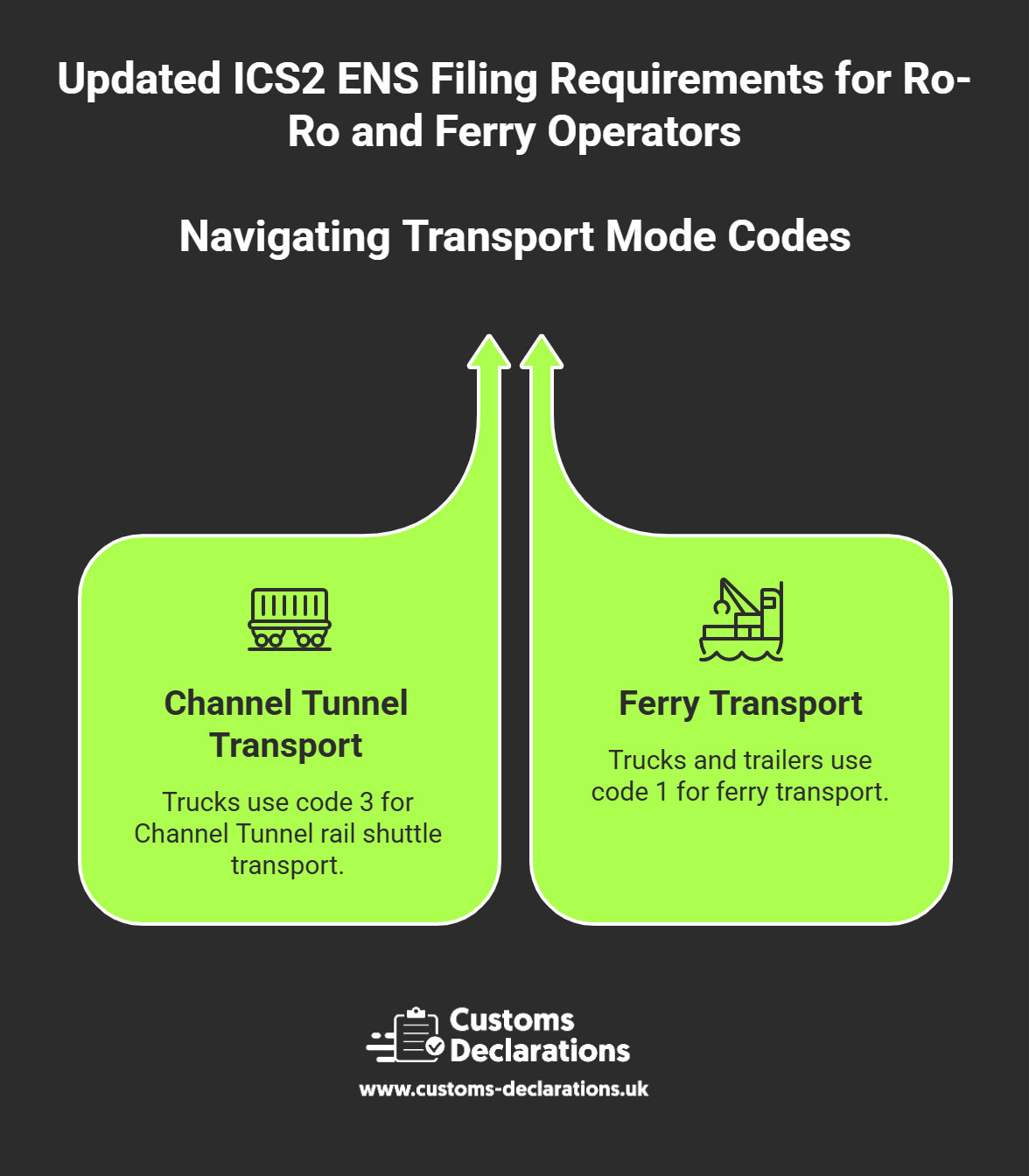
One of the most important — and frequently misunderstood — aspects of ENS filing at the Brexit Smart Border concerns the transport mode codes. The Smart Border is managed by the SI Brexit system, which does not support rail transport mode code 2. This creates a specific coding requirement that differs from what operators might expect for Eurotunnel shuttle movements.
The correct mode codes to use in the ENS are as follows:
This distinction is fundamental. Operators who have been filing with incorrect mode codes should review their processes immediately to ensure compliance with the updated requirements.
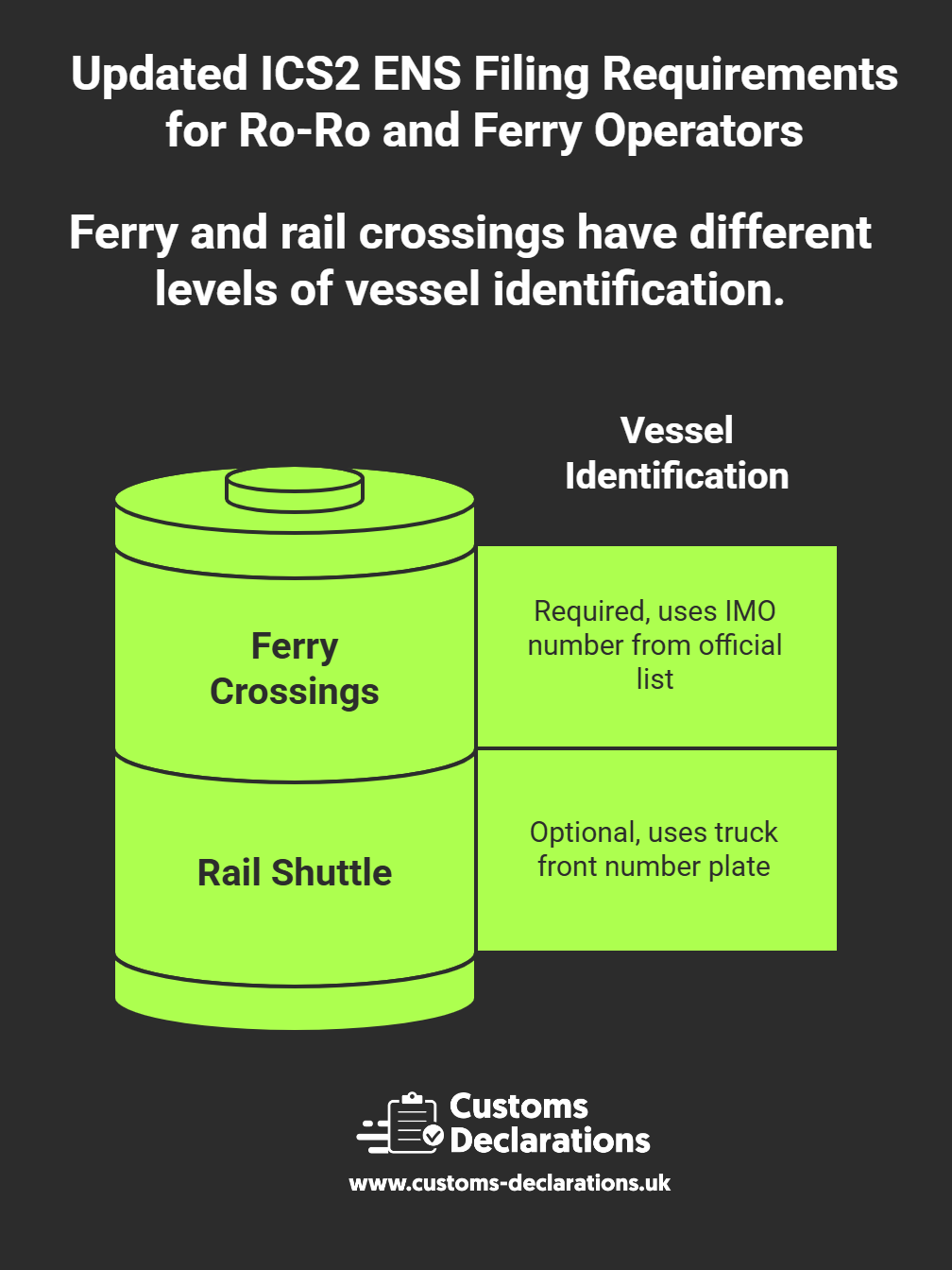
The active means of transport is a mandatory data field in the F50 ENS dataset. How this field is completed depends on the mode of crossing.
For ferry crossings, the active means of transport must be identified using an IMO number — the internationally recognised ship identification number. Because ferries operate on frequent, regular rotations and operators must submit their ENS before presenting the transport unit at the ferry terminal, it is not always possible to know in advance which specific vessel will be used. French customs and DG TAXUD have acknowledged this practical constraint and confirmed a compliant workaround: operators must select an IMO number from the official list provided by French customs that corresponds to a vessel operating on the relevant route. The IMO entered does not need to match the exact ferry ultimately used — it serves solely to allow the ENS to be lodged in ICS2 and to trigger the risk analysis. Critically, once an IMO number has been entered, it must not be subsequently modified.
All ferry companies operating on the Brexit Smart Border routes have cooperated with this arrangement and have each provided at least one IMO number per route to assist operators with ICS2 compliance. The official list of IMO numbers by company and route is reproduced at the end of this guide.
For rail shuttle crossings through the Channel Tunnel, the active means of transport field is optional for the F50 dataset. Where it is provided, operators should enter the front number plate of the truck.
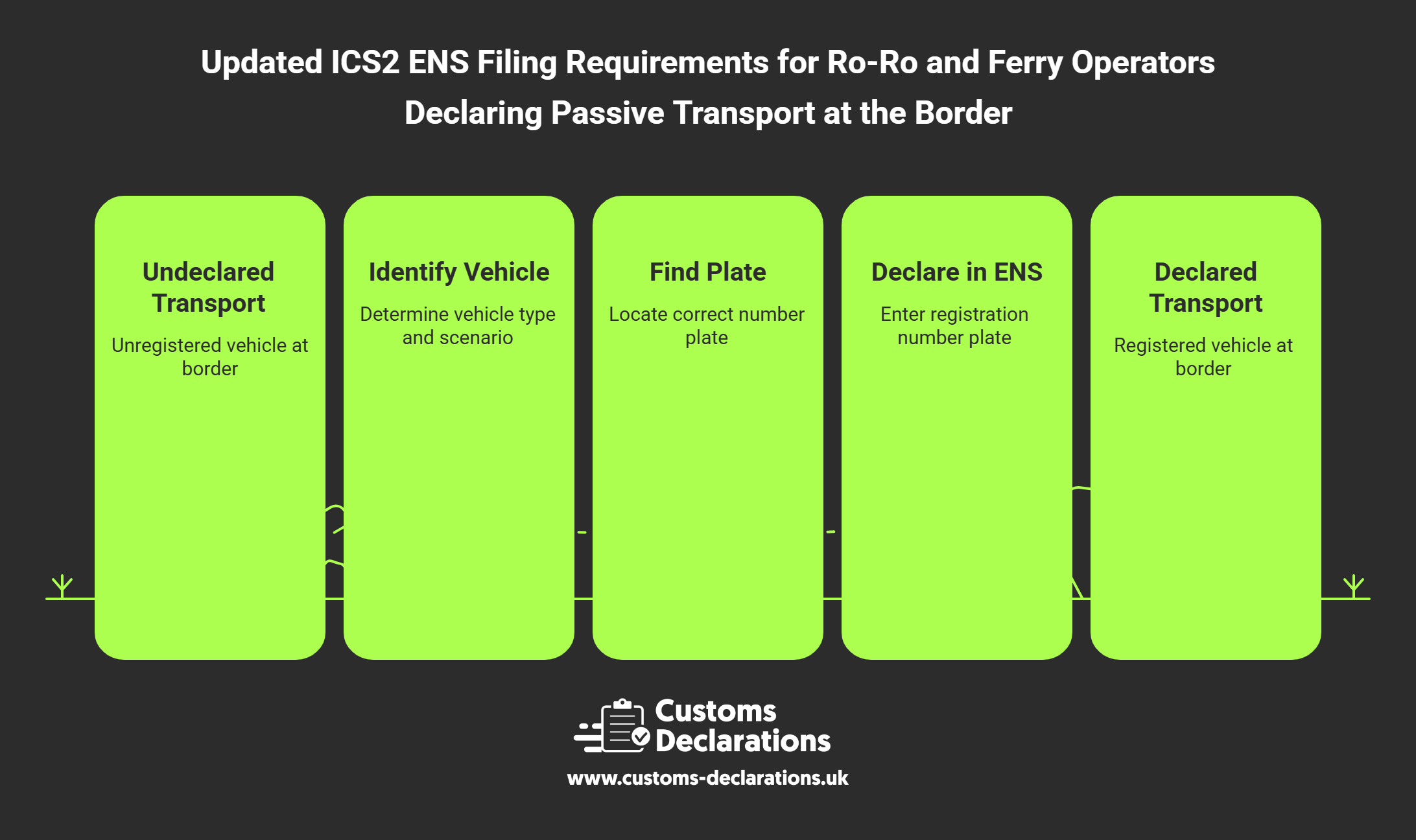
Regardless of whether the truck is loaded onto a ferry or a Channel Tunnel rail shuttle, the passive means of transport must always be declared in the ENS using the truck’s registration number plate. The specific plate to use varies by scenario:
For unaccompanied trailers on ferries (maritime F10 to F17 datasets), the back number plate of the trailer is used. For trucks on Ro-Ro vessels (road F50 dataset), the front number plate of the truck is required. For trucks on Channel Tunnel rail shuttles (road F50 dataset), the front number plate of the truck is again required.
This information is summarised in the official ENS completion table issued by French customs, reproduced in Annexe 2 of the original notice.
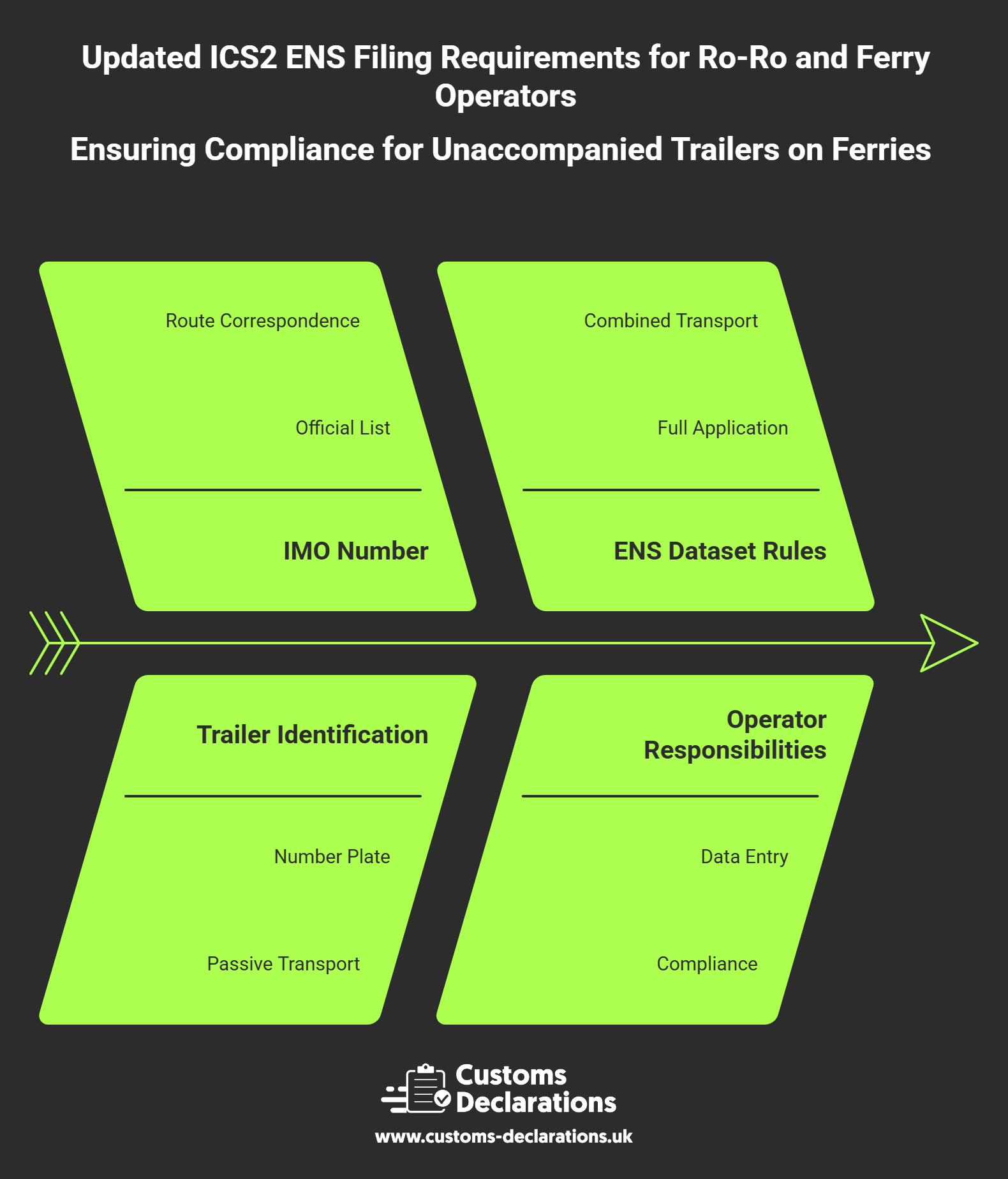
For unaccompanied trailers transported on ferries, the maritime ENS dataset rules apply in full. Operators must enter an IMO number from the official list corresponding to their route, in the same manner as for combined transport by ferry. The passive means of transport is identified by the trailer’s number plate.
The ELO (Enveloppe Logistique Obligatoire) is a digital document holder that consolidates all declarative reference numbers and cargo information for a given crossing into a single, scannable barcode. Its purpose is to secure and streamline the processing of goods at the Smart Border. ELO will become mandatory in spring 2026, but operators who have already migrated to ICS2 are required to use ELO at the Smart Border from the moment of that migration — they should not wait for mandatory enforcement.
The practical workflow is as follows. Once the ENS has been accepted in ICS2 and a Movement Reference Number (MRN) has been issued, that MRN must be integrated into the operator’s ELO. The ELO then generates a barcode that the truck driver presents at check-in with the ferry company. When the barcode is scanned at pairing, it triggers the processing of all declarations contained in the ELO, including the ENS, simultaneously.
This sequence has an important implication for timing. The ENS must be submitted to ICS2 — and the MRN obtained — before the driver arrives at the ferry terminal for check-in. Operators must therefore submit ENS declarations comfortably ahead of the minimum deadlines prescribed by EU legislation, leaving sufficient time to generate the ELO barcode. Late or last-minute ENS submissions risk disrupting the entire crossing process.
The SI Brexit system handles customs presentation of goods on behalf of operators and notifies ICS2 directly. It also transmits the routing decision — green lane or orange lane — directly to the truck driver based on the outcome of the risk analysis. As a result, operators crossing the Brexit Smart Border are not required to submit separate presentation formalities through the French ANTES system (FR-PNTS).
Operators should also note that shipments arriving directly from Northern Ireland are exempt from the ENS filing requirement entirely.
The following IMO numbers have been officially confirmed by ferry companies for use in ICS2 ENS filings. Operators should select the IMO corresponding to their route. Once entered in the ENS, the IMO must not be changed.
| Compagnie / Company | Route | IMO | Nom du ferry / Name of ferry |
|---|---|---|---|
| Brittany Ferries – BAI | Portsmouth Caen/Ouistreham | 9946324 | Guillaume de Normandie |
| Brittany Ferries – BAI | Portsmouth Le Havre | 9201750 | Commodore Clipper |
| Brittany Ferries – BAI | Portsmouth St Malo | 9946336 | Saint Malo |
| Brittany Ferries – BAI | Portsmouth Cherbourg | 9856189 | Galicia |
| Brittany Ferries – BAI | Poole Cherbourg | 9007130 | Barfleur |
| Brittany Ferries – BAI | Plymouth Roscoff | 9364980 | Armorique |
| DFDS | Dover – Dunkerque | 9293088 | DELFT SEAWAYS |
| DFDS | Dover – Calais | 9305843 | COTE DES FLANDRES |
| DFDS | Dieppe – Newhaven | 9320130 | SEVEN SISTERS |
| DFDS | Jersey – St. Malo | 9117985 | CAESAREA TRADER |
| Irish Ferries | Dover – Calais | 9524231 | Oscar Wilde |
| P&O | Dover – Calais | 9895173 | Liberté |
For operators seeking a structured, validated, and efficient pathway for ICS2 ENS submissions, the Customs Declarations UK (CDUK) platform provides a fully integrated ICS2 solution designed to meet exactly these operational requirements.
CDUK supports all ENS dataset types relevant to the Brexit Smart Border, including the maritime F10 to F17 series for unaccompanied trailers and ferry movements, and the road F50 dataset for Ro-Ro combined transport through the Channel Tunnel. The platform’s step-by-step filing wizards guide operators through each mandatory data field in plain English — including transport mode code selection, IMO number entry for active means of transport, and vehicle registration plate fields for passive means of transport — reducing the risk of the field-level errors that are the most common cause of ENS rejections and border delays.
Within CDUK, operators can set up carrier and consignor profiles once and reuse them across multiple declarations, significantly reducing data entry time on high-frequency routes such as Dover–Calais or Dover–Dunkerque. For operations involving large volumes of Ro-Ro movements, bulk upload capability via CSV or Excel allows entire batches of ENS filings to be prepared and submitted efficiently, rather than declaration by declaration.
The platform performs real-time compliance validation before each submission reaches ICS2, catching issues such as missing IMO numbers, incorrect transport mode codes, or mismatched dataset fields before they cause a processing failure. On acceptance, each ENS is issued an MRN that operators can immediately integrate into their ELO, ensuring the barcode required for Smart Border crossing can be generated without delay. All submitted declarations are archived securely within CDUK for the statutory retention period, maintaining a complete audit trail for both regulatory and operational purposes.
For operators managing the transition to mandatory ELO requirements in spring 2026, CDUK provides the underlying declaration infrastructure needed to generate timely MRNs — the essential prerequisite for ELO barcode generation. Filing through CDUK therefore directly supports the end-to-end Smart Border crossing workflow, from ENS submission through to driver check-in.
To explore the CDUK ENS service and begin filing ICS2 declarations, visit the Customs Declarations UK platform at www.customs-declarations.uk.
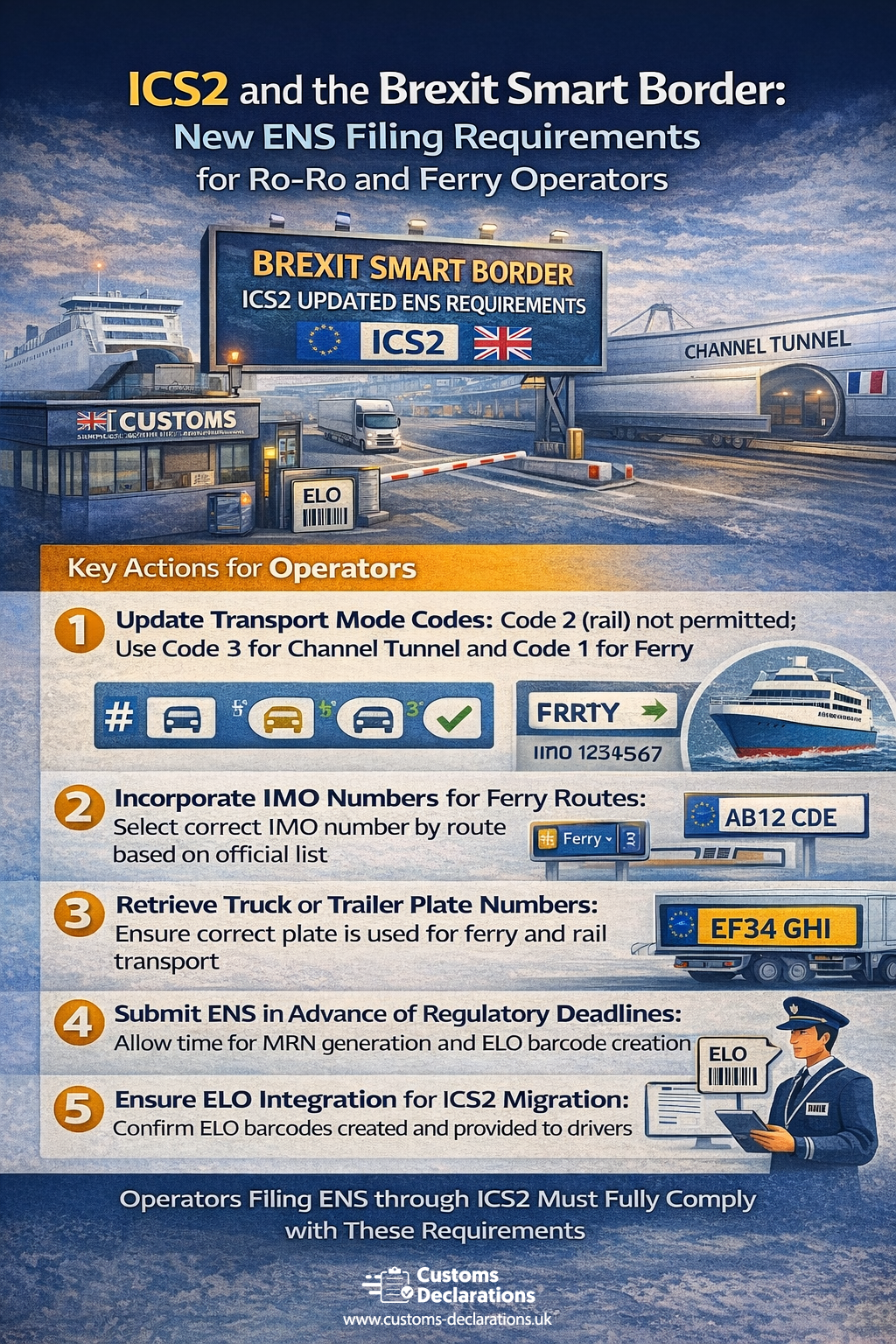
The updated French customs guidance makes clear that several operational changes are required for all operators crossing the Brexit Smart Border. The following actions should be completed without delay.
Transport mode codes must be reviewed and corrected in all ENS templates. Code 2 (rail) is not permitted at the Brexit Smart Border. Channel Tunnel Eurotunnel movements require code 3 (road); ferry movements require code 1 (maritime).
IMO numbers from the official list must be incorporated into ENS filing workflows for all ferry routes. The correct IMO should be selected by route, entered in the active means of transport field, and must not be modified after entry.
Vehicle registration plates must be entered correctly in the passive means of transport field for all movements — trailer back plate for unaccompanied trailers on ferries, and truck front plate for combined transport by ferry or rail shuttle.
ENS submissions must be submitted well ahead of the minimum regulatory deadlines to allow MRN generation and ELO barcode creation before the driver reaches the ferry terminal.
ELO integration must be in place and operational for all operators already filing through ICS2, as it is required from the point of ICS2 migration and will become formally mandatory in spring 2026.
Operators moving goods directly from Northern Ireland do not need to file an ENS and should confirm this exemption applies to their specific flows.
The updated guidance from French customs represents an important operational clarification for every business running freight across the UK-EU Smart Border. With ICS2 now fully live in France, ELO approaching mandatory status, and the specific transport mode coding rules confirmed in detail, there is no remaining ambiguity about what is required. Operators who align their ENS filing processes with these requirements now — using validated platforms like Customs Declarations UK to manage submission accuracy, MRN generation, and declaration archiving — will be best positioned for compliant, efficient crossings as the Smart Border environment continues to develop throughout 2026.
We value your feedback, and if you have any comments, suggestions or anything else that you would like to highlight to us, we will be delighted to hear from you and incorporate your feedback into our content.
Note: While we have made every attempt to ensure that the information contained in this Site has been obtained from reliable sources, Customs Declarations UK is not responsible for any errors or omissions, or for the results obtained from the use of this information. All information in this Site is provided “as is”, with no guarantee of completeness, accuracy, timeliness or of the results obtained from the use of this information, and without warranty of any kind, express or implied, including, but not limited to warranties of performance, merchantability and fitness for a particular purpose. Nothing herein shall to any extent substitute for the independent investigations and the sound technical and business judgment of the reader. In no event will Customs Declarations UK, or its partners, employees or agents, be liable to you or anyone else for any decision made or action taken in reliance on the information in this Site or for any consequential, special or similar damages, even if advised of the possibility of such damages. Certain links in this Site connect to other Web Sites maintained by third parties over whom Customs Declarations UK has no control. Customs Declarations UK makes no representations as to the accuracy or any other aspect of information contained in other Web Sites.