Pre-loader

The EU-India Free Trade Agreement: Creating a Two-Billion-Person Market

Introduction

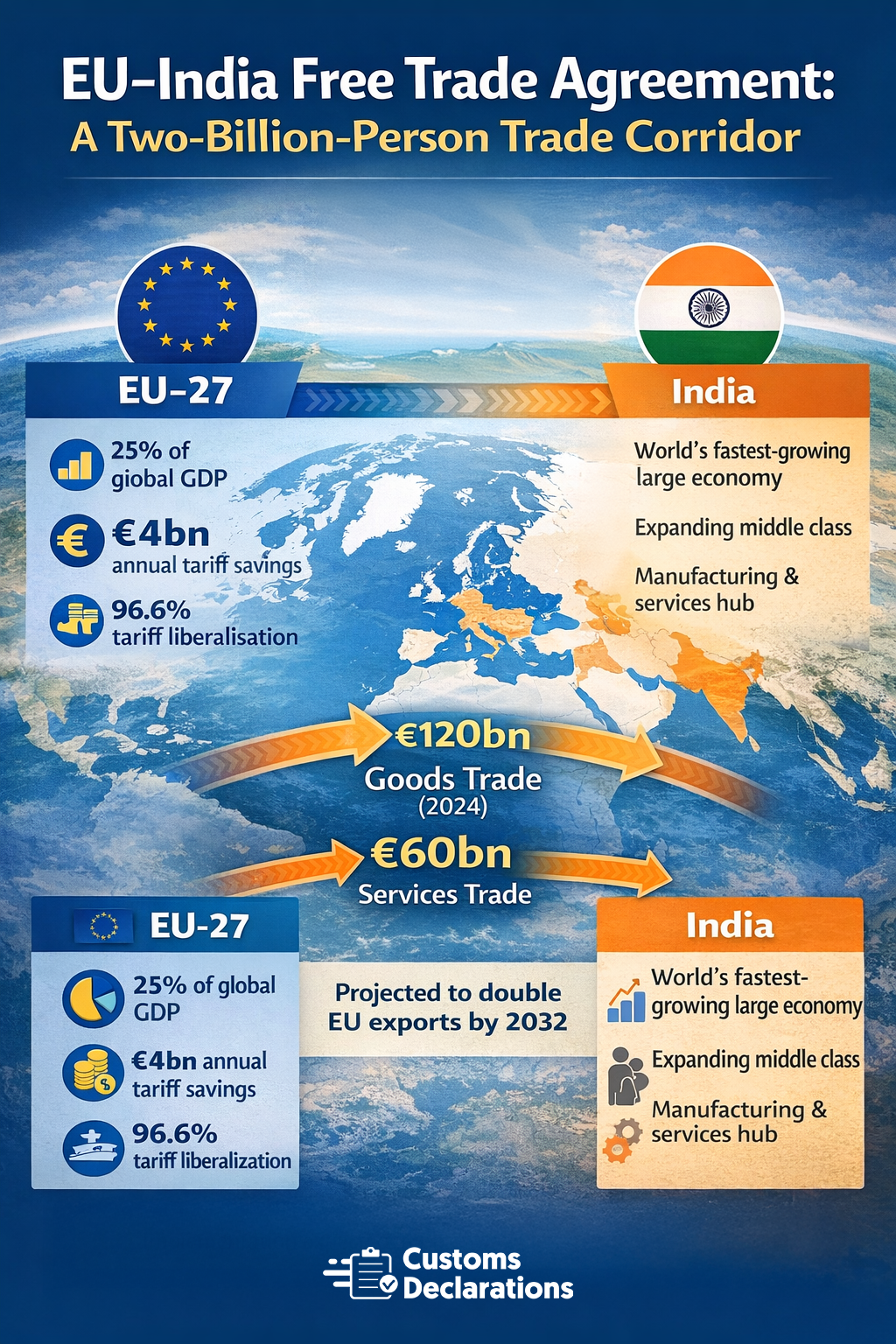
On January 27, 2026, European Commission President Ursula von der Leyen and Indian Prime Minister Narendra Modi formalized one of the most consequential trade agreements of the decade. The comprehensive EU-India Free Trade Agreement establishes a trading bloc encompassing approximately 25 percent of global GDP and creates a free trade zone serving nearly two billion people. The deal eliminates or substantially reduces tariffs on 96.6 percent of EU goods exports to India, with European exporters projected to save up to €4 billion annually in duties. For businesses across Europe and the United Kingdom navigating post-Brexit trade landscapes, this agreement signals profound shifts in tariff strategy, rules of origin compliance, supply chain planning, and customs declaration workflows. Understanding the mechanics of this agreement and preparing operational systems to capitalize on preferential duty access will determine competitive advantage in what is forecast to become one of the world’s most dynamic bilateral trade corridors.

The Scale and Scope of Tariff Liberalization

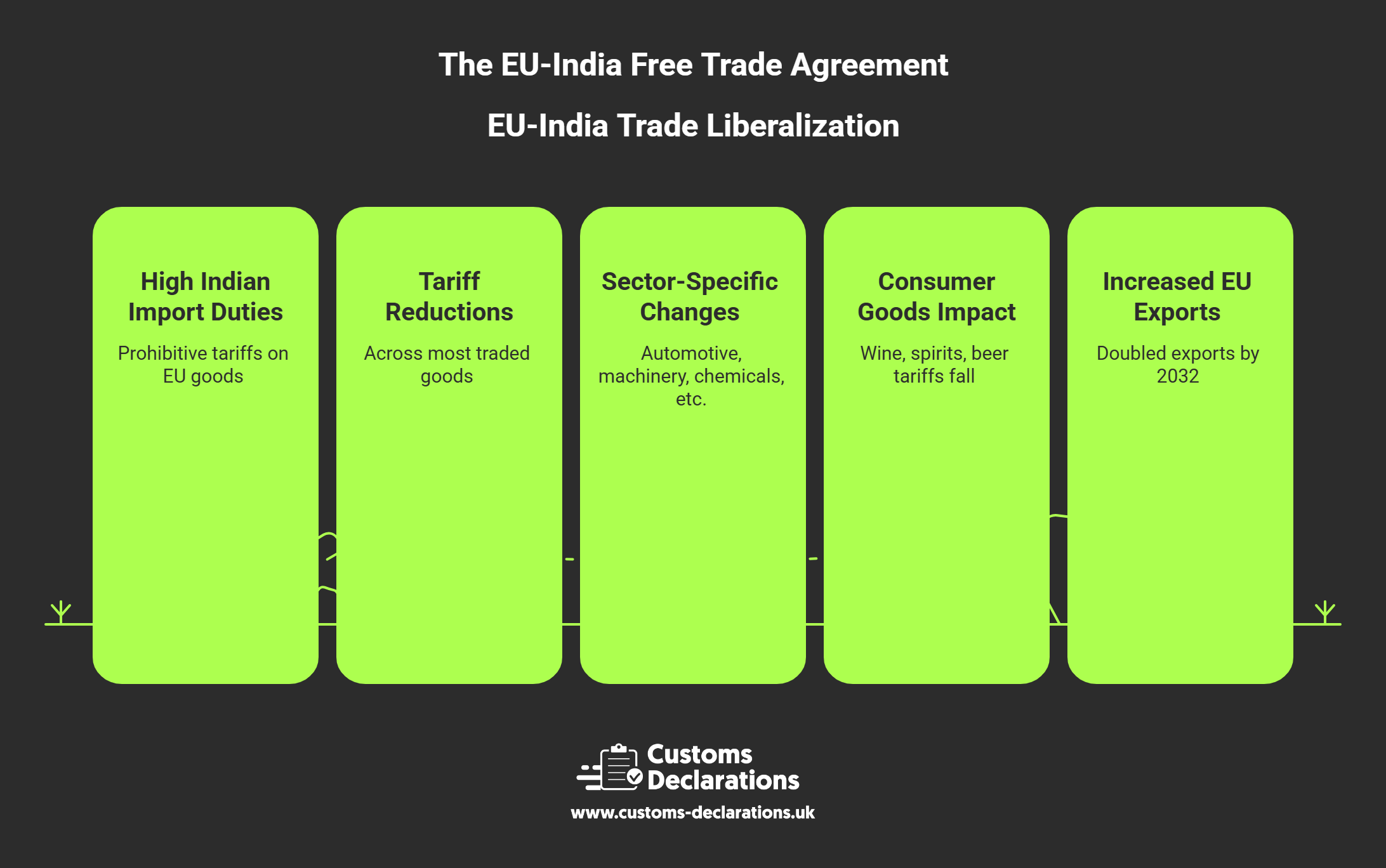
The EU-India agreement delivers tariff reductions across nearly the entire spectrum of traded goods, with some of the most dramatic changes affecting sectors where Indian import duties have historically been prohibitive. Automotive tariffs will fall from 110 percent to 10 percent, albeit within an annual quota of 250,000 vehicles. This opens substantial opportunity for European car manufacturers while creating complex origin and quota management obligations for customs declarants. Machinery, chemicals, pharmaceuticals, and most aircraft will see full tariff elimination, removing longstanding barriers that have constrained European industrial exports to the subcontinent. Consumer goods also benefit significantly, with wine tariffs reduced by 20 to 30 percent, spirits by 40 percent, and beer by 50 percent, positioning European producers to compete more aggressively in India’s rapidly expanding middle-class market.

Bilateral goods trade between the EU and India reached €120 billion in 2024, with services adding another €60 billion. Economic modeling suggests that the agreement could double EU exports to India by 2032, transforming the India corridor into a priority lane for European exporters seeking growth beyond saturated domestic markets. For UK businesses, the implications are multifaceted. While the United Kingdom is no longer an EU member state, UK companies with European supply chain integration, pan-European distribution strategies, or the ability to source inputs qualifying under EU origin rules may find indirect opportunities to leverage this agreement. Conversely, UK exporters selling directly to India will continue to face Most-Favoured-Nation tariff rates unless and until the United Kingdom concludes its own bilateral free trade agreement with India, negotiations for which remain in progress.

Geopolitical Drivers and Strategic Timing

The acceleration of the EU-India negotiations reflects broader geopolitical and economic forces reshaping global trade. The agreement’s conclusion follows nearly two decades of on-and-off negotiations that first launched in 2007, stalled repeatedly, and were relaunched in 2022 following Russia’s invasion of Ukraine. Both parties were motivated by a shared interest in diversifying trade relationships amid growing uncertainty around US trade policy, particularly the threat of sweeping tariff increases signaled by recent American political developments. For the European Union, deepening economic ties with India offers strategic hedging against potential trade conflicts with the United States and reduces reliance on Chinese manufacturing. For India, the agreement provides validation of its ambition to emerge as a major hub for global manufacturing and services, while securing access to European capital goods and technology that are critical to the country’s infrastructure and industrial modernization.

The formal signing of the agreement will follow five to six months of legal review and translation, with implementation expected within 2026. Once in force, the agreement will establish preferential tariff schedules, rules of origin protocols, customs cooperation frameworks, and dispute resolution mechanisms that will govern billions of euros in annual trade flows. Businesses that begin preparing now, mapping affected product lines, assessing origin eligibility, and updating customs systems, will be positioned to claim preferential duty rates from day one of implementation.

Implications for UK Businesses: Navigating Opportunity and Complexity

Although the EU-India agreement is formally a bilateral arrangement between the European Union and India, UK businesses will be affected in several important ways. First, UK companies with subsidiaries, manufacturing operations, or distribution partnerships within the EU-27 may be able to leverage the agreement indirectly by routing goods through EU entities and ensuring compliance with EU rules of origin. This requires careful legal structuring, origin planning, and coordination with customs advisors to ensure that products qualify as EU-originating goods eligible for preferential treatment when exported to India. Second, UK businesses that source components or finished goods from the EU may find that changes in EU-India trade flows affect pricing, availability, and lead times for inputs, requiring supply chain adjustments. Third, UK exporters competing with EU producers in the Indian market will face a new competitive disadvantage unless the United Kingdom concludes its own FTA with India offering comparable preferential access.

For UK importers bringing goods from India, the absence of a UK-India FTA means that standard MFN duty rates continue to apply. However, businesses should monitor developments in UK-India trade negotiations closely, as any future UK-India agreement could introduce preferential tariff schedules with different rules of origin, sector-specific provisions, and quota arrangements. Preparation for such an eventuality involves auditing current India-sourced product lines, understanding their tariff classifications under the UK Trade Tariff, and mapping potential origin compliance strategies that would allow claims for preference when a UK-India agreement enters into force.

Rules of Origin: The Foundation of Preferential Duty Claims

Tariff reductions under free trade agreements are not automatic. To lawfully claim preferential duty rates, goods must meet the agreement’s rules of origin, which are product-specific legal tests designed to ensure that tariff benefits flow only to goods genuinely manufactured within the parties’ territories. The EU-India agreement will contain detailed origin protocols specifying, for example, the minimum value-added threshold, permissible non-originating inputs, or required processing operations for each product category. These rules vary widely by sector and can be highly technical, particularly for manufactured goods with complex global supply chains.

Exporters seeking to claim preference must obtain or issue a statement on origin, or in some cases rely on importer’s knowledge, depending on the agreement’s certification framework. Businesses must maintain comprehensive origin evidence, including supplier declarations, production records, and cost breakdowns, to substantiate preference claims during customs audits. Importers, in turn, must validate that suppliers have correctly assessed origin and must declare preferential treatment on their customs declarations submitted to HMRC or the relevant EU customs authority. Misstatements of origin, whether intentional or negligent, can result in duty reassessments, penalties, and reputational damage, making robust compliance protocols essential.

For UK businesses contemplating indirect use of the EU-India agreement, the challenge is compounded by the need to satisfy EU origin rules for goods moving from the UK to the EU before they can qualify as EU-originating for onward export to India. This multi-stage origin analysis requires coordination across legal entities, alignment of production and sourcing strategies, and often the engagement of specialist trade compliance advisors.

Customs Declaration Implications: From MFN to Preferential Entries

The entry into force of the EU-India agreement will require customs professionals, freight forwarders, and in-house compliance teams to adapt their import declarations and export declarations workflows. Declarations previously filed under standard MFN duty rates must now incorporate preference claims, supported by origin evidence and the correct preference code. For EU exporters, this means capturing the preference indicator, statement on origin reference, and any applicable quota or safeguard information at the time of export. For Indian importers receiving EU goods, customs entries must declare the preferential tariff treatment, attach the required origin proof, and ensure that classification, valuation, and licensing data align with the terms of the agreement.

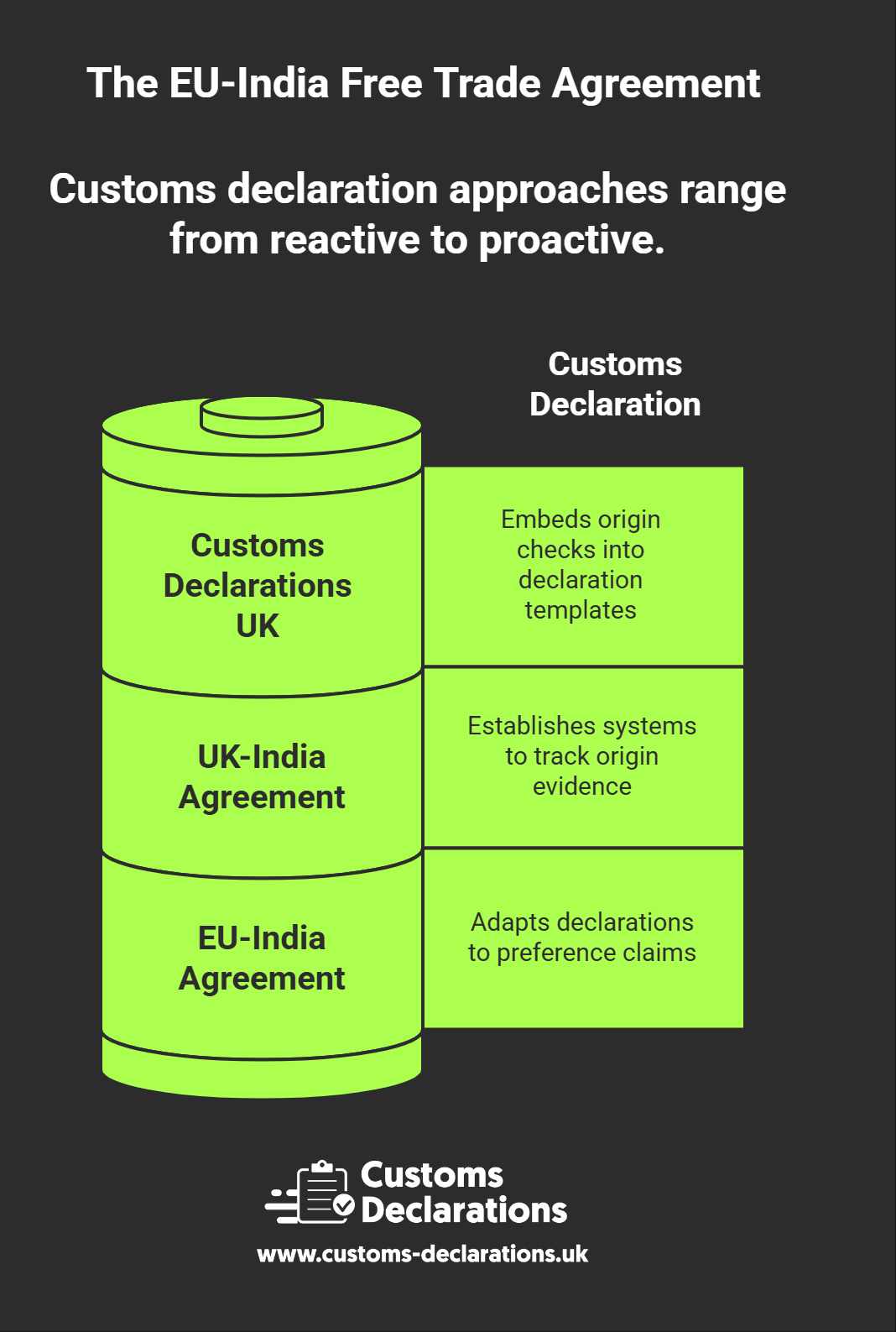
In the United Kingdom, businesses preparing for a potential future UK-India FTA should establish systems to track origin evidence now, even if preferential treatment is not yet available. This forward-looking approach allows businesses to model landed costs under hypothetical preferential scenarios, identify products with marginal origin compliance, and prioritize supply chain restructuring to maximize eligibility when an agreement is signed. The Customs Declarations UK platform provides a structured environment for managing both standard and preferential declarations, with guided workflows that prompt users to capture origin data, preference claims, and supporting documentation in alignment with HMRC’s Customs Declaration Service (CDS) requirements. By embedding origin checks and preference logic into declaration templates, businesses can reduce the risk of errors, accelerate clearance times, and maintain audit-ready records.

Sectoral Spotlights: Automotive, Pharmaceuticals, and Machinery

Three sectors illustrate the transformative potential and compliance complexity introduced by the EU-India agreement. In the automotive sector, the reduction of Indian car tariffs from 110 percent to 10 percent represents a seismic shift, although the 250,000-vehicle annual quota introduces a first-come, first-served dynamic that will require exporters to plan shipment timing strategically and monitor quota utilization in real time. Rules of origin for vehicles are typically among the most stringent in any FTA, often requiring substantial local content thresholds and detailed tracing of non-originating components. Automotive exporters must implement granular bill-of-materials tracking, supplier certification programs, and periodic origin reconciliations to ensure ongoing compliance.

In pharmaceuticals, full tariff elimination opens India’s vast healthcare market to European generic manufacturers, innovators, and contract development organizations. However, pharmaceutical exports are subject to additional regulatory controls, including licensing, Good Manufacturing Practice certifications, and import permits that must be referenced on customs declarations. For UK pharmaceutical companies with European manufacturing footprints, the agreement may enable cost-effective access to the Indian market through EU-based facilities, provided origin rules are satisfied and appropriate regulatory authorizations are in place.

For machinery and capital goods, the elimination of tariffs removes a longstanding barrier that has made European equipment uncompetitive relative to Chinese or domestic Indian alternatives. Machinery exporters will benefit from preferential access while navigating product-specific rules of origin that often hinge on substantial transformation tests, such as a change in tariff classification or a regional value content threshold. Compliance requires robust cost accounting systems, supplier declarations for purchased inputs, and periodic audits to verify that declared origin positions remain accurate as supply chains evolve.

Preparing for Implementation: A Practical Compliance Roadmap

Businesses seeking to capitalize on the EU-India agreement should begin preparation immediately, even before formal signature and ratification. The following roadmap outlines key steps for customs, trade, and supply chain professionals.

First, conduct a comprehensive product portfolio review to identify goods currently exported to or imported from India, their tariff classifications, current duty rates, and projected preferential rates under the agreement. This analysis should prioritize high-volume or high-value product lines where tariff savings will be most significant. Second, map existing supply chains to assess origin eligibility under the agreement’s rules. For complex manufactured goods, this requires tracing inputs, production processes, and assembly locations to determine whether products will qualify as EU or Indian originating. Third, establish or strengthen supplier certification programs to obtain reliable origin declarations from vendors. Many businesses underestimate the time required to train suppliers, negotiate contractual origin clauses, and verify certification accuracy, making early engagement critical.

Fourth, update customs systems and declaration templates to accommodate preference claims, including fields for preference codes, origin statements, and quota references. Platforms such as Customs Declarations UK allow declarants to pre-configure preference logic, validation rules, and supporting documentation requirements so that preference claims are processed consistently and compliantly from the first shipment. Fifth, train internal teams on the agreement’s provisions, rules of origin requirements, and documentation standards. Cross-functional training should include procurement, logistics, finance, and legal teams to ensure that origin compliance is embedded across business processes, not treated as an isolated customs function.

Sixth, establish monitoring and audit protocols to verify ongoing compliance. Preference claims are subject to post-clearance verification by customs authorities, and businesses must be prepared to produce origin evidence, cost records, and production documentation on demand. Regular internal audits help identify and correct errors before they escalate into enforcement actions. Finally, engage with industry associations, legal advisors, and customs authorities to stay informed of implementation timelines, interpretive guidance, and any transitional measures that may affect initial preference claims.

Conclusion: Strategic Preparation for a New Era of EU-India Trade

The EU-India Free Trade Agreement represents a historic expansion of preferential trade access, with profound implications for European exporters, Indian importers, and global supply chains. For UK businesses, the agreement offers both indirect opportunities, through EU-based operations or partnerships, and a competitive benchmark against which to measure the value of future UK-India trade negotiations. Capturing the benefits of this agreement requires disciplined preparation across product classification, rules of origin assessment, customs declaration systems, and cross-functional compliance protocols. Businesses that begin now, auditing product portfolios, securing supplier certifications, and configuring declaration platforms to handle preference claims, will be positioned to realize substantial tariff savings, accelerate market entry, and maintain compliance as the agreement transforms one of the world’s most dynamic bilateral trade corridors. With the right preparation, customs expertise, and declaration infrastructure such as that provided by Customs Declarations UK, the EU-India agreement becomes not just a policy development to monitor, but a strategic trade opportunity to actively pursue.

We value your feedback, and if you have any comments, suggestions or anything else that you would like to highlight to us, we will be delighted to hear from you and incorporate your feedback into our content.

Note: While we have made every attempt to ensure that the information contained in this Site has been obtained from reliable sources, Customs Declarations UK is not responsible for any errors or omissions, or for the results obtained from the use of this information. All information in this Site is provided “as is”, with no guarantee of completeness, accuracy, timeliness or of the results obtained from the use of this information, and without warranty of any kind, express or implied, including, but not limited to warranties of performance, merchantability and fitness for a particular purpose. Nothing herein shall to any extent substitute for the independent investigations and the sound technical and business judgment of the reader. In no event will Customs Declarations UK, or its partners, employees or agents, be liable to you or anyone else for any decision made or action taken in reliance on the information in this Site or for any consequential, special or similar damages, even if advised of the possibility of such damages. Certain links in this Site connect to other Web Sites maintained by third parties over whom Customs Declarations UK has no control. Customs Declarations UK makes no representations as to the accuracy or any other aspect of information contained in other Web Sites.