The landscape of European logistics is undergoing its most significant transformation in a generation. For customs agents, freight forwarders, and logistics providers, the transition from the legacy Import Control System (ICS1) to the sophisticated Import Control System 2 (ICS2) is no longer a distant regulatory milestone—it is an immediate operational reality.
As of 1 June 2026, five key Member States—Croatia, Latvia, Poland, Romania, and Slovakia—will officially decommission ICS1 for road transport, joining the ranks of earlier adopters. This shift represents the final frontier of Release 3, bringing the land-based supply chain into a digital-first security framework that mandates the submission of an Entry Summary Declaration (ENS) for every shipment entering or transiting the European Union.
The Shift from ICS1 to ICS2: Why the Change?
For years, ICS1 served as the baseline for safety and security, but its limitations in the face of modern global threats and high-volume e-commerce became apparent. ICS2 is not merely an “update”; it is a complete structural overhaul of how the EU performs pre-arrival risk analysis.
Under the old system, data was often fragmented or provided too late for meaningful intervention. ICS2 introduces a centralized repository and a more granular data set, allowing EU Customs authorities to identify high-risk consignments before they even reach the border. For road transport, this means that the ENS must now contain much more specific information than previously required, including 6-digit HS codes, detailed descriptions of goods, and the EORI numbers of all involved parties.
The June 2026 Road Rollout: Croatia, Latvia, Poland, Romania, and Slovakia
While several Member States transitioned earlier in 2025 and early 2026, the inclusion of Croatia, Latvia, Poland, Romania, and Slovakia on 1 June 2026 is a critical pivot point. These nations represent vital transit corridors for road freight entering the EU from the East and South.
What Changes on June 1st?
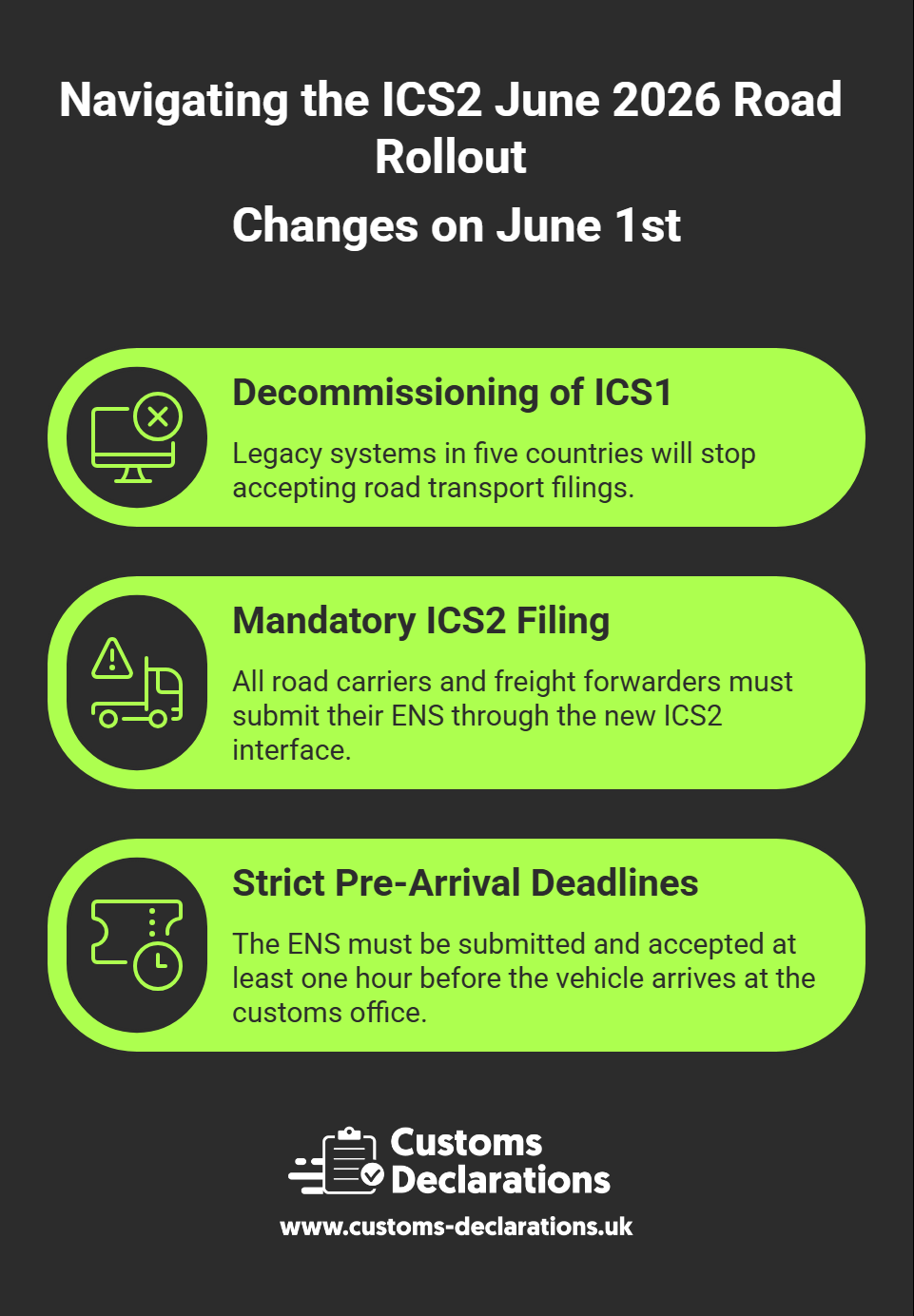
- Decommissioning of ICS1: The legacy systems in these five countries will stop accepting road transport filings. Any attempt to use the old format will result in a rejection.
- Mandatory ICS2 Filing: All road carriers and freight forwarders must submit their ENS through the new ICS2 interface.
- Strict Pre-Arrival Deadlines: For road transport, the ENS must be submitted and accepted at least one hour before the vehicle arrives at the customs office of first entry in the EU.
Failure to comply doesn’t just mean paperwork—it means stopped trucks, financial penalties, and a complete breakdown of the “just-in-time” delivery models that the road transport sector relies upon
The ENS Filing Dilemma: Single vs. Multiple Filing
A significant point of discussion within the industry, and one highlighted by the International Road Transport Union (IRU), is the “Multiple Filing” capability.
In maritime and air transport, different parties (like a carrier and a freight forwarder) can submit different parts of the ENS data—this is known as multiple filing. However, for road transport, this functionality is still in development.
Until that rollout occurs, single filing remains mandatory. This means the carrier (or their appointed agent) is solely responsible for collecting all necessary data from the shipper and consignee and submitting a single, comprehensive ENS for the entire vehicle. This puts immense pressure on data-sharing agreements between logistics partners.
Compliance Requirements: What You Need to File
To successfully lodge an ENS in the ICS2 system, your data must be “clean” and comprehensive. The days of generic descriptions like “General Cargo” or “Consumer Goods” are over.
Managing the Transition: Strategic Steps for Forwarders
For logistics professionals, the transition period requires a proactive stance. You cannot wait until May 31, 2026, to test your systems.
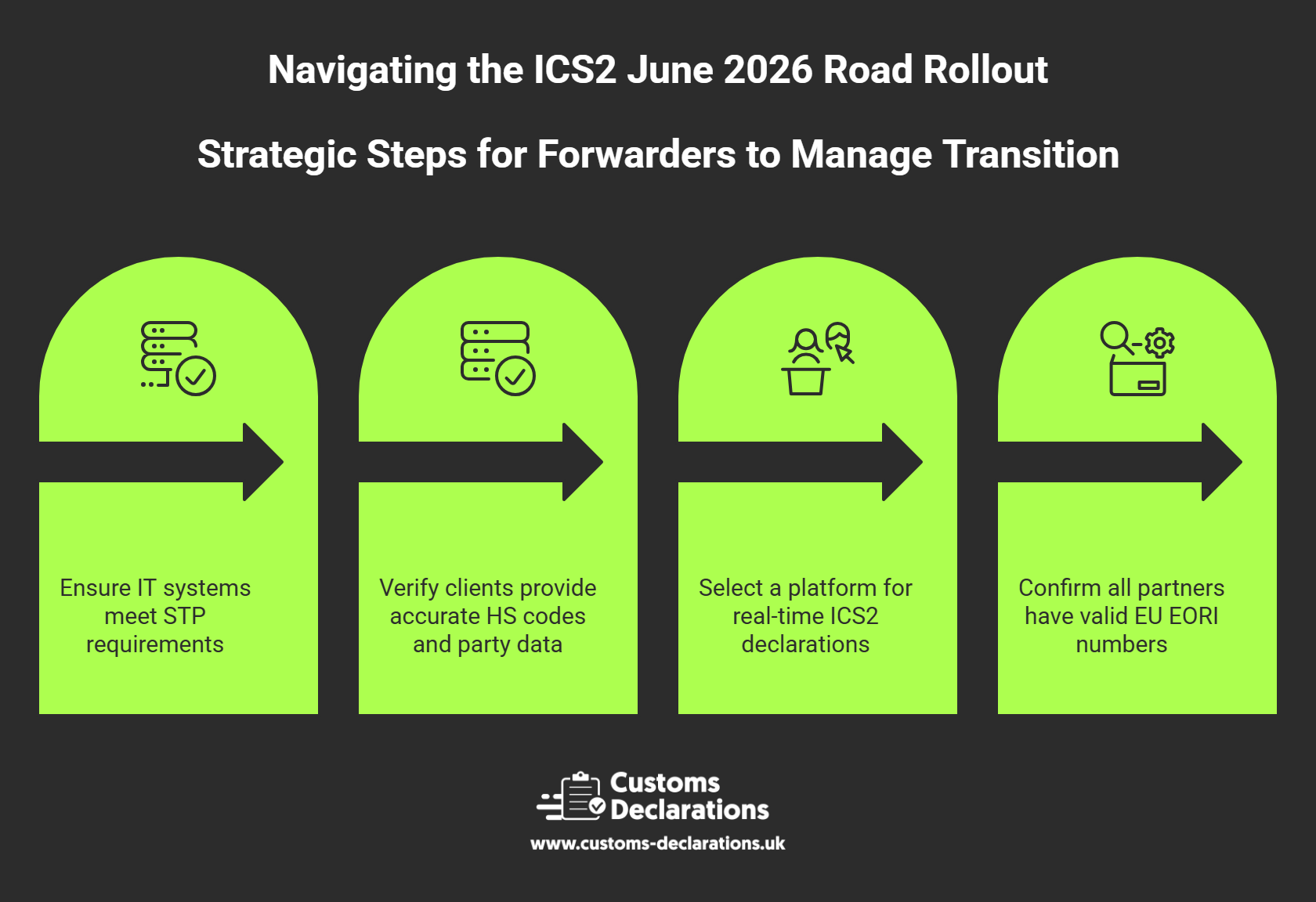
- System Conformance: Ensure your IT systems or third-party software providers have completed the mandatory self-conformance testing with the EU’s Shared Trader Portal (STP).
- Data Quality Audit: Work with your clients (shippers) now to ensure they can provide 6-digit HS codes and accurate party data.
- Choose a Platform: Platforms such as Customs Declarations UK can help you file you ICS2 declarations in real-time.
- EORI Verification: Ensure all your partners have valid EU EORI numbers. A single invalid EORI can cause an ENS rejection for an entire truckload.
Customs Declaration UK: Your Partner in ICS2 Compliance
As the regulatory environment becomes more complex, having a reliable technology partner is essential. At Customs Declaration UK, we have anticipated these shifts to ensure our clients stay ahead of the curve.
Our platform provides a seamless, easy-to-use interface designed specifically to handle the rigors of ICS2 and ENS filings across all modes of transport—be it road, rail, air, or sea. Whether you are navigating the new requirements for Poland and Romania or managing transit through the UK into the EU, our services are built to:
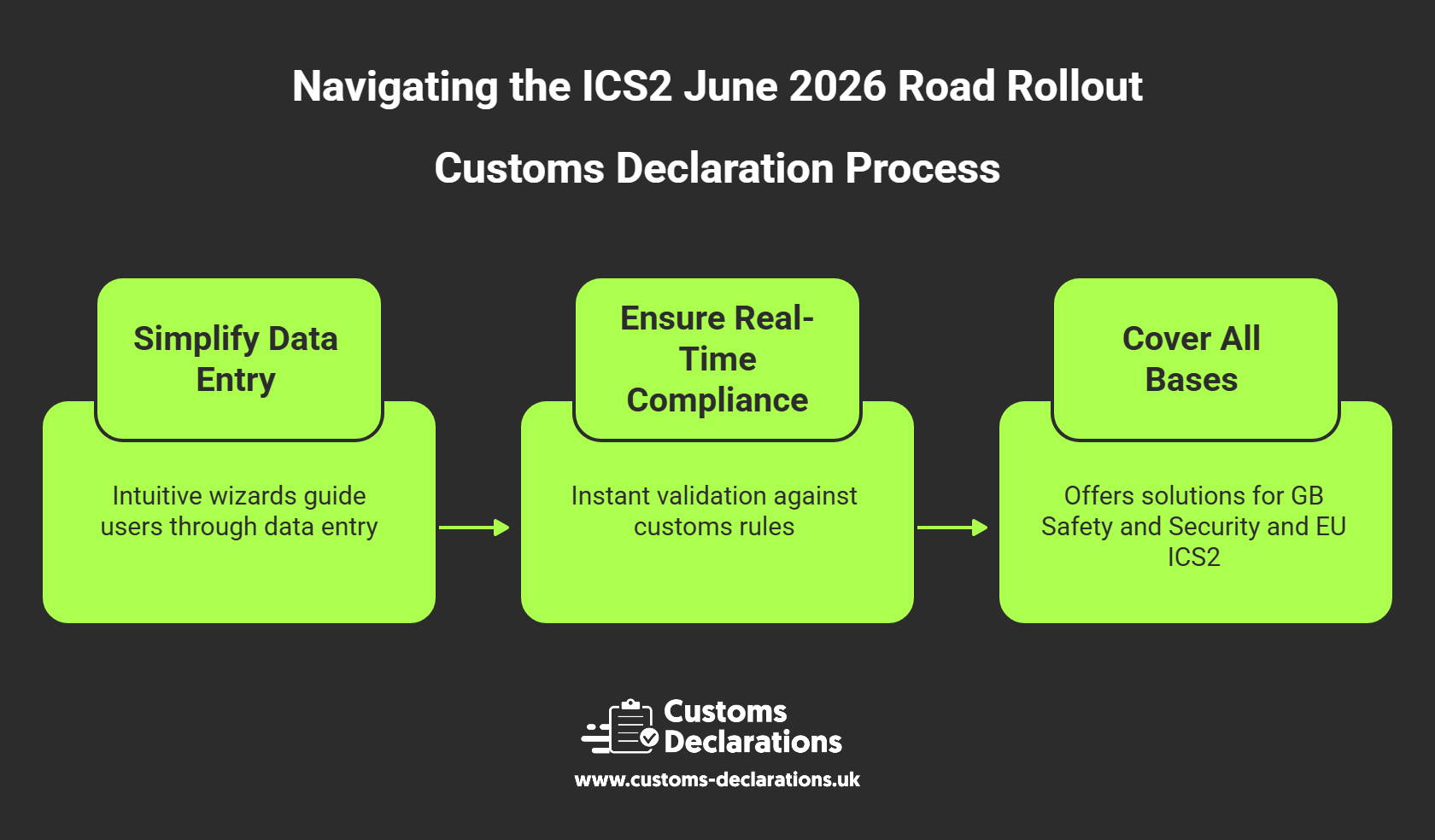
- Simplify Data Entry: Our intuitive wizards guide you through the mandatory fields, reducing the risk of human error.
- Ensure Real-Time Compliance: We provide instant validation against EU and UK customs rules, ensuring your ENS is accepted the first time.
- Cover All Bases: From GB Safety and Security declarations to the latest EU ICS2 mandates, we offer an all-in-one solution for the modern freight forwarder.
We understand that for road transport, speed and accuracy are non-negotiable. Our platform ensures that your filings are processed efficiently, allowing your fleet to keep moving across borders without delay.
Conclusion
The 1 June 2026 rollout in Croatia, Latvia, Poland, Romania, and Slovakia marks the final chapter in the decommissioning of ICS1. While the road transport sector awaits the “multiple filing” option later in 2026, the immediate focus must be on mastering the single-filing ENS requirements.
By embracing the digital requirements of ICS2 and leveraging professional declaration services, customs agents and logistics providers can turn a regulatory challenge into a competitive advantage—ensuring safety, security, and the uninterrupted flow of trade across the European continent.