OVERVIEW
Reading the December 2025 Trade Picture
On 12 February 2026, the Office for National Statistics (ONS) published the UK’s trade data for December 2025, offering the final snapshot of the year’s cross-border goods flows. The headline figures reveal a mixed picture: goods imports edged upward while goods exports contracted, and the UK-US trade corridor produced some of the month’s most notable movements. A supplementary analysis of UK-US trade impacts was also scheduled for publication on 24 February 2026, promising additional context for one of the UK’s most strategically significant bilateral trade relationships.
For importers, exporters, freight forwarders, and customs professionals, these figures are not merely statistical footnotes. Each shift in import and export volumes translates directly into the volume and complexity of customs declarations, the exposure to duty and VAT liabilities, and the operational demands placed on compliance teams. Understanding what the data shows — and what it signals for the months ahead — is essential for businesses that want to stay ahead of regulatory and commercial change.
The Data at a Glance
Visualising December 2025 Trade Movements
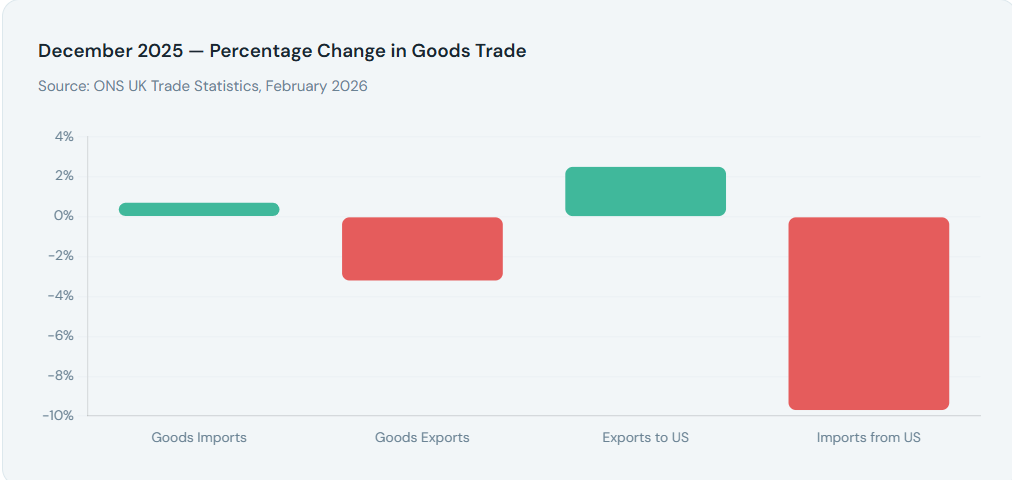
The chart below illustrates the key percentage changes reported by the ONS for December 2025.
Decomposing the Flows
Where Goods Moved — and Where They Did Not
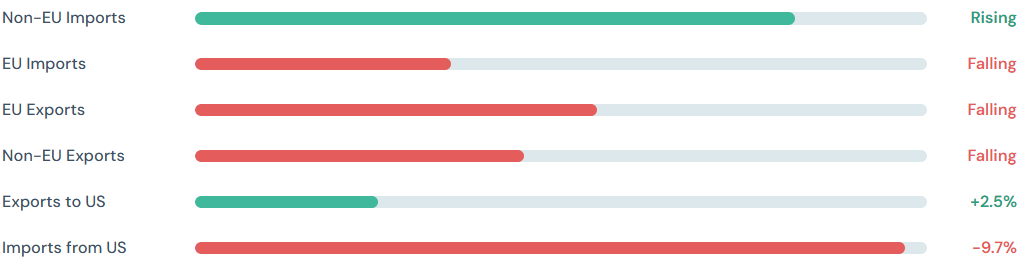
Breaking the headline figures down into their component parts helps identify the underlying commercial and regulatory dynamics. The divergence between EU and non-EU trade flows is particularly relevant for customs professionals who manage distinct declaration processes for each corridor.
The bifurcation between EU and non-EU import performance is significant. Goods sourced from outside the EU — including from trading partners across Asia, the Americas, and the wider world — drove the overall import increase, while EU-origin flows contracted. This pattern has implications for customs workloads: non-EU imports require full customs declarations, including commodity classification, customs valuation, and applicable duty calculations, whereas EU-origin goods benefit from zero-tariff treatment under the UK-EU Trade and Cooperation Agreement (TCA), though full declaration requirements remain in force.
On the export side, the 3.2% monthly contraction is broad-based, affecting both EU and non-EU destinations. This underlines that current export headwinds are not corridor-specific but reflect wider demand conditions. Businesses managing export declarations should ensure their commodity descriptions, origin documentation, and export licence records remain current and accessible.
Bilateral Focus
The UK–US Trade Corridor: A Month to Watch
The United States remains one of the UK’s most important bilateral trading partners, and December 2025 produced some of its most notable monthly movements. The 9.7% fall in goods imported from the United States — equivalent to a £0.5 billion decline — stands out as the month’s sharpest bilateral shift. At the same time, UK exports to the United States increased by 2.5%, a figure that the ONS noted included movements in precious metals.
The divergence between import and export performance in this corridor reflects a combination of factors including demand cycles, commodity-specific movements, and the broader economic backdrop. Importantly, the ONS scheduled a dedicated UK-US trade impact analysis for 24 February 2026, which is expected to shed further light on the structural and cyclical forces at play.
For customs teams, a sharp movement in import volumes from the United States has direct operational implications. When US-origin goods flow into the UK, they attract Most-Favoured-Nation (MFN) duty rates — there is no preferential free trade agreement between the UK and the United States — and require full import declarations submitted to HMRC through the Customs Declaration Service (CDS). A sustained decline in US imports would reduce declaration volumes in this corridor, while a recovery would require scalable filing capacity.
Compliance Perspective
What These Trade Flows Mean for Customs Declarations
Trade statistics are the aggregate of countless individual customs declarations. Every shipment counted in the ONS figures passed through a customs compliance process — or should have. For the businesses and customs professionals responsible for that process, understanding the macro picture helps contextualise operational planning and capacity management.
Rising non-EU imports: more declarations, more complexity
Non-EU imports require full customs declarations for every consignment, including accurate commodity classification under the UK Integrated Tariff, customs valuation built on the transaction value method, and determination of applicable duty rates. As non-EU import volumes grow, so does the workload on import declaration teams. Businesses sourcing from countries such as China, the United States, and others beyond the EU should ensure their declaration workflows are scalable and that their commodity classifications are reviewed regularly to reflect any product or regulatory changes.
EU imports still require full declarations under post-Brexit rules
A critical reminder: the fall in EU imports does not reduce the declaration requirement. All goods arriving from the EU into Great Britain are treated as imports under post-Brexit rules and must be declared via CDS, even when no tariffs apply under the TCA. Origin proof — typically a supplier statement on the commercial invoice or a separate statement on origin — must be retained to support any duty-free claim. Businesses that have grown accustomed to EU trade without declaration obligations prior to Brexit should ensure their compliance frameworks are robust.
Export contraction and the importance of export declaration accuracy
A broad-based decline in goods exports to both EU and non-EU destinations does not diminish the need for accurate export declarations. Each export from the UK requires a customs declaration submitted through CDS, and incorrect or incomplete filings can result in delayed consignments, reputational damage with overseas buyers, and potential HMRC enquiries. Businesses managing lower export volumes in the current environment should use the opportunity to audit their existing declaration data, review commodity descriptions for accuracy, and ensure that any required export licences are current.
UK-US movements and MFN duty management
Without a free trade agreement between the UK and the United States, all goods moving in either direction attract MFN duty rates. For businesses whose sourcing from or selling into the US has been affected by the December 2025 movements, accurate duty calculation and customs valuation are critical. The transaction value — the price actually paid or payable for goods sold for export to the UK, plus includable costs to the UK frontier — forms the basis of import duty and VAT calculations. Errors in valuation, whether through omission of freight and insurance costs or inclusion of post-import domestic costs, create exposure to HMRC revaluation and penalties.
Filing with Customs Declarations UK
Turning Trade Intelligence into Compliant Action
Understanding trade data is one thing; translating that understanding into accurate, timely, and compliant customs declarations is another. This is precisely where the Customs Declarations UK (CDUK) platform delivers operational value — regardless of whether your trade volumes are rising, falling, or shifting between corridors.
CDUK is a cloud-based customs filing solution that integrates directly with HMRC’s Customs Declaration Service. It is trusted by hundreds of businesses and processes thousands of declarations monthly, supporting import declarations, export declarations, CDS declarations, ENS (Entry Summary) declarations, and a range of special procedures. The platform is built for importers and exporters of every scale — from businesses filing their first import declaration to high-volume logistics operators managing thousands of entries.
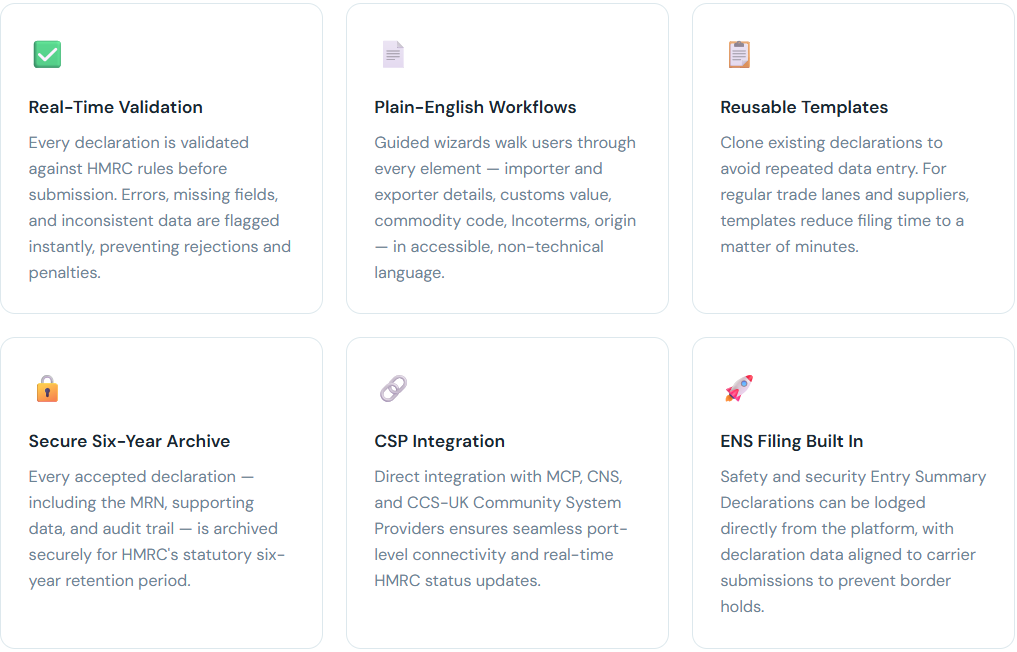
For businesses whose import volumes from non-EU sources are growing — as the December 2025 data suggests — CDUK’s bulk upload capability via CSV and Excel, and its integration options for ERP and logistics systems, provide the scalability needed to handle rising declaration volumes without proportional increases in manual effort. For those managing declining export volumes, the platform’s template and clone functionality ensures that each export declaration is filed with the same accuracy and consistency as the last, preserving audit readiness even during quieter trading periods.
CDUK was developed in close consultation with HMRC and integrates with the Customs Declaration Service to ensure that every import declaration, export declaration, and ENS declaration meets current regulatory requirements. As trade flows evolve — whether driven by macro data like the ONS release or by commercial decisions at the company level — CDUK provides the compliance infrastructure to keep declarations accurate, submissions timely, and records complete.
Looking Ahead
Key Dates and Considerations for Early 2026
The December 2025 trade data closes the book on a year of continued adjustment to post-Brexit trading arrangements, shifting bilateral relationships, and evolving supply chain strategies. As the ONS prepares to publish its UK-US trade impact analysis later in February 2026, businesses should take stock of their own trade patterns and ensure that their customs compliance infrastructure is positioned for the flows — and volumes — that lie ahead.
Several broader regulatory developments also warrant attention in the weeks ahead. HMRC’s Transitional Reduced Duty Arrangement (TRE) service becomes mandatory from 31 March 2026, requiring traders using simplified frontier declarations to update their procedures. For freight forwarders and hauliers managing high volumes of declarations, the approaching deadline underlines the value of operating on a platform that is continuously updated in line with HMRC requirements. CDUK’s development team monitors regulatory changes and deploys updates proactively, so users can file with confidence that their submissions reflect current rules.
For businesses with EU-bound movements, the continued roll-out of ICS2 (Import Control System 2) Entry Summary Declaration requirements across EU member states represents another compliance layer. CDUK’s ICS2 service supports the filing of Entry Summary Declarations for goods entering the EU, helping logistics operators and freight forwarders across the continent meet their safety and security obligations in a single, integrated platform.
Conclusion
Trade Data as a Compliance Signal
The ONS December 2025 trade release is more than a statistical snapshot. For the customs community, it is a forward indicator of declaration volumes, compliance complexity, and the commercial conditions that businesses will be navigating as 2026 progresses. Rising non-EU imports mean more full customs declarations. Continued EU trade — even at reduced volumes — means ongoing declaration obligations under post-Brexit rules. A volatile UK-US corridor means careful attention to MFN duty calculations and customs valuation accuracy.
By combining timely awareness of trade data with robust, validated customs declaration workflows — through platforms such as Customs Declarations UK — importers and exporters can turn compliance into a competitive advantage rather than an operational burden. The data tells you where trade is moving; CDUK helps ensure that every movement is declared accurately, efficiently, and compliantly.