Government figures confirm the airport’s position as Britain’s most valuable trading port — and what it means for UK customs compliance.


Government figures confirm the airport’s position as Britain’s most valuable trading port — and what it means for UK customs compliance.

When government trade data released in April 2026 confirmed that Heathrow Airport processed £293 billion worth of goods in 2025, it crystallised something that customs professionals have long understood: air freight is not a niche channel for perishables and luxury goods. It is the arterial system of modern UK trade, and Heathrow is its beating heart.
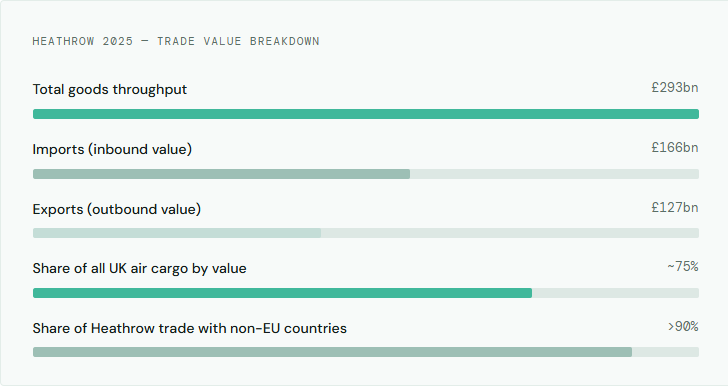
The figures, drawn from HMRC’s official trade statistics, place Heathrow above every seaport in the country when ranked by value. More than a quarter of all UK trade by value — some £1 in every £4 of goods Britain imports or exports — passes through a single airport in west London. That is a remarkable concentration of economic activity, and it carries significant implications for logistics operators, importers, exporters, and the customs compliance community that supports them.
“This data shows how vital the airport is to exporters, manufacturers and supply chains across the country. From life-saving medicines coming into the country to exporting fresh British produce, Heathrow enables the swift movement of goods around the world.” — James Golding, Head of Cargo and Airline Partnerships, Heathrow Airport |
Of the £293 billion total, approximately £166 billion represented goods arriving into the United Kingdom, while around £127 billion flowed outwards as exports. The import-to-export ratio reflects a familiar structural pattern in UK trade: Britain imports more by value than it exports, and the most time-sensitive, high-value goods overwhelmingly travel by air.
The composition of those flows is equally revealing. On the inbound side, pharmaceuticals and temperature-sensitive medicines move through Heathrow’s cold-chain infrastructure from North American and European hubs to hospitals and pharmacies across the country. High-value electronics — smartphones, semiconductors, precision components — arrive from Asian manufacturing centres in the bellyhold of passenger aircraft. Luxury fashion from Milan and Paris reaches Bond Street concessions within hours of departure. Fresh produce from Sub-Saharan Africa and South Asia fills supermarket shelves days after harvest.
The export picture tells its own story of British commercial ambition. Yorkshire food producers, premium spirits distillers, precision engineering firms, and biotech companies depend on Heathrow’s connectivity to reach markets in the Gulf, North America, and Asia-Pacific — markets where delivery speed is not merely a convenience but a commercial prerequisite. Gourmet food producers, for instance, rely on air freight to deliver products that retain freshness and quality upon arrival in markets as far afield as Singapore and Hong Kong.
Perhaps the most strategically significant finding in the 2025 data concerns the geographic composition of Heathrow’s trade flows. More than 90 percent of the airport’s trade by value is with countries outside the European Union. This is not simply a reflection of Heathrow’s long-haul route network — it is a structural feature of post-Brexit UK trade that has significant consequences for customs declaration volumes and compliance requirements.
Trade with non-EU third countries requires full customs declarations on both import and export. Unlike movements with the EU under the Trade and Cooperation Agreement — which, while no longer tariff-free in all directions, benefits from a degree of regulatory familiarity — third-country trade demands careful classification, accurate origin determination, correct customs valuation, and timely submission of documentation to HMRC. With over £263 billion of Heathrow’s throughput originating from or destined for non-EU markets, the volume of customs compliance activity generated by a single airport is extraordinary.
Key Compliance Implication More than 90% of Heathrow’s trade by value involves third-country movements, each requiring a full customs declaration under HMRC’s Customs Declaration Service (CDS). With average cargo values of £600,000 per flight and the airport processing thousands of movements daily, accurate, timely, and audit-ready declarations are not optional — they are essential to supply chain continuity. you are importing from Japan and claiming CEPA preference, you should check whether your specific commodity codes now attract lower duty rates under the updated 2026 schedule. Rates change annually and must be verified against the current tariff document — declarations filed with 2025 rates are not compliant from 3 March 2026. |
In volume terms, 2025 air cargo throughput at Heathrow reached 1.59 million tonnes, a year-on-year increase of approximately 0.8 percent. While modest in percentage terms, the absolute weight increase of some 12,600 tonnes reflects the sustained upward trajectory of UK air freight demand, particularly among domestic UK-origin shipments. The value figures represent a more substantial step up from the £215.6 billion recorded in 2024, underscoring the increasing premium nature of goods moving through the airport.
The average cargo value per flight stood at approximately £600,000. This figure is not simply a statistical curiosity: it illustrates why even minor delays at Heathrow carry disproportionate commercial consequences. When a single aircraft movement represents hundreds of thousands of pounds in perishable goods, pharmaceuticals, or electronics, clearance delays of hours — not days — translate directly into financial loss and supply chain disruption.
The airport is operating at or near capacity, and its operator has been explicit that expansion — including the long-discussed third runway, which received government endorsement — is critical to sustaining the UK’s position in global trade. A new 3.5-kilometre runway is part of a multi-billion-pound investment programme, and infrastructure upgrades are already under way. Cargo handlers at the airport have reported volume surges of 28 percent in early periods, with new warehouse facilities under development to accommodate further growth.
Expansion Context Heathrow’s proposed third runway would add substantial throughput capacity to the UK’s dominant air cargo hub. With a third runway, the airport could serve more routes and handle higher cargo volumes — increasing the total number of declarations filed with HMRC and making efficient, technology-enabled customs processing even more critical for businesses relying on Heathrow’s connectivity. |
The goods moving through Heathrow span an enormous range of commodity categories, each presenting distinct customs classification, valuation, and compliance challenges. Pharmaceuticals — among the highest-value goods by weight in UK trade — arrive under strict cold-chain conditions and may require licences, preferential duty claims under free trade agreements, or specific procedure codes on the import declaration. Semiconductor components and advanced electronics attract precise tariff classification requirements, with classification errors capable of triggering duty reassessments or enforcement action.
On the export side, industrial machinery, electric machinery, and high-end food and beverage products are consistently among the most significant categories by weight and value. Each of these requires accurate commodity classification under the UK Trade Tariff, correct origin determination, and complete documentation aligned with the destination country’s import requirements. For businesses exporting to markets with which the UK maintains a free trade agreement — Japan, Australia, Canada, or Singapore — correct origin proofs are the difference between a significant duty saving and the full Most-Favoured-Nation rate.
A Note on Safety & Security Declarations Every consignment arriving at Heathrow from a third country must be covered by an Entry Summary Declaration (ENS) lodged with HMRC ahead of the goods’ arrival. With the volume of air freight processed at the airport, this represents a substantial recurring compliance obligation for importers, freight forwarders, and carriers. ENS data must be accurate, timely, and consistent with the accompanying customs declaration to avoid border holds. |
The scale of trade flowing through Heathrow underscores a point that every importer, exporter, freight forwarder, and customs agent operating in the UK’s air freight sector must keep in sharp focus: the compliance burden associated with this volume of third-country trade is substantial, and the cost of errors — whether through incorrect classification, inaccurate valuation, or misaligned safety and security data — is equally so.
Customs Declarations UK (CDUK) provides a structured, cloud-based solution for submitting import and export declarations via Compass – Community Network Services for Heathrow, as well as Entry Summary Declarations (ENS) for safety and security compliance. The platform guides users through plain-English workflows covering all the critical data fields — importer and exporter identities, commodity classification, customs valuation, Incoterms, country of origin, and applicable licence references — with real-time validation checks that identify errors before submission.
For businesses handling regular movements through Heathrow, CDUK’s template and clone functionality allows declaration data to be reused and adapted across repeat shipments, significantly reducing manual data entry time. Every accepted declaration generates a Movement Reference Number instantly, with the full submission set archived securely for the statutory six-year retention period — providing the audit-ready records that HMRC may request at any point. Safety and security ENS data can be aligned with customs declaration records to ensure consistency and prevent the border holds that commonly arise from mismatched datasets between carriers and declarants.
As Heathrow’s throughput continues to grow — and with expansion on the horizon that will add further capacity and route diversity — the case for technology-enabled, validated customs filing has never been stronger. Efficient clearance is not simply an administrative convenience; at £600,000 per flight, it is a direct commercial imperative.
The 2025 Heathrow trade data is more than an impressive headline figure. It is a reminder of how deeply concentrated — and how commercially critical — UK air freight has become. A single airport handling £293 billion in goods annually, processing over 1.5 million tonnes of cargo, and serving as the gateway for more than 90 percent of that trade with countries outside the European Union, creates an unambiguous and ongoing demand for accurate, efficient, and fully documented customs compliance.
For the thousands of businesses that import or export through Heathrow every year — whether they are pharmaceutical multinationals bringing temperature-sensitive medicines into the UK, or small food producers shipping artisan products to international retailers — the mechanics of customs declarations are not a background administrative matter. They are operational infrastructure. Getting them right, first time, every time, is what keeps supply chains moving.
We value your feedback, and if you have any comments, suggestions or anything else that you would like to highlight to us, we will be delighted to hear from you and incorporate your feedback into our content.
Note: While we have made every attempt to ensure that the information contained in this Site has been obtained from reliable sources, Customs Declarations UK is not responsible for any errors or omissions, or for the results obtained from the use of this information. All information in this Site is provided “as is”, with no guarantee of completeness, accuracy, timeliness or of the results obtained from the use of this information, and without warranty of any kind, express or implied, including, but not limited to warranties of performance, merchantability and fitness for a particular purpose. Nothing herein shall to any extent substitute for the independent investigations and the sound technical and business judgment of the reader. In no event will Customs Declarations UK, or its partners, employees or agents, be liable to you or anyone else for any decision made or action taken in reliance on the information in this Site or for any consequential, special or similar damages, even if advised of the possibility of such damages. Certain links in this Site connect to other Web Sites maintained by third parties over whom Customs Declarations UK has no control. Customs Declarations UK makes no representations as to the accuracy or any other aspect of information contained in other Web Sites.